


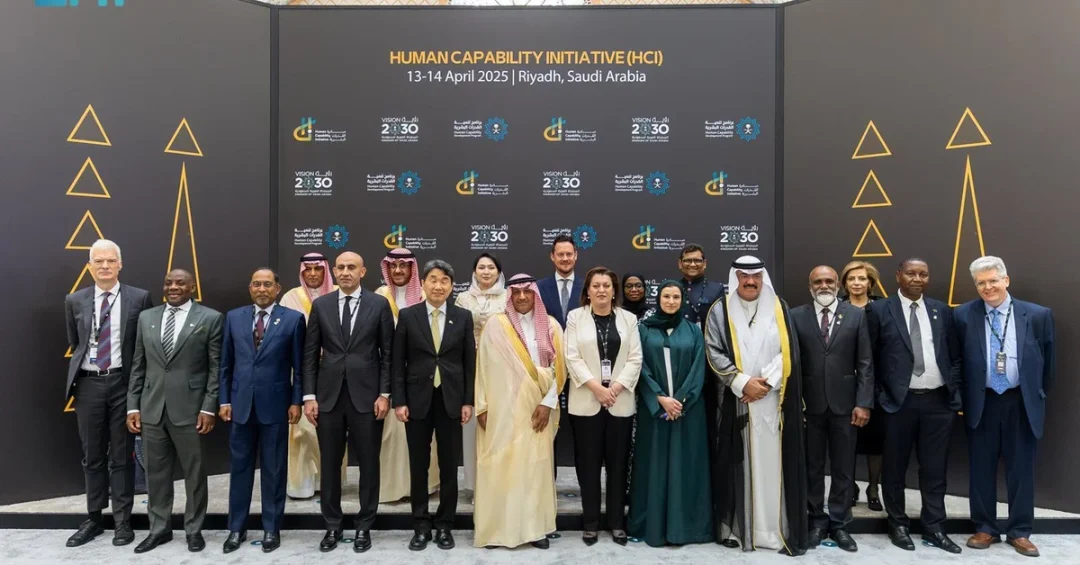
Riyadh hosted a high-level ministerial roundtable on human capability development on April 13, 2025, as the second edition of the Human Capability Initiative (HCI) Conference opened at the King Abdulaziz International Conference Center under the patronage of His Royal Highness Prince Mohammed bin Salman bin Abdulaziz Al Saud, Crown Prince, Prime Minister, and Chairman of the Human Capability Development Program (HCDP) Committee. The closed-door meeting, held under the theme “Beyond Readiness,” brought together 20 ministers from around the world alongside leading international experts in education and technology, convening under the banner “AI Literacy for All: Promoting Equitable Access for Resilient Capabilities.” The gathering marked the first day of a conference organized by the HCDP, one of the realization programs of Saudi Vision 2030, and signaled the Kingdom’s growing role as a convening power in global education and skills policy.
The ministerial roundtable represents a deliberate effort by Saudi Arabia to place human capital at the center of international economic planning, at a moment when governments everywhere are grappling with how artificial intelligence will reshape labor markets, classrooms, and national competitiveness. By assembling ministers and multilateral institutions in Riyadh, the Kingdom positioned itself not merely as a participant in the global conversation on digital skills but as an organizer of it. What does it mean for a single nation to convene the world’s education ministers around a shared challenge, and why has Riyadh chosen this particular moment to do so?
Context and Background
The Human Capability Initiative was established as a core component of the Human Capability Development Program, which sits within the architecture of Saudi Vision 2030 and is designed to build a globally competitive Saudi workforce. The program’s mandate spans education, training, and lifelong learning, aiming to equip citizens with the skills required by a diversifying economy. The first edition of the HCI Conference laid the groundwork for sustained international dialogue, and the second edition builds on that foundation with a sharper focus on artificial intelligence and equitable access to digital education. Why does a national development program need an international conference at all?
The answer lies in the nature of the challenge. Digital skills and AI literacy are not confined by borders, and no single country can develop the necessary talent pipelines, curricula, and governance frameworks in isolation. The roundtable therefore gathered representatives from key local and international entities, including the Education and Training Evaluation Commission, the Saudi Data and Artificial Intelligence Authority (SDAIA), the World Bank, and the Organisation for Economic Co-operation and Development (OECD). Each of these bodies brings distinct expertise, from assessment and standards to data governance, financing, and comparative policy research, creating a platform where national strategies can be tested against global evidence.
The timing is significant. As generative AI tools spread rapidly through economies and education systems, governments face mounting pressure to define what students should learn, how teachers should be trained, and how access can be widened rather than concentrated among wealthy institutions and regions. Saudi Arabia’s decision to host this conversation in Riyadh reflects a broader strategic calculation: that leadership in the AI era will depend as much on human capability as on computing infrastructure, and that convening power is itself a form of soft power.
Key Details of the Ministerial Roundtable
Discussions at the roundtable explored the critical role of digital skills in developing human capabilities and the importance of empowering individuals and institutions to keep pace with economic and digital transformations. Participants examined the need to develop national strategies for advancing digital education and for integrating AI skills into curricula from an early stage. The conversation was not limited to theory; ministers and experts shared concrete experiences of pilot programs, teacher training models, and assessment frameworks, with an emphasis on what can be replicated across different national contexts.
Participants stressed the importance of international collaboration to create scalable solutions that ensure equitable access to AI technologies and digital training, as well as the sharing of best practices and global expertise. The presence of the World Bank and OECD underscored a shared interest in financing mechanisms and measurement tools that can help lower-income countries participate fully in the AI transition. How can a ministerial meeting translate into measurable change in classrooms thousands of kilometers from Riyadh?
At the conclusion of the meeting, participating ministers agreed to issue a joint statement outlining key insights and recommendations. These include a call to integrate fundamental AI concepts into national curricula, promote initiatives that support continuous learning in AI-related fields, and strengthen international cooperation and resource-sharing to expand global access to AI skills and technologies. The joint statement is expected to serve as a reference point for participating governments as they design or revise their own national strategies in the months ahead, giving the Riyadh meeting a durable policy legacy beyond the conference itself.
International and Regional Impact
The gathering of 20 ministers in Riyadh carries weight beyond the conference hall. For countries across the Middle East, the roundtable offered a template for regional cooperation on skills development, a domain where labor markets are closely interlinked through migration, trade, and shared industries. For global participants, the meeting provided access to Saudi Arabia’s rapidly evolving education and technology ecosystem, including the work of SDAIA on AI governance and the Education and Training Evaluation Commission on standards and quality assurance. What lessons can other nations draw from a Kingdom that has made human capability a pillar of its national transformation?
The involvement of the World Bank and OECD signals that the outcomes of the roundtable may feed into international policy processes, including development financing and comparative education research. Multilateral engagement of this kind positions Saudi Arabia as a bridge between developed and developing economies, a role that aligns with the Kingdom’s expanding diplomatic footprint. The joint statement’s emphasis on resource-sharing and equitable access also speaks to a broader global debate about the concentration of AI benefits and the risk of a widening digital divide, giving the Riyadh discussions a distinctly inclusive character.
Economic and Strategic Significance
The economic logic behind the roundtable is straightforward: human capital is the binding constraint on growth in the AI era. Countries that can rapidly upskill their populations will capture productivity gains, attract investment, and build resilient economies, while those that lag risk deepening dependence on imported expertise. Saudi Arabia’s own economic diversification agenda depends on developing a workforce capable of operating in advanced manufacturing, digital services, health technology, and renewable energy. By anchoring AI literacy in national curricula and lifelong learning, the Kingdom is investing in the long-term foundations of its non-oil economy.
Strategically, hosting the ministerial roundtable advances Saudi Arabia’s position as a convening power in global governance. The Kingdom has increasingly sought to host international summits and initiatives that address shared challenges, from energy transition to tourism and now human capability. This approach strengthens bilateral relationships, creates channels for knowledge transfer, and enhances the Kingdom’s reputation as a reliable partner in multilateral problem-solving. Does convening the world’s education ministers make Saudi Arabia a rule-shaper rather than a rule-taker in the global AI economy?
The roundtable also complements the Kingdom’s substantial investments in technology and innovation, including national AI strategies and data infrastructure. Human capability is the complementary asset that determines whether those investments translate into broad-based prosperity. The HCDP’s work, showcased through the HCI Conference, therefore connects the Kingdom’s physical and digital infrastructure ambitions with the skills of its people, a linkage that policymakers increasingly view as essential to sustainable development.
Vision 2030 Alignment
The ministerial roundtable sits squarely within the objectives of Saudi Vision 2030, which places the development of human capability among its central pillars. The Human Capability Development Program is tasked with preparing citizens for the demands of a changing economy, and the HCI Conference serves as its international platform for dialogue, partnership, and policy exchange. Under the patronage of Crown Prince Mohammed bin Salman, the initiative reflects a leadership commitment to education, skills, and lifelong learning as engines of national progress and global engagement. What better expression of a forward-looking vision than a Kingdom that convenes the world to prepare people for the age of artificial intelligence?
As the second edition of the HCI Conference continues in Riyadh, the joint statement issued by participating ministers will carry the discussions forward, informing curricula, partnerships, and financing decisions across participating nations. For Saudi Arabia, the meeting reinforces a clear message: the Kingdom is not only investing in its own people but is helping to shape a global agenda that benefits communities everywhere. The road from Riyadh leads through classrooms, laboratories, and workplaces around the world, and the Kingdom intends to travel it as a leader, a partner, and a catalyst for shared prosperity in the decades to come.
20 Questions
Q1. What event took place in Riyadh on April 13, 2025?
A1. A ministerial roundtable on Human Capability Development concluded in Riyadh on the first day of the second edition of the Human Capability Initiative Conference, held at the King Abdulaziz International Conference Center.
Q2. Who patronized the ministerial roundtable?
A2. The meeting was held under the patronage of His Royal Highness Prince Mohammed bin Salman bin Abdulaziz Al Saud, Crown Prince, Prime Minister, and Chairman of the Human Capability Development Program Committee.
Q3. What was the theme of the HCI Conference?
A3. The second edition of the conference was held under the theme “Beyond Readiness,” reflecting its focus on preparing individuals and institutions for rapid economic and digital transformation.
Q4. What was the specific topic of the closed-door ministerial roundtable?
A4. The roundtable focused on “AI Literacy for All: Promoting Equitable Access for Resilient Capabilities,” exploring how digital skills and AI education can be made accessible to all.
Q5. How many ministers participated in the roundtable?
A5. The roundtable featured the participation of 20 ministers from around the world, along with leading international experts in education and technology and representatives from key local and international entities.
Q6. Which Saudi entities were represented at the meeting?
A6. The Education and Training Evaluation Commission and the Saudi Data and Artificial Intelligence Authority participated, alongside international institutions and experts in education and technology.
Q7. Which international organizations joined the discussions?
A7. The World Bank and the Organisation for Economic Co-operation and Development participated, bringing expertise in financing, policy research, and comparative education standards.
Q8. Which Saudi Vision 2030 program organized the conference?
A8. The conference was organized by the Human Capability Development Program, one of the realization programs of Saudi Vision 2030 focused on education, training, and lifelong learning.
Q9. What did discussions at the roundtable explore?
A9. Discussions explored the critical role of digital skills in developing human capabilities, the importance of empowering individuals and institutions, and the need for national strategies to advance digital education.
Q10. What did participants emphasize regarding international cooperation?
A10. Participants stressed the importance of international collaboration to create scalable solutions that ensure equitable access to AI technologies and digital training, along with sharing best practices and global expertise.
Q11. What did participating ministers agree to issue?
A11. At the conclusion of the meeting, participating ministers agreed to issue a joint statement outlining key insights and recommendations from their discussions.
Q12. What does the joint statement call for regarding curricula?
A12. The joint statement calls for integrating fundamental AI concepts into national curricula to ensure students gain essential skills for the digital economy.
Q13. What does the joint statement recommend about continuous learning?
A13. It promotes initiatives that support continuous learning in AI-related fields, enabling individuals to keep pace with evolving technologies throughout their careers.
Q14. How does the joint statement address global access?
A14. It calls for strengthened international cooperation and resource-sharing to expand global access to AI skills and technologies, particularly for underserved communities.
Q15. Where was the meeting held?
A15. The meeting was held at the King Abdulaziz International Conference Center in Riyadh, a prominent venue for major international conferences and diplomatic gatherings.
Q16. Why is human capability development important to Saudi Arabia?
A16. Human capability development is a central pillar of Saudi Vision 2030, aimed at building a globally competitive workforce capable of driving economic diversification and sustainable growth.
Q17. What role does AI literacy play in the conference’s agenda?
A17. AI literacy is a central focus, reflecting the conference’s recognition that digital skills are essential for individuals and institutions to thrive in an era of rapid technological change.
Q18. How does the roundtable reflect Saudi Arabia’s global role?
A18. By convening 20 ministers and major international organizations, the roundtable positions Saudi Arabia as a convening power and a leader in shaping global education and skills policy.
Q19. What is the significance of the first day of the conference?
A19. The first day set the tone for the second edition of the HCI Conference, establishing a ministerial consensus on AI literacy and equitable access that will guide subsequent discussions.
Q20. What does the roundtable signal about the future of education policy?
A20. It signals a global shift toward integrating AI skills into national education systems and a commitment to international cooperation in preparing societies for the digital future.
Reader Feedback
We value your thoughts. Please share your feedback on this article.
Your feedback helps us improve our coverage.
Related articles
 Kingdom Strongly Condemns Bombing of Al-Mamadani Hospital in Gaza
 Saudi Minister, US Energy Secretary Discuss Mining Cooperation
 Saudi Students Win Four Medals at Geneva Inventions Exhibition
 KSrelief Distributes Clothing Aid to 144 Families in Damascus
 KSrelief Distributes 1,650 Food Baskets in Sudan
 U.S. Energy Secretary Visits KFUPM in Dhahran