


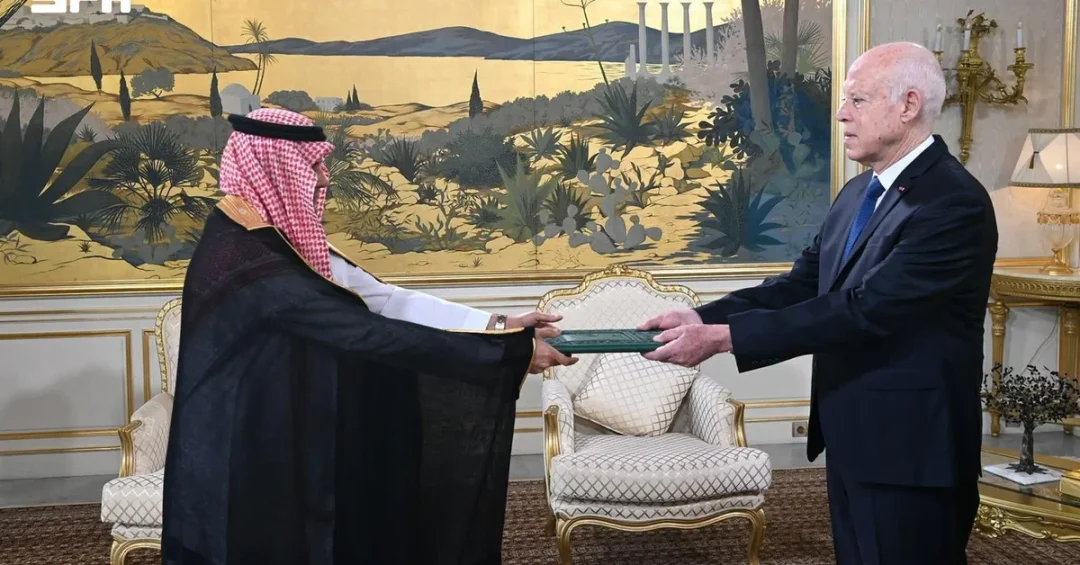
Saudi Ambassador to Tunisia Mohammed Al-Buraithin presented his credentials to President Kais Saied of the Republic of Tunisia during a formal ceremony held at Carthage Palace in Tunis on September 21, 2026, according to the Saudi Press Agency (SPA). The presentation of credentials marks the formal beginning of Ambassador Al-Buraithin’s diplomatic mission in Tunis and signals the continued strengthening of the longstanding relationship between the Kingdom of Saudi Arabia and the Republic of Tunisia. The ceremony was conducted in accordance with diplomatic protocol and reflects the mutual respect and close ties that have characterized Saudi-Tunisian relations for decades.
During the ceremony, Ambassador Al-Buraithin conveyed to President Saied the greetings of Custodian of the Two Holy Mosques King Salman bin Abdulaziz Al Saud and His Royal Highness Prince Mohammed bin Salman bin Abdulaziz Al Saud, Crown Prince and Prime Minister, along with their wishes for further progress and prosperity for the brotherly Tunisian people. President Saied, in turn, entrusted Ambassador Al-Buraithin with conveying his greetings to the Custodian of the Two Holy Mosques and HRH the Crown Prince, along with his wishes for continued progress and prosperity for Saudi Arabia and its people. The exchange of warm greetings underscores the depth of the fraternal bonds between the two nations and their peoples.
Context and Background
How did Saudi-Tunisian relations evolve to reach this point of mutual trust and cooperation? The relationship between the Kingdom of Saudi Arabia and the Republic of Tunisia is rooted in decades of diplomatic engagement, shared cultural heritage, and mutual respect. Since the establishment of formal diplomatic ties, the two countries have consistently worked to strengthen bilateral cooperation across political, economic, and social domains. Tunisia has long been viewed by Saudi Arabia as a valued partner in the Arab world, and the Kingdom has consistently supported Tunisia’s stability and development through various initiatives and agreements.
The appointment of Ambassador Mohammed Al-Buraithin is part of Saudi Arabia’s broader diplomatic strategy to enhance its presence and partnerships across the Arab region and beyond. Under the leadership of Custodian of the Two Holy Mosques King Salman bin Abdulaziz Al Saud and HRH Prince Mohammed bin Salman bin Abdulaziz Al Saud, Crown Prince and Prime Minister, the Kingdom has prioritized strengthening ties with brotherly Arab nations. This approach aligns with Saudi Arabia’s commitment to regional stability, economic integration, and cultural exchange, all of which are central to the Kingdom’s foreign policy objectives.
The ceremony at Carthage Palace, the official residence and workplace of the President of Tunisia, holds significant symbolic value. Carthage Palace has been the site of numerous historic diplomatic engagements, and the presentation of credentials there signifies the formal recognition and acceptance of the ambassador as the official representative of the Kingdom of Saudi Arabia in Tunisia. Such ceremonies are not merely procedural; they represent the beginning of a new chapter in bilateral relations, opening doors for enhanced cooperation and dialogue.
Key Details of the Credentials Ceremony
What exactly transpired during this important diplomatic engagement? The credentials ceremony was conducted with full diplomatic honors, reflecting the high regard in which both nations hold each other. Ambassador Al-Buraithin, upon presenting his credentials, formally assumed his role as the representative of the Kingdom of Saudi Arabia in Tunisia. The ceremony included the exchange of official documents and the conveying of verbal messages of goodwill from the Saudi leadership to President Saied and the Tunisian people.
Ambassador Al-Buraithin conveyed the greetings of Custodian of the Two Holy Mosques King Salman bin Abdulaziz Al Saud and HRH Prince Mohammed bin Salman bin Abdulaziz Al Saud, Crown Prince and Prime Minister, expressing their sincere wishes for Tunisia’s continued progress and prosperity. This gesture reflects the Kingdom’s consistent position of supporting Tunisia’s development and well-being. President Saied reciprocated by entrusting Ambassador Al-Buraithin with his greetings to the Saudi leadership, along with his wishes for continued progress and prosperity for Saudi Arabia and its people. He also wished Ambassador Al-Buraithin success in his diplomatic duties, a gesture that underscores the personal and professional respect between the two leaders.
The SPA report, which serves as the official source for this information, confirmed that the ceremony took place at Carthage Palace and emphasized the warm and cordial atmosphere in which it was conducted. The official Saudi Press Agency is the primary source for news related to Saudi government activities and official statements, and its reporting on this event provides authoritative confirmation of the details. The report noted that the ceremony was held on September 21, 2026, and was attended by appropriate Tunisian and Saudi diplomatic officials.
International and Regional Impact
What does this diplomatic engagement signify for the broader Middle East and North Africa region? The presentation of credentials by Ambassador Al-Buraithin comes at a time of evolving geopolitical dynamics in the region. Saudi Arabia has been actively strengthening its diplomatic and economic ties with countries across North Africa, recognizing the strategic importance of the region for trade, investment, and cultural exchange. Tunisia, with its strategic Mediterranean location and skilled workforce, represents a key partner in these efforts.
The continued engagement between Saudi Arabia and Tunisia also contributes to regional stability and cooperation. In a region often characterized by challenges, the Saudi-Tunisian relationship stands as a model of constructive engagement based on mutual respect and shared interests. The exchange of ambassadors and the regular conduct of diplomatic ceremonies such as this one reinforce the institutional frameworks that support peaceful coexistence and collaborative problem-solving among Arab nations.
Furthermore, this engagement reflects Saudi Arabia’s broader commitment to supporting Arab solidarity and unity. Under the leadership of Custodian of the Two Holy Mosques King Salman bin Abdulaziz Al Saud and HRH Prince Mohammed bin Salman bin Abdulaziz Al Saud, Crown Prince and Prime Minister, the Kingdom has consistently advocated for Arab cooperation and has worked to bridge differences and promote common interests. The warm reception of Ambassador Al-Buraithin by President Saied is a testament to the success of these efforts and to the enduring strength of Arab fraternal bonds.
Economic and Strategic Significance
How does this diplomatic milestone translate into tangible economic and strategic benefits? The Saudi-Tunisian relationship encompasses far more than diplomatic protocol; it is underpinned by significant economic and strategic interests. Saudi Arabia has been a consistent partner in Tunisia’s economic development, providing financial support, investment, and technical assistance across various sectors. In return, Tunisia offers a gateway to North African markets and a skilled workforce that can contribute to Saudi Arabia’s own development goals.
Trade between the two countries has the potential to expand further, particularly in sectors such as renewable energy, tourism, agriculture, and technology. Saudi Arabia’s Vision 2030, which aims to diversify the Kingdom’s economy away from oil dependence, creates opportunities for enhanced cooperation with Tunisia in areas such as renewable energy, where Tunisia has significant potential. Similarly, Tunisia’s tourism sector, which is a key pillar of its economy, can benefit from Saudi investment and partnership, drawing on the Kingdom’s experience in developing world-class tourism infrastructure.
The strategic significance of this relationship extends to cultural and educational exchanges as well. Saudi Arabia has long been a destination for Tunisian students and professionals, and the exchange of knowledge and expertise between the two countries strengthens their bilateral ties. The presence of a new Saudi ambassador in Tunis provides an opportunity to deepen these exchanges and to explore new avenues for collaboration that align with the aspirations of both nations.
Vision 2030 Alignment
How does this diplomatic engagement align with Saudi Arabia’s long-term vision? The presentation of credentials by Ambassador Al-Buraithin is a clear reflection of Saudi Arabia’s Vision 2030, which emphasizes the importance of international partnerships and diplomacy in achieving the Kingdom’s development goals. Vision 2030, launched by HRH Prince Mohammed bin Salman bin Abdulaziz Al Saud, Crown Prince and Prime Minister, seeks to transform Saudi Arabia into a global investment powerhouse and a hub connecting three continents: Asia, Europe, and Africa. Strengthening ties with Tunisia, a key North African nation, directly supports this objective by expanding the Kingdom’s network of partners and enhancing its influence in the region.
Moreover, Vision 2030 places a strong emphasis on cultural exchange and the promotion of Saudi Arabia’s rich heritage on the global stage. The warm reception of Ambassador Al-Buraithin and the exchange of greetings between the Saudi and Tunisian leadership reflect the cultural and historical bonds that unite the two nations. These bonds are not merely symbolic; they form the foundation for practical cooperation in areas such as tourism, heritage preservation, and education, all of which are integral to Vision 2030’s goals of enhancing quality of life and fostering a vibrant society.
In conclusion, the presentation of credentials by Saudi Ambassador Mohammed Al-Buraithin to Tunisian President Kais Saied at Carthage Palace represents a significant step forward in Saudi-Tunisian relations. It reaffirms the Kingdom’s commitment to strengthening ties with brotherly Arab nations and to playing a constructive role in regional affairs. As Saudi Arabia continues its journey toward Vision 2030, partnerships such as this one will be essential in achieving the Kingdom’s aspirations for a prosperous and interconnected future. The ceremony at Carthage Palace is not just a diplomatic formality; it is a testament to the enduring friendship between Saudi Arabia and Tunisia and a promise of even closer cooperation in the years to come.
20 Questions
Q1. Who presented his credentials to the Tunisian President?
A1. Saudi Ambassador to Tunisia Mohammed Al-Buraithin presented his credentials to President Kais Saied of the Republic of Tunisia during a ceremony at Carthage Palace in Tunis on September 21, 2026.
Q2. Where was the credentials ceremony held?
A2. The ceremony was held at Carthage Palace in Tunis, the official residence and workplace of the President of Tunisia, according to the Saudi Press Agency (SPA).
Q3. What greetings did Ambassador Al-Buraithin convey to President Saied?
A3. He conveyed the greetings of Custodian of the Two Holy Mosques King Salman bin Abdulaziz Al Saud and HRH Prince Mohammed bin Salman bin Abdulaziz Al Saud, Crown Prince and Prime Minister, along with their wishes for Tunisia’s progress and prosperity.
Q4. How did President Saied respond to the greetings?
A4. President Saied entrusted Ambassador Al-Buraithin with conveying his greetings to the Saudi leadership, along with his wishes for continued progress and prosperity for Saudi Arabia and its people, and wished the ambassador success.
Q5. What is the significance of presenting credentials?
A5. Presenting credentials formally marks the beginning of an ambassador’s diplomatic mission in the host country and signifies the official recognition and acceptance of the ambassador as the representative of their nation.
Q6. Which Saudi officials were mentioned in the greetings?
A6. The greetings were from Custodian of the Two Holy Mosques King Salman bin Abdulaziz Al Saud and HRH Prince Mohammed bin Salman bin Abdulaziz Al Saud, Crown Prince and Prime Minister.
Q7. What does this ceremony indicate about Saudi-Tunisian relations?
A7. It indicates the continued strengthening of the longstanding relationship between Saudi Arabia and Tunisia, reflecting mutual respect, close ties, and a shared commitment to cooperation and regional stability.
Q8. When did the ceremony take place?
A8. The ceremony took place on September 21, 2026, as reported by the Saudi Press Agency (SPA), which serves as the official source for Saudi government news.
Q9. Why is Carthage Palace significant?
A9. Carthage Palace is the official residence and workplace of the President of Tunisia and has been the site of numerous historic diplomatic engagements, symbolizing the importance of the credentials ceremony.
Q10. What role does the Saudi Press Agency play in this report?
A10. The Saudi Press Agency (SPA) is the official source that reported the details of the ceremony, providing authoritative confirmation of the event and the exchanges between the ambassador and the president.
Q11. How does this event align with Saudi Arabia’s foreign policy?
A11. It aligns with Saudi Arabia’s foreign policy of strengthening ties with brotherly Arab nations, promoting regional stability, and enhancing economic and cultural cooperation under the leadership of the Custodian of the Two Holy Mosques and HRH the Crown Prince.
Q12. What are the potential economic benefits of this engagement?
A12. The engagement can enhance trade and investment in sectors such as renewable energy, tourism, agriculture, and technology, supporting Saudi Arabia’s Vision 2030 economic diversification goals and Tunisia’s development.
Q13. How does this relate to Vision 2030?
A13. Vision 2030 emphasizes international partnerships and diplomacy. Strengthening ties with Tunisia supports the Kingdom’s goal of becoming a global investment powerhouse and a hub connecting Asia, Europe, and Africa.
Q14. What did President Saied wish for Saudi Arabia?
A14. President Saied wished continued progress and prosperity for Saudi Arabia and its people, and he also wished Ambassador Al-Buraithin success in his diplomatic duties, reflecting the warm relations between the two nations.
Q15. Who is Ambassador Mohammed Al-Buraithin?
A15. Ambassador Mohammed Al-Buraithin is the newly appointed Saudi Ambassador to Tunisia, who formally assumed his diplomatic role upon presenting his credentials to President Kais Saied at Carthage Palace.
Q16. What is the historical context of Saudi-Tunisian relations?
A16. Saudi-Tunisian relations are rooted in decades of diplomatic engagement, shared cultural heritage, and mutual respect, with Saudi Arabia consistently supporting Tunisia’s stability and development through various initiatives.
Q17. How does this ceremony reflect Arab solidarity?
A17. The warm exchange of greetings and the formal ceremony reflect the enduring strength of Arab fraternal bonds and Saudi Arabia’s commitment to Arab cooperation and unity under its leadership.
Q18. What sectors could see increased cooperation?
A18. Sectors such as renewable energy, tourism, agriculture, technology, education, and cultural exchange are poised for increased cooperation, benefiting from the strengthened diplomatic ties between the two countries.
Q19. What message does this send to the international community?
A19. It sends a message of Saudi Arabia’s active diplomatic engagement, its commitment to regional stability, and its dedication to building constructive partnerships with Arab nations in line with Vision 2030.
Q20. What are the next steps following this ceremony?
A20. Following the ceremony, Ambassador Al-Buraithin will begin his diplomatic duties in Tunisia, working to enhance bilateral cooperation across various fields and to implement initiatives that align with the shared interests of both nations.
Reader Feedback
We value your thoughts. Please share your feedback on this article.
Your feedback helps us improve our coverage.
Related articles
 Yanbu Streets Adorned with Flags Ahead of Saudi National Day
 Gas Tanker Hit by Shrapnel in Strait of Hormuz: UKMTO
 Al-Uwayqilah Adorned with Flags for Saudi National Day
 Makkah Mosques Launch Loyalty and Belonging Program for National Day
 Riyadh Adorned in Green Ahead of Saudi National Day
 Saudi Foreign Ministry Receives Indonesian Consul General