


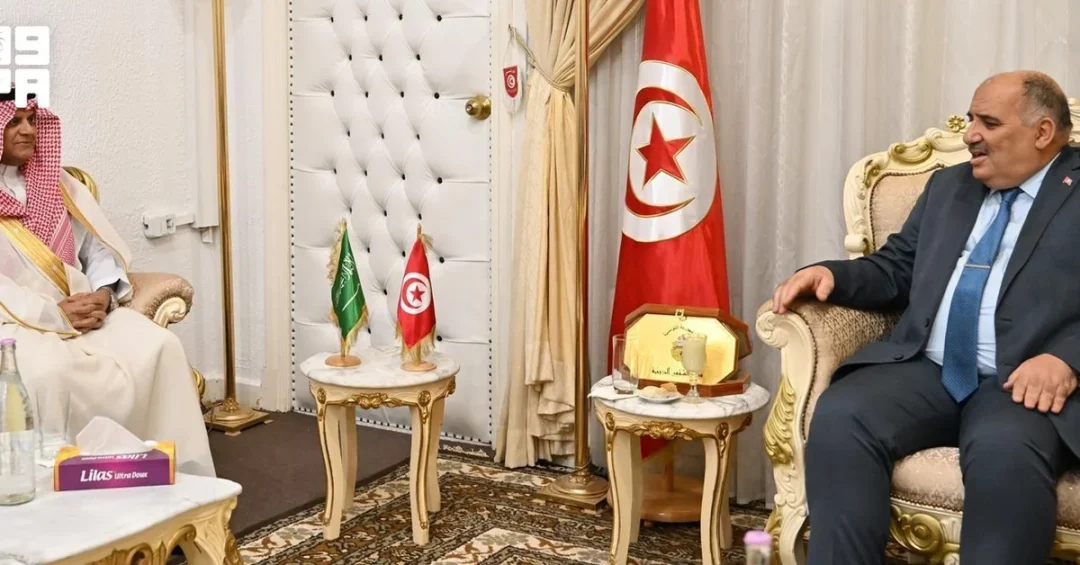
Saudi Ambassador to Tunisia Mohammed Al-Buraithin met with Tunisian Minister of Religious Affairs Ahmed Bouhali in Tunis on October 2, 2026, to review bilateral cooperation and discuss ways to strengthen ties across various fields, according to the Saudi Press Agency (SPA). The meeting, held at the ministry’s headquarters in the Tunisian capital, focused on enhancing collaboration in religious affairs, cultural exchange, and moderate discourse, while also addressing matters of mutual concern. Both officials underscored the importance of continued dialogue and coordination between the Kingdom of Saudi Arabia and the Republic of Tunisia, reflecting the enduring fraternal relations that have characterized ties between the two nations for decades.
The encounter is part of a broader diplomatic engagement by Saudi Arabia aimed at deepening partnerships across the Arab and Islamic world. It comes as the Kingdom continues to advance its Vision 2030 reform agenda, which emphasizes international cooperation, cultural diplomacy, and the promotion of moderate Islam. The meeting also highlights Tunisia’s role as a key partner in North Africa, a region of strategic importance to Saudi Arabia’s foreign policy and economic diversification efforts. By focusing on religious affairs, both sides signal a shared commitment to fostering tolerance, countering extremism, and supporting the spiritual and educational needs of their communities.
Context and Background
Why does a meeting between a Saudi ambassador and a Tunisian religious affairs minister matter in the broader landscape of regional diplomacy? Saudi-Tunisian relations have historically been strong, rooted in shared Arab and Islamic heritage, mutual respect, and a common vision for stability and prosperity in the region. Over the years, the two countries have signed numerous agreements covering trade, investment, education, and cultural exchange. The religious affairs portfolio is particularly significant, as both nations seek to promote moderate religious discourse and combat extremist ideologies that threaten social cohesion. Tunisia, with its rich Islamic history and renowned religious institutions such as the Zitouna Mosque and University, plays a vital role in shaping religious thought in North Africa. Saudi Arabia, as the custodian of the Two Holy Mosques, holds a unique position in the Islamic world, and its religious diplomacy is a cornerstone of its foreign policy.
The meeting between Ambassador Al-Buraithin and Minister Bouhali is therefore not merely a routine courtesy call but a strategic dialogue on how to align efforts in religious education, pilgrimage management, and interfaith understanding. It also reflects Saudi Arabia’s ongoing commitment to supporting Tunisia’s development and stability, particularly in the post-2011 era, where the country has navigated political transitions and economic challenges. Saudi Arabia has consistently provided economic assistance and investment to Tunisia, and religious cooperation is an extension of that support. By engaging with Tunisia’s religious leadership, the Kingdom reinforces its role as a stabilizing force and a partner in promoting peace and moderation.
Furthermore, the timing of the meeting in October 2026 coincides with preparations for the annual Hajj pilgrimage and ongoing efforts to enhance services for Tunisian pilgrims. Saudi Arabia has invested heavily in expanding the capacity of the Grand Mosque in Mecca and improving facilities for pilgrims from around the world. Tunisia, with its sizable Muslim population, sends thousands of pilgrims each year, and coordination with the Tunisian Ministry of Religious Affairs is essential to ensure a smooth and spiritually fulfilling experience. The discussions likely touched on these logistical matters, as well as on the broader theme of Islamic solidarity.
Key Details of the Meeting
What specific areas of cooperation were on the table during the talks? According to the Saudi Press Agency, the two officials reviewed existing cooperation and explored ways to strengthen ties across various fields. While the official statement did not disclose every detail, the context of Saudi-Tunisian relations suggests that several key areas were discussed. First, religious education and the training of imams and preachers were likely high on the agenda. Saudi Arabia has extensive experience in this domain, with institutions like the Islamic University of Madinah and the King Faisal Center for Research and Islamic Studies. Tunisia, too, has a proud tradition of religious scholarship. Sharing curricula, organizing exchange programs, and jointly developing moderate religious discourse could be among the outcomes.
Second, the management of Hajj and Umrah affairs was almost certainly a topic. The Saudi Ministry of Hajj and Umrah works closely with counterparts in Muslim-majority countries to streamline visa procedures, provide guidance, and ensure the safety and comfort of pilgrims. For Tunisia, this cooperation is crucial, as the pilgrimage is a significant religious and logistical undertaking. The meeting may have addressed improvements in services, digital platforms for registration, and health protocols. Third, cultural and educational exchanges, including scholarships for Tunisian students to study in Saudi universities, were likely discussed. Saudi Arabia offers numerous scholarships to international students, and Tunisia has been a beneficiary. These programs not only strengthen people-to-people ties but also promote mutual understanding and academic collaboration.
Finally, the two officials exchanged views on matters of mutual concern, which could include regional stability, counterterrorism efforts, and the promotion of moderate Islam. Both Saudi Arabia and Tunisia have a stake in combating radicalization and fostering tolerant interpretations of Islam. The meeting provided an opportunity to align their approaches and coordinate messaging. While no new agreements were announced, the dialogue itself is a step forward in operationalizing the longstanding friendship between the two nations. It also sets the stage for future high-level visits and possibly the signing of memoranda of understanding in the near future.
International and Regional Impact
How does this bilateral engagement resonate beyond the borders of Saudi Arabia and Tunisia? In a region often characterized by volatility, the meeting between Ambassador Al-Buraithin and Minister Bouhali sends a positive signal of constructive diplomacy and cooperation. It underscores Saudi Arabia’s role as a bridge-builder and a promoter of moderate values, countering narratives of division and extremism. For Tunisia, the engagement with the Kingdom provides diplomatic and economic support, which is vital as the country continues its democratic transition and seeks to attract foreign investment. Saudi Arabia is one of Tunisia’s key partners in the Gulf, and religious cooperation complements broader economic and political ties.
On a wider scale, the meeting aligns with Saudi Arabia’s efforts to strengthen ties with North African countries, a region that is increasingly important for trade, energy, and security. Tunisia, Algeria, and Morocco are all part of Saudi Arabia’s strategic outreach, and religious diplomacy is a soft-power tool that enhances the Kingdom’s influence. Moreover, the focus on moderate Islam resonates with international efforts to combat extremism, particularly in the Sahel and North Africa. By supporting Tunisia’s religious institutions, Saudi Arabia contributes to regional stability and helps counter radical ideologies that can take root in economically disadvantaged areas. This is consistent with the Kingdom’s Vision 2030 goal of promoting a moderate, open, and tolerant image of Islam globally.
Additionally, the meeting may have implications for the broader Islamic world. As the custodian of the Two Holy Mosques, Saudi Arabia has a responsibility to facilitate pilgrimage for all Muslims, and cooperation with Tunisia is part of that duty. The Kingdom’s religious diplomacy also extends to organizations like the Organization of Islamic Cooperation (OIC), where both Saudi Arabia and Tunisia are active members. The bilateral talks could pave the way for joint initiatives within the OIC framework, such as programs to promote interfaith dialogue and protect Islamic heritage. In a time of global uncertainty, such cooperation is a stabilizing force.
Economic and Strategic Significance
What economic and strategic benefits flow from strengthened Saudi-Tunisian ties? While the meeting focused on religious affairs, it is inextricably linked to economic and strategic cooperation. Saudi Arabia is a major investor in Tunisia, with projects spanning energy, infrastructure, and tourism. The Saudi Fund for Development has financed numerous projects in Tunisia, including roads, hospitals, and schools. By maintaining strong diplomatic relations, the Kingdom ensures a favorable environment for its investments and opens doors for Tunisian exports to the Gulf market. Religious cooperation often serves as a foundation for trust, which in turn facilitates business and trade. Tunisian companies can benefit from Saudi Arabia’s Vision 2030 megaprojects, such as NEOM and the Red Sea Project, by supplying goods and services or forming joint ventures.
Strategically, Tunisia’s location on the Mediterranean and its proximity to Europe make it a valuable partner for Saudi Arabia’s broader economic diversification. The Kingdom is looking to expand its non-oil trade and investment, and North Africa is a natural market. Moreover, Tunisia’s moderate religious stance aligns with Saudi Arabia’s efforts to present itself as a leader of moderate Islam, which is a key component of its soft power. By supporting Tunisia’s religious institutions, Saudi Arabia helps to stabilize a country that is a bulwark against extremism in a volatile neighborhood. This stability is in the interest of both nations and the wider region.
From a strategic perspective, the meeting also reinforces the strong people-to-people ties between the two countries. Thousands of Tunisians work in Saudi Arabia, contributing to its economy and sending remittances home. Cultural and religious exchanges deepen these connections, fostering goodwill and mutual understanding. In the long run, such ties can lead to increased tourism, educational partnerships, and collaborative research. For Saudi Arabia, a stable and prosperous Tunisia is a reliable partner in the Arab world, and religious diplomacy is a cost-effective way to build and maintain that partnership. The meeting between Ambassador Al-Buraithin and Minister Bouhali is thus a small but meaningful step in a larger strategy of engagement and cooperation.
Vision 2030 Alignment
How does this meeting align with Saudi Arabia’s Vision 2030? Vision 2030 is not only about economic diversification; it also encompasses social and cultural dimensions, including the promotion of moderate Islam and the enhancement of Saudi Arabia’s global role. The Kingdom’s religious diplomacy is a key pillar of its foreign policy, and interactions like the one in Tunis demonstrate its commitment to building bridges with other Muslim nations. By cooperating with Tunisia on religious affairs, Saudi Arabia advances its goal of fostering a tolerant and open image of Islam, which is essential for attracting tourists, investors, and partners. The Vision 2030 objective of increasing religious tourism, particularly Umrah and Hajj, is directly supported by such bilateral coordination, as smoother procedures for Tunisian pilgrims contribute to a better overall experience and higher numbers.
Furthermore, Vision 2030 emphasizes the importance of international partnerships and cultural exchange. The meeting reflects Saudi Arabia’s proactive approach to diplomacy, engaging with countries across the world to share expertise and build alliances. Tunisia, with its rich cultural heritage and moderate religious tradition, is an ideal partner in this endeavor. The discussions on religious education and counter-extremism also resonate with Vision 2030’s goal of promoting a moderate and balanced lifestyle. As Saudi Arabia continues to transform, its relationships with countries like Tunisia will play a role in shaping a more interconnected and peaceful world. The meeting between Ambassador Mohammed Al-Buraithin and Minister Ahmed Bouhali is a testament to the enduring friendship between the two nations and a step forward in realizing the ambitious goals of Vision 2030.
20 Questions
Q1. Who met in Tunis on October 2, 2026?
A1. Saudi Ambassador to Tunisia Mohammed Al-Buraithin met with Tunisian Minister of Religious Affairs Ahmed Bouhali to discuss bilateral cooperation and strengthen ties between the two nations.
Q2. What was the main purpose of the meeting?
A2. The meeting aimed to review cooperation, discuss ways to enhance relations across various fields, and exchange views on matters of mutual concern, according to the Saudi Press Agency.
Q3. Which Saudi official represented the Kingdom at the talks?
A3. Saudi Ambassador to Tunisia Mohammed Al-Buraithin represented the Kingdom, highlighting Saudi Arabia’s commitment to maintaining strong diplomatic and religious ties with Tunisia.
Q4. Who is the Tunisian Minister of Religious Affairs?
A4. Ahmed Bouhali serves as Tunisia’s Minister of Religious Affairs, responsible for overseeing religious institutions, education, and pilgrimage affairs in the country.
Q5. Where did the meeting take place?
A5. The meeting was held in Tunis, the capital of Tunisia, at the Ministry of Religious Affairs, as reported by the Saudi Press Agency.
Q6. What does the meeting signify for Saudi-Tunisian relations?
A6. It signifies the enduring friendship and strategic partnership between the two countries, emphasizing cooperation in religious affairs, education, and cultural exchange.
Q7. How does this meeting relate to Saudi Vision 2030?
A7. It aligns with Vision 2030’s goals of promoting moderate Islam, enhancing international partnerships, and facilitating religious tourism, including Hajj and Umrah services.
Q8. What areas of cooperation were discussed?
A8. Discussions covered religious education, pilgrimage management, cultural exchange, and efforts to promote moderate discourse and counter extremism.
Q9. Did the meeting result in any new agreements?
A9. No new agreements were announced, but the dialogue strengthens existing cooperation and sets the stage for future collaboration and possible memoranda of understanding.
Q10. Why is Tunisia important to Saudi Arabia’s foreign policy?
A10. Tunisia is a key North African partner, sharing historical, cultural, and religious ties with Saudi Arabia, and plays a vital role in regional stability and moderate Islam.
Q11. How does Saudi Arabia support Tunisian pilgrims?
A11. Saudi Arabia coordinates with Tunisia’s Ministry of Religious Affairs to streamline Hajj and Umrah procedures, provide guidance, and ensure the safety and comfort of Tunisian pilgrims.
Q12. What role does religious diplomacy play in Saudi foreign policy?
A12. Religious diplomacy is a cornerstone of Saudi foreign policy, promoting moderate Islam, building bridges with Muslim nations, and enhancing the Kingdom’s soft power and global standing.
Q13. How does this meeting impact regional stability?
A13. By promoting cooperation and moderate values, the meeting contributes to regional stability, countering extremism and fostering peaceful coexistence in North Africa and beyond.
Q14. What is the significance of the Zitouna Mosque in this context?
A14. The Zitouna Mosque and University in Tunis are historic centers of Islamic scholarship, and cooperation with them supports moderate religious education and cultural exchange.
Q15. Will there be follow-up visits or agreements?
A15. While not specified, such meetings often lead to further high-level visits and agreements, as both sides expressed commitment to strengthening ties across various fields.
Q16. How does Saudi Arabia benefit from cooperation with Tunisia?
A16. Saudi Arabia benefits through enhanced regional influence, economic partnerships, and the promotion of its moderate Islamic vision, aligning with Vision 2030 objectives.
Q17. What economic ties exist between Saudi Arabia and Tunisia?
A17. Saudi Arabia invests in Tunisian infrastructure, energy, and tourism, and the Saudi Fund for Development supports projects, fostering economic growth and bilateral trade.
Q18. How does the meeting reflect Saudi Arabia’s commitment to moderate Islam?
A18. By engaging with Tunisia’s religious leadership, Saudi Arabia demonstrates its dedication to promoting tolerance, countering extremism, and supporting moderate religious discourse globally.
Q19. What is the expected outcome of the meeting?
A19. The expected outcome is strengthened cooperation in religious affairs, improved pilgrimage services, and enhanced cultural and educational exchanges between the two countries.
Q20. How does this meeting contribute to Vision 2030’s international goals?
A20. It advances Vision 2030 by building international partnerships, promoting religious tourism, and showcasing Saudi Arabia’s role as a leader in moderate Islam and global diplomacy.
Reader Feedback
We value your thoughts. Please share your feedback on this article.
Your feedback helps us improve our coverage.
Related articles
 National Security Operations Center Highlights 911 Services at Saudi Falcons Exhibition
 Sudanese Health Minister Meets KSrelief Delegation in Khartoum
 Saudi ETEC Earns Historic US CHEA Recognition
 Mauritania Condemns Attack on Taibah Power Station, Backs Saudi Arabia
 Saudi Crown Prince Congratulates Guinea on Independence Day
 King Salman Congratulates Guinea on Independence Day