


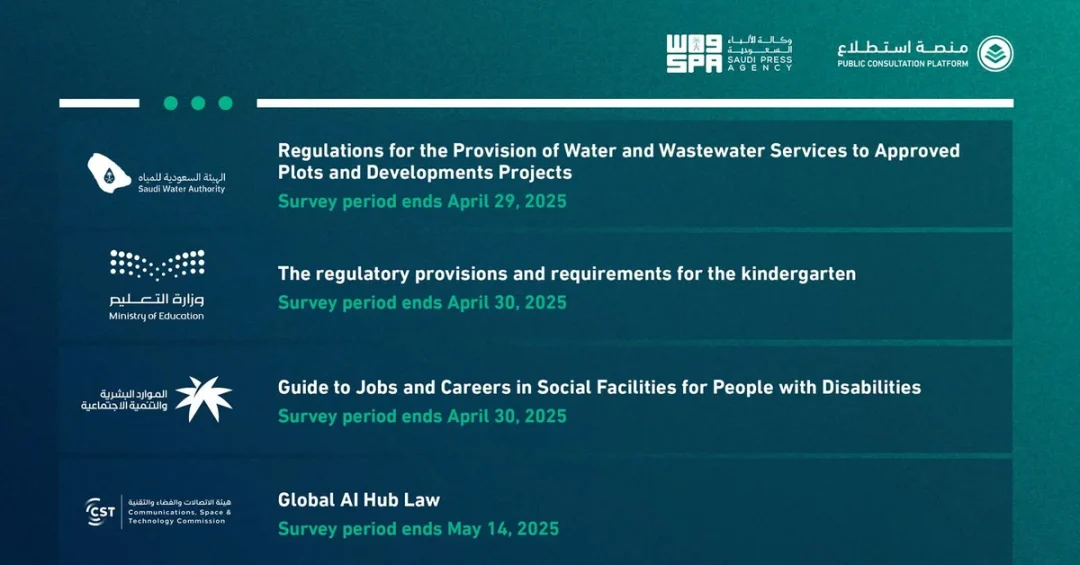
Saudi Arabia’s National Competitiveness Center (NCC) has opened 24 economic and development projects for public feedback through its Istitlaa Public Consultation Platform, in cooperation with 13 government agencies. The announcement, carried by the Saudi Press Agency on April 21, 2025, marks a further step in the Kingdom’s drive to involve citizens, government entities, and the private sector in shaping regulations before they are approved. The projects span water services, early childhood education, disability employment, artificial intelligence, and civil defense, among other fields. Have you ever wondered how a nation can turn policy-making into a truly inclusive exercise? Istitlaa offers a concrete answer, inviting stakeholders to review draft regulations and submit their views online.
The platform, launched by the NCC, is designed to enhance transparency in the legislative environment and foster a culture of public participation. By publishing draft regulations, by-laws, and similar documents, Istitlaa allows anyone with an interest in the business environment to contribute insights before rules become final. This round of consultations covers projects from ministries and authorities such as the Saudi Water Authority, the Ministry of Education, the Ministry of Human Resource and Social Development, the Communications, Space & Technology Commission, and the General Directorate of Civil Defense. The deadlines for feedback vary, with some closing as early as April 29 and others remaining open until mid-May 2025. How often do ordinary people get a direct say in the rules that govern their daily lives? Through Istitlaa, Saudi Arabia is making that question a practical reality.
Context and Background
The Istitlaa platform is an initiative of the National Competitiveness Center, a government body tasked with improving Saudi Arabia’s business environment and competitiveness. Since its establishment, Istitlaa has become a central channel for public consultation on proposed regulations. It reflects a broader shift in Saudi governance toward openness and evidence-based policy-making. By inviting feedback from citizens, government agencies, and the private sector, the platform ensures that regulations are not drafted in isolation but are tested against the experience of those they will affect. This approach aligns with international best practices in regulatory impact assessment and stakeholder engagement. Why does inclusive consultation matter for a rapidly transforming economy? Because regulations that work in practice require the input of those who will implement and live with them.
The current batch of 24 projects is being developed in cooperation with 13 government agencies, underscoring the cross-sector nature of the consultation. The projects range from technical standards for water and wastewater services to a global AI hub law and a guide to jobs in social facilities for people with disabilities. Each project has its own consultation period, allowing the public sufficient time to review and respond. The NCC’s role is to coordinate and host these consultations, ensuring a consistent and accessible process. This round follows previous consultation cycles that have covered areas such as tourism, investment, and digital economy regulations. How does a platform like Istitlaa help build trust between the state and its people? By making the rule-making process visible and open to influence, it demonstrates that the government values public input and is willing to adjust its plans accordingly.
Key Details
Among the projects open for feedback is the ‘Regulations for the Provision of Water and Wastewater Services to Approved Plots and Development Projects,’ developed by the Saudi Water Authority. This project aims to establish clear controls for organizing the provision of water and wastewater services to approved plots, a critical step as Saudi Arabia expands its urban and industrial infrastructure. The public can comment on this project through the Istitlaa platform until April 29, 2025. The Ministry of Education is seeking feedback on a new regulatory framework titled ‘Regulatory Provisions and Requirements for the Kindergarten.’ This project seeks to develop and update documents, policies, and requirements for kindergarten stages in line with internationally approved standards. Consultation on this project will remain open until April 30, 2025. What do these two very different projects have in common? They both show how regulation can be tailored to improve everyday life, from turning on a tap to preparing a child for school.
The Ministry of Human Resource and Social Development has put forward a project titled ‘Guide to Jobs and Careers in Social Facilities for People with Disabilities.’ This guide aims to define job titles for workers in social facilities for people with disabilities and to regulate the work of the workforce so that the facilities’ objectives are achieved. Feedback on this project will conclude on April 30, 2025. The Communications, Space & Technology Commission is seeking public feedback on a new regulatory framework titled ‘Global AI Hub Law.’ This project aims to enhance Saudi Arabia’s position as a global AI hub and a pioneer in advanced technologies. Public consultation on this project will remain open until May 14, 2025. The General Directorate of Civil Defense has opened for feedback a project titled ‘List of Responsibilities of the Specialist in Safety, Protection, and Fire Prevention in Government and Private Agencies.’ This project aims to enhance the level of safety and fire protection in various work environments, with consultation closing on May 15, 2025. How can a single platform host such a diverse array of topics and still remain accessible? By providing a unified, digital space where every draft regulation is published with clear instructions and deadlines.
The introduction of draft regulations, by-laws, and similar projects through the Istitlaa platform serves as an affirmation of enhanced transparency in the legislative environment. Likewise, Istitlaa fosters a culture of public participation by enabling citizens, government agencies, and the private sector to contribute their insights and feedback on proposed regulations related to the business environment. This round of 24 projects is part of a continuous effort to refine regulations before they are approved, reducing the risk of unintended consequences and increasing compliance. The platform’s user-friendly interface allows visitors to browse projects by sector, read summaries, and submit comments electronically. What does this mean for a business owner or a concerned citizen? It means they can influence the rules that will shape their operations and daily lives, often with just a few clicks.
International and Regional Impact
Saudi Arabia’s use of the Istitlaa platform sends a positive signal to international investors and partners about the predictability and openness of its regulatory environment. When draft laws are published for public comment, foreign companies can assess upcoming changes and provide input, reducing uncertainty. This is particularly relevant for the Global AI Hub Law, which aims to position the Kingdom as a leader in advanced technologies. International tech firms looking to invest in AI in the region will note that Saudi Arabia is not only building infrastructure but also crafting a legal framework through inclusive consultation. How does regulatory transparency affect a country’s attractiveness as an investment destination? It lowers risk and builds confidence, two factors that global capital values highly.
Regionally, the Istitlaa model could inspire other Gulf Cooperation Council (GCC) states to adopt similar public consultation mechanisms. By demonstrating that stakeholder engagement can be efficient and meaningful, Saudi Arabia is setting a benchmark for participatory governance in the Middle East. The projects themselves also have regional implications: improved water and wastewater regulations support sustainable development, while updated kindergarten standards contribute to human capital formation, a key driver of long-term economic growth. The civil defense project enhances workplace safety, a concern for multinational employers across the region. What can other nations learn from Saudi Arabia’s approach? That embracing public feedback is not a sign of weakness but a mark of institutional strength and forward planning.
Economic and Strategic Significance
The economic significance of these consultations lies in their potential to improve the business environment. Regulations that are clear, fair, and informed by stakeholder input reduce compliance costs and encourage entrepreneurship. The Saudi Water Authority’s project, for instance, will clarify the rules for providing water and wastewater services to development projects, which is essential for construction and real estate investment. The Ministry of Education’s kindergarten framework will support the expansion of early childhood education, enabling more parents to join the workforce. The guide for jobs in social facilities for people with disabilities will professionalize a vital sector, improving service quality and creating career paths. How does better regulation translate into economic growth? By removing ambiguities, it allows businesses to plan, invest, and hire with greater confidence.
Strategically, the Global AI Hub Law is a centerpiece of Saudi Arabia’s ambition to diversify its economy beyond oil. By consulting the public on this law, the Communications, Space & Technology Commission is ensuring that the regulatory framework for AI aligns with the needs of innovators, researchers, and entrepreneurs. This is not just about attracting foreign tech giants; it is about nurturing a domestic AI ecosystem that can create jobs and solve local challenges. The civil defense project, meanwhile, enhances safety standards that are prerequisites for industrial and commercial activity. Together, these consultations contribute to a more predictable and business-friendly regulatory environment, which is a core objective of Saudi Vision 2030. What is the ultimate goal of these efforts? To build a resilient, knowledge-based economy that offers opportunities for all.
Vision 2030 Alignment
The Istitlaa platform and the 24 projects now open for feedback are directly aligned with Saudi Vision 2030’s goals of enhancing government effectiveness, fostering public participation, and improving the business environment. Vision 2030 envisions a nation where regulations are transparent, where citizens are engaged, and where the private sector can thrive. By institutionalizing public consultation, the National Competitiveness Center is helping to make that vision a reality. The projects themselves touch on key Vision 2030 themes: education, social development, technology, infrastructure, and safety. Each consultation is a small but important step toward a more responsive and agile regulatory state. How does a single platform contribute to a national transformation? By embedding the principles of openness and collaboration into the everyday work of government.
As Saudi Arabia continues its journey toward 2030, the role of Istitlaa will only grow. The platform not only allows for feedback but also creates a record of public input that can inform future policy. This iterative approach to regulation is a hallmark of mature governance systems. For international observers, the message is clear: Saudi Arabia is serious about reform, and it is doing so in a way that invites scrutiny and participation. The 24 projects are a snapshot of a dynamic regulatory agenda, one that touches on water, education, disability employment, AI, and civil defense. What should we expect next? More consultations, more transparency, and more opportunities for people to shape the rules that affect them. That is the promise of Istitlaa, and it is a promise that Saudi Arabia is keeping.
20 Questions
Q1. What is the Istitlaa platform?
A1. Istitlaa is a public consultation platform launched by Saudi Arabia’s National Competitiveness Center. It allows citizens, government agencies, and the private sector to review and comment on draft regulations before they are approved, enhancing transparency and participation.
Q2. How many projects are currently open for feedback?
A2. There are 24 projects related to economic and development affairs open for public feedback through the Istitlaa platform, developed in cooperation with 13 government agencies.
Q3. Which government agencies are involved in these projects?
A3. The projects involve agencies such as the Saudi Water Authority, Ministry of Education, Ministry of Human Resource and Social Development, Communications, Space & Technology Commission, and General Directorate of Civil Defense, among others.
Q4. What is the deadline for feedback on the water and wastewater services project?
A4. The public can provide feedback on the Regulations for the Provision of Water and Wastewater Services to Approved Plots and Development Projects until April 29, 2025.
Q5. What does the kindergarten regulatory framework aim to achieve?
A5. The Ministry of Education’s project aims to develop and update documents, policies, and requirements for kindergarten stages in line with internationally approved standards. Feedback is open until April 30, 2025.
Q6. How does the guide for jobs in social facilities for people with disabilities help?
A6. It defines job titles and regulates the workforce in social facilities for people with disabilities, ensuring the facilities’ objectives are achieved. Consultation ends on April 30, 2025.
Q7. What is the Global AI Hub Law?
A7. The Global AI Hub Law is a proposed regulatory framework by the Communications, Space & Technology Commission to enhance Saudi Arabia’s position as a global AI hub and a pioneer in advanced technologies. Feedback is open until May 14, 2025.
Q8. What is the purpose of the civil defense project?
A8. The General Directorate of Civil Defense seeks feedback on a list of responsibilities for safety, protection, and fire prevention specialists in government and private agencies, aiming to enhance workplace safety. Consultation closes on May 15, 2025.
Q9. How does Istitlaa enhance transparency?
A9. By publishing draft regulations and by-laws for public review, Istitlaa makes the legislative process visible and allows stakeholders to contribute before rules are finalized, affirming enhanced transparency.
Q10. Who can participate in the consultations?
A10. The general public, government agencies, and the private sector are all invited to express their views and feedback on the proposed projects through the Istitlaa platform.
Q11. What is the role of the National Competitiveness Center?
A11. The NCC coordinates and hosts the Istitlaa platform, working with government agencies to publish draft regulations and gather public feedback to improve the business environment.
Q12. How does public consultation benefit the economy?
A12. It leads to clearer, more effective regulations that reduce compliance costs, encourage investment, and support entrepreneurship, ultimately contributing to economic growth and competitiveness.
Q13. Are the consultations open to international stakeholders?
A13. Yes, the platform is accessible online, and international investors and partners can review draft regulations and provide input, which helps reduce uncertainty and build confidence.
Q14. What is the significance of the water and wastewater project?
A14. It establishes controls for providing water and wastewater services to approved plots, supporting urban and industrial development and ensuring sustainable infrastructure.
Q15. How does the kindergarten project align with Vision 2030?
A15. By updating early childhood education standards, it supports human capital development and helps prepare children for future learning, aligning with Vision 2030’s focus on education and social development.
Q16. What impact does the AI hub law have on Saudi Arabia’s tech sector?
A16. It aims to position the Kingdom as a global AI leader, attracting investment and fostering innovation, which is a key pillar of economic diversification under Vision 2030.
Q17. How can someone submit feedback on a project?
A17. Feedback can be submitted through the Istitlaa platform’s website, where each project has a dedicated page with details and a comment submission form.
Q18. What happens to the feedback collected?
A18. The feedback is reviewed by the relevant government agency and considered before the regulation is finalized, ensuring that public input informs the final rules.
Q19. Is there a cost to participate in the consultations?
A19. No, participation is free of charge. The platform is a public service provided by the National Competitiveness Center to encourage broad engagement.
Q20. How does Istitlaa reflect Saudi Arabia’s Vision 2030?
A20. Istitlaa embodies Vision 2030’s goals of transparent governance, public participation, and a thriving private sector by making the regulatory process inclusive and responsive to stakeholders.
Reader Feedback
We value your thoughts. Please share your feedback on this article.
Your feedback helps us improve our coverage.
Related articles
 Al-Jubeir Receives New Spanish Ambassador to Saudi Arabia
 GCC-China Nuclear Forum Marks Key Cooperation Step
 Saudi Vice Minister Receives Gambian Ambassador
 Saudi Minister Al-Jubeir Meets Chinese Ambassador
 OIC Condemns Terrorist Attacks in Northern Benin
 Saudi, Egyptian FMs Co-Chair Political Consultation Committee