


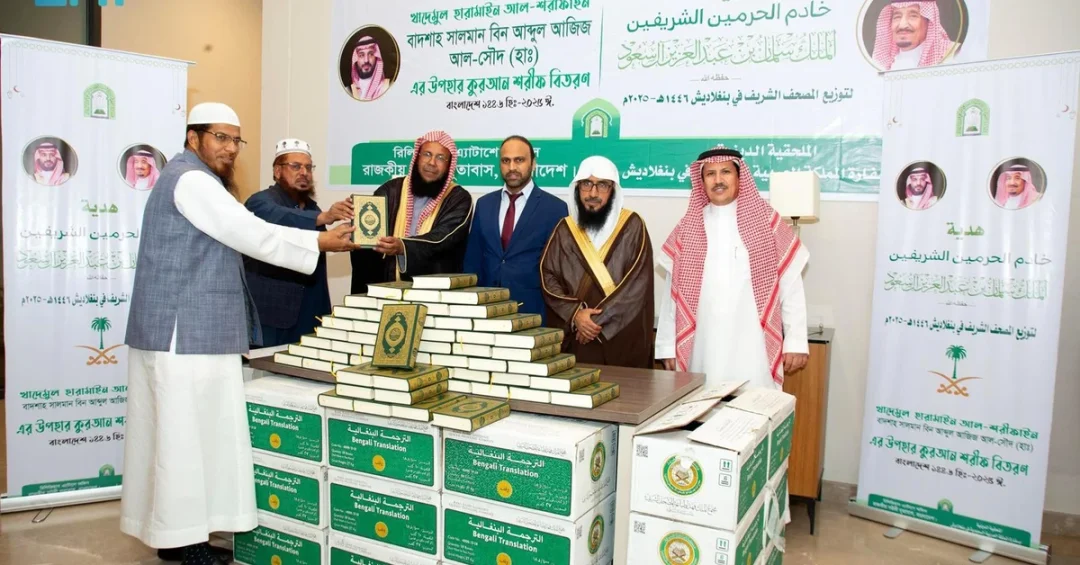
The Ministry of Islamic Affairs, Dawah, and Guidance, through the Religious Attaché at the Kingdom of Saudi Arabia’s Embassy in Bangladesh, has launched the Custodian of the Two Holy Mosques’ programs for distributing iftar meals, dates, and copies of the Holy Quran in Dhaka during the holy month of Ramadan 1446 AH. The initiative, announced via the Saudi Press Agency, forms part of the Kingdom’s long-standing global Ramadan outreach, designed to support Muslims around the world during the sacred month of fasting, prayer, and reflection.
The launch event in the Bangladeshi capital brought together members of the Saudi diplomatic mission alongside scholars, sheikhs, preachers, and mosque imams, all of whom expressed deep appreciation for Saudi Arabia’s leadership and its consistent commitment to serving Muslim communities worldwide. The programs reflect the Kingdom’s enduring role as a guardian of Islamic heritage and its dedication to easing the spiritual and material burdens of believers during Ramadan. But what does this latest initiative reveal about the Kingdom’s broader humanitarian vision, and why does it resonate so deeply in a country like Bangladesh?
Context and Background
The Custodian of the Two Holy Mosques’ iftar and dates distribution programs are among the most visible expressions of Saudi Arabia’s global Islamic outreach. Every year, the Ministry of Islamic Affairs, Dawah, and Guidance coordinates with Saudi embassies and religious attachés in dozens of countries to deliver dates, iftar meals, and Quran copies to millions of beneficiaries. The programs are funded by the Saudi government and implemented in partnership with local Islamic institutions, ensuring that aid reaches those who need it most during the fasting month.
Bangladesh, home to one of the world’s largest Muslim populations, has been a key partner in these initiatives for many years. The country’s deep Islamic traditions, combined with its strong bilateral ties to the Kingdom, make it a natural focus for such outreach. The Religious Attaché at the Saudi Embassy in Dhaka plays a central role in coordinating logistics, identifying distribution points, and working with local scholars and mosque leaders to ensure the programs run smoothly and transparently.
Why has this partnership endured and expanded over the decades? The answer lies in the shared values and mutual respect that define Saudi-Bangladeshi relations. The Kingdom has long supported Bangladesh’s development through humanitarian aid, educational scholarships, and religious cooperation. In return, Bangladesh has consistently stood by Saudi Arabia in international forums, reinforcing a bond that goes beyond diplomacy to encompass faith and culture.
Key Details of the Ramadan Programs
The 1446 AH Ramadan programs in Bangladesh include three main components: the distribution of iftar meals, the provision of dates, and the gifting of copies of the Holy Quran. The iftar meals are prepared and distributed daily at designated locations across Dhaka, allowing fasting Muslims to break their fast in a communal setting that strengthens social bonds and spiritual solidarity. The dates, a traditional and nutritious food for breaking the fast, are sourced from Saudi Arabia’s renowned date farms and shipped to Bangladesh for distribution among families, mosques, and charitable organizations.
The Quran copies, printed in Arabic with accompanying translations where appropriate, are intended to support religious education and personal devotion. They are distributed to mosques, Islamic centers, schools, and individual worshippers, helping to deepen understanding of the faith and promote the values of tolerance and moderation that Saudi Arabia champions globally. The launch event in Dhaka was attended by members of the Saudi diplomatic mission, including the Religious Attaché, as well as prominent Bangladeshi scholars, sheikhs, preachers, and mosque imams.
What do these beneficiaries say about the impact of such programs? According to statements shared at the event, the recipients expressed heartfelt gratitude to the Custodian of the Two Holy Mosques, King Salman bin Abdulaziz Al Saud, and to Crown Prince Mohammed bin Salman for their unwavering support. The scholars noted that these initiatives not only meet immediate physical needs but also uplift the spirit, reminding Muslims of the unity of the Ummah and the generosity of the Kingdom.
International and Regional Impact
The distribution of iftar meals, dates, and Quran copies in Bangladesh is part of a much larger global program that spans Asia, Africa, Europe, and the Americas. Each year, the Ministry of Islamic Affairs, Dawah, and Guidance oversees similar initiatives in dozens of countries, often in coordination with local Islamic organizations and Saudi embassies. These efforts reinforce Saudi Arabia’s soft power and its image as a benevolent leader of the Muslim world, a role that is particularly important in a time of global challenges and regional tensions.
In South Asia, where Bangladesh is a key player, the programs help counter extremism by promoting moderate Islamic values and providing alternative narratives to those espoused by radical groups. By supporting educational and religious institutions, Saudi Arabia contributes to stability and social cohesion in a region that is vital to global security. Moreover, the programs strengthen people-to-people ties between Saudi Arabia and Bangladesh, creating a foundation of goodwill that supports broader diplomatic and economic cooperation.
How does the international community perceive these efforts? While some critics occasionally question the motives behind Saudi religious outreach, the overwhelming response from beneficiaries and local leaders is one of appreciation and respect. The Kingdom’s transparent and consistent approach, coupled with its willingness to work with local partners, has earned it a reputation as a reliable and generous ally in the Muslim world.
Economic and Strategic Significance
Beyond their spiritual and humanitarian dimensions, these programs have economic and strategic implications. The dates and iftar meals are sourced from Saudi producers, providing a boost to the Kingdom’s agricultural sector and reinforcing its position as a leading exporter of high-quality dates. The logistics of shipping and distributing these goods also create opportunities for Saudi companies and their local partners, contributing to trade and investment flows between the two countries.
Strategically, the programs serve to deepen Saudi Arabia’s influence in Bangladesh, a country of strategic importance due to its location, population, and growing economy. By investing in religious and humanitarian initiatives, the Kingdom builds goodwill that can translate into support for its foreign policy objectives, including its efforts to promote peace and stability in the region. Furthermore, the programs align with Saudi Arabia’s Vision 2030, which seeks to diversify the economy and enhance the Kingdom’s global role through soft power and cultural diplomacy.
What does this mean for the future of Saudi-Bangladeshi relations? As both countries continue to grow and develop, the bonds forged through these Ramadan programs are likely to strengthen, paving the way for greater cooperation in trade, education, and culture. The Kingdom’s commitment to supporting Muslims worldwide is not just a charitable gesture but a strategic investment in a shared future.
Vision 2030 Alignment
Saudi Arabia’s Vision 2030, the ambitious reform plan championed by Crown Prince Mohammed bin Salman, places great emphasis on the Kingdom’s role as a global leader and its responsibility to serve humanity. The Ramadan programs in Bangladesh exemplify this vision by combining humanitarian aid with cultural and religious diplomacy, showcasing Saudi Arabia’s commitment to moderation, tolerance, and international cooperation. They also highlight the Kingdom’s efforts to modernize its image while staying true to its Islamic heritage.
Under Vision 2030, Saudi Arabia is expanding its global outreach through initiatives that promote education, healthcare, and economic development in partner countries. The distribution of iftar meals, dates, and Quran copies is a tangible expression of these goals, demonstrating that the Kingdom is not only a economic powerhouse but also a compassionate and reliable partner. As the programs continue to grow, they will further solidify Saudi Arabia’s position as a beacon of Islamic values and a force for good in the world.
In conclusion, the launch of the Custodian of the Two Holy Mosques’ Ramadan programs in Bangladesh is a testament to Saudi Arabia’s enduring commitment to the Muslim Ummah and its strategic vision for a peaceful and prosperous world. By supporting the spiritual and material needs of Muslims in Bangladesh, the Kingdom reinforces its leadership role and builds bridges of friendship that will last for generations. As Ramadan 1446 AH unfolds, the impact of these initiatives will be felt not only in Dhaka but across the globe, reminding us all of the power of generosity and faith.
20 Questions
Q1. What programs has the Ministry of Islamic Affairs launched in Bangladesh?
A1. The Ministry of Islamic Affairs, Dawah, and Guidance, through the Religious Attaché at the Saudi Embassy in Bangladesh, launched programs to distribute iftar meals, dates, and copies of the Holy Quran during Ramadan 1446 AH.
Q2. Where was the launch event held?
A2. The event was held in Dhaka, the capital of Bangladesh, and was attended by members of the Saudi diplomatic mission, scholars, sheikhs, preachers, and mosque imams.
Q3. Who is responsible for implementing these programs?
A3. The programs are implemented by the Ministry of Islamic Affairs, Dawah, and Guidance through the Religious Attaché at the Kingdom’s Embassy in Bangladesh, in coordination with local Islamic institutions.
Q4. What is the significance of distributing dates during Ramadan?
A4. Dates are a traditional and nutritious food for breaking the fast, and their distribution reflects the Sunnah of the Prophet Muhammad (peace be upon him) while providing essential sustenance to fasting Muslims.
Q5. How many beneficiaries are expected to receive aid?
A5. While exact numbers are not specified, the programs aim to reach thousands of Muslims across Dhaka and potentially other regions, supporting both spiritual and material needs during Ramadan.
Q6. What role does the Saudi Embassy play in these initiatives?
A6. The Saudi Embassy, through its Religious Attaché, coordinates logistics, identifies distribution points, and works with local scholars and mosque leaders to ensure the programs are implemented effectively and transparently.
Q7. Why is Bangladesh a focus for Saudi Arabia’s Ramadan outreach?
A7. Bangladesh has one of the world’s largest Muslim populations and enjoys strong bilateral ties with Saudi Arabia, making it a natural partner for religious and humanitarian cooperation.
Q8. What are the main components of the Ramadan programs in Bangladesh?
A8. The programs consist of three main components: daily iftar meals, distribution of dates, and gifting of copies of the Holy Quran to mosques, schools, and individuals.
Q9. How do these programs align with Saudi Vision 2030?
A9. They align with Vision 2030 by promoting Saudi Arabia’s role as a global leader, enhancing soft power, and supporting humanitarian and cultural diplomacy that reflects the Kingdom’s Islamic values.
Q10. What was the reaction of local scholars and imams?
A10. Local scholars, sheikhs, preachers, and mosque imams expressed deep appreciation for Saudi Arabia’s leadership and its commitment to supporting Muslims worldwide during the holy month.
Q11. Are these programs new or ongoing?
A11. These are ongoing annual programs that have been implemented for many years, reflecting the Kingdom’s consistent dedication to serving Muslims globally during Ramadan.
Q12. How are the dates and iftar meals sourced?
A12. The dates are sourced from Saudi Arabia’s renowned date farms, and the iftar meals are prepared locally in Bangladesh with support from the Saudi government and local partners.
Q13. What is the role of the Custodian of the Two Holy Mosques in these programs?
A13. The Custodian of the Two Holy Mosques, King Salman bin Abdulaziz Al Saud, oversees these programs as part of his role as guardian of Islam’s holiest sites and leader of the Muslim Ummah.
Q14. Do these programs extend beyond Dhaka?
A14. While the launch event was in Dhaka, the programs are designed to reach Muslims across Bangladesh, including in rural areas, through partnerships with local mosques and charities.
Q15. How do these initiatives counter extremism?
A15. By promoting moderate Islamic values, providing educational resources like Quran copies, and addressing material needs, the programs offer a positive alternative to extremist narratives and foster social cohesion.
Q16. What economic benefits do these programs bring to Saudi Arabia?
A16. They support Saudi agricultural exports, particularly dates, and create opportunities for Saudi companies in logistics and trade, contributing to economic diversification under Vision 2030.
Q17. How can other countries benefit from similar programs?
A17. Other countries can benefit by partnering with Saudi Arabia to implement similar initiatives, which strengthen bilateral ties, support local communities, and promote the Kingdom’s message of tolerance and generosity.
Q18. What is the expected impact on Saudi-Bangladeshi relations?
A18. The programs are expected to deepen people-to-people ties, enhance mutual goodwill, and pave the way for greater cooperation in trade, education, and culture between the two nations.
Q19. Are there any educational components to the Quran distribution?
A19. Yes, the Quran copies often include translations and are distributed to schools and Islamic centers, supporting religious education and helping recipients understand the teachings of Islam more deeply.
Q20. How does this initiative reflect Saudi Arabia’s global humanitarian role?
A20. It demonstrates Saudi Arabia’s commitment to serving Muslims worldwide, showcasing its leadership in humanitarian aid and its dedication to the values of compassion, generosity, and Islamic solidarity.
Reader Feedback
We value your thoughts. Please share your feedback on this article.
Your feedback helps us improve our coverage.
Related articles
 KSrelief Distributes 620 Food Baskets in West Java, Indonesia
 Makkah Hosts Second Building Bridges Islamic Conference
 163rd GCC Ministerial Council Convenes in Makkah with Four Arab States
 KSrelief Launches Ramadan Food Basket Project in Mali
 Manarah Robot Launched at Grand Mosque to Aid Pilgrims
 SISU Delegation Visits King Faisal Center in Riyadh