


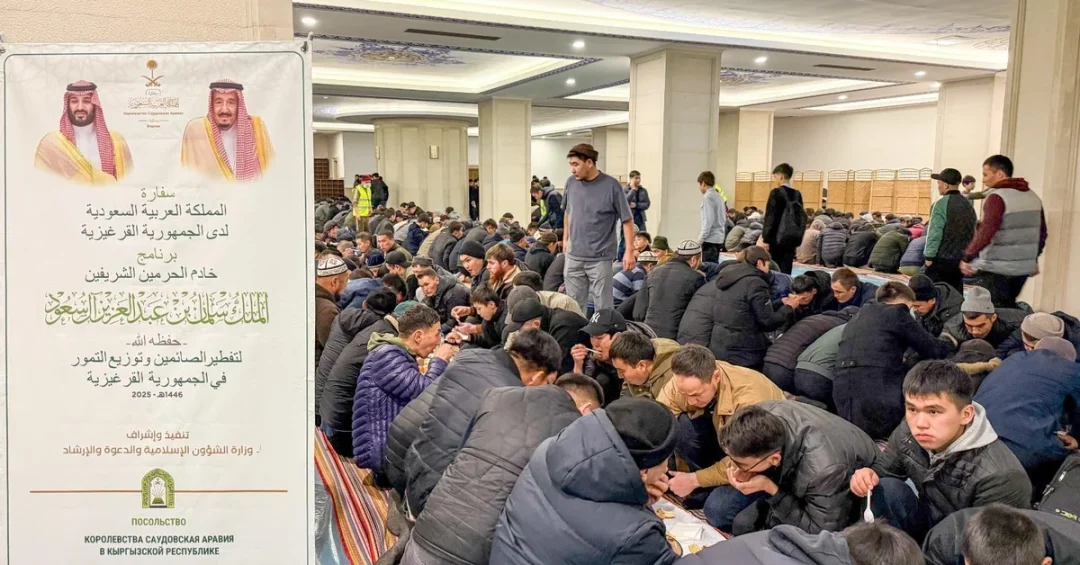
Saudi Arabia’s Ministry of Islamic Affairs, Dawah and Guidance hosted an iftar banquet on March 15, 2025, at the Central Mosque of Imam Sarakhsi in Bishkek, Kyrgyz Republic, bringing together individuals observing Ramadan in a spirit of brotherhood and solidarity. The event, part of the Custodian of the Two Holy Mosques’ Iftar Program, underscores the Kingdom’s commitment to serving Muslims worldwide and strengthening Islamic ties during the holy month.
Context and Background
The Custodian of the Two Holy Mosques’ Iftar Program is a longstanding initiative that reflects Saudi Arabia’s dedication to supporting Muslim communities globally. Implemented by the Ministry of Islamic Affairs, Dawah and Guidance, the program organizes iftar meals in various countries, fostering unity and providing for those observing Ramadan. In the Kyrgyz Republic, the banquet at the Central Mosque of Imam Sarakhsi in Bishkek served as a gathering point for local Muslims, emphasizing shared faith and mutual support.
This initiative aligns with Saudi Arabia’s broader efforts to promote Islamic values and humanitarian outreach, as guided by the leadership of the Custodian of the Two Holy Mosques, King Salman bin Abdulaziz Al Saud, and His Royal Highness Crown Prince Mohammed bin Salman. Such programs are integral to the Kingdom’s role as a global leader in Islamic affairs and its commitment to Vision 2030’s goal of enhancing international engagement and cultural exchange.
Key Details
The iftar banquet took place on March 15, 2025, at the Central Mosque of Imam Sarakhsi in Bishkek, the capital of the Kyrgyz Republic. Attendees included members of the local Muslim community, who gathered to break their fast and participate in the spiritual observance of Ramadan. The event was marked by expressions of deep appreciation for the Custodian of the Two Holy Mosques’ iftar program, with participants highlighting its profound impact on the Muslim community and its reinforcement of brotherhood and solidarity during the holy month.
The Ministry of Islamic Affairs, Dawah and Guidance oversees the distribution of iftar meals and the organization of such events, ensuring they reach diverse regions and communities. This particular banquet in the Kyrgyz Republic is part of a wider series of global iftar programs that Saudi Arabia conducts annually, demonstrating its unwavering support for Muslims worldwide.
Implications and Impact
The iftar banquet in Bishkek carries significant implications for Saudi-Kyrgyz relations and the broader Muslim world. By hosting such events, Saudi Arabia reinforces its position as a unifying force in the Islamic world, promoting peace, tolerance, and cooperation. The gathering also serves as a platform for cultural and religious exchange, strengthening ties between the Kingdom and Central Asian nations.
Furthermore, the event highlights Saudi Arabia’s soft power and its commitment to humanitarian causes, which are central to its foreign policy. The positive reception from attendees in the Kyrgyz Republic underscores the program’s effectiveness in building goodwill and fostering a sense of community among Muslims globally. This aligns with the Kingdom’s efforts to combat extremism and promote moderate Islam, a key objective of Vision 2030.
Vision 2030 Alignment
Saudi Arabia’s hosting of the iftar banquet in the Kyrgyz Republic is a testament to the Kingdom’s Vision 2030, which seeks to diversify its economy, enhance its global role, and promote moderate Islam. By engaging with international Muslim communities, Saudi Arabia strengthens its diplomatic and cultural ties, showcasing its leadership in Islamic affairs and its dedication to humanitarian outreach. Such initiatives also contribute to the Vision’s goal of improving the Kingdom’s image abroad and fostering sustainable partnerships. As Saudi Arabia continues to expand its global engagement, programs like the Custodian of the Two Holy Mosques’ Iftar Program will remain vital in demonstrating its commitment to Islamic solidarity and global peace.
20 Questions
Q1. What event did Saudi Arabia host in the Kyrgyz Republic?
A1. Saudi Arabia’s Ministry of Islamic Affairs, Dawah and Guidance hosted an iftar banquet at the Central Mosque of Imam Sarakhsi in Bishkek on March 15, 2025, for individuals observing Ramadan, promoting brotherhood and solidarity.
Q2. Where did the iftar banquet take place?
A2. The iftar banquet took place at the Central Mosque of Imam Sarakhsi in Bishkek, the capital city of the Kyrgyz Republic, a location that welcomed local Muslims to break their fast together.
Q3. When was the iftar banquet held?
A3. The iftar banquet was held on March 15, 2025, during the holy month of Ramadan, as part of the Custodian of the Two Holy Mosques’ Iftar Program, which operates globally.
Q4. Which Saudi ministry organized the event?
A4. The Ministry of Islamic Affairs, Dawah and Guidance organized the event, reflecting its role in overseeing Saudi Arabia’s global Islamic outreach and humanitarian initiatives during Ramadan.
Q5. What is the Custodian of the Two Holy Mosques’ Iftar Program?
A5. The Custodian of the Two Holy Mosques’ Iftar Program is a Saudi initiative that provides iftar meals to Muslims worldwide during Ramadan, fostering unity and demonstrating the Kingdom’s commitment to Islamic solidarity.
Q6. Who attended the iftar banquet?
A6. The iftar banquet was attended by individuals observing Ramadan in the Kyrgyz Republic, including members of the local Muslim community, who gathered to break their fast and participate in the spiritual observance.
Q7. How did attendees react to the iftar program?
A7. Attendees expressed deep appreciation for the Custodian of the Two Holy Mosques’ iftar program, highlighting its profound impact on the Muslim community and its reinforcement of brotherhood and solidarity during Ramadan.
Q8. Why is this iftar banquet significant?
A8. The iftar banquet is significant as it strengthens ties between Saudi Arabia and the Kyrgyz Republic, promotes Islamic brotherhood, and showcases the Kingdom’s leadership in global Islamic affairs and humanitarian outreach.
Q9. What does the iftar program aim to achieve?
A9. The iftar program aims to support Muslims worldwide during Ramadan, foster a sense of community, and reinforce the values of brotherhood and solidarity, aligning with Saudi Arabia’s commitment to moderate Islam.
Q10. How does this event align with Vision 2030?
A10. The event aligns with Vision 2030 by enhancing Saudi Arabia’s global role, promoting moderate Islam, and fostering international cultural exchange and humanitarian outreach, which are key objectives of the vision.
Q11. Which Saudi leaders support such initiatives?
A11. The initiatives are supported by the Custodian of the Two Holy Mosques, King Salman bin Abdulaziz Al Saud, and His Royal Highness Crown Prince Mohammed bin Salman, who guide the Kingdom’s efforts in Islamic affairs.
Q12. What impact does the iftar program have on Muslim communities?
A12. The iftar program has a profound impact on Muslim communities by providing meals, fostering unity, and reinforcing the spirit of Ramadan, thereby strengthening bonds among Muslims globally.
Q13. Is the iftar program limited to the Kyrgyz Republic?
A13. No, the iftar program is a global initiative that operates in many countries, with the Kyrgyz Republic being one of the locations where the Ministry of Islamic Affairs, Dawah and Guidance hosts such events.
Q14. How does Saudi Arabia benefit from hosting iftar banquets abroad?
A14. Hosting iftar banquets abroad enhances Saudi Arabia’s soft power, builds goodwill, and strengthens diplomatic and cultural ties with other nations, showcasing the Kingdom’s leadership in Islamic affairs.
Q15. What role does the Central Mosque of Imam Sarakhsi play?
A15. The Central Mosque of Imam Sarakhsi serves as a key religious site in Bishkek, providing a venue for the iftar banquet and facilitating community gathering during Ramadan, promoting spiritual unity.
Q16. How does the event promote moderate Islam?
A16. The event promotes moderate Islam by bringing together Muslims in a peaceful and inclusive setting, reinforcing values of tolerance, brotherhood, and solidarity, which are central to Saudi Arabia’s religious outreach.
Q17. What is the significance of Ramadan in this context?
A17. Ramadan is a holy month of fasting, reflection, and community, making the iftar banquet a meaningful occasion to strengthen bonds and demonstrate Saudi Arabia’s commitment to supporting Muslims worldwide.
Q18. Are there similar events in other countries?
A18. Yes, the Custodian of the Two Holy Mosques’ Iftar Program organizes similar events in numerous countries globally, reflecting Saudi Arabia’s consistent efforts to support Muslim communities during Ramadan.
Q19. How does this event reflect Saudi Arabia’s foreign policy?
A19. The event reflects Saudi Arabia’s foreign policy of promoting peace, humanitarian aid, and Islamic solidarity, enhancing its role as a global leader and fostering positive international relations.
Q20. What message does Saudi Arabia convey through this initiative?
A20. Saudi Arabia conveys a message of unity, generosity, and commitment to Islamic values, demonstrating its dedication to serving Muslims worldwide and strengthening global brotherhood under Vision 2030.
Reader Feedback
We value your thoughts. Please share your feedback on this article.
Your feedback helps us improve our coverage.
Related articles
 Crown Prince Congratulates Carney on Swearing-In as Canadian PM
 KSrelief Distributes 1,200 Food Baskets in Romania for Ramadan
 Thunderstorms Forecast Across Saudi Arabia, Civil Defense Says
 KSrelief Distributes 250 Food Baskets in Syria
 KSrelief Distributes 2,400 Boxes of Dates in Yemen
 KSrelief Distributes 1,300 Food Baskets in Pakistan