


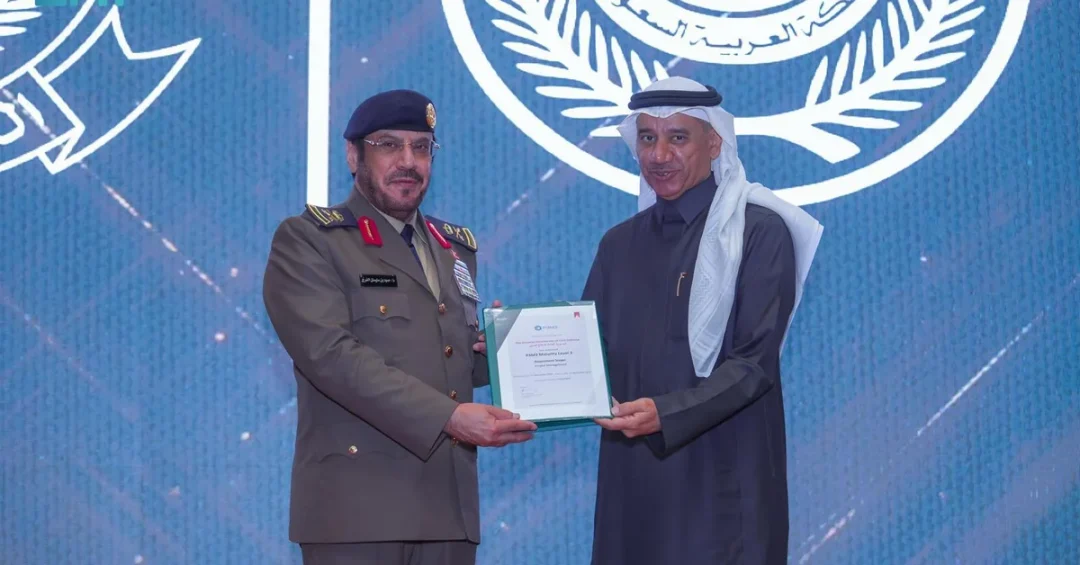
The General Directorate of Civil Defense has become the first sector within the Ministry of Interior to receive Level 3 accreditation under the Axelos Portfolio, Programme and Project Management Maturity Model (P3M3®), an internationally recognized benchmark for organizational project-delivery capability. The accreditation was formally presented during a ceremony held at the directorate’s headquarters in Riyadh, according to the Saudi Press Agency, and was attended by the Director-General of Saudi Civil Defense, Major General Dr. Hammoud bin Suleiman Al-Faraj, alongside the Chief Executive of the Ministry of Interior Development Program, Eng. Nabil bin Khalid Al-Dabal. The recognition places the Civil Defense among a select group of public-sector organizations worldwide whose management systems have been independently assessed against a rigorous international standard. For observers of Saudi governance, the milestone signals something broader than a single certificate: it reflects a systematic national effort to embed global best practice into the institutions that protect citizens, residents, and pilgrims across the Kingdom.
The announcement matters because it links two priorities that define modern Saudi Arabia — public safety and institutional excellence. The Civil Defense is the agency responsible for firefighting, rescue operations, emergency response, and disaster preparedness across the country, a mandate that has grown in scale and complexity as the Kingdom hosts ever-larger events, expands its tourism sector, and develops giga-projects under Vision 2030. Achieving P3M3® Level 3 means the directorate can demonstrate that its portfolios, programmes, and projects are managed through defined, documented, and consistently applied processes rather than ad hoc arrangements. In practical terms, that translates into better planning, more predictable delivery timelines, stronger risk controls, and more efficient use of public funds. For a ministry whose work is measured in lives protected and emergencies contained, that is a meaningful operational upgrade rather than a symbolic award.
Context and Background
What exactly is P3M3®, and why does an accreditation from Axelos carry weight in government circles? P3M3® — the Portfolio, Programme and Project Management Maturity Model — is a framework owned by Axelos, the joint venture originally formed by the UK Government and Capita that also manages global standards such as PRINCE2® and ITIL®. The model assesses how mature an organization’s management of change initiatives is, scoring capability across five progressive levels. Level 1 reflects awareness, Level 2 indicates repeatable processes, and Level 3 — the level now achieved by the Civil Defense — signifies that defined processes are established, documented, and consistently applied across the organization. Higher levels, Levels 4 and 5, address measured and optimized performance respectively. Independent assessment against this model is widely used by governments and enterprises to benchmark delivery capability and to identify where improvement efforts should be concentrated.
The Ministry of Interior, which oversees the Civil Defense, has pursued institutional development as a strategic objective for several years. The Ministry of Interior Development Program, represented at the Riyadh ceremony by its Chief Executive Eng. Nabil bin Khalid Al-Dabal, works to modernize the ministry’s agencies, align their operations with national transformation goals, and raise the quality of services delivered to the public. The fact that the Civil Defense is the first sector within the ministry to reach P3M3® Level 3 suggests a deliberate sequencing strategy: prove the model in one high-stakes operational agency, then extend the approach to other sectors. Saudi Arabia’s public institutions have increasingly adopted international standards in fields ranging from financial auditing to healthcare accreditation, and the P3M3® milestone fits that pattern of measured, verifiable reform.
Key Details of the Accreditation
The ceremony in Riyadh marked the formal handover of the Level 3 accreditation to the General Directorate of Civil Defense. According to the Saudi Press Agency, the event was attended by Major General Dr. Hammoud bin Suleiman Al-Faraj, Director-General of Saudi Civil Defense, and Eng. Nabil bin Khalid Al-Dabal, Chief Executive of the Ministry of Interior Development Program. Their joint presence underscores the collaborative nature of the achievement: the Civil Defense delivered the operational transformation, while the ministry’s development program provided the strategic framework and support. The directorate’s recognition as the first Ministry of Interior sector to attain this level adds a competitive dimension, establishing a benchmark that other agencies within the ministry can now aim to match.
What does Level 3 look like inside a civil protection organization? In practice, it means the directorate maintains a defined portfolio of projects and programmes tied to its strategic objectives, with clear governance structures, assigned responsibilities, and standardized documentation. Projects are initiated, monitored, and closed according to established processes, and lessons learned are captured for future use. For an agency that must simultaneously manage station construction, equipment procurement, workforce training, digital systems, and emergency planning, that discipline is essential. The accreditation also provides an external validation mechanism: Axelos-recognized assessors review evidence and interview staff, meaning the Level 3 rating is not self-declared but independently verified. That external scrutiny is what gives the certification credibility with international partners and peer institutions.
International and Regional Impact
How does a management maturity rating in Riyadh resonate beyond Saudi borders? International standards function as a shared language between institutions. When Saudi Arabia’s Civil Defense holds an Axelos accreditation, it can more easily cooperate with counterpart agencies in other countries, participate in joint training and exchange programmes, and contribute to multinational emergency response frameworks on equal technical footing. The Kingdom already plays a prominent role in regional civil protection coordination, and credentials of this kind strengthen its position in those forums. For international organizations that assess disaster preparedness, the accreditation offers a recognizable signal that Saudi Arabia’s emergency management institutions are governed by transparent, auditable processes.
Regionally, the milestone reinforces a broader trend of Gulf states investing in institutional quality alongside physical infrastructure. Neighboring countries looking to modernize their own civil protection systems now have a concrete regional example to study — one achieved within a Middle Eastern government context rather than imported wholesale from a Western template. The timing is also significant given the scale of events Saudi Arabia hosts, from the annual Hajj pilgrimage, which draws millions of worshippers, to major sporting, cultural, and business gatherings. Reliable project delivery underpins the crowd-safety, infrastructure, and response capabilities that such events demand. In that sense, the accreditation supports the Kingdom’s reputation as a capable host and a responsible regional actor.
Economic and Strategic Significance
Why should efficiency in project management be treated as an economic story? Public-sector projects consume substantial national resources, and poor delivery carries costs that compound over time — delayed facilities, duplicated spending, and unrealized service improvements. By institutionalizing defined management processes, the Civil Defense improves its ability to deliver on budget and on schedule, which directly supports fiscal responsibility. The Ministry of Interior Development Program has emphasized that modernization efforts should raise service quality while optimizing resource use, and P3M3® Level 3 provides a verified framework for achieving that balance. For a government executing an unprecedented pipeline of national projects, this kind of capability is as strategically valuable as any single piece of infrastructure.
The accreditation also strengthens human capital. Implementing a maturity model requires training staff in portfolio, programme, and project management disciplines, defining roles, and building a culture of continuous improvement. Those skills remain within the institution and can be applied to every future initiative. Over time, this creates a cadre of professionals whose expertise extends beyond civil protection into general public administration — a national asset as Saudi Arabia pursues the workforce development goals embedded in Vision 2030. The achievement therefore has a dual dividend: immediate improvements in project delivery and a long-term investment in the capabilities of Saudi public servants.
Vision 2030 Alignment
How does a civil defense accreditation connect to Saudi Arabia’s long-term national transformation? Vision 2030 calls for a government that is effective, transparent, and accountable, delivering high-quality services to citizens and residents. The P3M3® Level 3 milestone is a direct expression of that objective: an operational agency voluntarily submitting to international assessment and meeting a demanding standard. It also supports the Vision’s emphasis on safety and quality of life, since dependable emergency services are foundational to the livable, secure communities the Kingdom aims to build. As Saudi Arabia attracts more visitors, hosts more global events, and develops ambitious new cities and destinations, the institutions that keep people safe must operate at world-class standards — and this accreditation demonstrates that they are being held to exactly that expectation.
The recognition of the Civil Defense as the first Ministry of Interior sector to achieve P3M3® Level 3 is best understood as a beginning rather than an endpoint. Maturity models are designed for progression, and the framework naturally points toward Levels 4 and 5, where performance is measured and continuously optimized. Other agencies within the ministry now have a proven internal path to follow. For international readers, the takeaway is clear: Saudi Arabia’s transformation is being built not only in steel and concrete but in the management systems, standards, and skills of its public institutions. The Civil Defense accreditation is a quiet but telling indicator that the Kingdom’s commitment to excellence extends to the agencies that protect lives every day — and that Vision 2030’s promise of a safer, more capable nation is being delivered one verified milestone at a time.
20 Questions
Q1. What accreditation did the Saudi Civil Defense receive?
A1. The General Directorate of Civil Defense received Level 3 accreditation under the Axelos P3M3® model, which assesses portfolio, programme, and project management maturity. It is the first Ministry of Interior sector to earn this recognition.
Q2. Who attended the accreditation ceremony in Riyadh?
A2. The ceremony was attended by Major General Dr. Hammoud bin Suleiman Al-Faraj, Director-General of Saudi Civil Defense, and Eng. Nabil bin Khalid Al-Dabal, Chief Executive of the Ministry of Interior Development Program.
Q3. What does P3M3® stand for?
A3. P3M3® stands for Portfolio, Programme and Project Management Maturity Model. It is owned by Axelos and used worldwide to benchmark how well organizations manage change initiatives and deliver projects.
Q4. What does Level 3 mean in the P3M3® framework?
A4. Level 3 indicates that an organization has defined, documented, and consistently applied management processes. It sits above awareness and repeatable stages but below the measured and optimized levels.
Q5. Why is this accreditation significant for Saudi Arabia?
A5. It demonstrates that Saudi public institutions are adopting international best practices, improving project delivery, and strengthening the emergency services that protect citizens, residents, and the millions of pilgrims who visit the Kingdom.
Q6. Is the Civil Defense the first ministry sector to achieve this?
A6. Yes. According to the Saudi Press Agency, the Civil Defense is the first sector within the Ministry of Interior to receive Axelos P3M3® Level 3 accreditation, setting a benchmark for other agencies.
Q7. What does the General Directorate of Civil Defense do?
A7. It is responsible for firefighting, rescue operations, emergency response, and disaster preparedness across Saudi Arabia. Its duties have expanded as the Kingdom hosts larger events and develops major new projects.
Q8. Who is Axelos?
A8. Axelos is a joint venture originally formed by the UK Government and Capita. It manages globally recognized standards including PRINCE2®, ITIL®, and the P3M3® maturity model used in this accreditation.
Q9. How does this accreditation improve public safety?
A9. Defined management processes lead to better planning, stronger risk controls, and more reliable delivery of equipment, facilities, and training. These improvements directly enhance the Civil Defense’s ability to respond to emergencies.
Q10. What role did the Ministry of Interior Development Program play?
A10. The program, led by Chief Executive Eng. Nabil bin Khalid Al-Dabal, supports the modernization of ministry agencies. It provided strategic direction and support that helped the Civil Defense achieve the accreditation.
Q11. Does the accreditation have international benefits?
A11. Yes. International standards act as a shared language between agencies, making it easier for Saudi Civil Defense to cooperate with counterparts abroad, join training exchanges, and participate in multinational emergency response efforts.
Q12. How does this relate to Vision 2030?
A12. Vision 2030 calls for an effective, transparent government delivering high-quality services. The accreditation reflects that objective by showing an operational agency meeting demanding international standards for management and delivery.
Q13. What are the higher levels of P3M3®?
A13. Level 4 focuses on measured performance, where organizations use data to track and manage delivery. Level 5 represents continuous optimization, with processes refined based on performance evidence and feedback.
Q14. Why is project management maturity important for government agencies?
A14. Public projects consume significant national resources. Mature management processes help agencies deliver on time and on budget, reduce waste, and ensure that investments translate into real service improvements for the public.
Q15. How might other Saudi agencies benefit from this milestone?
A15. The Civil Defense provides a proven internal example. Other Ministry of Interior sectors can study its approach, adopt similar processes, and pursue their own accreditation, raising standards across the ministry.
Q16. Does the accreditation involve independent assessment?
A16. Yes. P3M3® ratings are not self-declared. Recognized assessors review evidence and evaluate processes against the model’s criteria, which gives the Level 3 rating external credibility.
Q17. How does this affect Saudi Arabia’s ability to host major events?
A17. Large events such as Hajj and international gatherings require dependable safety and emergency infrastructure. Stronger project delivery capability helps ensure the facilities, equipment, and planning those events depend on are in place.
Q18. What skills does the accreditation build within the workforce?
A18. It develops expertise in portfolio, programme, and project management, including governance, risk control, and continuous improvement. These skills remain in the institution and support future national initiatives.
Q19. Where was the accreditation presented?
A19. The accreditation was presented at a ceremony at the Civil Defense directorate’s headquarters in Riyadh, as reported by the Saudi Press Agency, with senior leadership from the directorate and the ministry present.
Q20. What is the broader message of this achievement?
A20. It shows that Saudi Arabia’s transformation includes strengthening public institutions, not just building infrastructure. The Civil Defense milestone signals that the Kingdom’s agencies are being held to world-class standards of management and service.
Reader Feedback
We value your thoughts. Please share your feedback on this article.
Your feedback helps us improve our coverage.
Related articles
 KSrelief and WFP Sign New Humanitarian Partnership in Riyadh
 KSrelief, UNICEF Sign $200M Deal to Eradicate Polio
 Saudi Mission to Geneva Organizes Seminar on Tolerance, Inclusivity in Sports
 Ramadan Preparations Completed at Mosques Across Saudi Arabia
 Religious Affairs Presidency Enhances Ramadan at Prophet’s Mosque
 KSrelief, IsDB Sign $100M Memorandum for Lives, Livelihoods Fund