


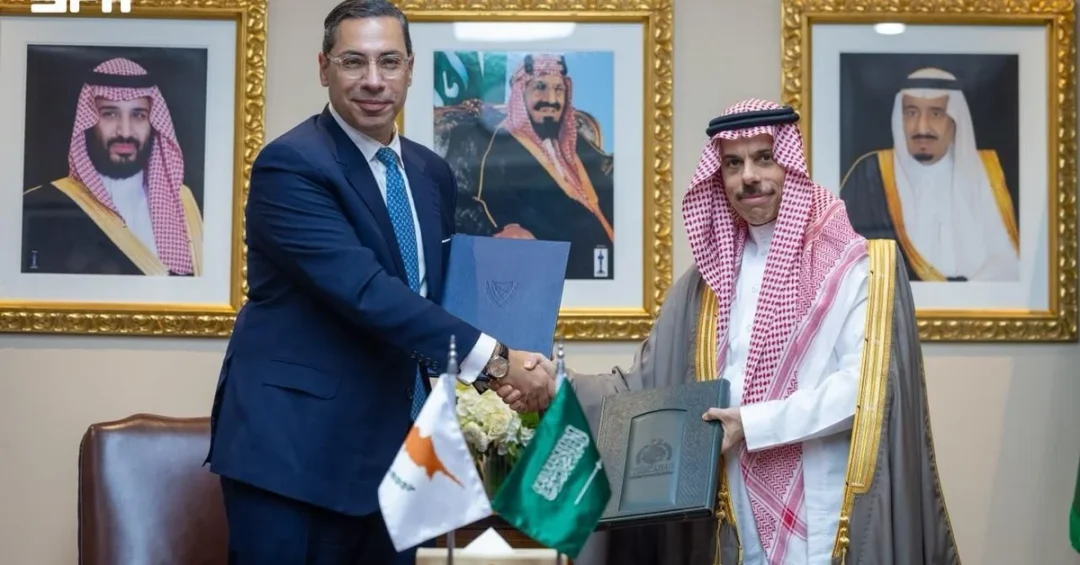
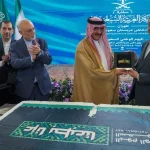
Saudi Minister of Foreign Affairs Prince Faisal bin Farhan bin Abdullah met with the Minister of Foreign Affairs of the Republic of Cyprus, Constantinos Kombos, in New York on Thursday, on the sidelines of the 81st session of the United Nations General Assembly High-Level Week, where the two sides signed a cooperation program on diplomatic training between the Prince Saud Al Faisal Institute for Diplomatic Studies and the Diplomatic Academy of the Ministry of Foreign Affairs of Cyprus. The agreement is designed to strengthen joint research and training in the diplomatic field and to serve the shared interests of both countries, according to information released through official Saudi channels. The meeting also reviewed bilateral relations, explored avenues for expanded cooperation, and addressed regional and international issues of common concern.
Permanent Representative of the Kingdom of Saudi Arabia to the United Nations Dr. Abdulaziz Alwasil attended the meeting, underscoring the diplomatic weight the Kingdom attaches to its engagement at the United Nations and to its growing network of partnerships across Europe and the Mediterranean. The encounter took place during one of the busiest diplomatic weeks of the international calendar, when heads of state, foreign ministers, and senior officials gather in New York to advance national priorities and collective responses to global challenges. For Saudi Arabia, the meeting formed part of a broader program of high-level bilateral engagements that reflect the Kingdom’s active and outward-looking foreign policy under the leadership of the Custodian of the Two Holy Mosques, King Salman bin Abdulaziz Al Saud, and His Royal Highness Prince Mohammed bin Salman bin Abdulaziz Al Saud, Crown Prince and Prime Minister.
Context and Background
Why does a diplomatic training agreement between two friendly countries deserve attention at the world’s most prominent multilateral gathering? The answer lies in the quiet, cumulative power of institutional diplomacy. The Prince Saud Al Faisal Institute for Diplomatic Studies is the training and research arm of the Saudi Ministry of Foreign Affairs, named after the late Prince Saud Al Faisal, who served as the Kingdom’s foreign minister for four decades and became a defining figure in Saudi and regional diplomacy. The institute prepares Saudi diplomats for a rapidly changing international environment, combining language skills, negotiation training, area studies, and research on global governance.
Its Cypriot counterpart, the Diplomatic Academy of the Ministry of Foreign Affairs of Cyprus, performs a similar function for a European Union member state situated at the crossroads of Europe, the Middle East, and the Eastern Mediterranean. Cyprus has long maintained close and cordial relations with the Arab world and with the Gulf region in particular, and its diplomatic academy has developed recognized expertise in multilateral affairs, European integration, and regional mediation. A structured cooperation program between the two institutions therefore links two diplomatic traditions that share geography, history, and a stake in regional stability.
The signing in New York also reflects a wider pattern in Saudi diplomacy: the Kingdom increasingly pairs high-level political meetings with concrete, technical agreements that outlast the news cycle. Rather than remaining a purely ceremonial encounter, the ministerial meeting produced a deliverable that will shape how diplomats from both countries are trained, how joint research is conducted, and how professional networks between Riyadh and Nicosia are deepened in the years ahead.
Key Details of the Meeting and the Agreement
According to the official account, the two ministers reviewed bilateral relations between the Kingdom of Saudi Arabia and the Republic of Cyprus and explored opportunities to expand cooperation across fields of mutual interest. They also exchanged views on regional and international developments, a standard but significant element of Saudi diplomatic practice that allows the Kingdom to align positions, reduce misunderstandings, and identify areas where joint action is possible. The presence of Dr. Abdulaziz Alwasil, the Kingdom’s Permanent Representative to the United Nations, linked the bilateral conversation directly to the multilateral agenda being debated at the General Assembly.
The centerpiece of the meeting was the signing of a cooperation program on diplomatic training between the Prince Saud Al Faisal Institute for Diplomatic Studies and the Diplomatic Academy of the Ministry of Foreign Affairs of Cyprus. The program is aimed at strengthening joint research and training to serve shared interests, a formulation that points to several practical activities: exchange of faculty and researchers, joint seminars and workshops, shared curricula on regional and international affairs, and possibly reciprocal training opportunities for junior and mid-career diplomats. Such programs typically create durable professional ties that inform day-to-day diplomatic practice long after the signing ceremony concludes.
What makes this agreement notable is its timing and placement. It was concluded on the margins of the 81st session of the United Nations General Assembly High-Level Week, a setting that signals that the Kingdom treats bilateral and multilateral diplomacy as complementary rather than separate tracks. The meeting also occurred as Saudi Arabia continues to expand its diplomatic footprint, hosting major international events, mediating regional disputes, and deepening partnerships with European states across trade, energy, tourism, and technology.
International and Regional Impact
How does a training program between two diplomatic academies translate into regional and international impact? Diplomacy is ultimately conducted by people, and the quality of a country’s diplomatic corps shapes its ability to advance national interests, defuse crises, and build coalitions. By investing in the professional development of diplomats, Saudi Arabia and Cyprus are investing in the predictability and effectiveness of their bilateral relationship. The program creates a standing channel through which officials at similar career stages can build trust, share perspectives on regional files, and develop a common vocabulary for addressing challenges in the Eastern Mediterranean, the Middle East, and beyond.
The agreement also carries symbolic weight at a moment when the Eastern Mediterranean has become a zone of intensified geopolitical competition and opportunity. Cyprus, as a European Union member and a regional neighbor of the Middle East, occupies a position of particular relevance to Gulf states. Enhanced diplomatic training cooperation can support broader efforts to promote stability, maritime security, energy cooperation, and people-to-people ties. For Saudi Arabia, partnerships of this kind reinforce its reputation as a constructive international actor that builds institutions rather than merely reacting to events.
Economic and Strategic Significance
Is there an economic dimension to what appears to be a technical diplomatic agreement? In practice, diplomatic capacity and economic cooperation are closely linked. Well-trained diplomats are better equipped to negotiate trade and investment agreements, support companies operating abroad, and resolve consular and regulatory issues that affect business. As Saudi Arabia pursues its Vision 2030 goal of diversifying the economy and expanding non-oil trade, a professional diplomatic service becomes an economic asset. The same is true for Cyprus, whose economy benefits from its role as a regional services and shipping hub.
Strategically, the meeting in New York forms part of the Kingdom’s broader effort to strengthen ties with European partners, including smaller and mid-sized states whose voices matter in the European Union and in multilateral institutions. By building durable institutional links with Cyprus, Saudi Arabia enhances its ability to communicate its positions, understand European perspectives, and identify areas of converging interest. The cooperation program thus serves both a bilateral purpose and a wider strategic one, contributing to a more connected and stable regional environment.
Vision 2030 Alignment
How does a diplomatic training agreement connect to Saudi Vision 2030? Vision 2030 is not only an economic transformation program; it is also a project of international integration. A more diversified, open, and globally engaged Kingdom requires a diplomatic service capable of managing complex relationships, attracting investment, supporting tourism and cultural exchange, and representing Saudi interests in multilateral forums. The Prince Saud Al Faisal Institute for Diplomatic Studies is a key instrument in that effort, and its cooperation with the Diplomatic Academy of the Ministry of Foreign Affairs of Cyprus strengthens the human capital on which the Kingdom’s global engagement depends.
The meeting between Prince Faisal bin Farhan bin Abdullah and Constantinos Kombos, and the agreement it produced, illustrate the Kingdom’s approach under Vision 2030: combining high-level diplomacy with practical institution-building, and pairing traditional alliances with new partnerships across Europe and the Mediterranean. As Saudi Arabia continues to expand its role as a bridge between regions and a contributor to international stability, agreements of this kind will remain an important, if understated, part of its foreign policy toolkit, helping to ensure that the Kingdom’s relationships are as durable as they are ambitious.
20 Questions
Q1. Who met in New York on Thursday?
A1. Saudi Minister of Foreign Affairs Prince Faisal bin Farhan bin Abdullah met with the Minister of Foreign Affairs of the Republic of Cyprus, Constantinos Kombos, according to the official Saudi account.
Q2. What event provided the setting for the meeting?
A2. The meeting took place on the sidelines of the 81st session of the United Nations General Assembly High-Level Week in New York, a major annual gathering of world leaders and ministers.
Q3. What agreement was signed during the meeting?
A3. The two ministers signed a cooperation program on diplomatic training between the Prince Saud Al Faisal Institute for Diplomatic Studies and the Diplomatic Academy of the Ministry of Foreign Affairs of Cyprus.
Q4. What is the purpose of the cooperation program?
A4. The program aims to strengthen joint research and training to serve the shared interests of Saudi Arabia and Cyprus in the diplomatic field.
Q5. Who else attended the meeting?
A5. Dr. Abdulaziz Alwasil, the Permanent Representative of the Kingdom of Saudi Arabia to the United Nations, attended the meeting, linking the bilateral talks to the multilateral agenda.
Q6. What topics did the two ministers discuss?
A6. They reviewed bilateral relations, explored cooperation opportunities, and discussed regional and international issues of common concern, according to official information.
Q7. What is the Prince Saud Al Faisal Institute for Diplomatic Studies?
A7. It is the training and research institution of the Saudi Ministry of Foreign Affairs, named after the late Prince Saud Al Faisal, a long-serving Saudi foreign minister.
Q8. What is the Diplomatic Academy of Cyprus?
A8. It is the training institution of the Ministry of Foreign Affairs of Cyprus, a European Union member state with close ties to the Middle East and the Gulf region.
Q9. Why is diplomatic training important for Saudi Arabia?
A9. It prepares Saudi diplomats to manage complex international relationships, support investment and trade, and represent the Kingdom effectively in multilateral forums.
Q10. How does the agreement reflect Saudi foreign policy?
A10. It shows the Kingdom pairing high-level political meetings with concrete institutional agreements that build durable professional ties with European partners.
Q11. What is the significance of Cyprus for Saudi Arabia?
A11. Cyprus is an EU member and Eastern Mediterranean state whose geographic position and regional expertise make it a valuable partner for dialogue and cooperation.
Q12. How does the meeting relate to the United Nations General Assembly?
A12. It demonstrates how Saudi Arabia uses the General Assembly period to conduct bilateral diplomacy alongside its multilateral engagement at the United Nations.
Q13. What practical activities might the program include?
A13. It could involve joint research, seminars, workshops, exchange of faculty, and reciprocal training opportunities for diplomats at various career stages.
Q14. Does the agreement have economic implications?
A14. Yes, stronger diplomatic capacity supports trade negotiations, investment promotion, and the resolution of consular and regulatory issues affecting businesses.
Q15. How does this fit with Saudi Vision 2030?
A15. Vision 2030 requires a globally engaged Kingdom, and a well-trained diplomatic corps is essential for managing partnerships, attracting investment, and supporting tourism and cultural exchange.
Q16. What does the agreement say about Saudi Arabia’s international role?
A16. It reinforces the Kingdom’s reputation as a constructive actor that builds institutions and partnerships rather than merely reacting to regional events.
Q17. Who is Prince Faisal bin Farhan bin Abdullah?
A17. He is the Minister of Foreign Affairs of the Kingdom of Saudi Arabia, responsible for conducting the Kingdom’s foreign policy and representing it internationally.
Q18. Who is Constantinos Kombos?
A18. He is the Minister of Foreign Affairs of the Republic of Cyprus, the official responsible for his country’s diplomatic relations and international engagement.
Q19. Why was the meeting held in New York rather than Riyadh or Nicosia?
A19. The United Nations General Assembly High-Level Week brings ministers together in one place, allowing efficient bilateral meetings alongside multilateral commitments.
Q20. What is the likely long-term effect of the cooperation program?
A20. It should deepen professional networks between Saudi and Cypriot diplomats, improve mutual understanding, and support stable, productive bilateral relations over time.
Reader Feedback
We value your thoughts. Please share your feedback on this article.
Your feedback helps us improve our coverage.
Related articles
 Saudi Arabia Friday Weather: Rain, Hail, and Dust Winds
 Saudi Deputy Minister Joins OIC Coordination Meeting in New York
 Saudi Deputy Minister Joins Global Water Action Event in New York
 Al-Baha Chamber Celebrates Saudi National Day
 Saudi Embassy in Iran Hosts National Day Reception
 Saudi Embassy in Denmark Hosts National Day Reception