


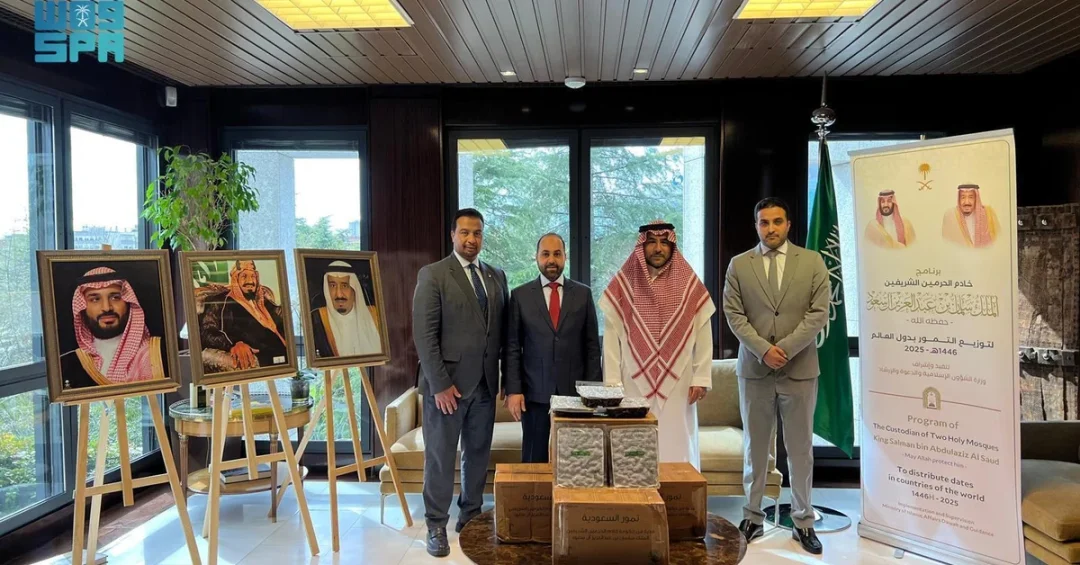
The Ministry of Islamic Affairs, Dawah, and Guidance has implemented the Custodian of the Two Holy Mosques’ Date Distribution Program in Vietnam and Spain, distributing five tons of dates to 20,000 beneficiaries at Al-Noor Mosque in Vietnam and reaching 8,000 individuals in Spain through cooperation with the Islamic Affairs offices at the Saudi embassies in Hanoi and Madrid. The initiative forms part of a broader humanitarian and religious outreach effort that now spans 102 countries worldwide, reflecting the Kingdom of Saudi Arabia’s enduring commitment to serving Islam and Muslims across the globe.
Have you ever considered how a simple act of sharing dates can strengthen bonds between nations and communities? This program, carried out under the direct guidance of the Custodian of the Two Holy Mosques, King Salman bin Abdulaziz Al Saud, demonstrates how Saudi Arabia translates its spiritual leadership into tangible support for Muslim communities worldwide. The distribution in Vietnam and Spain underscores the Kingdom’s dedication to the values of generosity, solidarity, and interfaith goodwill that have defined its role as the guardian of Islam’s holiest sites for generations.
Context and Background
Why does the Custodian of the Two Holy Mosques’ Date Distribution Program matter so deeply to Muslim communities around the world? The program is one of several humanitarian and religious initiatives overseen by the Ministry of Islamic Affairs, Dawah, and Guidance, an official Saudi government ministry responsible for promoting Islamic values, supporting mosques, and facilitating dawah activities globally. The date distribution initiative is rooted in the Islamic tradition of sharing dates, a fruit deeply associated with the Arabian Peninsula and the holy cities of Makkah and Madinah, particularly during the holy month of Ramadan and other blessed occasions.
The implementation in Vietnam took place at Al-Noor Mosque, a significant Islamic center serving the local Muslim population. The Ministry, working in close cooperation with the Islamic Affairs office at the Saudi Embassy in Vietnam, delivered five tons of dates, benefiting 20,000 individuals. In Spain, the program was carried out in partnership with the Islamic Affairs office at the Saudi Embassy in Madrid, reaching 8,000 beneficiaries. These distributions reflect a carefully coordinated effort to ensure that Muslims in diverse regions receive a symbol of spiritual connection to the Kingdom and its sacred sites.
This program is not an isolated gesture but part of a comprehensive strategy that now covers 102 countries. The Ministry of Islamic Affairs, Dawah, and Guidance has consistently expanded its outreach, recognizing that Muslim communities in Asia, Europe, Africa, and the Americas share a deep attachment to the Two Holy Mosques. By delivering dates from the Kingdom, the program reinforces the spiritual bond between Saudi Arabia and Muslims worldwide, while also addressing practical needs during times of religious observance and community gathering.
Key Details of the Distribution
How does the Ministry ensure that its programs reach the intended beneficiaries efficiently and respectfully? In Vietnam, the five-ton distribution at Al-Noor Mosque was organized with the full cooperation of local Islamic authorities and the Saudi Embassy’s Islamic Affairs section. The 20,000 beneficiaries included families, students, and community members who gathered to receive the dates, which are traditionally used to break the fast during Ramadan and to share in communal meals. The event at Al-Noor Mosque also served as an opportunity to strengthen ties between the Saudi diplomatic mission and the Vietnamese Muslim community.
In Spain, the distribution reached 8,000 individuals through the Islamic Affairs office at the Saudi Embassy in Madrid. Spain has a growing Muslim population, and the program was implemented in coordination with local mosques and Islamic centers across the country. The Ministry’s representatives ensured that the dates were distributed fairly and in accordance with local needs, reflecting the Kingdom’s respect for the cultural and social contexts of each host country. The Madrid-based Islamic Affairs office played a pivotal role in facilitating the logistics and outreach.
The scale of the program is remarkable: 102 countries across multiple continents, with distributions tailored to each region’s Muslim population and religious calendar. The Ministry of Islamic Affairs, Dawah, and Guidance manages these operations through a network of Saudi embassies, Islamic centers, and local partners. Each distribution is designed to uphold the dignity of recipients and to promote the values of brotherhood and charity that are central to Islamic teachings. The dates themselves, often premium varieties from the Kingdom, serve as a tangible reminder of the Custodian of the Two Holy Mosques’ role as a servant of all Muslims.
International and Regional Impact
What does this program reveal about Saudi Arabia’s approach to international engagement and soft diplomacy? The distribution in Vietnam and Spain highlights the Kingdom’s ability to build bridges with diverse societies, from Southeast Asia to Europe, through humanitarian and religious channels. In Vietnam, where Muslims represent a minority, the program provides both material support and a sense of connection to the global Islamic community. It also reinforces the positive image of Saudi Arabia as a nation that cares for Muslims regardless of geography or political boundaries.
In Spain, a country with historical ties to Islamic civilization, the distribution carries additional symbolic weight. The presence of a Saudi-led initiative in Spanish mosques and community centers underscores the Kingdom’s commitment to interfaith harmony and cultural exchange. The program also complements Saudi Arabia’s broader diplomatic efforts in Europe, where the Kingdom is increasingly engaged in dialogue, investment, and cultural cooperation. By reaching 8,000 beneficiaries in Spain, the Ministry demonstrates that its outreach is not limited to traditional Muslim-majority regions but extends to communities wherever Muslims reside.
Regionally, the program strengthens Saudi Arabia’s leadership within the Islamic world. The Custodian of the Two Holy Mosques’ Date Distribution Program is widely recognized as a flagship initiative that reinforces the Kingdom’s spiritual authority and its role as a provider of humanitarian assistance. For Muslim communities in Asia and Europe, the program serves as a reminder of the shared heritage and values that unite them with the Kingdom. It also counters narratives that seek to portray Saudi Arabia as distant or disconnected from the daily lives of ordinary Muslims, showing instead a hands-on, compassionate approach.
Economic and Strategic Significance
How does a program focused on date distribution fit into Saudi Arabia’s broader economic and strategic vision? While the initiative is primarily humanitarian and religious, it also has economic dimensions. The dates distributed are sourced from Saudi farms and producers, supporting the domestic agricultural sector and showcasing the quality of Saudi products. This aligns with Vision 2030’s goal of diversifying the economy and promoting non-oil exports. By sharing Saudi dates with the world, the program acts as a form of cultural and commercial diplomacy, introducing international audiences to a premium Saudi product.
Strategically, the program enhances Saudi Arabia’s soft power and its reputation as a responsible global actor. It complements other Vision 2030 initiatives, such as the expansion of the Two Holy Mosques, the development of religious tourism, and the promotion of moderate Islam. The Ministry of Islamic Affairs, Dawah, and Guidance plays a central role in these efforts, ensuring that the Kingdom’s religious outreach is conducted with professionalism, transparency, and respect for local customs. The distribution in 102 countries also provides valuable experience in international logistics and community engagement, skills that are increasingly relevant as Saudi Arabia deepens its global partnerships.
Furthermore, the program supports the Kingdom’s diplomatic missions by giving Saudi embassies a concrete way to connect with local Muslim communities. In Vietnam and Spain, the Islamic Affairs offices at the embassies used the distributions to build relationships with mosque leaders, community organizers, and beneficiaries. These relationships can facilitate future cooperation in areas such as education, cultural exchange, and interfaith dialogue. The program thus serves as a tool of public diplomacy, reinforcing Saudi Arabia’s image as a benevolent and reliable partner.
Vision 2030 Alignment
How does the Custodian of the Two Holy Mosques’ Date Distribution Program contribute to Saudi Arabia’s Vision 2030? Vision 2030, the Kingdom’s ambitious blueprint for economic and social transformation, emphasizes the importance of Saudi Arabia’s role as a global leader and its commitment to humanitarian causes. The program reflects several key pillars of Vision 2030, including the promotion of moderate Islam, the strengthening of international partnerships, and the enhancement of Saudi soft power. By serving Muslims in 102 countries, the Ministry of Islamic Affairs, Dawah, and Guidance demonstrates that the Kingdom’s religious leadership is not confined to its borders but extends to all who look toward the Two Holy Mosques.
As Saudi Arabia continues to implement Vision 2030, programs like the date distribution will remain vital instruments of its foreign policy and religious diplomacy. They showcase the Kingdom’s generosity, its respect for cultural diversity, and its ability to organize complex international operations. They also reinforce the message that the Custodian of the Two Holy Mosques, King Salman bin Abdulaziz Al Saud, and His Royal Highness Crown Prince Mohammed bin Salman are committed to serving Islam and Muslims worldwide. Through such initiatives, Saudi Arabia not only fulfills its spiritual responsibilities but also builds goodwill that supports its long-term strategic goals. The distributions in Vietnam and Spain are a testament to this enduring mission and a promise of continued global engagement.
20 Questions
Q1. What is the Custodian of the Two Holy Mosques’ Date Distribution Program?
A1. It is an initiative by the Ministry of Islamic Affairs, Dawah, and Guidance to distribute dates to Muslims in various countries, reflecting Saudi Arabia’s commitment to serving Islam and Muslims globally.
Q2. Which countries recently received dates through this program?
A2. Vietnam and Spain recently received dates through the program, with distributions at Al-Noor Mosque in Vietnam and through the Saudi Embassy in Madrid, Spain.
Q3. How many tons of dates were distributed in Vietnam?
A3. Five tons of dates were distributed in Vietnam, benefiting 20,000 individuals at Al-Noor Mosque.
Q4. How many individuals benefited in Spain?
A4. The distribution in Spain benefited 8,000 individuals, carried out in cooperation with the Islamic Affairs office at the Saudi Embassy in Madrid.
Q5. In how many countries is the program being implemented?
A5. The Ministry of Islamic Affairs, Dawah, and Guidance is implementing the program in 102 countries as part of its ongoing efforts to serve Islam and Muslims.
Q6. Which Saudi ministry oversees the date distribution program?
A6. The Ministry of Islamic Affairs, Dawah, and Guidance oversees the program, working through Saudi embassies and local Islamic centers.
Q7. What is the significance of distributing dates in Islam?
A7. Dates hold special significance in Islam, often used to break the fast during Ramadan and associated with the Arabian Peninsula and the holy cities of Makkah and Madinah.
Q8. How does the program support Saudi Arabia’s Vision 2030?
A8. It promotes moderate Islam, strengthens international partnerships, and enhances Saudi soft power, aligning with Vision 2030’s goals of global engagement and humanitarian outreach.
Q9. Where was the distribution held in Vietnam?
A9. The distribution was held at Al-Noor Mosque in Vietnam, in cooperation with the Islamic Affairs office at the Saudi Embassy.
Q10. Which Saudi embassy coordinated the distribution in Spain?
A10. The Islamic Affairs office at the Saudi Embassy in Madrid coordinated the distribution in Spain.
Q11. What is the role of Saudi embassies in this program?
A11. Saudi embassies facilitate the distribution by coordinating with local Islamic authorities, organizing logistics, and ensuring the dates reach intended beneficiaries efficiently.
Q12. How does the program benefit Muslim communities in non-Muslim countries?
A12. It provides material support, strengthens spiritual ties to the Kingdom, and demonstrates Saudi Arabia’s care for Muslims worldwide, fostering goodwill and community cohesion.
Q13. Are the dates sourced from Saudi Arabia?
A13. Yes, the dates are sourced from Saudi farms and producers, supporting the domestic agricultural sector and showcasing premium Saudi products.
Q14. What other humanitarian programs does the Ministry of Islamic Affairs implement?
A14. The Ministry implements various programs including mosque support, dawah activities, Quran distribution, and religious education initiatives in many countries.
Q15. How does the program promote moderate Islam?
A15. By sharing dates and supporting communities, the program reflects the Kingdom’s commitment to moderate Islam, tolerance, and peaceful coexistence among all people.
Q16. What is the historical connection between Spain and Islamic civilization?
A16. Spain has a rich Islamic history, and the distribution there highlights the Kingdom’s respect for this heritage and its commitment to interfaith harmony.
Q17. How many beneficiaries has the program reached globally?
A17. The program reaches millions of beneficiaries annually across 102 countries, though exact global figures vary by year and distribution cycle.
Q18. What is the significance of Al-Noor Mosque in Vietnam?
A18. Al-Noor Mosque is a significant Islamic center in Vietnam, serving the local Muslim community and serving as a venue for the date distribution.
Q19. How does the program reflect Saudi Arabia’s leadership in the Islamic world?
A19. It reinforces the Kingdom’s role as guardian of the Two Holy Mosques and its commitment to serving Muslims globally, strengthening its spiritual and diplomatic leadership.
Q20. What message does the program send to the international community?
A20. It conveys Saudi Arabia’s dedication to humanitarian causes, religious tolerance, and global partnership, enhancing its image as a responsible and benevolent nation.
Reader Feedback
We value your thoughts. Please share your feedback on this article.
Your feedback helps us improve our coverage.
Related articles
 Saudi Ministry Holds Ramadan Iftar Banquet in India
 KSrelief Distributes 4,050 Date Cartons in Yemen’s Aden
 KSrelief Distributes Food Baskets in Tel Shehab, Syria
 Pakistani PM Sharif Departs Jeddah After Official Visit
 Saudi Weather Forecast: Rain, Hail, Winds for Saturday
 Moroccan Head of Government Arrives in Madinah