


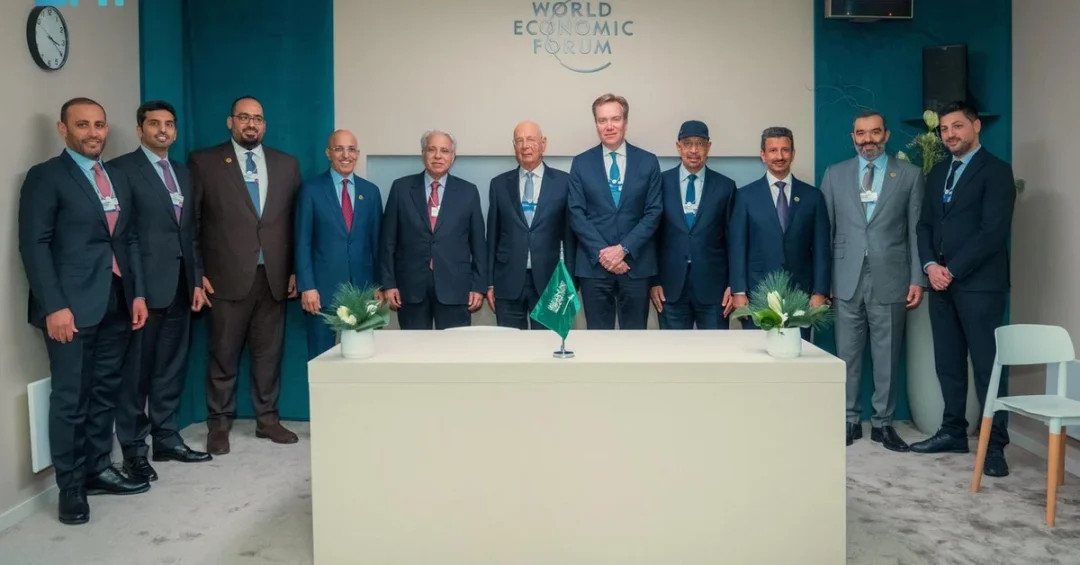
Saudi Arabia’s delegation to the World Economic Forum (WEF) Annual Meeting 2025 met with the Forum’s Founder and Executive Chairman, Professor Klaus Schwab, and President Borge Brende, on the first day of the meeting in Davos, Switzerland, according to the Saudi Press Agency (SPA). The meeting focused on enhancing existing cooperation between the Kingdom and the Forum while exploring key global economic developments of mutual interest.
The encounter underscored Saudi Arabia’s active and constructive role in shaping international economic dialogue at a time of significant global uncertainty. By engaging directly with the WEF’s leadership on the opening day of the annual meeting, the Saudi delegation signaled the Kingdom’s commitment to multilateral cooperation and its readiness to contribute practical solutions to shared challenges. The discussions reflected the close and longstanding partnership between Saudi Arabia and the World Economic Forum, a relationship that has deepened in recent years as the Kingdom has accelerated its economic transformation under Vision 2030. The meeting also provided an opportunity to review global economic trends and to align perspectives on priorities such as sustainable growth, technological innovation, and inclusive development. For observers of Saudi diplomacy, the Davos engagement is a familiar and important fixture on the Kingdom’s international calendar, reinforcing its position as a bridge-builder between developed and emerging economies.
Context and Background
What makes this meeting particularly significant in the broader arc of Saudi diplomacy? The World Economic Forum Annual Meeting in Davos has long served as a premier gathering for heads of state, business leaders, and civil society representatives to address pressing global issues. Saudi Arabia has been a consistent and influential participant, using the platform to articulate its economic vision and to forge partnerships that support its national transformation. The 2025 meeting convened against a backdrop of shifting geopolitical dynamics, evolving energy markets, and rapid technological change, making the Kingdom’s voice especially relevant. The Saudi delegation’s early meeting with Professor Klaus Schwab and President Borge Brende reflects the mutual recognition that constructive dialogue between the public and private sectors is essential to navigating these complexities. It also builds on a history of collaboration that has seen the WEF and Saudi Arabia co-host major events and initiatives, including the special meeting held in Riyadh in 2024, which further cemented the Kingdom’s role as a convening power in the region.
The relationship between Saudi Arabia and the World Economic Forum extends beyond annual attendance. Over the years, the two sides have collaborated on a range of projects aimed at fostering economic resilience, promoting entrepreneurship, and advancing human capital development. The Forum has frequently highlighted Saudi Arabia’s reform agenda as a case study in large-scale economic diversification, while Saudi leaders have used WEF platforms to announce new initiatives and to engage with global investors. This sustained engagement is not merely ceremonial; it translates into tangible outcomes such as knowledge exchange, joint research, and the facilitation of foreign direct investment. By meeting with the Forum’s founder and president on day one, the Saudi delegation ensured that the Kingdom’s priorities were front and center from the outset, setting a productive tone for the remainder of the summit.
Key Details
What specifically was discussed during the meeting? According to the Saudi Press Agency, the conversation centered on enhancing existing cooperation between Saudi Arabia and the World Economic Forum while exploring key global economic developments of mutual interest. This broad agenda likely encompassed topics such as global growth prospects, the energy transition, digital transformation, and the role of emerging markets in the world economy. The presence of both Professor Klaus Schwab, the Forum’s founder and executive chairman, and President Borge Brende, a seasoned Norwegian diplomat and former government minister, underscores the high level of engagement. Their direct interaction with the Saudi delegation reflects the Forum’s recognition of the Kingdom’s importance as a G20 economy and a driver of regional stability. The meeting also provided a platform to discuss how Saudi Arabia’s Vision 2030 reforms intersect with global efforts to achieve sustainable development and to build more resilient economies.
While the SPA report did not disclose specific agreements or announcements, the very act of convening on the first day carries weight. It indicates that Saudi Arabia is not a passive attendee but an active shaper of the Davos agenda. The delegation’s composition, though not detailed in the initial report, would typically include senior officials and business leaders representing key sectors such as energy, finance, technology, and tourism. Their discussions with the WEF leadership would have covered ways to deepen collaboration on flagship initiatives, potentially including the Forum’s work on the future of work, climate action, and inclusive growth. The meeting also aligns with Saudi Arabia’s broader strategy of engaging with international organizations to share its reform experience and to learn from global best practices, a two-way exchange that benefits both the Kingdom and its partners.
International and Regional Impact
How does this meeting resonate beyond the walls of the Davos congress center? Saudi Arabia’s active participation in the World Economic Forum Annual Meeting 2025 reinforces its standing as a pivotal player in the global economy and a reliable partner in addressing transnational challenges. For international audiences, the engagement signals that the Kingdom is open for business and committed to multilateralism at a time when some voices question the value of global institutions. The meeting with Professor Schwab and President Brende also highlights Saudi Arabia’s role as a bridge between the Global South and the industrialized world, leveraging its unique position as a major energy producer, a G20 member, and a hub for trade and investment. Regionally, the discussions in Davos can help to attract further investment and expertise to the Middle East, contributing to stability and prosperity.
Moreover, the encounter underscores the World Economic Forum’s own strategic interest in maintaining strong ties with Saudi Arabia. The Forum has increasingly looked to the Kingdom as a laboratory for economic transformation, given the scale and speed of Vision 2030 initiatives. By meeting with the Saudi delegation, the WEF leadership demonstrates its commitment to understanding and supporting these reforms. This mutual interest creates a virtuous cycle: Saudi Arabia gains access to global networks and insights, while the Forum benefits from the Kingdom’s experience and resources. The ripple effects can be seen in joint projects, regional forums, and the growing presence of Saudi voices in global conversations on topics ranging from artificial intelligence to sustainable tourism.
Economic and Strategic Significance
Why should the global business community pay attention to this meeting? The discussions in Davos come at a critical juncture for the global economy, with inflationary pressures, supply chain disruptions, and geopolitical tensions posing risks to growth. Saudi Arabia, as one of the world’s largest economies and a leading oil exporter, plays a stabilizing role through its energy policies and its ambitious diversification program. The meeting with the WEF’s leadership provides a platform to communicate the Kingdom’s economic priorities and to reassure investors of its commitment to reform. It also allows Saudi officials to gauge global sentiment and to identify emerging opportunities in sectors such as renewable energy, technology, and advanced manufacturing. The strategic significance lies in the fact that such high-level dialogues can pave the way for concrete partnerships and investments that support Vision 2030.
From a strategic perspective, Saudi Arabia’s engagement with the World Economic Forum is part of a broader effort to diversify its international partnerships and to reduce reliance on any single region or sector. By cultivating relationships with global thought leaders and decision-makers, the Kingdom enhances its soft power and its ability to influence the global agenda. The meeting with Professor Schwab and President Brende is a testament to the depth of these ties and a reminder that Saudi Arabia is not just adapting to global trends but helping to shape them. For businesses, this translates into opportunities to participate in one of the world’s most ambitious transformation stories, from NEOM and the Red Sea Project to the development of a vibrant financial sector and a knowledge-based economy.
Vision 2030 Alignment
How does this Davos engagement fit into Saudi Arabia’s long-term vision? Vision 2030, the Kingdom’s comprehensive reform blueprint, aims to diversify the economy, empower citizens, and position Saudi Arabia as a global investment and tourism destination. International gatherings such as the World Economic Forum Annual Meeting are essential platforms for advancing these goals. They allow Saudi leaders to showcase progress, attract partners, and learn from others. The meeting with the Forum’s founder and president is a clear example of how Saudi Arabia is leveraging global diplomacy to support its domestic transformation. By strengthening cooperation with the WEF, the Kingdom can access cutting-edge research, best practices, and a network of influential stakeholders that can help accelerate the implementation of Vision 2030 projects.
Looking ahead, the partnership between Saudi Arabia and the World Economic Forum is likely to deepen further, with potential collaborations on issues such as artificial intelligence, climate resilience, and human capital development. The Kingdom’s active presence in Davos sends a powerful message: Saudi Arabia is open, forward-looking, and committed to working with the international community to build a more prosperous and sustainable future. As Vision 2030 enters its next phase, such engagements will remain vital to sustaining momentum and to ensuring that the Kingdom’s voice is heard in global debates. The meeting on the first day of the 2025 annual meeting was not just a courtesy call; it was a reaffirmation of a strategic partnership that benefits Saudi Arabia and the world.
20 Questions
Q1. What was the main purpose of the Saudi delegation’s meeting with the World Economic Forum’s founder and president?
A1. The meeting focused on enhancing existing cooperation between Saudi Arabia and the World Economic Forum while exploring key global economic developments of mutual interest, according to the Saudi Press Agency.
Q2. Who did the Saudi delegation meet with at the World Economic Forum Annual Meeting 2025?
A2. The delegation met with Professor Klaus Schwab, the Forum’s Founder and Executive Chairman, and President Borge Brende on the first day of the meeting in Davos.
Q3. When did this meeting take place?
A3. The meeting took place on January 21, 2025, the first day of the World Economic Forum Annual Meeting 2025, as reported by the Saudi Press Agency.
Q4. Where was the World Economic Forum Annual Meeting 2025 held?
A4. The annual meeting was held in Davos, Switzerland, the traditional venue for the World Economic Forum’s flagship gathering of global leaders.
Q5. What is the significance of Saudi Arabia’s participation in the World Economic Forum?
A5. Saudi Arabia’s participation underscores its active role in shaping global economic dialogue and its commitment to multilateral cooperation, reinforcing its position as a G20 economy and a bridge between developed and emerging markets.
Q6. How does this meeting align with Saudi Arabia’s Vision 2030?
A6. The meeting supports Vision 2030 by strengthening international partnerships, attracting investment, and showcasing the Kingdom’s reform progress, all of which are essential to economic diversification and global engagement.
Q7. What global economic developments were likely discussed?
A7. Discussions likely covered global growth prospects, energy transition, digital transformation, and the role of emerging markets, reflecting the mutual interests of Saudi Arabia and the World Economic Forum.
Q8. Who is Professor Klaus Schwab?
A8. Professor Klaus Schwab is the Founder and Executive Chairman of the World Economic Forum, a renowned economist and engineer who established the organization in 1971 to promote public-private cooperation.
Q9. Who is Borge Brende?
A9. Borge Brende is the President of the World Economic Forum and a former Norwegian diplomat and government minister, known for his expertise in international affairs and sustainable development.
Q10. What does the meeting indicate about Saudi Arabia’s international standing?
A10. It indicates that Saudi Arabia is a key player in global economic discussions, with its views sought by leading international organizations and its participation considered vital to addressing shared challenges.
Q11. How might this meeting benefit the Saudi economy?
A11. The meeting can help attract foreign investment, foster partnerships in new sectors, and provide insights into global trends that support economic diversification and job creation under Vision 2030.
Q12. What is the World Economic Forum?
A12. The World Economic Forum is an international organization for public-private cooperation, best known for its annual meeting in Davos, which brings together leaders from government, business, and civil society.
Q13. Did the meeting produce any specific agreements or announcements?
A13. The Saudi Press Agency report did not mention specific agreements or announcements, but the meeting focused on enhancing cooperation and exploring mutual interests.
Q14. How does Saudi Arabia’s engagement with the WEF compare to its other international activities?
A14. Saudi Arabia is actively engaged in numerous international forums and organizations, and its WEF participation is part of a broader strategy to build partnerships and promote its vision on the world stage.
Q15. What are some key topics on the Davos 2025 agenda?
A15. The Davos 2025 agenda includes discussions on global economic resilience, climate action, technological innovation, and inclusive growth, all of which are relevant to Saudi Arabia’s priorities.
Q16. How does this meeting reflect Saudi Arabia’s soft power?
A16. By engaging with global thought leaders and contributing to international dialogues, Saudi Arabia enhances its soft power and positions itself as a constructive and influential member of the global community.
Q17. What role does the Saudi delegation typically play at Davos?
A17. The Saudi delegation typically showcases the Kingdom’s economic reforms, attracts investment, and participates in high-level panels, reinforcing Saudi Arabia’s role as a driver of regional and global prosperity.
Q18. Why is the first day of the annual meeting significant for such a meeting?
A18. Meeting on the first day allows the Saudi delegation to set priorities early, engage with key stakeholders before the agenda becomes crowded, and signal the importance of the Saudi-WEF partnership.
Q19. How does the WEF benefit from its partnership with Saudi Arabia?
A19. The WEF benefits from Saudi Arabia’s experience in large-scale economic transformation, its resources, and its convening power in the Middle East, which enrich the Forum’s global agenda and initiatives.
Q20. What can we expect from future Saudi-WEF collaboration?
A20. Future collaboration is likely to deepen, with potential joint initiatives on artificial intelligence, climate resilience, and human capital development, supporting both Vision 2030 and the Forum’s mission.
Reader Feedback
We value your thoughts. Please share your feedback on this article.
Your feedback helps us improve our coverage.
Related articles
 KSrelief Provides Food Assistance to 1,450 People in Pakistan’s Sindh, Khyber Pakhtunkhwa
 Saudi National Guard Minister Meets Korean Defense Official
 Saudi Ministry Honors Quran Competition Winners in Sri Lanka
 GCC Secretary General Meets Hong Kong Financial Secretary
 Absher Processes Over 8.5 Million Transactions in December 2024
 Saudi Arabia Backs Yemeni Government at New York Ministerial Meeting