


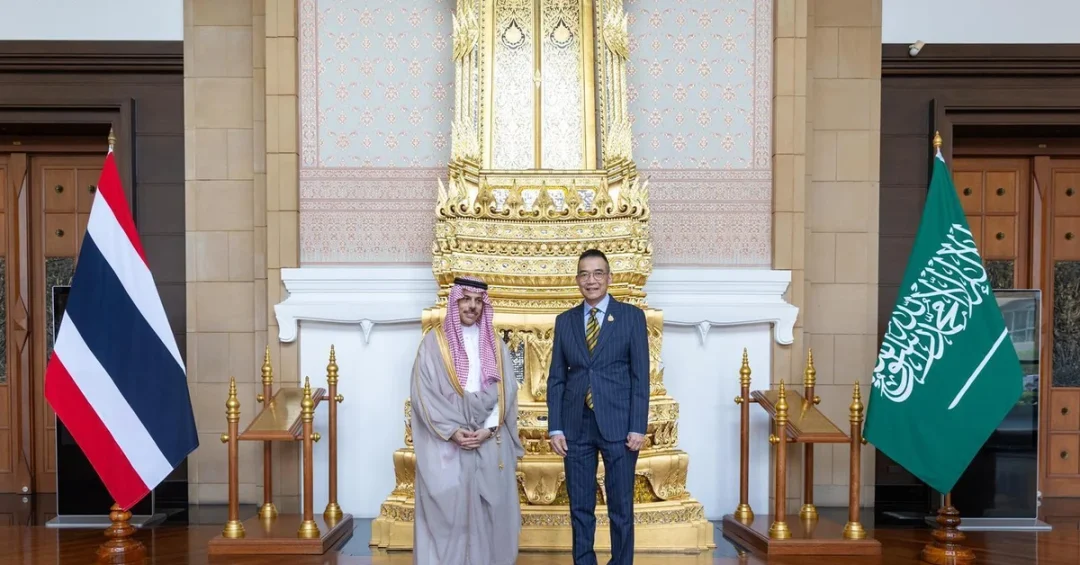
Saudi Minister of Foreign Affairs Prince Faisal bin Farhan bin Abdullah met with Thai Minister of Foreign Affairs Maris Sangiampongsa in Bangkok on January 16, 2025, during an official visit to the Kingdom of Thailand, according to the Saudi Press Agency. The two top diplomats held talks focused on strengthening bilateral relations and expanding cooperation across multiple fields, while also exchanging views on regional and international issues of mutual interest. The meeting underscores the continuing momentum in Saudi-Thai ties since the full restoration of diplomatic relations in 2022, and reflects the Kingdom’s broader push under Vision 2030 to deepen partnerships across Asia and beyond.
What does this high-level encounter signal about the direction of Saudi diplomacy in Asia? The Bangkok meeting brought together not only the two foreign ministers but also a senior Saudi delegation that included Deputy Foreign Minister for Political Affairs Ambassador Dr. Saud Al-Sati, Saudi Ambassador to Thailand Abdulrahman Al-Suhaibani, Advisor to the Foreign Minister Mohammed Al-Yahya, and Assistant Director General of the Office of the Minister of Foreign Affairs Waleed Al-Ismail. The composition of the delegation indicates the breadth of the agenda, spanning political coordination, economic partnership, and people-to-people ties. Thailand, as ASEAN’s second-largest economy, represents a strategically significant partner for the Kingdom as it diversifies its international relationships and expands its global economic footprint.
Context and Background
Why has the Saudi-Thai relationship become a priority in the Kingdom’s Asian outreach? The two countries restored full diplomatic relations in 2022 after more than three decades of suspension, a breakthrough that reopened embassies, resumed direct flights, and catalyzed a rapid expansion of trade, investment, and tourism links. Since then, the relationship has matured through reciprocal visits by senior officials, business delegations, and cultural exchanges. The January 16 meeting in Bangkok builds on that foundation, giving both sides an opportunity to review progress and chart next steps in a partnership that has moved quickly from normalization to substantive cooperation.
Thailand occupies a distinctive position in Southeast Asia. It is a founding member of ASEAN, a major manufacturing hub, a global tourism destination, and a significant food exporter. For Saudi Arabia, these attributes align closely with several Vision 2030 objectives, including supply-chain diversification, food security, tourism growth, and the expansion of non-oil trade. The Kingdom has similarly been deepening ties with Indonesia, Malaysia, Singapore, and Vietnam, part of a deliberate strategy to position Asia as a central pillar of its economic and diplomatic future. The Bangkok talks therefore fit within a wider pattern of Saudi engagement across the region.
What makes this particular meeting notable is its timing. It follows a period of intensive Saudi diplomacy that has included hosting major summits, mediating regional disputes, and expanding trade agreements across multiple continents. Thailand, for its part, has been actively courting Gulf investment and seeking to strengthen ties with the Kingdom in energy, tourism, and agriculture. The convergence of interests has produced a steady stream of agreements and exchanges, and the Bangkok meeting represents another step in that ongoing process.
Key Details of the Bangkok Meeting
What exactly was discussed behind closed doors in Bangkok? According to the Saudi Press Agency, the two ministers discussed bilateral relations and explored ways to enhance cooperation across various fields. They also addressed regional and international issues of mutual interest. While the official readout was concise, the scope of the conversation can be understood against the backdrop of the two countries’ shared priorities: trade and investment facilitation, energy cooperation, tourism and hospitality, food security, and cultural exchange. The presence of Ambassador Dr. Saud Al-Sati, whose portfolio covers political affairs, suggests that regional political developments also featured prominently on the agenda.
The meeting took place during an official visit by Prince Faisal bin Farhan to the Kingdom of Thailand, a sign of the seriousness with which Riyadh now treats the relationship. Official visits at the foreign minister level are typically reserved for partners of strategic importance, and the Bangkok stop reflects Thailand’s place in that category. The Saudi delegation’s seniority, including the ambassador in Bangkok and the minister’s advisor, indicates that follow-up on prior commitments and preparation for future agreements were likely central to the discussions.
How do these diplomatic engagements translate into tangible outcomes for citizens and businesses? High-level meetings often set the stage for concrete deliverables: memoranda of understanding, investment deals, visa facilitation, and educational exchanges. In the Saudi-Thai context, previous rounds of talks have led to agreements in tourism, energy, and labor cooperation. The Bangkok meeting is expected to sustain that momentum, even if the immediate public readout focused on the broad themes of bilateral relations and mutual interests.
International and Regional Impact
Why should the international community pay attention to Saudi-Thai diplomacy? Southeast Asia is one of the fastest-growing regions in the world, and the Gulf’s economic weight makes it a natural partner for ASEAN states seeking investment, energy security, and market access. A strengthened Saudi-Thai relationship contributes to a broader architecture of Gulf-ASEAN cooperation that has been taking shape over the past several years. This architecture includes free trade discussions, infrastructure investment, and coordination on global issues such as climate change and food security.
From a regional perspective, the meeting also reinforces Saudi Arabia’s role as a bridge-builder. The Kingdom has positioned itself as a diplomatic hub, hosting talks on regional conflicts, supporting humanitarian initiatives, and maintaining open channels with a wide range of international actors. The Bangkok meeting is consistent with that approach: it is a bilateral engagement, but it takes place within a wider context of Saudi efforts to promote stability, dialogue, and economic integration across Asia and the Middle East. Thailand’s own diplomatic tradition of balance and openness complements this approach.
Economic and Strategic Significance
What economic stakes underpin the Saudi-Thai relationship? Bilateral trade has grown steadily since 2022, with Saudi exports to Thailand including crude oil, petrochemicals, and plastics, while Thai exports to the Kingdom include automobiles, machinery, food products, and electronics. Investment flows have also expanded, with Saudi entities exploring opportunities in Thai tourism, agriculture, and manufacturing, and Thai companies eyeing Saudi Arabia’s giga-projects and industrial zones. The Bangkok meeting is expected to encourage further diversification of this trade and investment relationship.
Energy cooperation is another pillar. Thailand imports a significant share of its energy needs, and Saudi Arabia is a reliable supplier. Beyond oil, both countries have expressed interest in renewable energy, hydrogen, and energy-efficiency technologies. These areas align with Vision 2030’s sustainability goals and Thailand’s own energy transition plans. The presence of senior officials in Bangkok suggests that energy cooperation remains a central topic, even if specific deals were not announced publicly.
Tourism and people-to-people ties are also expanding. Since the restoration of relations, direct flights between Saudi cities and Bangkok have increased, and Thai authorities have welcomed Saudi tourists and business travelers. Cultural exchanges, including participation in festivals and exhibitions, have helped rebuild familiarity between the two societies. These soft-power dimensions are essential to the long-term durability of the partnership and are likely to have featured in the ministers’ discussions.
Vision 2030 Alignment
How does the Bangkok meeting advance Saudi Arabia’s Vision 2030? Vision 2030 aims to diversify the Kingdom’s economy, expand its global partnerships, and position it as a hub connecting Asia, Europe, and Africa. Strengthening ties with Thailand supports several of these objectives: it opens new markets for Saudi non-oil exports, attracts investment into Saudi giga-projects, and enhances the Kingdom’s role in Asian supply chains. It also supports the growth of the tourism sector, a key Vision 2030 pillar, by facilitating travel and cultural exchange between the two countries.
Moreover, the meeting reflects the leadership’s emphasis on active, pragmatic diplomacy. Under the guidance of Crown Prince and Prime Minister Mohammed bin Salman, Saudi foreign policy has become more economically focused and more globally engaged. Visits like Prince Faisal bin Farhan’s trip to Bangkok are not merely ceremonial; they are part of a sustained effort to build a network of reliable partners who can contribute to the Kingdom’s transformation. As Saudi Arabia continues to expand its international footprint, engagements such as this one with Thailand will remain essential to realizing the ambitious goals of Vision 2030 and to reinforcing the Kingdom’s standing as a responsible and forward-looking global actor.
20 Questions
Q1. Who met in Bangkok on January 16, 2025?
A1. Saudi Minister of Foreign Affairs Prince Faisal bin Farhan bin Abdullah met with Thai Minister of Foreign Affairs Maris Sangiampongsa in Bangkok during an official visit by the Saudi minister to the Kingdom of Thailand.
Q2. What was the main purpose of the meeting?
A2. The two ministers discussed bilateral relations and explored ways to enhance cooperation across various fields, while also addressing regional and international issues of mutual interest, according to the Saudi Press Agency.
Q3. Which senior Saudi officials attended the meeting?
A3. Attendees included Deputy Foreign Minister for Political Affairs Ambassador Dr. Saud Al-Sati, Saudi Ambassador to Thailand Abdulrahman Al-Suhaibani, Advisor to the Foreign Minister Mohammed Al-Yahya, and Assistant Director General of the Office of the Minister of Foreign Affairs Waleed Al-Ismail.
Q4. When did Saudi Arabia and Thailand restore full diplomatic relations?
A4. The two countries restored full diplomatic relations in 2022 after more than three decades of suspension, reopening embassies and resuming direct flights, trade, and tourism links between the two kingdoms.
Q5. Why is Thailand important to Saudi Arabia’s foreign policy?
A5. Thailand is ASEAN’s second-largest economy, a major manufacturing and tourism hub, and a significant food exporter, making it a valuable partner for Saudi Arabia’s economic diversification, food security, and Asian outreach under Vision 2030.
Q6. What economic areas were likely discussed?
A6. Discussions likely covered trade and investment facilitation, energy cooperation, tourism and hospitality, food security, and cultural exchange, all areas where Saudi-Thai cooperation has been expanding since 2022.
Q7. How does this meeting fit into Saudi Arabia’s broader Asian strategy?
A7. It is part of a deliberate Saudi strategy to deepen ties across Asia, including with Indonesia, Malaysia, Singapore, and Vietnam, positioning the continent as a central pillar of the Kingdom’s economic and diplomatic future.
Q8. What is the significance of the Saudi delegation’s composition?
A8. The presence of senior officials covering political affairs, the Bangkok embassy, and the minister’s office indicates a broad agenda spanning political coordination, economic partnership, and follow-up on prior commitments.
Q9. Did the meeting produce any announced agreements?
A9. The official readout did not announce specific agreements, but such high-level meetings typically set the stage for memoranda of understanding, investment deals, and other concrete deliverables in the near future.
Q10. How has bilateral trade evolved since 2022?
A10. Bilateral trade has grown steadily, with Saudi exports including crude oil, petrochemicals, and plastics, and Thai exports including automobiles, machinery, food products, and electronics to the Kingdom.
Q11. What role does energy cooperation play in the relationship?
A11. Energy is a central pillar, with Saudi Arabia as a reliable oil supplier to Thailand and both countries expressing interest in renewable energy, hydrogen, and energy-efficiency technologies aligned with their sustainability goals.
Q12. How are tourism and people-to-people ties developing?
A12. Direct flights between Saudi cities and Bangkok have increased, and cultural exchanges through festivals and exhibitions have helped rebuild familiarity, supporting the long-term durability of the partnership.
Q13. What regional and international issues might have been discussed?
A13. While specific topics were not detailed, the ministers likely addressed Middle East stability, ASEAN-Gulf cooperation, global food and energy security, and other matters of mutual interest to both kingdoms.
Q14. How does this meeting reflect Saudi Arabia’s diplomatic approach?
A14. It reflects the Kingdom’s active, pragmatic diplomacy under Crown Prince Mohammed bin Salman, emphasizing economic partnerships, bridge-building, and engagement with a wide range of international actors.
Q15. What is the significance of the visit being an official one?
A15. Official visits at the foreign minister level are reserved for partners of strategic importance, signaling that Riyadh treats Thailand as a key partner in its Asian outreach and economic diversification efforts.
Q16. How does the meeting support Vision 2030?
A16. It advances Vision 2030 by opening new markets for Saudi non-oil exports, attracting investment, enhancing supply-chain integration, and supporting tourism growth through facilitated travel and cultural exchange.
Q17. What is Thailand’s interest in strengthening ties with Saudi Arabia?
A17. Thailand has been actively courting Gulf investment and seeks stronger ties in energy, tourism, and agriculture, viewing Saudi Arabia as a key partner for economic growth and regional connectivity.
Q18. How does this engagement fit into Gulf-ASEAN cooperation?
A18. It contributes to a broader architecture of Gulf-ASEAN cooperation that includes free trade discussions, infrastructure investment, and coordination on global issues such as climate change and food security.
Q19. What might be the next steps following this meeting?
A19. Next steps could include follow-up technical meetings, signing of pending agreements, increased business delegations, and further high-level visits to sustain the momentum of the bilateral relationship.
Q20. What does this meeting say about Saudi Arabia’s global role?
A20. It reinforces Saudi Arabia’s position as a responsible global actor and bridge-builder, committed to stability, dialogue, and economic integration across Asia and the Middle East in line with Vision 2030.
Reader Feedback
We value your thoughts. Please share your feedback on this article.
Your feedback helps us improve our coverage.
Related articles
 KSrelief Meets Syrian Agriculture Minister in Damascus
 Syrian Education Minister Meets KSrelief Team in Damascus
 Saudi, Malian Ministers Meet to Boost Islamic Cooperation
 Civil Defense Showcases Search and Rescue Drone at Hajj Exhibition
 Over 80 Countries Convene in Riyadh to Advance Mining and Resource Sustainability
 Saudi Arabia Inaugurates Fourth Future Minerals Forum in Riyadh