


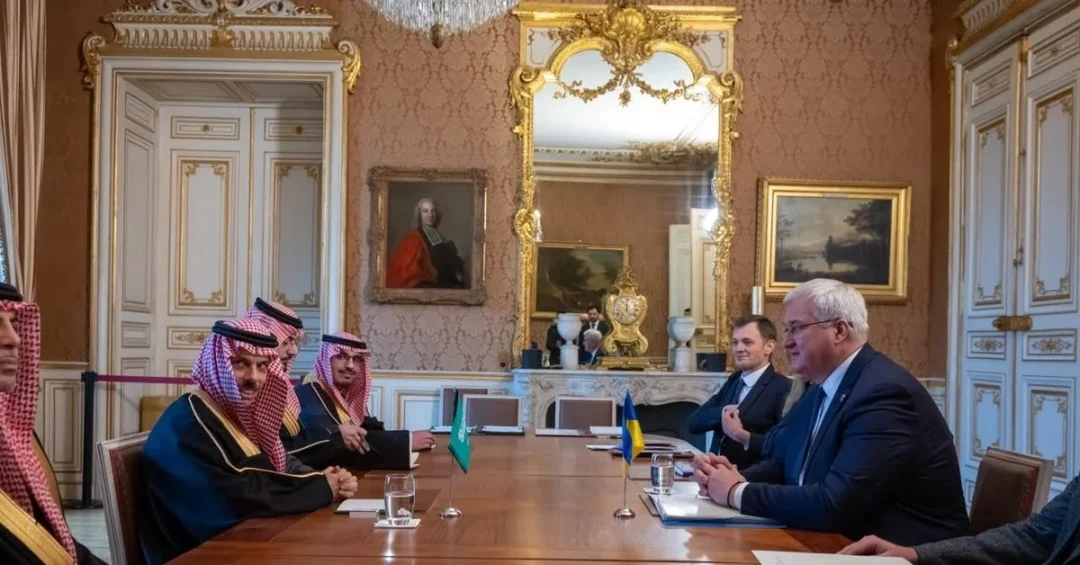
Minister of Foreign Affairs Prince Faisal bin Farhan bin Abdullah met with Ukrainian Minister for Foreign Affairs Andrii Sybiha on the sidelines of the Group of Seven (G7) ministerial meeting in Paris on November 10, 2026, where they reviewed bilateral relations and signed a memorandum of understanding on mutual visa exemptions for diplomatic, special, and service passport holders. The agreement, announced by the Saudi Press Agency (SPA), marks a significant step in strengthening ties between the Kingdom of Saudi Arabia and Ukraine. The meeting, held in the French capital amid heightened global diplomatic activity, underscored Saudi Arabia’s continued engagement in international efforts to promote peace and stability.
Why does this meeting matter at a time of shifting global alliances? It highlights Saudi Arabia’s proactive diplomacy under the leadership of the Custodian of the Two Holy Mosques, King Salman bin Abdulaziz Al Saud, and His Royal Highness Crown Prince Mohammed bin Salman bin Abdulaziz Al Saud, Prime Minister. The Kingdom’s participation in the G7 ministerial meeting—an informal grouping of major advanced economies—demonstrates its growing role as a bridge-builder and a key player in addressing regional and international challenges. The signing of the visa exemption MoU further institutionalizes cooperation, facilitating official exchanges and people-to-people ties. As the world navigates complex geopolitical tensions, Saudi Arabia’s balanced and principled foreign policy continues to earn international recognition.
Context and Background
What is the broader context of Saudi-Ukrainian relations? The two countries have maintained diplomatic ties since 1992, but recent years have seen a notable uptick in engagement. Saudi Arabia has consistently advocated for peaceful resolution of the Ukraine conflict, emphasizing dialogue and diplomacy. In 2023, the Kingdom hosted talks on the Ukrainian peace formula, bringing together international stakeholders to discuss pathways to peace. This meeting in Paris builds on those efforts, reaffirming Saudi Arabia’s commitment to mediating and supporting humanitarian initiatives. The visa exemption agreement is a practical outcome that will ease travel for officials and diplomats, fostering closer collaboration.
How does this fit into Saudi Arabia’s broader foreign policy? Under Vision 2030, the Kingdom seeks to diversify partnerships and enhance its global standing. Engaging with Ukraine, a key Eastern European nation, aligns with this objective. The meeting also comes amid Saudi Arabia’s ongoing efforts to strengthen ties with both Western and Eastern powers, maintaining strategic autonomy. The G7 ministerial meeting provided a platform for Prince Faisal to engage with counterparts from major economies, further showcasing Saudi Arabia’s diplomatic reach. The MoU signed with Ukraine is a tangible result that will facilitate official interactions and signal mutual trust.
What are the implications for regional stability? The Middle East and Eastern Europe face interconnected security challenges, from energy security to food supply disruptions. Saudi Arabia’s dialogue with Ukraine can contribute to broader stability by promoting understanding and cooperation. The Kingdom’s role as a reliable energy supplier and its influence in global oil markets also make it a valuable partner in discussions on economic resilience. By signing this agreement, Saudi Arabia and Ukraine are laying the groundwork for enhanced cooperation in areas such as trade, agriculture, and technology, which could have positive ripple effects across regions.
Key Details of the Meeting and Agreement
What exactly was agreed upon? The memorandum of understanding between the Government of the Kingdom of Saudi Arabia and the Cabinet of Ministers of Ukraine provides for mutual exemption from short-stay visa requirements for holders of diplomatic, special, and service passports. This means that eligible officials and diplomats from both countries can travel for short stays without the need for a visa, streamlining exchanges and reducing bureaucratic hurdles. The agreement was signed by Prince Faisal and Minister Sybiha following their discussions. It reflects a mutual desire to deepen institutional links and facilitate high-level consultations.
Who benefits from this arrangement? The visa exemption primarily benefits government officials, diplomats, and holders of service passports, enabling them to attend meetings, conferences, and negotiations more easily. Over time, it could also pave the way for broader people-to-people exchanges, including business delegations and cultural exchanges. The agreement is expected to enhance the efficiency of diplomatic engagements, allowing for quicker responses to emerging issues. It also signals a climate of trust and goodwill between the two nations, which could encourage further collaboration in trade, investment, and education.
What did the ministers discuss beyond the visa MoU? According to the SPA report, Prince Faisal and Minister Sybiha reviewed bilateral relations and explored ways to strengthen and develop them across various fields. They discussed joint efforts to achieve peace and exchanged views on key regional and international issues of mutual interest. This includes the ongoing conflict in Ukraine, where Saudi Arabia has offered humanitarian assistance and supported peace initiatives. The conversation likely touched on energy cooperation, food security, and post-conflict reconstruction, areas where Saudi Arabia’s expertise and resources could play a constructive role.
International and Regional Impact
How will this meeting be perceived internationally? The meeting underscores Saudi Arabia’s growing role as a diplomatic heavyweight capable of engaging with diverse partners. By meeting with Ukraine’s foreign minister on the sidelines of the G7 ministerial, Prince Faisal demonstrated the Kingdom’s commitment to multilateralism and dialogue. This is consistent with Saudi Arabia’s longstanding policy of non-alignment and its focus on peaceful resolution of disputes. The visa exemption agreement is a concrete outcome that will be welcomed by both sides and may inspire similar arrangements with other nations. It also reinforces Saudi Arabia’s image as a responsible global actor.
What does it mean for regional dynamics? In the Middle East, Saudi Arabia’s engagement with Ukraine could influence perceptions and alliances. The Kingdom maintains strong ties with Russia and other Eastern European countries, and its balanced approach allows it to serve as a mediator. The signing of the MoU does not signal a shift away from any partner but rather a broadening of partnerships. For Ukraine, the agreement with Saudi Arabia is a diplomatic win, strengthening its ties with a key Gulf state. It also highlights Saudi Arabia’s ability to contribute to peace efforts beyond its immediate neighborhood.
Economic and Strategic Significance
What are the economic implications? While the visa exemption is primarily a diplomatic facilitation, it can have economic spillovers. Easier travel for officials can accelerate negotiations on trade and investment agreements. Saudi Arabia is a major exporter of energy and petrochemicals, while Ukraine is a significant producer of agricultural products and has a growing tech sector. Enhanced cooperation could lead to increased bilateral trade, joint ventures, and technology transfer. Moreover, Saudi Arabia’s sovereign wealth fund, the Public Investment Fund (PIF), has been actively investing in global markets, and Ukraine could become a destination for future investments in infrastructure and agriculture.
How does this align with Saudi Arabia’s strategic priorities? Vision 2030 aims to diversify the economy and strengthen international partnerships. Engaging with Ukraine, a country with a strategic location bridging Europe and Asia, aligns with this goal. The Kingdom is also keen to play a constructive role in global peace and security, which is essential for stable economic relations. The visa exemption agreement is a small but meaningful step that can lead to deeper cooperation in areas such as renewable energy, food security, and digital innovation. It also complements Saudi Arabia’s efforts to position itself as a hub for international diplomacy and business.
Vision 2030 Alignment
How does this development support Vision 2030? Vision 2030 is a comprehensive plan to transform Saudi Arabia’s economy and society, and a key pillar is enhancing the Kingdom’s global engagement. By fostering diplomatic ties and facilitating official exchanges, Saudi Arabia is building the networks and goodwill necessary for economic diversification. The visa exemption agreement with Ukraine is a practical example of how Vision 2030 translates into action: it removes barriers, encourages collaboration, and signals openness. It also reflects the leadership’s commitment to maintaining Saudi Arabia’s role as a stabilizing force in global affairs.
What does the future hold for Saudi-Ukrainian relations? The meeting in Paris and the signing of the MoU lay a foundation for further cooperation. As both countries continue to navigate global challenges, regular dialogue and mutual understanding will be essential. Saudi Arabia’s principled stance and its willingness to engage with all parties position it as a trusted partner. The Kingdom’s Vision 2030 journey is not just about domestic transformation; it is also about contributing to a more peaceful and prosperous world. This agreement is a step in that direction, and it will be interesting to see how it evolves into broader collaboration in the years ahead.
20 Questions
Q1. Who met on the sidelines of the G7 ministerial meeting in Paris?
A1. Saudi Minister of Foreign Affairs Prince Faisal bin Farhan bin Abdullah met with Ukrainian Minister for Foreign Affairs Andrii Sybiha on November 10, 2026, in Paris.
Q2. What agreement was signed between Saudi Arabia and Ukraine?
A2. They signed a memorandum of understanding on mutual exemption from short-stay visa requirements for holders of diplomatic, special, and service passports.
Q3. What is the purpose of the visa exemption MoU?
A3. The MoU aims to facilitate travel for officials and diplomats, streamlining exchanges and reducing bureaucratic hurdles between the two countries.
Q4. Which passports are covered under the visa exemption?
A4. The exemption applies to holders of diplomatic, special, and service passports from both Saudi Arabia and Ukraine.
Q5. What did the ministers discuss besides the visa agreement?
A5. They reviewed bilateral relations, explored ways to strengthen cooperation across various fields, and exchanged views on key regional and international issues of mutual interest.
Q6. How does this meeting reflect Saudi Arabia’s foreign policy?
A6. It demonstrates Saudi Arabia’s commitment to dialogue, peaceful resolution of disputes, and building balanced partnerships with diverse nations.
Q7. What is the significance of the G7 ministerial meeting for Saudi Arabia?
A7. Participation showcases Saudi Arabia’s growing role as a global diplomatic player and its willingness to engage with major economies.
Q8. How does this agreement benefit Saudi officials?
A8. Saudi diplomats and officials can travel to Ukraine for short stays without visas, facilitating high-level consultations and meetings.
Q9. How does it benefit Ukrainian officials?
A9. Ukrainian officials can similarly travel to Saudi Arabia without visas, enhancing diplomatic engagement and cooperation.
Q10. What are the potential economic benefits of this agreement?
A10. It can accelerate negotiations on trade and investment, leading to increased bilateral trade and joint ventures in sectors like agriculture and technology.
Q11. How does this align with Vision 2030?
A11. Vision 2030 emphasizes global engagement and economic diversification; this agreement fosters international partnerships and facilitates official exchanges.
Q12. What role has Saudi Arabia played in the Ukraine conflict?
A12. Saudi Arabia has advocated for peaceful resolution, hosted talks on the Ukrainian peace formula, and provided humanitarian assistance.
Q13. What are the regional implications of this meeting?
A13. It reinforces Saudi Arabia’s balanced diplomacy, maintaining ties with both Eastern and Western powers while promoting stability.
Q14. Could this lead to broader visa liberalization?
A14. It may pave the way for future agreements on regular passport holders, but currently it is limited to diplomatic, special, and service passports.
Q15. How does this affect Saudi-Ukrainian trade relations?
A15. By easing travel for officials, it can facilitate trade negotiations and enhance economic cooperation in key sectors.
Q16. What is the history of Saudi-Ukrainian diplomatic relations?
A16. Diplomatic ties were established in 1992, and recent years have seen increased engagement, including Saudi peace initiatives.
Q17. What message does this send to the international community?
A17. It signals Saudi Arabia’s commitment to multilateralism, dialogue, and constructive engagement in global affairs.
Q18. How does this fit into Saudi Arabia’s mediation efforts?
A18. It complements Saudi Arabia’s role as a mediator, as seen in hosting talks and supporting peace efforts in various conflicts.
Q19. What are the next steps for Saudi-Ukrainian relations?
A19. Both countries are expected to continue dialogue, explore further cooperation in trade, energy, and technology, and implement the visa MoU.
Q20. How does this contribute to Saudi Arabia’s global standing?
A20. It enhances Saudi Arabia’s reputation as a responsible global actor, capable of building bridges and contributing to peace and stability.
Reader Feedback
We value your thoughts. Please share your feedback on this article.
Your feedback helps us improve our coverage.
Related articles
 Saudi Forces Highlight AI, Drones in Hajj Crowd Management
 Hajj Conference in Jeddah Reviews Service Integration and Pilgrim Experience
 GASTAT President Joins 15th GCC Statistical Committee Meeting
 Saudi Transport Ecosystem Integrates 13 Entities for Hajj
 Al-Balad Al-Ameen Pavilion Showcases Makkah Investment
 Transport Minister Visits GFSA Early Warning Center