


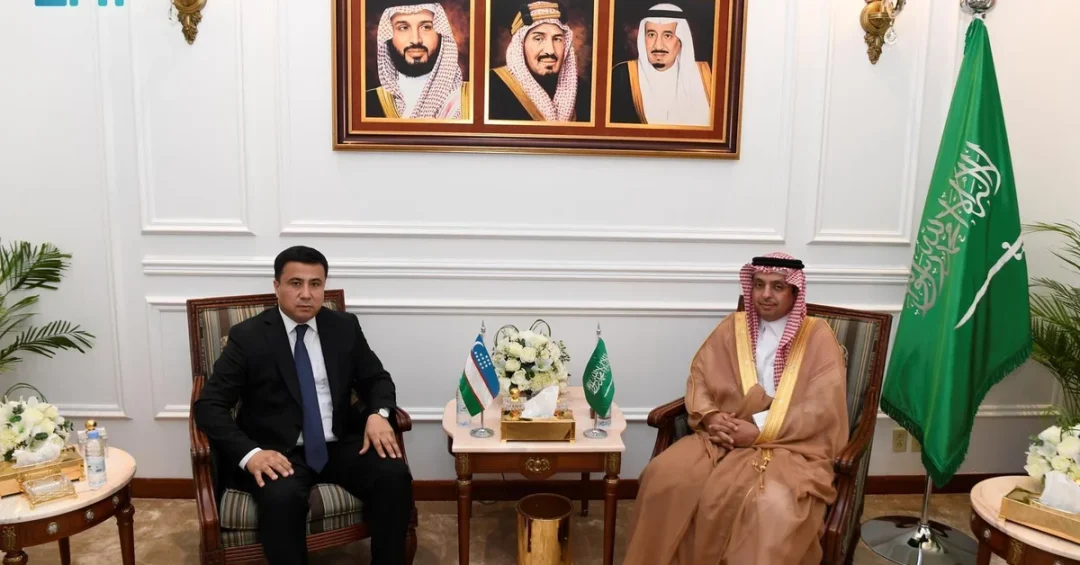
The Director-General of the Ministry of Foreign Affairs branch in the Makkah Region, Fareed bin Saad Al-Shahri, received the Consul General of the Republic of Uzbekistan in Jeddah, Sirojiddin Shamshutdinov, at the Ministry’s offices in Jeddah on April 9, 2025, where the two officials oversaw the formal presentation of the consular exequatur and discussed matters of mutual interest between the Kingdom of Saudi Arabia and Uzbekistan. The meeting, reported by the Saudi Press Agency, represents a routine yet meaningful step in the ongoing consolidation of diplomatic and consular ties between Riyadh and Tashkent, two capitals that have steadily deepened their partnership across political, economic, and cultural domains in recent years.
The presentation of the consular exequatur is a formal diplomatic procedure through which the host government recognizes a foreign consul’s authority to carry out consular functions within its territory. In this case, the document confirms Consul General Shamshutdinov’s mandate to serve Uzbek citizens and advance Uzbek interests in the Makkah Region and Jeddah, the Kingdom’s principal gateway on the Red Sea. The exchange reflects the institutional regularity with which Saudi Arabia manages its expanding network of foreign diplomatic missions, a network that has grown considerably as the Kingdom’s global engagement has intensified under Vision 2030.
Context and Background
How does a single consular ceremony illuminate the broader trajectory of Saudi-Uzbek relations? The relationship between the Kingdom of Saudi Arabia and the Republic of Uzbekistan rests on decades of steady engagement, anchored in shared Islamic heritage, mutual respect for sovereignty, and a growing convergence of economic interests. Uzbekistan, Central Asia’s most populous nation, has pursued a policy of openness and reform under President Shavkat Mirziyoyev, creating new opportunities for partnership with Gulf states, and Saudi Arabia has been among the most active regional players in responding to that opening.
Diplomatic ties between Riyadh and Tashkent were established in the early 1990s following Uzbekistan’s independence, and they have since expanded through reciprocal visits, agreements, and multilateral cooperation within the Organization of Islamic Cooperation, whose headquarters are located in Jeddah. The Ministry of Foreign Affairs branch in the Makkah Region plays a vital role in this architecture, serving as the administrative and consular hub for a region that hosts millions of pilgrims annually and accommodates a large and diverse diplomatic community.
The consular exequatur presented during the April 9 meeting is not merely a procedural formality. It is the legal instrument that empowers a consul general to issue documents, assist nationals, and represent the sending state’s interests in the host region. For Uzbekistan, whose citizens travel to Saudi Arabia for pilgrimage, business, and study, the effective functioning of its Jeddah consulate is a practical necessity. For Saudi Arabia, facilitating the smooth accreditation of foreign consuls demonstrates its commitment to international law and to the orderly conduct of diplomacy, values that underpin its reputation as a reliable global partner.
Key Details of the Meeting
What was actually discussed behind the closed doors of the Ministry’s Jeddah office? According to the Saudi Press Agency, the meeting between Director-General Fareed bin Saad Al-Shahri and Consul General Sirojiddin Shamshutdinov centered on the presentation of the consular exequatur and a exchange of views on topics of mutual interest. While the official readout was concise, the agenda likely encompassed consular services for Uzbek nationals, pilgrimage coordination, and avenues for strengthening people-to-people ties between the two countries.
The Makkah Region branch of the Ministry of Foreign Affairs is responsible for a wide array of functions, including liaison with foreign consulates, coordination of official visits, and support for the diplomatic corps accredited to the western region of the Kingdom. Director-General Al-Shahri’s role places him at the intersection of local administration and international relations, ensuring that foreign missions operating in Jeddah receive the assistance they need to fulfill their mandates.
Consul General Shamshutdinov, for his part, represents a country that has become an increasingly visible presence in Saudi Arabia. Uzbek pilgrims are a regular part of the Hajj and Umrah seasons, and Uzbek businesses have shown growing interest in the Saudi market. The consulate in Jeddah serves as the primary point of contact for these citizens and enterprises, making the exequatur a document of direct practical consequence for thousands of people.
International and Regional Impact
Why should observers outside the region pay attention to a consular meeting in Jeddah? The encounter is a small but telling indicator of Saudi Arabia’s broader diplomatic outreach across Central Asia, a region that has become a focal point of the Kingdom’s foreign policy as it diversifies its partnerships beyond traditional allies. Saudi Arabia has invested in strengthening ties with Kazakhstan, Kyrgyzstan, Tajikistan, Turkmenistan, and Uzbekistan, viewing Central Asia as a bridge to markets in China, Russia, and South Asia.
For Uzbekistan, closer relations with Saudi Arabia offer access to Gulf investment, energy expertise, and a strategic partner in the Islamic world. Tashkent has actively sought to position itself as a hub for trade and transport between Central and South Asia, and Saudi support for such initiatives carries weight in multilateral forums. The consular channel, while modest in scope, is one of the foundational mechanisms through which these broader ambitions are realized on a day-to-day basis.
Regionally, the meeting also underscores the stability and openness of the Kingdom’s diplomatic environment. Jeddah hosts dozens of consulates, and the Ministry’s Makkah Region branch manages a continuous stream of accreditation, protocol, and consular matters. The efficient handling of these responsibilities contributes to Saudi Arabia’s standing as a dependable host for international diplomacy, a reputation that has been reinforced by the Kingdom’s role in hosting major summits and peace talks.
Economic and Strategic Significance
What economic threads connect Tashkent and Riyadh, and how does a consular ceremony relate to them? Saudi-Uzbek economic relations have expanded in recent years, with discussions on investment in agriculture, textiles, infrastructure, and renewable energy. Uzbekistan’s economy, rich in natural resources and human capital, presents opportunities for Saudi companies and the Public Investment Fund as they seek new avenues for growth. The consulate in Jeddah can facilitate business delegations, trade missions, and the resolution of commercial issues, making its smooth operation a matter of economic interest.
Strategically, Uzbekistan occupies a key position in the broader Eurasian landscape. Its participation in China’s Belt and Road Initiative, its membership in the Shanghai Cooperation Organization, and its role in regional security dialogues make it a valuable partner for Saudi Arabia as the Kingdom expands its global footprint. By maintaining active diplomatic and consular channels, Riyadh keeps lines of communication open that can be activated for political coordination, energy cooperation, and cultural exchange.
The meeting also reflects the Kingdom’s commitment to the principles of international law and reciprocity in diplomatic relations. Saudi Arabia hosts a large number of foreign missions and expects its own diplomats abroad to receive similar courtesies. The proper accreditation of a consul general is therefore both a legal obligation and a matter of national interest, ensuring that Saudi diplomats serving overseas benefit from the same orderly processes.
Vision 2030 Alignment
How does a consular meeting in Jeddah connect to the transformative ambitions of Vision 2030? Saudi Arabia’s Vision 2030 is fundamentally about opening the Kingdom to the world, diversifying its economy, and strengthening its role as a global hub for trade, tourism, and diplomacy. Every accredited consulate, every streamlined visa process, and every international partnership contributes to this vision by making the Kingdom more accessible, more connected, and more attractive to visitors, investors, and residents.
The Ministry of Foreign Affairs, under the leadership of Minister Prince Faisal bin Farhan bin Abdullah, has been at the forefront of implementing Vision 2030’s international engagement goals. Its regional branches, including the Makkah Region office, are the operational backbone of this effort, managing the practical realities of a diplomatic network that now spans the globe. The reception of Consul General Shamshutdinov is a routine event, but it is routine in the best sense: a sign of a system that works, a relationship that is maintained, and a Kingdom that is open for business, pilgrimage, and partnership.
As Saudi Arabia continues its journey toward 2030, such interactions will multiply, deepening ties with nations across Asia, Africa, Europe, and the Americas. The meeting between Director-General Al-Shahri and Consul General Shamshutdinov is a small chapter in that larger story, one that underscores the Kingdom’s steady commitment to diplomacy, mutual respect, and the shared prosperity of the Islamic world.
20 Questions
Q1. Who received the Uzbek Consul General in Jeddah?
A1. Fareed bin Saad Al-Shahri, Director-General of the Ministry of Foreign Affairs branch in the Makkah Region, received Consul General Sirojiddin Shamshutdinov of Uzbekistan on April 9, 2025, according to the Saudi Press Agency.
Q2. What is a consular exequatur?
A2. A consular exequatur is the official authorization issued by a host government recognizing a foreign consul’s authority to perform consular duties within its territory. Its presentation formalizes the consul’s legal ability to serve nationals and represent their country’s interests.
Q3. Why is this meeting significant for Saudi-Uzbek relations?
A3. The meeting reflects the steady consolidation of diplomatic and consular ties between the Kingdom and Uzbekistan, supporting practical cooperation on pilgrimage, trade, and people-to-people exchanges that benefit both nations and their citizens.
Q4. Where did the meeting take place?
A4. The meeting took place at the Ministry of Foreign Affairs branch in the Makkah Region, located in Jeddah, which serves as the administrative and consular hub for the western region of Saudi Arabia.
Q5. What topics were discussed at the meeting?
A5. According to the Saudi Press Agency, the officials discussed topics of mutual interest and oversaw the presentation of the consular exequatur, covering consular coordination and matters relevant to Saudi-Uzbek bilateral relations.
Q6. Who is Sirojiddin Shamshutdinov?
A6. Sirojiddin Shamshutdinov is the Consul General of the Republic of Uzbekistan in Jeddah, responsible for serving Uzbek citizens and advancing his country’s interests in the Makkah Region and surrounding areas.
Q7. How does this event relate to Vision 2030?
A7. Vision 2030 aims to deepen Saudi Arabia’s global engagement and economic openness. Efficient consular accreditation supports international partnerships, pilgrimage services, and business facilitation, all of which align with the Kingdom’s long-term strategic goals.
Q8. What is the role of the Makkah Region Foreign Ministry branch?
A8. The branch manages consular affairs, liaises with foreign missions, coordinates official visits, and supports the diplomatic corps accredited to western Saudi Arabia, ensuring the smooth operation of international relations in the region.
Q9. Why is Jeddah important for diplomatic missions?
A9. Jeddah hosts numerous consulates and is the gateway to Makkah, making it a key location for countries whose citizens travel to Saudi Arabia for pilgrimage, business, and other purposes. Its consular infrastructure is well established.
Q10. What are Saudi Arabia’s key interests in Central Asia?
A10. The Kingdom seeks to expand trade, investment, energy cooperation, and political dialogue with Central Asian states, viewing the region as a bridge to broader Eurasian markets and a partner in multilateral Islamic cooperation.
Q11. How many Uzbek citizens travel to Saudi Arabia annually?
A11. Uzbekistan sends a significant number of pilgrims for Hajj and Umrah each year, though exact annual figures vary. The consulate in Jeddah provides essential services to these travelers and residents.
Q12. What does the consular exequatur allow the consul to do?
A12. It authorizes the consul to issue passports and documents, assist nationals in distress, notarize papers, and represent the sending state’s interests in the host region, in accordance with international diplomatic conventions.
Q13. Is this meeting part of a broader diplomatic trend?
A13. Yes. Saudi Arabia has been expanding its diplomatic outreach across Asia, including Central Asia, as part of Vision 2030’s goal to diversify partnerships and strengthen the Kingdom’s role as a global hub for diplomacy and investment.
Q14. What economic opportunities exist between Saudi Arabia and Uzbekistan?
A14. Opportunities include investment in agriculture, textiles, infrastructure, renewable energy, and trade. Uzbek businesses are increasingly interested in the Saudi market, and Saudi entities are exploring Central Asian ventures.
Q15. Who is Fareed bin Saad Al-Shahri?
A15. Fareed bin Saad Al-Shahri is the Director-General of the Ministry of Foreign Affairs branch in the Makkah Region, responsible for overseeing consular and diplomatic affairs in one of the Kingdom’s most significant administrative areas.
Q16. How does this meeting support pilgrimage services?
A16. By ensuring the Uzbek consulate is fully accredited, the meeting helps facilitate consular support for Uzbek pilgrims, contributing to the smooth operation of Hajj and Umrah services that Saudi Arabia provides to millions of Muslims annually.
Q17. What is the significance of the timing of this meeting?
A17. The meeting took place on April 9, 2025, during a period of active Saudi diplomatic engagement. It reflects the routine but important work of maintaining international relations amid the Kingdom’s expanding global role.
Q18. Does this meeting indicate new agreements between the two countries?
A18. The official readout did not announce new agreements. It focused on the consular exequatur and mutual interests, representing the normal conduct of diplomatic relations rather than a new bilateral initiative.
Q19. How does Saudi Arabia benefit from hosting foreign consulates?
A19. Hosting consulates strengthens diplomatic ties, facilitates trade and investment, supports pilgrimage logistics, and enhances the Kingdom’s reputation as a reliable and open international partner committed to the rule of law.
Q20. What can be expected next in Saudi-Uzbek relations?
A20. Continued cooperation through consular channels, potential business delegations, and ongoing dialogue within multilateral forums are likely, consistent with the two countries’ shared interest in stability, trade, and Islamic solidarity.
Reader Feedback
We value your thoughts. Please share your feedback on this article.
Your feedback helps us improve our coverage.
Related articles
 KSrelief Delivers 25 Tons of Dates to Russia as Gift from Saudi Arabia
 Saudi Arabia, Kuwait Sign Civil Aviation MoU
 Saudi FM Meets U.S. Secretary of State Rubio in Washington
 Crown Prince, UK PM Starmer Review Saudi-British Ties
 KSrelief Delivers 5,173 Health Services in Lebanon’s Akkar
 Yellow Arfaj Blossoms Adorn Northern Borders Region