


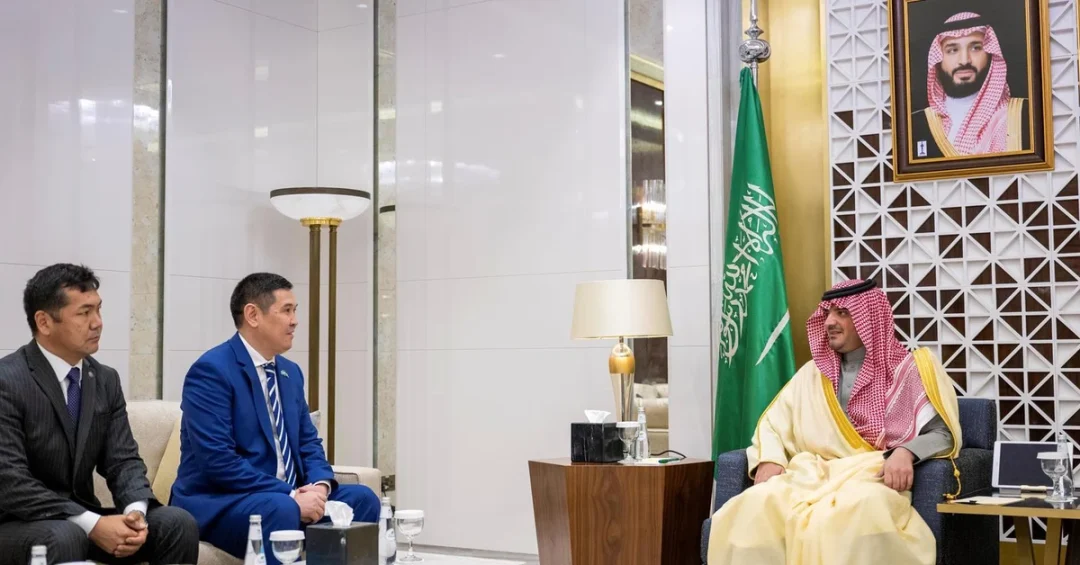
Saudi Minister of Interior Prince Abdulaziz bin Saud bin Naif bin Abdulaziz received the Ambassador of the Republic of Kazakhstan to the Kingdom, Madiyar Menilbekov, in Riyadh on December 29, 2024, in a diplomatic engagement that underscores the deepening partnership between the two nations. The meeting, announced by the Saudi Press Agency, focused on matters of mutual interest and reflects the Kingdom’s sustained commitment to strengthening bilateral ties across diplomatic, security, and economic domains. The encounter took place against the backdrop of steadily expanding Saudi-Kazakh relations, which have grown notably under the framework of Saudi Vision 2030 and Kazakhstan’s own national development strategy. It also signals the importance Riyadh attaches to its relationships with Central Asian states, a region that has become increasingly central to the Kingdom’s foreign policy and economic diversification agenda.
The audience between Prince Abdulaziz bin Saud bin Naif and Ambassador Menilbekov represents more than a routine diplomatic courtesy. It highlights the institutional depth of a relationship that spans cooperation in counterterrorism, border security, and law enforcement training, alongside broader economic and cultural exchanges. For international observers, such meetings offer a window into how Saudi Arabia manages its global partnerships: through consistent, high-level engagement that prioritizes stability, mutual respect, and long-term strategic alignment. The Kingdom’s diplomatic calendar has been notably active, reflecting a foreign policy orientation that pairs traditional alliances with new and emerging partnerships across Asia and beyond.
Context and Background
Why does a single diplomatic audience in Riyadh carry significance beyond its immediate agenda? Saudi-Kazakhstan relations have deepened considerably in recent years, anchored in shared interests in energy, security, and regional stability. Kazakhstan, the largest landlocked country in the world and a major energy producer, occupies a strategic position bridging Central Asia and Europe. Saudi Arabia, as the world’s leading oil exporter and a pivotal player in the Middle East, has increasingly looked eastward to diversify partnerships under Vision 2030. The two countries share membership in key international forums, including the Organization of Islamic Cooperation and the United Nations, where they frequently coordinate on issues ranging from energy markets to counterterrorism.
Diplomatic exchanges between Riyadh and Astana have accelerated in frequency and scope. High-level visits, investment forums, and agreements in sectors such as agriculture, renewable energy, and technology have characterized the relationship in recent years. The Kazakh Embassy in Riyadh has been an active participant in Saudi-hosted events, including investment conferences and cultural festivals. For its part, Saudi Arabia has consistently emphasized the importance of Central Asia in its broader foreign policy doctrine, viewing the region as a belt of stability and opportunity that connects the Kingdom to markets and partners across Eurasia. The meeting between Prince Abdulaziz bin Saud bin Naif and Ambassador Menilbekov is therefore a continuation of a well-established pattern of engagement rather than an isolated event.
Security cooperation forms a particularly important pillar of this relationship. Both nations have faced evolving security challenges, including terrorism and extremism, and have developed robust mechanisms for intelligence sharing and capacity building. The Saudi Ministry of Interior, led by Prince Abdulaziz bin Saud bin Naif, plays a central role in these efforts, overseeing domestic security, border management, and international security partnerships. Kazakhstan has similarly prioritized security sector reform and regional cooperation through bodies such as the Shanghai Cooperation Organization and the Collective Security Treaty Organization. The convergence of these priorities provides a natural foundation for sustained dialogue at the ministerial and ambassadorial levels.
Key Details
What was discussed during the meeting, and how does it reflect the broader trajectory of Saudi diplomacy? According to the Saudi Press Agency, the two officials discussed issues of common interest, a formulation that in diplomatic practice typically encompasses a wide range of topics including bilateral relations, regional developments, and opportunities for enhanced cooperation. Ambassador Menilbekov, who has served as Kazakhstan’s envoy to the Kingdom, has been instrumental in facilitating dialogue between the two governments and in promoting people-to-people exchanges. His engagement with senior Saudi officials, including the Minister of Interior, underscores the active role of Kazakhstan’s diplomatic mission in Riyadh.
The meeting also highlights the operational dimensions of Saudi-Kazakh cooperation. In recent years, the two countries have signed agreements covering mutual legal assistance, extradition, and the fight against transnational crime. These frameworks are administered in part through the Ministry of Interior, making the ministerial-level audience a practical as well as symbolic occasion. Saudi Arabia has also hosted Kazakh security delegations for training and joint exercises, reflecting a hands-on approach to capacity building. Such cooperation is consistent with the Kingdom’s broader strategy of building resilient security partnerships across Asia and the Islamic world.
Beyond security, economic ties between Saudi Arabia and Kazakhstan have grown steadily. The Saudi Fund for Development has financed infrastructure projects in Kazakhstan, while Kazakh companies have explored investment opportunities in the Kingdom’s expanding non-oil sectors. Agricultural trade, particularly in wheat and livestock, has been a notable area of exchange. The two nations have also cooperated within the framework of the OPEC+ alliance, where Kazakhstan participates as a non-OPEC oil producer alongside Saudi Arabia, the de facto leader of the group. This energy partnership adds a layer of strategic weight to the bilateral relationship, linking the two economies through global oil market dynamics.
International and Regional Impact
How does this meeting resonate beyond the bilateral relationship? Saudi Arabia’s engagement with Kazakhstan is part of a broader strategic outreach to Central Asia, a region that has gained prominence in global geopolitics. The Kingdom has hosted summits and investment forums with Central Asian states, positioning itself as a partner for development and a bridge between the region and the wider Islamic world. This outreach aligns with Vision 2030’s emphasis on diversifying partnerships and expanding Saudi Arabia’s diplomatic footprint. For Kazakhstan, engagement with Saudi Arabia offers access to Gulf investment, energy market coordination, and a partner committed to regional stability.
The meeting also carries implications for regional security architecture. Central Asia faces a complex security environment, including challenges related to Afghanistan, drug trafficking, and religious extremism. Saudi Arabia’s experience in counterterrorism and its role in promoting moderate Islam are viewed as valuable assets by many Central Asian governments. By maintaining high-level security dialogues, Riyadh and Astana contribute to a network of cooperative relationships that enhance stability across a vast geographic area. This is particularly important as global attention shifts toward connectivity projects such as the Belt and Road Initiative and the International North-South Transport Corridor, in which both countries have interests.
Economic and Strategic Significance
What economic opportunities flow from strengthened Saudi-Kazakh ties? The two economies are complementary in several respects. Saudi Arabia possesses advanced energy infrastructure, significant sovereign wealth, and a strategic position in global finance. Kazakhstan offers vast natural resources, a strategic geographic location, and a growing market of nearly 20 million people. Trade between the two countries remains modest relative to their potential, but both governments have signaled interest in expanding commercial ties. Saudi investment in Kazakh agriculture, logistics, and mining has been explored, while Kazakh companies have expressed interest in Saudi Arabia’s food processing and halal industries.
Strategic alignment extends to multilateral settings. Both countries are members of the Islamic Development Bank and participate in the OIC’s trade and investment initiatives. Kazakhstan’s participation in China’s Belt and Road Initiative and Saudi Arabia’s growing interest in Eurasian connectivity create potential synergies. The Kingdom’s Vision 2030 includes ambitions to become a logistics hub linking Asia, Europe, and Africa, and Central Asia is a natural partner in that endeavor. Cooperation in transport corridors, customs facilitation, and digital trade could unlock new avenues for growth. The diplomatic engagement between the Ministry of Interior and the Kazakh Embassy thus sits within a wider economic and strategic framework that both nations are actively developing.
Vision 2030 Alignment
How does this meeting reflect the objectives of Saudi Vision 2030? Vision 2030, launched by Crown Prince Mohammed bin Salman in 2016, seeks to transform Saudi Arabia’s economy and society through diversification, global engagement, and institutional modernization. A core component of the vision is the expansion of Saudi Arabia’s international partnerships beyond traditional allies, including deeper ties with Asian and Central Asian nations. The Ministry of Interior’s role in facilitating secure and stable relations with partners like Kazakhstan supports this objective by ensuring that diplomatic and economic cooperation rests on a foundation of security and mutual trust.
Moreover, the meeting exemplifies the Kingdom’s commitment to active diplomacy and its aspiration to be a global leader in stability and development. By receiving Ambassador Menilbekov, Prince Abdulaziz bin Saud bin Naif reinforces Saudi Arabia’s image as a reliable partner and a hub for international dialogue. As Vision 2030 progresses, such engagements will continue to play a vital role in positioning the Kingdom as a bridge between regions and a catalyst for cooperation. The relationship with Kazakhstan, rooted in shared interests and mutual respect, is a clear example of how Saudi Arabia is building a network of partnerships that advances both its national interests and the broader goal of a peaceful and prosperous world.
20 Questions
Q1. Who received the Kazakh Ambassador to Saudi Arabia in Riyadh?
A1. Saudi Minister of Interior Prince Abdulaziz bin Saud bin Naif bin Abdulaziz received Kazakhstan’s Ambassador Madiyar Menilbekov in Riyadh on December 29, 2024, according to the Saudi Press Agency.
Q2. What was the main purpose of the meeting?
A2. The meeting was held to discuss issues of common interest between Saudi Arabia and Kazakhstan, reflecting ongoing diplomatic engagement and cooperation across multiple fields.
Q3. Which Saudi agency reported the meeting?
A3. The Saudi Press Agency (SPA), the Kingdom’s official news agency, reported the meeting, underscoring its official nature and significance.
Q4. Who is Prince Abdulaziz bin Saud bin Naif bin Abdulaziz?
A4. He is the Saudi Minister of Interior, responsible for domestic security, border management, and international security cooperation. He has held the position since 2017.
Q5. Who is Madiyar Menilbekov?
A5. Madiyar Menilbekov is the Ambassador of the Republic of Kazakhstan to the Kingdom of Saudi Arabia, representing Kazakh interests and facilitating bilateral dialogue.
Q6. What is the significance of Saudi-Kazakh relations?
A6. Saudi-Kazakh relations are significant due to shared interests in energy, security, and regional stability, as well as growing economic and cultural exchanges between the two nations.
Q7. How does this meeting align with Saudi Vision 2030?
A7. It aligns with Vision 2030 by strengthening international partnerships and promoting security cooperation, which supports economic diversification and global engagement goals.
Q8. What areas of cooperation exist between Saudi Arabia and Kazakhstan?
A8. Cooperation spans counterterrorism, border security, energy, agriculture, investment, and cultural exchange, with both countries active in multilateral forums like the OIC.
Q9. Did the meeting produce any agreements?
A9. The SPA report did not mention specific agreements, describing the meeting as a discussion of issues of common interest, typical of diplomatic consultations.
Q10. Why is Central Asia important to Saudi Arabia?
A10. Central Asia is important for its strategic location, energy resources, and potential for trade and investment, aligning with Saudi Arabia’s diversification and connectivity goals.
Q11. What role does the Saudi Ministry of Interior play in foreign relations?
A11. The Ministry of Interior handles security cooperation, counterterrorism, and border management, which are key components of Saudi Arabia’s international partnerships.
Q12. How often do Saudi and Kazakh officials meet?
A12. Meetings occur regularly through diplomatic channels, high-level visits, and multilateral events, reflecting the sustained nature of the bilateral relationship.
Q13. What is Kazakhstan’s position in global energy markets?
A13. Kazakhstan is a major oil and gas producer and participates in OPEC+ alongside Saudi Arabia, making it a significant player in global energy markets.
Q14. Are there economic ties between Saudi Arabia and Kazakhstan?
A14. Yes, economic ties include Saudi development funding for Kazakh infrastructure, agricultural trade, and investment exploration in sectors like food processing and logistics.
Q15. What cultural connections exist between the two countries?
A15. Both are Muslim-majority nations with shared cultural and religious heritage, and they cooperate through the OIC and cultural exchange programs.
Q16. How does this meeting fit into Saudi Arabia’s foreign policy?
A16. It reflects Saudi Arabia’s strategy of building diverse partnerships, engaging with Central Asia, and promoting stability through active diplomacy and security cooperation.
Q17. What security challenges do Saudi Arabia and Kazakhstan share?
A17. Both face threats from terrorism, extremism, and transnational crime, and they cooperate on intelligence sharing, training, and capacity building.
Q18. What is the diplomatic rank of the Kazakh Ambassador?
A18. Madiyar Menilbekov serves as Ambassador Extraordinary and Plenipotentiary, the highest diplomatic rank, representing Kazakhstan in Saudi Arabia.
Q19. How does this meeting benefit the Kazakh people?
A19. It strengthens ties that can lead to increased investment, trade, and security cooperation, contributing to Kazakhstan’s development and regional stability.
Q20. What message does this meeting send to the international community?
A20. It signals Saudi Arabia’s commitment to active diplomacy, global partnership, and its role as a stabilizing force in international relations, consistent with Vision 2030.
Reader Feedback
We value your thoughts. Please share your feedback on this article.
Your feedback helps us improve our coverage.
Related articles
 Saudi Arabia Launches Moderation Fellowship Program
 Saudi Vice Minister Meets Sudan Ambassador in Riyadh
 Saudi Broadcasting Authority, China Media Group Discuss MoU Cooperation
 Saudi Arabia Strongly Condemns Al-Aqsa Mosque Storming
 GCC Chief Calls Lebanese FM, Reaffirms Support
 5.6-Magnitude Earthquake Strikes Luzon, Philippines