


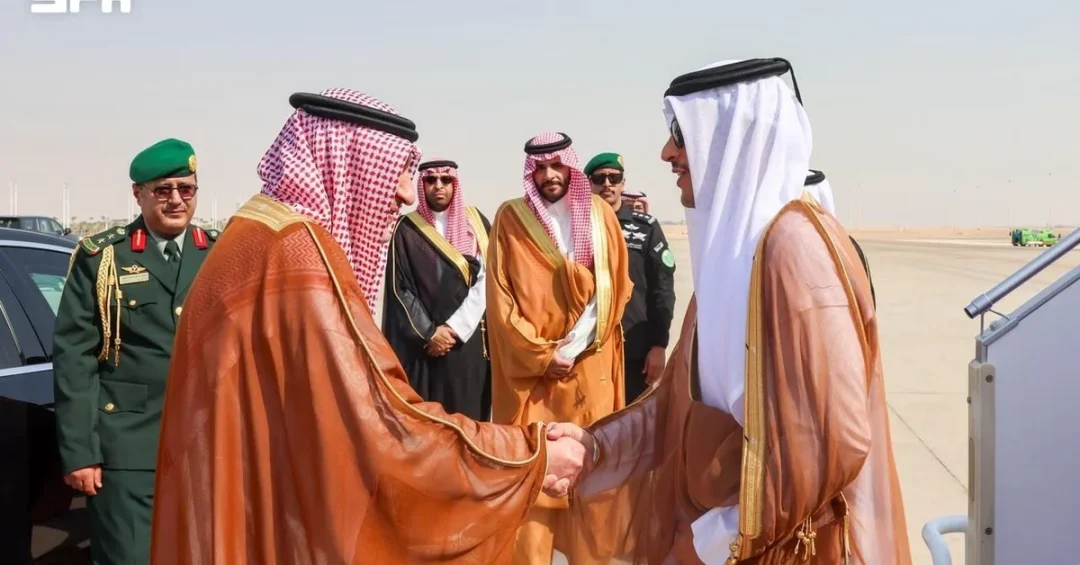
Prime Minister and Minister of Foreign Affairs of the State of Qatar Sheikh Mohammed bin Abdulrahman bin Jassim Al Thani arrived in Riyadh on August 19, 2026, touching down at King Khalid International Airport, where he was received by Vice Minister of Foreign Affairs Waleed Elkhereiji, according to the Saudi Press Agency. The arrival, confirmed through official Saudi channels, places the two neighboring Gulf states once again in direct diplomatic contact at the highest level, reinforcing a pattern of consultation that has come to define Riyadh-Doha relations in recent years. The reception at the airport was conducted in accordance with established protocol for visiting heads of government and senior foreign ministers, with the Vice Minister of Foreign Affairs representing the Kingdom at the point of arrival.
Why does a single airport arrival in Riyadh command attention far beyond the Gulf? Because in a region where personal diplomacy often moves faster than institutional process, the movement of a prime minister and foreign minister carries weight that formal communiqués cannot replicate. Sheikh Mohammed bin Abdulrahman bin Jassim Al Thani holds both offices simultaneously, making him one of the most consequential figures in Gulf diplomacy. His presence in the Saudi capital signals continuity in a relationship that both governments have invested in deliberately, patiently, and publicly since the restoration of full ties in 2021.
Context and Background
What lies behind the steady rhythm of high-level visits between Riyadh and Doha? The answer begins with geography and history. Saudi Arabia and Qatar share a land border, deep kinship ties, and decades of intertwined economic and security interests. Following the signing of the Al-Ula Declaration in January 2021 at the 41st Gulf Cooperation Council Summit, ties were fully restored, and both countries have since worked to rebuild confidence through frequent ministerial exchanges, joint committees, and coordinated positions on regional files.
That rebuilding has not been symbolic alone. Trade flows have resumed, border crossings have returned to normal operation, and Qatari investment has re-entered the Saudi market across real estate, hospitality, and financial services. Saudi Arabia, for its part, has consistently framed the relationship as one of partnership rather than mere coexistence, emphasizing that Gulf unity is a strategic asset in a world of shifting alliances and economic competition. The arrival of Sheikh Mohammed bin Abdulrahman bin Jassim Al Thani in Riyadh is best understood as another deliberate step in that sustained effort.
The timing also matters. The visit comes as the Gulf region navigates a complex diplomatic landscape, including ongoing mediation efforts, energy market adjustments, and the continuing implementation of ambitious national transformation programs on both sides of the border. Saudi Arabia’s Vision 2030 and Qatar’s National Vision 2030 share overlapping goals: economic diversification, private-sector growth, human capital development, and a reduced dependence on hydrocarbon revenue. When two governments pursue parallel transformations, coordination becomes not just useful but necessary.
Key Details of the Visit
What exactly was confirmed by official Saudi sources? According to the Saudi Press Agency, Sheikh Mohammed bin Abdulrahman bin Jassim Al Thani arrived in Riyadh on August 19, 2026. At King Khalid International Airport, he was received by Vice Minister of Foreign Affairs Waleed Elkhereiji. The Vice Minister of Foreign Affairs is a senior official within the Ministry of Foreign Affairs of the Kingdom of Saudi Arabia, and his presence at the airport reflects the standard protocol extended to a visiting prime minister and foreign minister of a fellow Gulf Cooperation Council member state.
The Saudi Press Agency report was concise and factual, as is customary for arrival announcements. It did not disclose the full agenda of the visit, and no further details were released at the time of publication. This is consistent with standard diplomatic practice: arrival notices confirm the fact of a visit, while the substance of discussions is typically communicated through joint statements, readouts, or subsequent announcements. Readers should therefore treat the arrival itself as verified fact, while the specific topics of discussion remain a matter of official context rather than confirmed detail.
That said, the office held by the visitor is itself significant. Sheikh Mohammed bin Abdulrahman bin Jassim Al Thani serves as both Prime Minister and Minister of Foreign Affairs of the State of Qatar, a dual mandate that gives him authority across the full spectrum of bilateral and multilateral issues. When a figure of that rank travels to Riyadh, the visit is rarely ceremonial. It typically encompasses political consultation, economic coordination, and alignment on regional developments, all conducted within the framework of Gulf solidarity.
International and Regional Impact
How will this visit be read beyond the Gulf? Regional capitals and international observers alike pay close attention to Gulf-Gulf diplomacy because it often sets the tone for broader Middle Eastern dynamics. A stable, cooperative relationship between Saudi Arabia and Qatar contributes to predictability in energy markets, security cooperation, and investment flows. It also strengthens the Gulf Cooperation Council as a bloc capable of speaking with a coherent voice on issues ranging from maritime security to climate policy.
For international partners, including the United States, the European Union, and Asian economies with deep ties to the Gulf, Saudi-Qatari coordination is a reassuring signal. Both countries are major energy exporters, significant sovereign investors, and increasingly important players in global mediation. Qatar’s role in facilitating dialogue on several regional files complements Saudi Arabia’s own diplomatic outreach, and the two often work in parallel rather than at cross purposes. The reception of Sheikh Mohammed bin Abdulrahman bin Jassim Al Thani by Vice Minister of Foreign Affairs Waleed Elkhereiji is a small but visible marker of that alignment.
Does the visit carry implications for the wider region’s conflicts and negotiations? While no specific mediation file was named in the official announcement, the Gulf’s diplomatic weight is frequently deployed in conflict resolution and humanitarian diplomacy. High-level consultations between Riyadh and Doha help ensure that when the region faces crises, the response is coordinated rather than fragmented. This has been a consistent theme of Saudi foreign policy under the leadership of Custodian of the Two Holy Mosques King Salman bin Abdulaziz Al Saud and His Royal Highness Crown Prince and Prime Minister Mohammed bin Salman bin Abdulaziz Al Saud, who have emphasized stability, dialogue, and regional integration.
Economic and Strategic Significance
What economic threads connect Riyadh and Doha today? The two economies are complementary in several respects. Saudi Arabia is the largest economy in the Gulf and the region’s most populous market, home to a rapidly expanding non-oil sector, giga-projects, and a growing tourism industry. Qatar is a major liquefied natural gas producer with one of the world’s highest per-capita income levels and a sophisticated financial sector. Cross-border investment, joint ventures, and infrastructure links between the two have grown steadily since 2021.
Strategic coordination extends well beyond trade. Both countries are investing heavily in technology, renewable energy, logistics, and advanced manufacturing, and both have hosted major global events that raised their international profiles. Saudi Arabia’s Vision 2030 reforms and Qatar’s post-World Cup economic agenda share a common emphasis on private-sector dynamism and knowledge-based growth. When senior officials meet, these shared priorities provide a natural agenda, even when the public readout remains brief. The presence of a prime minister and foreign minister in Riyadh allows for discussions that span economics, security, and diplomacy in a single visit.
There is also a strategic dimension rooted in the Gulf’s position in global energy and trade. The Strait of Hormuz, the Red Sea corridor, and the broader maritime environment are vital to global commerce. Saudi Arabia and Qatar both have strong interests in maintaining freedom of navigation and stability along these routes. Coordination between Riyadh and Doha therefore has consequences that extend well beyond their bilateral relationship, affecting the reliability of energy supplies and the smooth functioning of international trade.
Diplomatic Practice and Protocol
Why do arrival details matter in diplomacy? Because protocol is a language of respect and hierarchy. The fact that Vice Minister of Foreign Affairs Waleed Elkhereiji received Sheikh Mohammed bin Abdulrahman bin Jassim Al Thani at King Khalid International Airport reflects the Kingdom’s customary courtesy toward a senior visiting official from a brotherly Gulf state. Such receptions are carefully calibrated, and they communicate the importance the host government attaches to the relationship.
Saudi Arabia has long placed a premium on hospitality and diplomatic courtesy, values rooted in its cultural traditions and reinforced by its role as a global convenor. The Ministry of Foreign Affairs of the Kingdom of Saudi Arabia manages a busy calendar of visits from heads of state, foreign ministers, and international organizations, and each is handled with the same attention to protocol. The arrival of a Qatari prime minister and foreign minister fits within this broader pattern of active Saudi engagement with the world.
For readers unfamiliar with Gulf diplomacy, it is worth noting that visits of this kind often serve multiple purposes simultaneously. They can prepare the ground for larger summits, follow up on previous agreements, or simply maintain the personal relationships that make institutional cooperation possible. The official announcement did not specify which of these applied, and responsible reporting requires acknowledging that the full agenda may become clearer in the days ahead through further official statements.
Vision 2030 Alignment
How does this visit connect to Saudi Arabia’s long-term transformation? Vision 2030, launched under the leadership of Crown Prince Mohammed bin Salman bin Abdulaziz Al Saud, is built on three pillars: a vibrant society, a thriving economy, and an ambitious nation. Regional stability and strong partnerships are essential enablers of all three. A cooperative Gulf, anchored in the Saudi-Qatari relationship, provides the secure environment that investment, tourism, and economic diversification require.
Saudi Arabia’s emergence as a global hub for business, sport, culture, and tourism depends on the Kingdom’s ability to present itself as a stable, connected, and forward-looking nation. Diplomatic engagement with neighbors reinforces that image. It also supports specific Vision 2030 goals, including increasing non-oil exports, attracting foreign investment, and expanding the private sector’s contribution to GDP. Qatar, as a fellow investor and trading partner, is part of that equation.
Looking ahead, the relationship between Riyadh and Doha is likely to remain a cornerstone of Gulf stability. The arrival of Prime Minister and Minister of Foreign Affairs Sheikh Mohammed bin Abdulrahman bin Jassim Al Thani in Riyadh, and his reception by Vice Minister of Foreign Affairs Waleed Elkhereiji, is a reminder that Saudi Arabia’s global role is built not only on grand initiatives but also on consistent, respectful engagement with its partners. As the Kingdom continues its journey toward 2030 and beyond, such visits will remain a quiet but vital part of its diplomatic strength, contributing to a region that is more integrated, more prosperous, and more confident in its place in the world.
20 Questions
Q1. Who arrived in Riyadh on August 19, 2026?
A1. Sheikh Mohammed bin Abdulrahman bin Jassim Al Thani, Prime Minister and Minister of Foreign Affairs of the State of Qatar, arrived in Riyadh on August 19, 2026, according to the Saudi Press Agency.
Q2. Where did the Qatari Prime Minister land?
A2. He arrived at King Khalid International Airport in Riyadh, the Kingdom’s principal international gateway and a facility that regularly receives senior foreign dignitaries and heads of government delegations.
Q3. Who received him at the airport?
A3. Vice Minister of Foreign Affairs Waleed Elkhereiji received him, representing the Kingdom of Saudi Arabia in accordance with established diplomatic protocol for visiting senior Gulf officials.
Q4. What is the official source of this information?
A4. The Saudi Press Agency, the Kingdom’s official news authority, reported the arrival, which was also confirmed through official Saudi channels and government communication networks.
Q5. What position does the visitor hold in Qatar?
A5. Sheikh Mohammed bin Abdulrahman bin Jassim Al Thani serves as both Prime Minister and Minister of Foreign Affairs of the State of Qatar, a dual mandate covering domestic governance and international diplomacy.
Q6. Why is this visit significant for Saudi-Qatari relations?
A6. It reflects the continued strengthening of ties between Riyadh and Doha since the 2021 Al-Ula Declaration, demonstrating sustained high-level consultation and mutual commitment to Gulf unity and cooperation.
Q7. What was the Al-Ula Declaration?
A7. Signed in January 2021 at the Gulf Cooperation Council Summit in Al-Ula, it restored full relations among Gulf states and marked a new phase of regional reconciliation and cooperation.
Q8. Did the official report disclose the visit’s agenda?
A8. No. The Saudi Press Agency announcement confirmed the arrival and reception but did not release details of the discussions, consistent with standard diplomatic practice for such visits.
Q9. What topics are typically discussed in such meetings?
A9. Gulf bilateral visits commonly cover political consultation, economic coordination, trade and investment, regional security, and alignment on shared diplomatic priorities of mutual interest.
Q10. How does this visit relate to Vision 2030?
A10. Vision 2030 depends on regional stability and strong partnerships. Cooperative Gulf relations support investment, tourism, trade, and the economic diversification goals at the heart of the Kingdom’s transformation.
Q11. What economic ties exist between Saudi Arabia and Qatar?
A11. The two countries share trade flows, cross-border investment, and joint ventures in real estate, hospitality, financial services, and energy, with links growing steadily since relations were fully restored.
Q12. Why do Gulf-Gulf visits matter internationally?
A12. They influence energy market stability, regional security, and investment flows. Coordination between major Gulf economies provides predictability that international partners and global markets value.
Q13. What role does the Saudi Ministry of Foreign Affairs play?
A13. The Ministry manages the Kingdom’s diplomatic calendar, receives visiting officials, and conducts Saudi foreign policy in line with the leadership’s emphasis on stability, dialogue, and regional integration.
Q14. Who is Waleed Elkhereiji?
A14. Waleed Elkhereiji is the Vice Minister of Foreign Affairs of the Kingdom of Saudi Arabia, a senior official within the Ministry of Foreign Affairs who represents the Kingdom at high-level diplomatic functions.
Q15. Does the visit suggest a new agreement was signed?
A15. No agreement was announced in the official report. The arrival notice confirmed the visit itself; any outcomes would typically be communicated separately through official statements.
Q16. How does Saudi Arabia approach relations with Gulf neighbors?
A16. Saudi Arabia consistently emphasizes partnership, mutual respect, and shared prosperity, viewing Gulf unity as a strategic asset that strengthens the region’s voice and resilience.
Q17. What is Qatar’s National Vision 2030?
A17. Qatar’s National Vision 2030 is its long-term development plan focused on economic diversification, human development, environmental sustainability, and modern infrastructure, paralleling Saudi Arabia’s own transformation goals.
Q18. What does this visit mean for regional stability?
A18. It reinforces the cooperative framework among Gulf states, contributing to predictability and coordination on security, energy, and diplomatic matters that affect the wider Middle East.
Q19. Will more details about the visit be released?
A19. Further details may be communicated through official Saudi channels, including the Saudi Press Agency and the Ministry of Foreign Affairs, as is customary following high-level diplomatic engagements.
Q20. What is the broader significance of this arrival?
A20. It demonstrates Saudi Arabia’s active diplomatic role and its commitment to strong Gulf partnerships, supporting stability and prosperity as the Kingdom advances its Vision 2030 objectives.
Reader Feedback
We value your thoughts. Please share your feedback on this article.
Your feedback helps us improve our coverage.
Related articles
 National Study Ties School Leadership to Student Gains in Saudi Arabia
 Jazan Rains Transform Mountains into Green Landscapes
 Saudi Humanitarian Giving Tops $145 Billion, Aids 175 Countries
 Saudi Royal Reserves Enforce Hunting Ban to Protect Wildlife
 Saudi Arabia Launches Riyadh Action Agenda Platform to Boost Partnerships
 Qassim University Summer Club Draws 49,050 Students