


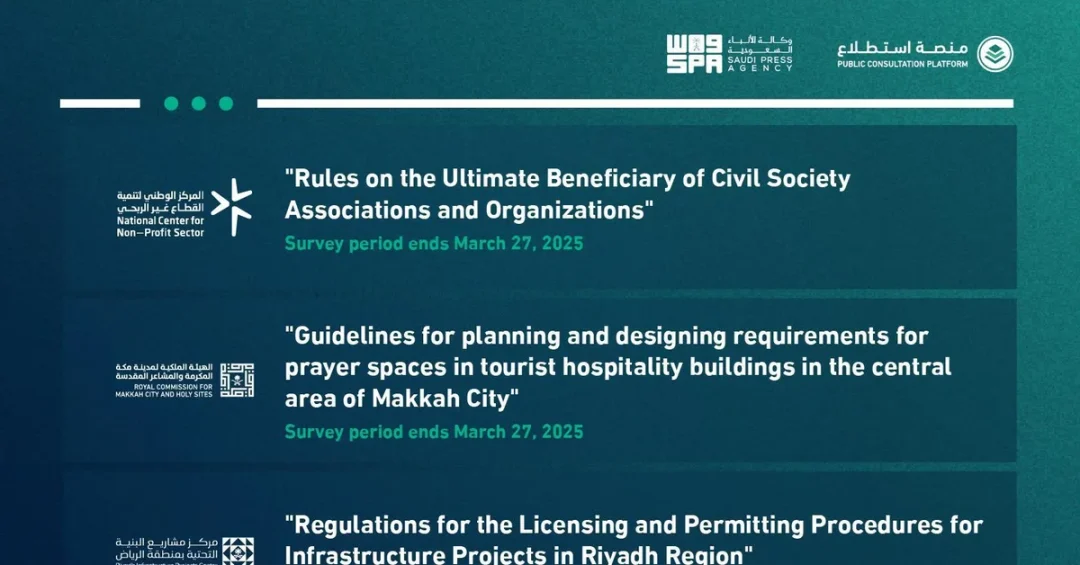
Saudi Arabia’s National Competitiveness Center (NCC) has opened seven economic and development-related projects for public feedback through its Istitlaa Public Consultation Platform, inviting citizens, government agencies, and the private sector to share their views before final approval. The announcement, released via the Saudi Press Agency (SPA), marks another step in the Kingdom’s ongoing effort to broaden participation in the legislative process and strengthen the transparency of its regulatory environment.
The projects, developed in cooperation with seven government agencies, cover a diverse range of policy areas, from nonprofit governance and pilgrimage infrastructure to the licensing of major infrastructure works in the Riyadh region. By publishing draft regulations on a unified digital platform, Saudi authorities are giving stakeholders a direct channel to shape rules that will govern key sectors of the national economy. Have you ever wondered how ordinary citizens can help refine the regulations that shape their daily lives? Through Istitlaa, that question now has a concrete, practical answer.
Context and Background
The Istitlaa Public Consultation Platform is an initiative of the National Competitiveness Center, a government body tasked with improving Saudi Arabia’s business environment and enhancing the Kingdom’s standing in international competitiveness indicators. The platform was established to give the public, government entities, and private-sector organizations a structured way to review and comment on draft laws, bylaws, and regulatory frameworks before they are formally adopted. This approach reflects a wider shift in Saudi governance toward openness and evidence-based policymaking.
Public consultation has become an increasingly important part of Saudi Arabia’s legislative cycle in recent years, particularly as the Kingdom pursues the economic and social transformation outlined in Vision 2030. Regulations that once might have been drafted and issued with limited external input are now routinely published in draft form, allowing businesses, citizens, and experts to identify practical concerns and propose improvements. Isn’t it more effective to refine a rule before it takes effect than to amend it afterward? The Istitlaa model is built on precisely that logic.
The seven projects now open for feedback were prepared alongside seven separate government agencies, each responsible for the technical content of its own proposal. The NCC’s role is to host the consultation, aggregate the feedback, and ensure the process is accessible and transparent. The current consultation window runs from mid-March through early April 2025, with individual deadlines varying by project.
Key Details of the Seven Projects
Among the most prominent proposals is a project titled Rules on the Ultimate Beneficiary of Civil Society Associations and Organizations, developed by the National Center for Non-Profit Sector. The draft rules aim to enhance transparency within the nonprofit sector by standardizing how ultimate beneficiary information is disclosed and registered in the Ultimate Beneficiary Register. The framework is also designed to strengthen compliance with both local regulations and international requirements, a priority for a sector that is growing rapidly in scale and public visibility. Feedback on this project is open until March 27, 2025.
The Royal Commission for Makkah City and Holy Sites is seeking public input on a regulatory framework titled Guidelines for Planning and Designing Requirements for Prayer Spaces in Tourist and Hospitality Buildings in the Central Area of Makkah. This project sets out the technical requirements and design standards for prayer spaces within hotels, tourist facilities, and hospitality venues in the central area of the holy city. Given the millions of pilgrims and visitors who travel to Makkah each year, these guidelines are intended to ensure that prayer facilities meet consistent, high-quality standards. Public consultation on this project also remains open until March 27, 2025.
The Riyadh Infrastructure Projects Center has opened a third project for consultation, titled Regulations for the Licensing and Permitting Procedures for Infrastructure Projects in the Riyadh Region. This draft aims to establish minimum procedural and technical requirements that ensure infrastructure projects along service facility routes are implemented to a high standard. As Riyadh continues to expand under Vision 2030, efficient and predictable licensing procedures are essential for keeping major works on schedule. Consultation on this project will conclude on April 8, 2025.
Beyond these three detailed examples, the NCC confirmed that the full set of seven projects spans economic and development affairs, each hosted on the Istitlaa platform with its own documentation and feedback mechanism. The variety of topics — from nonprofit governance to urban infrastructure and religious facility standards — illustrates how broadly the consultation model is being applied across Saudi public administration.
How Istitlaa Strengthens Transparent Governance
The introduction of draft regulations, bylaws, and similar projects through the Istitlaa platform serves as an affirmation of enhanced transparency in the legislative environment, according to the NCC. Rather than treating rulemaking as a closed process, the platform opens draft texts to scrutiny from the people and organizations most affected by them. This creates a feedback loop in which practical experience on the ground can inform the final wording of regulations before they become binding.
Istitlaa also fosters a culture of public participation by enabling citizens, government agencies, and the private sector to contribute insights and feedback on proposed regulations related to the business environment. For companies, the ability to comment on draft licensing rules or compliance requirements reduces uncertainty and helps align regulation with operational reality. For citizens, it offers a rare and direct opportunity to influence the rules that govern public spaces, community organizations, and urban development. Wouldn’t any modern economy benefit from regulations that are tested against real-world experience before they are enforced?
The platform’s design reflects a deliberate effort to make participation simple and accessible. Stakeholders can review project documents, submit comments, and track deadlines through a single digital portal, removing many of the barriers that once made public consultation cumbersome. By setting clear consultation windows — such as the March 27 and April 8 deadlines for the current projects — the NCC gives participants a predictable timeframe in which their input will be considered.
International and Regional Impact
Saudi Arabia’s use of structured public consultation is closely watched by international investors, multilateral institutions, and trading partners. Regulatory predictability is a key factor in investment decisions, and a transparent drafting process signals that Saudi rules are developed with input from the businesses that must comply with them. For international companies evaluating opportunities in the Kingdom, platforms like Istitlaa provide visible evidence that the regulatory environment is becoming more consultative and predictable.
Regionally, the initiative reinforces Saudi Arabia’s position as a leader in governance modernization within the Middle East. As the Kingdom hosts major global events, expands its tourism sector, and attracts foreign direct investment, the quality and clarity of its regulations take on greater importance. The Makkah prayer space guidelines, for example, touch directly on the experience of international pilgrims and tourists, while the Riyadh infrastructure regulations affect contractors and investors involved in the capital’s rapid build-out. In each case, public consultation helps ensure that Saudi regulations meet both domestic needs and international expectations.
Economic and Strategic Significance
The economic significance of the Istitlaa process lies in its cumulative effect. Each individual regulation may appear technical — defining beneficiary disclosure rules or licensing procedures — but together they shape the cost and ease of doing business in Saudi Arabia. Clear rules on ultimate beneficiary registration, for instance, support the integrity of the nonprofit sector and help prevent misuse, which in turn builds trust among donors and international partners. Streamlined infrastructure licensing reduces delays and cost overruns on projects that are central to national development.
Strategically, the consultation platform supports the Kingdom’s broader goal of improving its ranking in global competitiveness indices. The National Competitiveness Center was created precisely to drive such improvements, and public consultation is one of its core tools. By demonstrating that regulations are developed transparently and with stakeholder input, Saudi Arabia strengthens its case in international assessments of governance quality, regulatory burden, and business friendliness. What better way to demonstrate a commitment to reform than by inviting the public to help write the rules?
The current batch of projects also illustrates how Vision 2030 priorities intersect with everyday regulation. Nonprofit sector transparency supports the growth of civil society under the Quality of Life Program. Prayer space standards in Makkah support the Pilgrim Experience Program, which aims to welcome ever-larger numbers of pilgrims with improved facilities. Riyadh infrastructure licensing supports the capital’s transformation into a global city. Each project, though narrow in scope, contributes to a larger national agenda.
Vision 2030 Alignment
The Istitlaa platform and the seven projects now open for feedback align directly with Vision 2030’s emphasis on transparent, effective government and an enabling business environment. Vision 2030 calls for a public sector that is accountable, responsive, and open to participation, and the consultation model turns that principle into a working process. By giving citizens and businesses a formal voice in regulatory drafting, Saudi Arabia is building the kind of institutional trust that underpins long-term economic growth and social development.
As the consultation windows close on March 27 and April 8, 2025, the feedback gathered will feed into the final versions of the regulations before they are approved and implemented. The process demonstrates that Saudi Arabia’s modernization is not limited to megaprojects and headline initiatives — it extends to the detailed rules that govern daily life and business activity. In doing so, it reinforces the Kingdom’s broader ambition to be a global model of governance that combines tradition, transparency, and forward-looking reform. Isn’t that the kind of regulatory environment that both citizens and investors hope to see? The answer, increasingly, is being written in public, one consultation at a time.
20 Questions
Q1. What is the Istitlaa Public Consultation Platform?
A1. Istitlaa is a digital platform run by Saudi Arabia’s National Competitiveness Center that allows citizens, government agencies, and the private sector to review and comment on draft regulations before they are approved, supporting transparency and public participation in policymaking.
Q2. How many projects has the NCC opened for feedback?
A2. The National Competitiveness Center has opened seven economic and development-related projects for public feedback through the Istitlaa platform, developed in cooperation with seven government agencies, according to the Saudi Press Agency.
Q3. Which agency developed the rules on ultimate beneficiaries of civil society associations?
A3. The National Center for Non-Profit Sector developed the project titled Rules on the Ultimate Beneficiary of Civil Society Associations and Organizations, which aims to enhance transparency and standardize disclosure in the nonprofit sector.
Q4. What is the deadline for feedback on the ultimate beneficiary rules?
A4. The public can provide feedback on the Rules on the Ultimate Beneficiary of Civil Society Associations and Organizations through the Istitlaa platform until March 27, 2025, according to the NCC announcement.
Q5. What does the Makkah prayer space project cover?
A5. The Royal Commission for Makkah City and Holy Sites is consulting on guidelines for planning and designing prayer spaces in tourist and hospitality buildings in the central area of Makkah, setting technical requirements and standards.
Q6. When does consultation close on the Makkah prayer space guidelines?
A6. Public consultation on the Guidelines for Planning and Designing Requirements for Prayer Spaces in Tourist and Hospitality Buildings in the Central Area of Makkah remains open until March 27, 2025.
Q7. Which body is behind the Riyadh infrastructure licensing project?
A7. The Riyadh Infrastructure Projects Center is seeking feedback on Regulations for the Licensing and Permitting Procedures for Infrastructure Projects in the Riyadh Region, aimed at ensuring high-quality implementation along service facility routes.
Q8. What is the deadline for the Riyadh infrastructure consultation?
A8. Public consultation on the Riyadh infrastructure licensing regulations will conclude on April 8, 2025, giving stakeholders additional time to review and submit their comments through the Istitlaa platform.
Q9. Why is public consultation important for Saudi regulations?
A9. Public consultation allows citizens, agencies, and businesses to identify practical concerns and propose improvements before rules take effect, resulting in clearer, more effective regulations that support the business environment and serve the public interest.
Q10. Who can participate in the Istitlaa consultations?
A10. The NCC invites the general public, government agencies, and the private sector to express their views and feedback on the proposed projects, ensuring a broad range of perspectives is considered before approval.
Q11. How does Istitlaa reflect enhanced transparency?
A11. By publishing draft regulations, bylaws, and similar projects for open comment, Istitlaa affirms enhanced transparency in Saudi Arabia’s legislative environment and fosters a culture of public participation in rulemaking.
Q12. What does the ultimate beneficiary register aim to achieve?
A12. The register standardizes disclosure and registration of ultimate beneficiary information for civil society associations, strengthening compliance with local and international requirements and enhancing trust in the nonprofit sector.
Q13. How do the Makkah guidelines support pilgrims?
A13. The guidelines set consistent technical standards for prayer spaces in hotels and tourist buildings in central Makkah, helping ensure that the millions of pilgrims and visitors each year have access to suitable, high-quality facilities.
Q14. Why are infrastructure licensing rules significant for Riyadh?
A14. Clear licensing and permitting procedures help ensure infrastructure projects along service facility routes are implemented to a high standard, supporting Riyadh’s rapid expansion and reducing uncertainty for contractors and investors.
Q15. What role does the National Competitiveness Center play?
A15. The NCC hosts the Istitlaa platform, coordinates consultation with government agencies, and works to improve Saudi Arabia’s business environment and competitiveness, including through transparent regulatory processes.
Q16. How does Istitlaa benefit the private sector?
A16. The platform lets companies comment on draft licensing, compliance, and business regulations before they are finalized, reducing uncertainty, aligning rules with operational reality, and supporting a more predictable investment climate.
Q17. What happens to feedback submitted through Istitlaa?
A17. Feedback gathered during the consultation windows is considered by the sponsoring agencies as they finalize the regulations before approval and implementation, ensuring stakeholder input shapes the final rules.
Q18. How do these projects connect to Vision 2030?
A18. The projects support Vision 2030 goals for transparent government, a thriving nonprofit sector, improved pilgrim experiences, and world-class urban infrastructure, showing how detailed regulation advances the Kingdom’s broader transformation.
Q19. Are the consultations open to international stakeholders?
A19. The NCC invites the general public, government agencies, and the private sector, and the platform’s open digital format allows a wide range of stakeholders, including international investors, to review and comment on draft regulations.
Q20. What does the Istitlaa process signal about Saudi governance?
A20. It signals a commitment to openness, evidence-based policymaking, and public participation, reinforcing Saudi Arabia’s position as a reforming economy that develops regulations transparently with input from those they affect.
Reader Feedback
We value your thoughts. Please share your feedback on this article.
Your feedback helps us improve our coverage.
Related articles
 Grand Mosque Security Center Ensures Smooth Flow, Safety
 GCC Chief Welcomes Tajikistan-Kyrgyzstan Border Deal
 Saudi Arabia Distributes Dates, Iftar Meals in Niger
 Saudi Iftar Banquets Serve 1,650 Students and Orphans in Jordan
 GCC Chief Meets EU Parliament Vice-Chair in Brussels
 Saudi Islamic Affairs Ministry Distributes Dates and Iftar Meals in Chad