


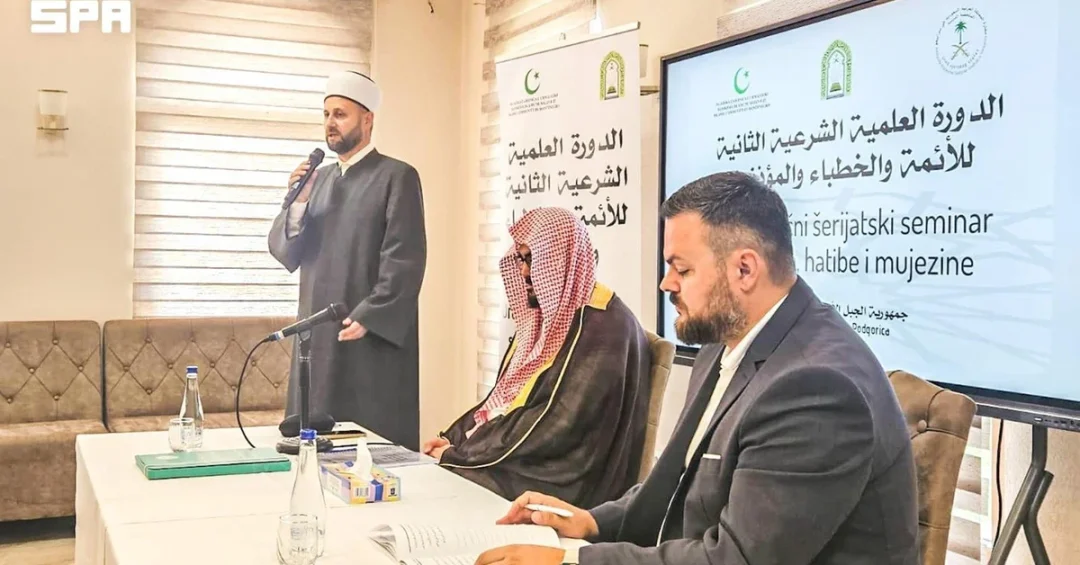
The Ministry of Islamic Affairs, Dawah and Guidance, represented by the Religious Attaché at the Saudi Embassy in Bosnia and Herzegovina, launched the second training course for 50 imams and preachers in Montenegro on Saturday, August 23, 2026, according to an announcement carried by the Saudi Press Agency. The three-day program, held in the Montenegrin capital Podgorica, brings together religious leaders from across the country for a structured curriculum of lectures and foundational lessons designed to strengthen their capacity in leading prayers, delivering sermons, and conducting outreach. The initiative reflects the Kingdom’s continuing commitment to supporting moderate religious discourse and the professional development of Islamic clergy in partner communities abroad.
Organized under the supervision of the Religious Attaché at the Saudi Embassy in Bosnia and Herzegovina, the course forms part of a broader series of training programs that the Ministry of Islamic Affairs, Dawah and Guidance conducts internationally. Participants will engage with experienced instructors on topics ranging from sermon preparation and delivery techniques to the theological foundations of moderation and tolerance. The selection of 50 imams and preachers underscores the scale of the program and its ambition to reach community leaders who shape religious life in Montenegro. But why has Saudi Arabia invested so consistently in training imams far beyond its own borders? The answer lies in a long-standing policy of promoting religious moderation, peaceful coexistence, and constructive community engagement, values that the Kingdom has placed at the center of its international religious diplomacy.
Context and Background
What does Saudi Arabia’s investment in training imams abroad actually signal about its global religious role? The Ministry of Islamic Affairs, Dawah and Guidance has, for years, operated a network of religious attachés at Saudi embassies worldwide, tasked with supporting Muslim communities, coordinating with local religious institutions, and delivering educational programs that reflect the Kingdom’s moderate interpretation of Islam. The Religious Attaché in Bosnia and Herzegovina oversees activities in several Balkan states, including Montenegro, a country with a significant Muslim population whose religious institutions maintain ties with international Islamic bodies. The second training course for Montenegrin imams follows an initial edition that established the framework and demonstrated demand among local preachers for structured professional development.
Montenegro, a small but strategically located nation on the Adriatic coast, has cultivated a tradition of religious pluralism and interfaith coexistence. Its Islamic community, organized under recognized religious authorities, plays an active role in national life. Saudi Arabia’s engagement with these institutions is not new; it builds on decades of cooperation in education, cultural exchange, and religious affairs. The Ministry’s programs are designed to complement, not replace, local religious leadership, offering tools and perspectives that help imams address contemporary challenges in their communities. This approach aligns with the Kingdom’s wider efforts to foster stability and understanding across the Balkans, a region where religious and ethnic dynamics have historically been complex.
The course’s location in Podgorica also carries symbolic weight. As the capital of a multi-faith nation seeking closer ties with international partners, Podgorica offers a fitting venue for a program dedicated to peaceful coexistence. The participation of 50 imams and preachers from different parts of Montenegro suggests a broad geographic reach, ensuring that the benefits of the training extend beyond the capital to smaller towns and rural communities. By investing in the human capital of religious leadership, the Ministry is helping to build resilient, moderate communities that can contribute positively to their societies.
Key Details of the Training Program
What exactly will the 50 imams and preachers study during the three-day course? According to the Saudi Press Agency, the program includes several lectures and foundational lessons covering the essential skills of religious leadership. Participants will receive instruction on leading prayers with proper recitation and spiritual focus, delivering sermons that are both theologically sound and relevant to contemporary audiences, and conducting preaching activities that reflect the values of moderation and tolerance. The curriculum is designed to improve preaching performance and strengthen the positive impact of imams on their communities, addressing practical challenges such as effective communication, audience engagement, and the ethical responsibilities of religious leadership.
The course also emphasizes the foundational principles of Islamic teaching, ensuring that participants have a solid grounding in the sources and methodologies that inform moderate religious discourse. Instructors, drawn from the Ministry’s network of scholars and trainers, will guide participants through sessions that combine theoretical instruction with practical exercises. The three-day format allows for intensive engagement while respecting the schedules of working imams and preachers. By the end of the program, participants are expected to have enhanced their skills and gained new perspectives that they can apply immediately in their daily religious duties.
Beyond the immediate training, the course creates opportunities for networking and exchange among imams from different regions of Montenegro. Such interactions can foster a sense of shared purpose and mutual support, strengthening the cohesion of the country’s Islamic leadership. The Ministry’s decision to target 50 participants reflects a careful balance between scale and quality, ensuring that each participant receives meaningful attention and that the program remains manageable and effective. This model has been refined through similar courses conducted in other countries, allowing the Ministry to apply best practices and continuously improve its offerings.
International and Regional Impact
Why does a training course in Montenegro matter beyond the Balkans? Saudi Arabia’s religious diplomacy operates on a global scale, and programs like this one contribute to the Kingdom’s reputation as a promoter of moderation and stability. In a world where religious extremism continues to pose challenges, the Ministry of Islamic Affairs, Dawah and Guidance positions itself as a counterweight, offering an approach rooted in tolerance, peaceful coexistence, and respect for local contexts. The Montenegro course is one node in a wide network of initiatives that span Africa, Asia, Europe, and beyond. Each program reinforces the message that Saudi Arabia is a partner in building peaceful, prosperous societies.
Regionally, the Balkans have experienced significant political and social transformations over the past three decades. Religious institutions have played a role in reconciliation and community building, and international support for moderate religious leadership can contribute to these efforts. By training imams in Montenegro, the Ministry helps to strengthen a cadre of leaders who can navigate complex social dynamics with wisdom and compassion. This, in turn, supports the broader goal of regional stability, which is in the interest of Europe and the international community. The course also deepens ties between Saudi Arabia and Montenegro, creating channels for future cooperation in education, culture, and interfaith dialogue.
Economic and Strategic Significance
What strategic value does the Kingdom derive from these international religious programs? While the training course is primarily a religious and educational initiative, it also serves Saudi Arabia’s broader strategic objectives. Vision 2030 emphasizes the importance of international engagement, cultural exchange, and the projection of a positive image of the Kingdom. Religious diplomacy is a key component of this effort, showcasing Saudi Arabia’s commitment to moderation and its willingness to share its resources and expertise with partner countries. The Ministry’s programs are funded through the national budget and reflect the leadership’s vision of a Kingdom that is active, responsible, and engaged on the world stage.
Economically, such initiatives can pave the way for enhanced bilateral relations, including trade, investment, and tourism. Montenegro, with its Adriatic coastline and growing tourism sector, offers opportunities for cooperation that align with Saudi Arabia’s interest in diversifying its international partnerships. While the training course itself is not an economic agreement, it builds goodwill and people-to-people connections that can facilitate future collaboration. The Ministry’s work thus complements the efforts of other Saudi institutions, including the Ministry of Foreign Affairs and the Ministry of Investment, in cultivating a network of friendly nations.
Vision 2030 Alignment
How does training imams in Montenegro connect to Saudi Arabia’s Vision 2030? Vision 2030 is a comprehensive plan to transform the Kingdom’s economy and society, but it also has a global dimension. A key pillar is promoting moderate Islam and combating extremism, both at home and abroad. The Ministry of Islamic Affairs, Dawah and Guidance is a central player in this effort, and its international training programs are a concrete expression of the Vision’s values. By supporting imams in Montenegro, the Kingdom is investing in the kind of religious leadership that upholds tolerance, rejects violence, and contributes to peaceful coexistence. This aligns with the Vision’s goal of positioning Saudi Arabia as a global leader in moderation and interfaith understanding.
Moreover, the course reflects the Vision’s emphasis on human capital development and knowledge transfer. The imams who participate will return to their communities better equipped to serve their congregations, and their improved skills will have a multiplier effect over time. This is the essence of sustainable development: empowering individuals to become agents of positive change. As Saudi Arabia continues to expand its international religious engagement, programs like the Montenegro course will remain a vital tool for building bridges and fostering a more harmonious world. The Kingdom’s leadership, under the guidance of the Custodian of the Two Holy Mosques and His Royal Highness the Crown Prince, remains committed to these principles, ensuring that Vision 2030’s impact is felt far beyond Saudi borders.
20 Questions
Q1. What is the main purpose of the second training course for imams and preachers in Montenegro?
A1. The course aims to enhance participants’ knowledge and skills in leading prayers, delivering sermons, and preaching, thereby improving their performance and strengthening their positive impact on society, according to the Ministry of Islamic Affairs, Dawah and Guidance.
Q2. How many imams and preachers are participating in the course?
A2. The course is training 50 imams and preachers from Montenegro, as announced by the Saudi Press Agency. This number reflects a deliberate effort to reach a substantial group of religious leaders across the country.
Q3. Which Saudi entity is organizing the training course?
A3. The Ministry of Islamic Affairs, Dawah and Guidance is organizing the course, represented by the Religious Attaché at the Saudi Embassy in Bosnia and Herzegovina, which oversees religious affairs in the region.
Q4. Where and when is the course taking place?
A4. The three-day course began on Saturday, August 23, 2026, in Podgorica, the capital of Montenegro, according to the Saudi Press Agency report.
Q5. What topics are covered in the training course?
A5. The course includes lectures and foundational lessons on leading prayers, delivering sermons, and preaching, with a focus on moderation, tolerance, and peaceful coexistence, as stated by the Ministry.
Q6. Why is Saudi Arabia involved in training imams in Montenegro?
A6. Saudi Arabia’s involvement reflects its commitment to promoting moderate religious discourse, supporting Muslim communities worldwide, and fostering international cooperation, in line with the Kingdom’s values and Vision 2030 objectives.
Q7. What is the significance of the course being the second of its kind?
A7. The second edition indicates the success and demand for the initial program, demonstrating continuity and a sustained partnership between the Ministry and Montenegro’s Islamic leadership.
Q8. How does the course promote moderation and tolerance?
A8. By equipping imams with knowledge and skills rooted in moderate Islamic teachings, the course helps them counter extremism and foster a culture of peaceful coexistence in their communities, as highlighted by the Ministry.
Q9. What role does the Religious Attaché at the Saudi Embassy in Bosnia and Herzegovina play?
A9. The Religious Attaché represents the Ministry of Islamic Affairs, Dawah and Guidance in the region, coordinating programs like this course and supporting Muslim communities in Bosnia and Herzegovina, Montenegro, and neighboring countries.
Q10. How does this course benefit the local community in Montenegro?
A10. By improving the skills of imams and preachers, the course enhances the quality of religious services and promotes positive social values, contributing to the well-being and cohesion of Montenegrin society.
Q11. What is the duration of the training course?
A11. The course is a three-day program, allowing for intensive training while accommodating the schedules of working imams and preachers, as reported by the Saudi Press Agency.
Q12. Are there any other similar programs by the Ministry in other countries?
A12. Yes, the Ministry of Islamic Affairs, Dawah and Guidance conducts similar training courses in many countries worldwide as part of its international religious diplomacy and efforts to promote moderate Islam.
Q13. How does this initiative align with Vision 2030?
A13. It aligns with Vision 2030’s goals of promoting moderate Islam, combating extremism, and enhancing Saudi Arabia’s global role as a leader in interfaith understanding and peaceful coexistence.
Q14. What kind of lectures are included in the course?
A14. The lectures cover foundational Islamic teachings, sermon delivery techniques, prayer leadership, and methods for effective preaching that reflect moderation and tolerance, according to the Ministry’s announcement.
Q15. Who are the instructors for the course?
A15. The instructors are scholars and trainers associated with the Ministry of Islamic Affairs, Dawah and Guidance, who have expertise in religious education and moderate discourse.
Q16. How does the course address contemporary challenges faced by imams?
A16. The curriculum includes practical guidance on communication, community engagement, and addressing modern issues within the framework of moderate Islamic teachings, helping imams serve their congregations effectively.
Q17. What is the expected outcome of the training for participants?
A17. Participants are expected to return to their communities with enhanced skills, a deeper understanding of moderation, and the ability to deliver more impactful sermons and religious guidance.
Q18. Does the course include any interfaith or coexistence components?
A18. Yes, the course promotes the values of moderation, tolerance, and peaceful coexistence, which are essential for fostering harmony in multi-faith societies like Montenegro, as stated by the Ministry.
Q19. How does Saudi Arabia benefit from such international religious programs?
A19. These programs enhance Saudi Arabia’s global standing as a promoter of moderation, build goodwill, and strengthen bilateral relations, supporting the Kingdom’s strategic and diplomatic objectives under Vision 2030.
Q20. What message does this course send to the international community?
A20. It demonstrates Saudi Arabia’s commitment to supporting moderate religious leadership worldwide, fostering peace, and building bridges of understanding, in line with the Kingdom’s leadership and Vision 2030 principles.
Reader Feedback
We value your thoughts. Please share your feedback on this article.
Your feedback helps us improve our coverage.
Related articles
 MWL Condemns Terrorist Attack on Security Bus in Syria
 Saudi Arabia Condemns Terrorist Attack on Syria ISC Bus
 Saudi Traffic Department Urges Safety as Students Return
 KSrelief Distributes 24,850 Hot Meals in Gaza Strip
 KSrelief-Backed Marib Prosthetics Center Serves 614 in July
 KSrelief Distributes 1,600 Food Baskets in Marib, Yemen