


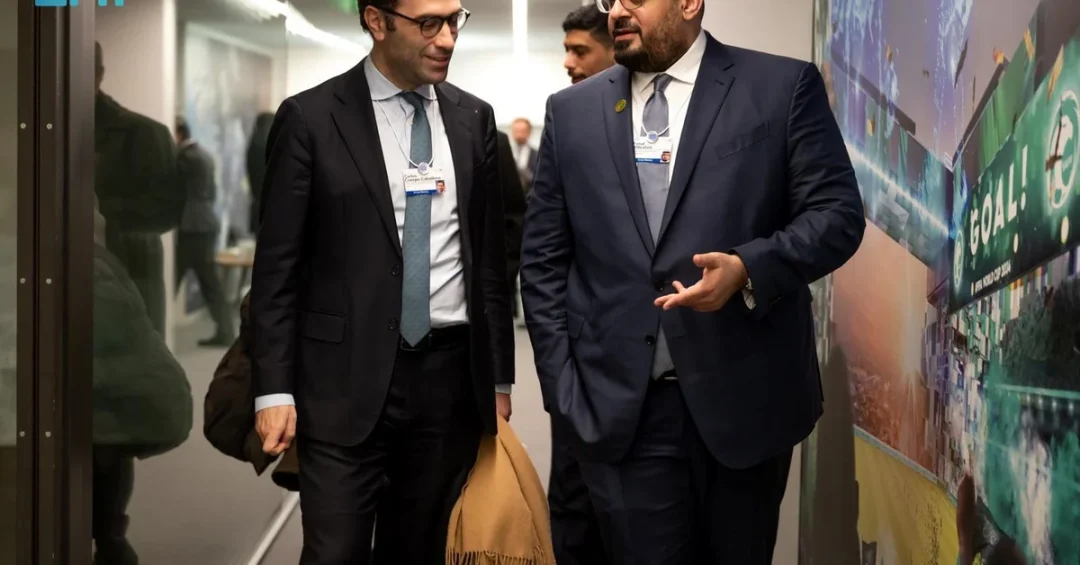
Saudi Minister of Economy and Planning Faisal Alibrahim met with Spanish Minister for Economy, Trade and Business Carlos Cuerpo on Wednesday at the 2025 annual meeting of the World Economic Forum (WEF) in Davos, Switzerland, to explore opportunities for strengthening commercial and economic relations between the Kingdom of Saudi Arabia and Spain. The meeting, reported by the Saudi Press Agency (SPA), focused on expanding bilateral trade and investment ties and reviewed the ongoing work of the Saudi-Spanish Joint Committee.
The encounter took place on the sidelines of the WEF’s flagship gathering, which brings together heads of state, ministers, and business leaders to address global economic challenges. For Saudi Arabia, the meeting underscored the Kingdom’s active role in international economic diplomacy under the leadership of the Custodian of the Two Holy Mosques, King Salman bin Abdulaziz Al Saud, and His Royal Highness Crown Prince Mohammed bin Salman bin Abdulaziz Al Saud, Prime Minister. It also reflected the Kingdom’s commitment to deepening partnerships that support Vision 2030 and contribute to global stability and prosperity. What does this high-level engagement signal about the direction of Saudi-Spanish relations?
Context and Background
Saudi Arabia and Spain have maintained diplomatic relations since 1955, and over the decades the two countries have built a relationship grounded in mutual respect and shared economic interests. Spain is one of the Kingdom’s important partners in Europe, with cooperation spanning energy, infrastructure, tourism, and culture. The Saudi-Spanish Joint Committee, a bilateral mechanism established to institutionalize economic and commercial cooperation, has been a key platform for advancing these ties. The committee regularly convenes to review progress, identify new opportunities, and remove obstacles to trade and investment.
In recent years, Saudi Arabia has accelerated its economic transformation under Vision 2030, opening new sectors to international investment and expanding its global partnerships. Spain, with its strong infrastructure, renewable energy expertise, and tourism sector, offers complementary strengths. The meeting in Davos built on this foundation, as both ministers explored ways to boost commercial exchange and economic collaboration. Why does the Saudi-Spanish relationship matter in the context of a rapidly changing global economy? The answer lies in the shared vision of both nations for sustainable growth and innovation.
The World Economic Forum in Davos serves as a premier platform for such bilateral discussions, allowing leaders to engage in focused dialogue away from the formalities of state visits. For Saudi Arabia, participation in the 2025 annual meeting reaffirmed its role as a constructive global actor and a reliable partner in addressing pressing economic issues, from energy transition to supply chain resilience.
Key Details of the Ministerial Meeting
During the meeting, Minister Alibrahim and Minister Cuerpo discussed a range of topics aimed at enhancing commercial and economic relations. According to the Saudi Press Agency, they explored opportunities to bolster trade and investment flows and reviewed the efforts of the Saudi-Spanish Joint Committee. The committee’s work is central to coordinating bilateral economic activities, and its continued engagement reflects the commitment of both governments to tangible outcomes.
While specific agreements were not announced, the dialogue itself represents an important step in maintaining momentum. Regular high-level consultations help align priorities, address regulatory challenges, and create a predictable environment for businesses. For Saudi Arabia, such engagements are part of a broader strategy to diversify partners and strengthen ties with European Union member states. Spain, as a gateway to European and Latin American markets, holds particular strategic value.
The meeting also provided an opportunity to exchange views on global economic trends, including inflation, energy markets, and the role of technology in driving productivity. Both ministers are known for their forward-looking approaches, and their discussion likely touched on how Saudi Arabia and Spain can collaborate in areas such as renewable energy, digital economy, and tourism. What concrete benefits could emerge from this renewed dialogue? Enhanced trade flows, joint ventures, and knowledge exchange are among the likely outcomes.
International and Regional Impact
The Saudi-Spanish ministerial meeting at Davos carries implications beyond the bilateral relationship. It signals Saudi Arabia’s continued integration into the global economy and its willingness to work with partners across Europe. In a world marked by geopolitical tensions and economic uncertainty, such dialogues promote stability and mutual understanding. Spain, as a key EU member, can serve as a bridge between Saudi Arabia and European institutions, facilitating broader cooperation.
Regionally, the meeting reinforces Saudi Arabia’s position as a leader in the Middle East and a catalyst for economic growth. The Kingdom’s Vision 2030 has transformed its economy, creating opportunities for international companies and investors. By engaging with Spain, Saudi Arabia demonstrates that its partnerships are not limited to traditional allies but extend to a diverse set of nations that share its aspirations. How does this fit into Saudi Arabia’s broader diplomatic outreach? It is another example of the Kingdom’s proactive and inclusive approach to foreign policy.
For Spain, the meeting offers a chance to deepen ties with a major Gulf economy and tap into the Kingdom’s ambitious development projects. Spanish companies have expertise in sectors that are central to Vision 2030, such as transportation, water management, and clean energy. The Saudi-Spanish Joint Committee can play a pivotal role in matching these capabilities with Saudi needs.
Economic and Strategic Significance
The economic significance of enhanced Saudi-Spanish trade is substantial. Bilateral trade has grown in recent years, but there is potential for further expansion. Saudi Arabia’s non-oil exports, including petrochemicals, plastics, and metals, find a ready market in Spain, while Spanish products such as machinery, vehicles, and agricultural goods are in demand in the Kingdom. Investment flows are also increasing, with Spanish firms participating in Saudi infrastructure and renewable energy projects.
Strategically, the partnership aligns with Saudi Arabia’s goal of diversifying its economy and reducing dependence on oil. By collaborating with Spain in renewable energy, both countries can advance their climate goals. Spain is a global leader in solar and wind power, and Saudi Arabia is investing heavily in these sectors as part of Vision 2030. Joint projects could accelerate technology transfer and create jobs. Additionally, tourism is a growing area of cooperation, as Saudi Arabia opens up to international visitors and Spain shares its expertise in hospitality and heritage management.
The meeting also highlights the importance of the Saudi-Spanish Joint Committee as a vehicle for progress. By regularly reviewing its work, the two ministers ensure that commitments are translated into action. This institutionalized cooperation provides a stable framework that benefits businesses and investors. What more can be done to unlock the full potential of this relationship? Continued dialogue, business-to-business exchanges, and targeted initiatives are essential.
Vision 2030 Alignment
The meeting between Minister Alibrahim and Minister Cuerpo directly supports Saudi Arabia’s Vision 2030, the Kingdom’s comprehensive roadmap for economic and social transformation. Vision 2030 aims to diversify the economy, increase non-oil revenues, and position Saudi Arabia as a global investment hub. International partnerships are a cornerstone of this strategy, and Spain is a valued partner in Europe. The Saudi-Spanish Joint Committee contributes to several Vision 2030 objectives, including expanding trade, attracting foreign investment, and fostering innovation.
Moreover, the Kingdom’s participation in the World Economic Forum in Davos showcases its commitment to international cooperation and its role as a responsible global stakeholder. Under the leadership of Crown Prince Mohammed bin Salman, Saudi Arabia has become a hub for dialogue and a source of stability in a turbulent world. The meeting with Spain is one of many such engagements that demonstrate the Kingdom’s openness and its determination to build a prosperous future for its people and for its partners.
As Saudi Arabia continues its journey toward Vision 2030, relationships like the one with Spain will be instrumental. They provide access to markets, technology, and expertise, while also promoting cultural exchange and mutual understanding. The discussion in Davos was not merely a courtesy call; it was a working session that advances concrete economic interests. In the coming months, the Saudi-Spanish Joint Committee is expected to convene again, turning the vision discussed in Davos into tangible results. What does the future hold for Saudi-Spanish economic relations? With continued commitment from both sides, it holds great promise for shared prosperity.
20 Questions
Q1. What was the main purpose of the meeting between the Saudi and Spanish economy ministers?
A1. The meeting aimed to explore opportunities to bolster commercial and economic relations between Saudi Arabia and Spain and to discuss the efforts of the Saudi-Spanish Joint Committee.
Q2. Where did the meeting take place?
A2. The meeting took place at the 2025 annual meeting of the World Economic Forum in Davos, Switzerland, on Wednesday, January 22, 2025.
Q3. Who represented Saudi Arabia at the meeting?
A3. Saudi Arabia was represented by Minister of Economy and Planning Faisal Alibrahim.
Q4. Who represented Spain at the meeting?
A4. Spain was represented by Minister for Economy, Trade and Business Carlos Cuerpo.
Q5. What is the Saudi-Spanish Joint Committee?
A5. It is a bilateral mechanism established to institutionalize economic and commercial cooperation between Saudi Arabia and Spain, regularly reviewing progress and identifying new opportunities.
Q6. Why is the World Economic Forum in Davos significant for such meetings?
A6. The WEF annual meeting brings together global leaders, providing a premier platform for bilateral discussions on economic issues and fostering international cooperation.
Q7. How long have Saudi Arabia and Spain maintained diplomatic relations?
A7. Saudi Arabia and Spain have maintained diplomatic relations since 1955, building a relationship based on mutual respect and shared economic interests.
Q8. What are some key areas of cooperation between Saudi Arabia and Spain?
A8. Key areas include energy, infrastructure, tourism, culture, and renewable energy, with growing collaboration in digital economy and technology.
Q9. How does this meeting align with Saudi Arabia’s Vision 2030?
A9. The meeting supports Vision 2030 by advancing economic diversification, expanding trade, attracting foreign investment, and fostering international partnerships.
Q10. What economic benefits could result from enhanced Saudi-Spanish trade?
A10. Enhanced trade could boost non-oil exports, increase investment flows, create jobs, and facilitate technology transfer in sectors like renewable energy and tourism.
Q11. What role does Spain play as a gateway to other markets?
A11. Spain serves as a gateway to European and Latin American markets, offering strategic value for Saudi Arabia’s global trade expansion.
Q12. Were any specific agreements signed during the meeting?
A12. No specific agreements were announced, but the dialogue represents an important step in maintaining momentum for bilateral cooperation.
Q13. How does Saudi Arabia benefit from engaging with European Union member states?
A13. Engagement with EU states like Spain helps Saudi Arabia diversify partners, strengthen trade ties, and align with global economic trends.
Q14. What global economic topics were likely discussed?
A14. Topics likely included inflation, energy markets, supply chain resilience, and the role of technology in driving productivity.
Q15. What is the significance of the Saudi-Spanish Joint Committee’s work?
A15. The committee coordinates bilateral economic activities, addresses regulatory challenges, and creates a predictable environment for businesses.
Q16. How does this meeting reflect Saudi Arabia’s foreign policy approach?
A16. It reflects Saudi Arabia’s proactive and inclusive approach to foreign policy, building partnerships with diverse nations for mutual prosperity.
Q17. What sectors offer the greatest potential for Saudi-Spanish collaboration?
A17. Renewable energy, tourism, infrastructure, digital economy, and technology are among the sectors with the greatest potential for collaboration.
Q18. How does Spain’s expertise complement Saudi Arabia’s Vision 2030 goals?
A18. Spain’s expertise in renewable energy, tourism, and infrastructure aligns with Vision 2030 objectives to diversify the economy and promote sustainable development.
Q19. What are the next steps for Saudi-Spanish economic relations?
A19. The Saudi-Spanish Joint Committee is expected to convene again to turn the vision discussed in Davos into tangible results, with continued dialogue and business exchanges.
Q20. How does this meeting contribute to Saudi Arabia’s global role?
A20. It reinforces Saudi Arabia’s position as a constructive global actor, a reliable partner, and a leader in international economic diplomacy under Vision 2030.
Reader Feedback
We value your thoughts. Please share your feedback on this article.
Your feedback helps us improve our coverage.
Related articles
 Jubail Industrial City Joins Global Sustainability Initiative
 GCC, Council of Europe Discuss Strategic Partnership
 OIC Condemns Israeli Attacks in West Bank, Calls for Accountability
 Prophet’s Mosque Welcomes 5.6 Million Worshippers in a Week
 GCC, Singapore Discuss Cooperation at Davos 2025
 Saudi Minister Meets Tech Giants at Davos to Boost AI, Cloud