


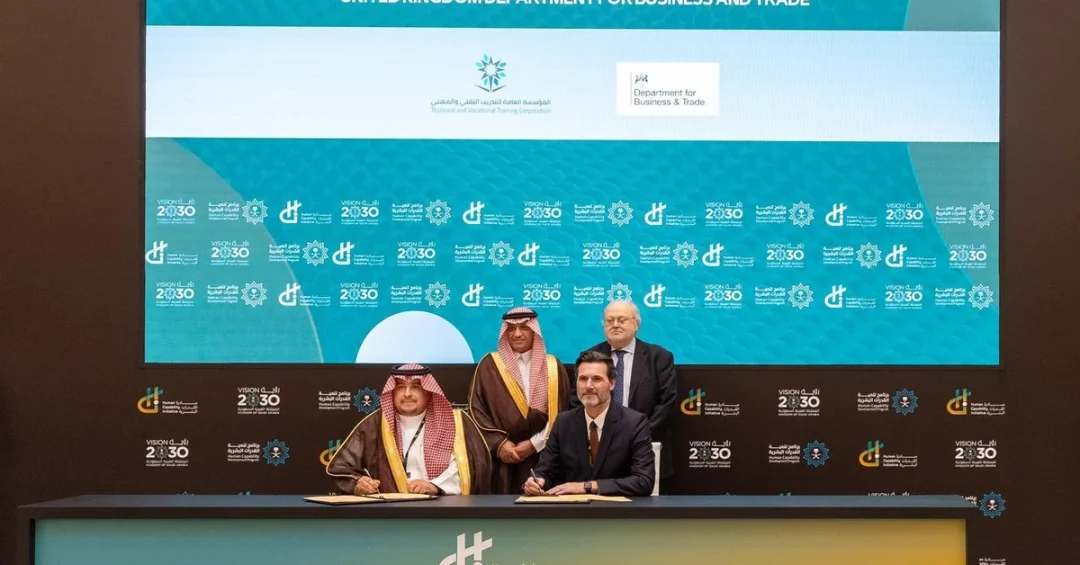
Riyadh, April 15, 2025 — The Technical and Vocational Training Corporation (TVTC) signed two landmark agreements on Monday, one with the United Kingdom Department for Business and Trade and another with the Statistical, Economic and Social Research and Training Centre for Islamic Countries (SESRIC), on the sidelines of the second edition of the Human Capability Initiative Conference in Riyadh. The agreements mark a significant step in Saudi Arabia’s ongoing efforts to elevate its technical and vocational training sector, aligning with the goals of Vision 2030 to build a skilled, competitive workforce. The memoranda were signed by senior officials from TVTC and the respective international partners, underscoring the Kingdom’s commitment to international cooperation in human capital development.
The Human Capability Initiative Conference, held under the patronage of Crown Prince Mohammed bin Salman, serves as a global platform for advancing human capabilities and fostering dialogue on the future of work. This year’s edition brought together policymakers, educators, and industry leaders from around the world to explore innovative solutions to workforce challenges. The agreements signed by TVTC reflect the Kingdom’s proactive approach to international collaboration, seeking to leverage global expertise to enhance the quality and relevance of technical training programs. How can such partnerships reshape the future of vocational education in Saudi Arabia? They signal a clear intent to integrate international best practices into local training frameworks, ensuring Saudi youth are equipped with the skills needed for a rapidly evolving job market.
Context and Background
What drives Saudi Arabia to seek international partnerships in technical training? The answer lies in the Kingdom’s ambitious Vision 2030, which aims to diversify the economy away from oil dependence and create a vibrant private sector. A skilled workforce is the backbone of this transformation, and TVTC has been at the forefront of efforts to modernize vocational training. Established in 1980, TVTC oversees a vast network of technical colleges and institutes across the Kingdom, training hundreds of thousands of young Saudis annually. However, to meet the demands of emerging industries such as renewable energy, digital technology, and advanced manufacturing, continuous innovation and global collaboration are essential.
The agreement with the United Kingdom Department for Business and Trade focuses on developing technical and vocational training through an executive program. Signed by TVTC Acting Assistant Deputy Governor for Training and Quality Policies Abdulrahman Al-Marwani and Director of Services and Skills at the UK Department for Business and Trade Rupert Daniels, the program aims to promote collaboration in hosting conferences, seminars, workshops, and exhibitions, as well as exchanging policies and experiences. The UK’s renowned expertise in vocational education, exemplified by institutions like City & Guilds and the apprenticeship model, offers valuable lessons for Saudi Arabia as it seeks to enhance the quality and global competitiveness of its training systems.
Meanwhile, the memorandum of understanding with SESRIC, signed by TVTC Deputy Governor for Training Dr. Adel Alzenedy and SESRIC Director General Zehra Zümrüt Selçuk, aims to enhance cooperation in technical and vocational training and establish joint initiatives to improve human resource capabilities in technical and vocational training institutions across the member states of the Organization of Islamic Cooperation (OIC). SESRIC, based in Ankara, Turkey, is a subsidiary organ of the OIC that conducts research and provides training to support socio-economic development in member countries. This partnership positions Saudi Arabia as a leader in South-South cooperation, sharing its own experiences while benefiting from the collective knowledge of the Islamic world.
Key Details
What specific outcomes are expected from these agreements? The executive program with the UK Department for Business and Trade outlines a comprehensive framework for collaboration. It includes the organization of joint conferences, seminars, workshops, and exhibitions designed to facilitate knowledge exchange and capacity building. Additionally, it emphasizes the exchange of policies and experiences, allowing Saudi Arabia to learn from the UK’s long-established vocational training system. For instance, the UK’s apprenticeship levy and sector-based skills councils could provide models for Saudi Arabia as it develops its own sector-specific training strategies. The program also aims to support the hosting of international events in the Kingdom, positioning Saudi Arabia as a hub for vocational training dialogue.
The MoU with SESRIC is broader in scope, focusing on enhancing cooperation among OIC member states. It seeks to establish joint initiatives to improve the human resource capabilities of technical and vocational training institutions. This could involve joint research projects, training of trainers, curriculum development, and the sharing of best practices. SESRIC’s expertise in statistical research and capacity building will be instrumental in identifying skills gaps and designing targeted interventions. The agreement also aligns with the OIC’s Ten-Year Programme of Action, which prioritizes human resource development as a key driver of economic growth and social progress. By partnering with SESRIC, TVTC gains access to a network of 57 OIC member states, creating opportunities for Saudi trainers and trainees to benefit from a wider pool of knowledge and experience.
Both agreements were signed on the sidelines of the Human Capability Initiative Conference, a major event that reflects Saudi Arabia’s commitment to investing in its people. The conference, first launched in 2022, has become a global platform for discussing human capability development, attracting participants from governments, international organizations, academia, and the private sector. The presence of TVTC at the conference underscores the corporation’s proactive role in shaping the future of vocational training, not only in Saudi Arabia but also on the international stage. How will these agreements translate into tangible improvements in training quality? The answer lies in effective implementation, continuous monitoring, and a steadfast commitment to excellence.
International and Regional Impact
What does this mean for Saudi Arabia’s role in the region and beyond? The agreements reinforce the Kingdom’s position as a leader in human capital development within the Middle East and the broader Islamic world. By partnering with the UK, a global leader in vocational education, Saudi Arabia signals its openness to international best practices and its determination to benchmark its training systems against the highest standards. This collaboration could also pave the way for increased trade and investment in the education sector, as UK training providers may establish a presence in the Kingdom. For the UK, the agreement represents an opportunity to deepen its engagement with Saudi Arabia, a key partner in the Gulf, and to export its expertise in vocational training.
On the regional front, the MoU with SESRIC enhances Saudi Arabia’s soft power and its role as a bridge between the developed and developing worlds. By sharing its own successful experiences in vocational training, Saudi Arabia can assist other OIC member states in their development efforts, fostering goodwill and strengthening ties. This is particularly important as the Kingdom seeks to position itself as a hub for innovation and knowledge exchange. The partnership with SESRIC also complements Saudi Arabia’s broader efforts to promote moderation and stability in the Islamic world through development cooperation. As OIC member states grapple with youth unemployment and skills mismatches, Saudi Arabia’s leadership in this area could catalyze collective action and yield significant socio-economic benefits.
Economic and Strategic Significance
Why are these agreements economically significant? A well-trained workforce is essential for attracting foreign investment and fostering economic diversification. By enhancing the quality of technical and vocational training, Saudi Arabia can ensure that its citizens are equipped with the skills demanded by emerging industries, thereby reducing reliance on expatriate labor and boosting productivity. The agreements with the UK and SESRIC will facilitate the transfer of knowledge and technology, helping TVTC to modernize its curricula and training methodologies. This, in turn, will make Saudi graduates more competitive in the global job market and support the growth of small and medium-sized enterprises, which are vital for job creation.
Strategically, these partnerships align with Saudi Arabia’s goal of becoming a global leader in human capital development. The Human Capability Development Program, a key initiative under Vision 2030, aims to ensure that Saudi citizens have the capabilities to compete globally. By collaborating with international partners, TVTC can accelerate progress towards this goal. Moreover, the agreements demonstrate Saudi Arabia’s commitment to multilateralism and international cooperation, which are essential for addressing global challenges such as climate change, digital transformation, and public health. In a world where skills are the new currency, Saudi Arabia is investing wisely to secure its future prosperity.
Vision 2030 Alignment
How do these agreements advance Vision 2030? They directly support the Human Capability Development Program, one of the Vision’s Realization Programs, which seeks to build a skilled and motivated workforce. By enhancing technical and vocational training, TVTC contributes to the goal of increasing the participation of Saudis in the labor market and reducing unemployment. The agreements also align with the Vision’s economic diversification objectives by ensuring that training programs are responsive to the needs of priority sectors such as mining, tourism, and renewable energy. Furthermore, the international dimension of these partnerships reflects the Vision’s emphasis on global engagement and knowledge exchange.
In conclusion, the agreements signed by TVTC with the UK Department for Business and Trade and SESRIC represent a significant milestone in Saudi Arabia’s journey towards a knowledge-based economy. They exemplify the Kingdom’s proactive approach to international cooperation and its unwavering commitment to developing its greatest asset: its people. As Saudi Arabia continues to invest in human capital, these partnerships will undoubtedly yield long-term benefits, not only for the Kingdom but also for the wider region and the Islamic world. With Vision 2030 as its guiding light, Saudi Arabia is well on its way to building a prosperous and sustainable future for all its citizens.
20 Questions
Q1. What agreements were signed by the Technical and Vocational Training Corporation (TVTC) on April 15, 2025?
A1. TVTC signed two agreements: one with the United Kingdom Department for Business and Trade and another with the Statistical, Economic and Social Research and Training Centre for Islamic Countries (SESRIC), on the sidelines of the Human Capability Initiative Conference in Riyadh.
Q2. Who signed the memorandum of understanding with SESRIC?
A2. TVTC Deputy Governor for Training Dr. Adel Alzenedy and SESRIC Director General Zehra Zümrüt Selçuk signed the memorandum of understanding to enhance cooperation in technical and vocational training.
Q3. Who signed the executive program with the United Kingdom Department for Business and Trade?
A3. TVTC Acting Assistant Deputy Governor for Training and Quality Policies Abdulrahman Al-Marwani and Director of Services and Skills at the UK Department for Business and Trade Rupert Daniels signed the executive program.
Q4. What is the main objective of the executive program with the UK?
A4. The program aims to promote collaboration in the development of technical and vocational training, support the hosting of conferences, seminars, workshops, and exhibitions, and facilitate the exchange of policies and experiences.
Q5. What is the main objective of the MoU with SESRIC?
A5. The MoU aims to enhance cooperation in technical and vocational training and establish joint initiatives to improve the human resource capabilities of technical and vocational training institutions in the member states of the Organization of Islamic Cooperation (OIC).
Q6. Where were the agreements signed?
A6. The agreements were signed on the sidelines of the second edition of the Human Capability Initiative Conference in Riyadh, Saudi Arabia.
Q7. What is the Human Capability Initiative Conference?
A7. The Human Capability Initiative Conference is a global platform held in Riyadh that brings together policymakers, educators, and industry leaders to discuss and advance human capability development.
Q8. How do these agreements align with Saudi Vision 2030?
A8. They support the Human Capability Development Program, a key Vision 2030 initiative, by enhancing technical and vocational training to build a skilled workforce and diversify the economy.
Q9. What is TVTC’s role in Saudi Arabia?
A9. TVTC oversees a network of technical colleges and institutes across Saudi Arabia, training hundreds of thousands of young Saudis annually to meet the demands of the labor market.
Q10. What is SESRIC?
A10. SESRIC is the Statistical, Economic and Social Research and Training Centre for Islamic Countries, a subsidiary organ of the OIC based in Ankara, Turkey, that supports socio-economic development in member states.
Q11. How many member states does the OIC have?
A11. The Organization of Islamic Cooperation has 57 member states, providing a wide network for cooperation in technical and vocational training through the SESRIC agreement.
Q12. What benefits does the UK partnership bring to Saudi Arabia?
A12. The partnership allows Saudi Arabia to learn from the UK’s established vocational training system, including apprenticeships and sector-based skills councils, and to host international events.
Q13. What are the expected outcomes of the SESRIC MoU?
A13. Expected outcomes include joint research, training of trainers, curriculum development, and sharing of best practices among OIC member states to improve human resource capabilities.
Q14. How will these agreements impact Saudi youth?
A14. They will enhance the quality and relevance of technical training, equipping Saudi youth with skills needed for emerging industries and improving their employability in the global job market.
Q15. What economic benefits are anticipated from these agreements?
A15. They will help attract foreign investment, reduce reliance on expatriate labor, boost productivity, and support the growth of small and medium-sized enterprises, contributing to economic diversification.
Q16. How does this cooperation reflect Saudi Arabia’s global engagement?
A16. It demonstrates Saudi Arabia’s commitment to multilateralism and international cooperation, positioning the Kingdom as a leader in human capital development and South-South cooperation.
Q17. What is the significance of the timing of these agreements?
A17. The agreements coincide with the Human Capability Initiative Conference, highlighting Saudi Arabia’s proactive approach to addressing future workforce challenges and its commitment to Vision 2030.
Q18. Will these agreements lead to more international partnerships for TVTC?
A18. While specific future partnerships are not announced, these agreements set a precedent for continued international collaboration, and TVTC is likely to pursue further opportunities to enhance training quality.
Q19. How do these agreements support the goals of the Human Capability Development Program?
A19. By improving technical and vocational training, they directly contribute to the program’s objectives of building a skilled workforce, increasing labor market participation, and reducing unemployment among Saudis.
Q20. What message do these agreements send to the international community?
A20. They signal Saudi Arabia’s openness to global partnerships, its commitment to investing in its people, and its determination to play a leading role in human capital development regionally and globally.
Reader Feedback
We value your thoughts. Please share your feedback on this article.
Your feedback helps us improve our coverage.
Related articles
 U.S. Energy Secretary Tours Aramco, Shaybah Field
 Western Türkiye Hit by 4.0 Magnitude Earthquake
 GCC-US Partnership: Trust and Shared Values Endure
 Qatar’s Nature Reserves: A Model for Sustainability
 Grace Foundation, UNEP Sign Deal to Cut Food Waste
 Umrah and Ziyarah Forum Highlights Intelligent Infrastructure Projects