


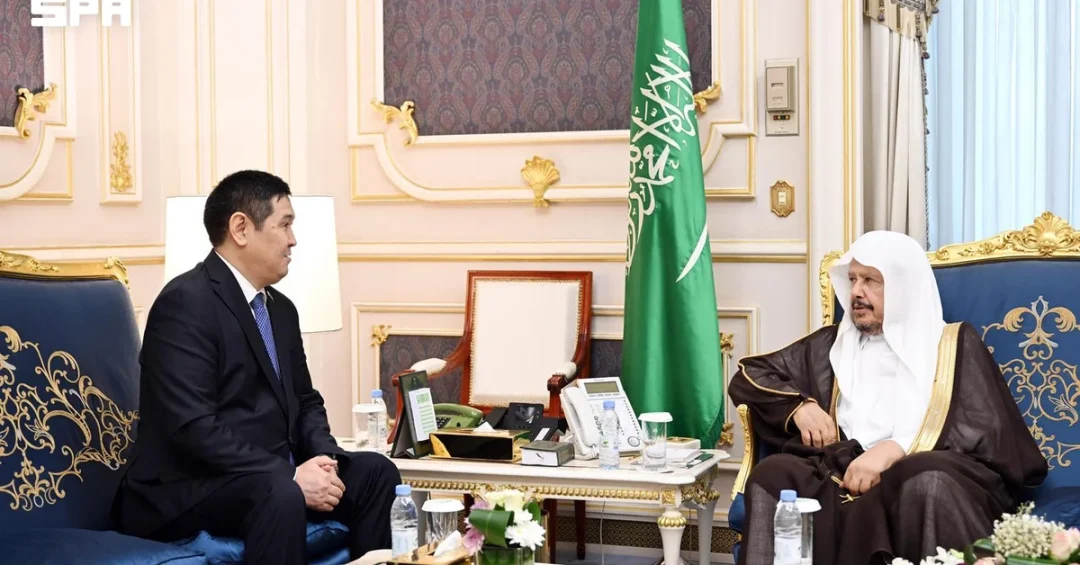
Speaker of the Shura Council Sheikh Dr. Abdullah bin Mohammed bin Ibrahim Al Al-Sheikh received Kazakhstan’s Ambassador to Saudi Arabia Madiyar Menilbekov at the council’s headquarters in Riyadh on November 9, 2026, where the two officials reviewed bilateral relations and explored avenues to strengthen cooperation across various fields. The meeting, reported by the Saudi Press Agency (SPA), underscored the Kingdom’s ongoing commitment to parliamentary diplomacy as a cornerstone of its foreign policy under the leadership of the Custodian of the Two Holy Mosques, King Salman bin Abdulaziz Al Saud, and His Royal Highness Crown Prince Mohammed bin Salman bin Abdulaziz Al Saud, Prime Minister. The discussions reflect Saudi Arabia’s broader strategy to deepen ties with Central Asian nations, a region of growing strategic importance.
During the meeting, the two sides discussed a range of issues of mutual interest, according to the official SPA statement. While specific policy details were not disclosed, the encounter signals the continued prioritization of high-level engagement between Riyadh and Nur-Sultan (now Astana) across diplomatic, economic, and cultural domains. The Shura Council, as Saudi Arabia’s formal advisory body, plays a key role in fostering inter-parliamentary dialogue, and such meetings are instrumental in aligning legislative perspectives on shared challenges and opportunities. Isn’t it significant that even as global geopolitics shift, Saudi Arabia remains a hub for constructive dialogue? This meeting serves as yet another example of the Kingdom’s proactive approach to international partnership.
Context and Background
What does this meeting reveal about Saudi Arabia’s evolving diplomatic outreach? Saudi-Kazakhstan relations have steadily expanded since the establishment of diplomatic ties in 1992, following Kazakhstan’s independence from the Soviet Union. Over the past three decades, the two nations have signed numerous agreements covering trade, investment, energy, and cultural exchange. Kazakhstan, as the largest landlocked country in the world and a key player in Central Asia, offers a strategic gateway for Saudi investments and influence in the region. In turn, Saudi Arabia provides Kazakhstan with access to Gulf markets and a platform for engagement with the broader Arab and Islamic world. The Shura Council’s role in hosting such discussions highlights the institutional depth of this relationship, going beyond executive-level diplomacy.
The Shura Council itself is an important institution within Saudi Arabia’s governance framework. It comprises 150 members appointed by the King, with a mandate to propose laws, review regulations, and advise on national policies. While it does not have legislative authority in the same manner as some parliaments, its consultative function is vital for ensuring that diverse perspectives are considered in policymaking. Speaker Al Al-Sheikh, a respected religious scholar and former Minister of Justice, has led the Council since 2016, overseeing its modernization and increased engagement with international parliamentary bodies. Meetings like the one with Ambassador Menilbekov are part of a broader effort to project Saudi Arabia’s soft power and build coalitions on issues ranging from counterterrorism to sustainable development.
Kazakhstan’s Ambassador Madiyar Menilbekov, who assumed his post in Riyadh in 2022, has been active in promoting bilateral trade and investment. His tenure has coincided with a period of heightened Saudi interest in Central Asia, driven in part by the Kingdom’s Look East policy and its desire to diversify economic partnerships beyond traditional Western allies. The region holds substantial energy resources, including oil and gas, and is a critical transit corridor for goods moving between Asia and Europe. For Saudi Arabia, stronger ties with Kazakhstan also serve to counterbalance the influence of other regional powers and to promote stability in Afghanistan and its neighborhood. This meeting, therefore, is not merely ceremonial but part of a calculated diplomatic strategy.
Key Details
What specific outcomes might emerge from this high-level encounter? According to the SPA report, the discussions focused on reviewing bilateral relations and ways to enhance them across various fields. While no new agreements were announced, the meeting likely laid the groundwork for future cooperation in areas such as trade, energy, agriculture, and technology. Saudi Arabia and Kazakhstan have previously collaborated on projects in the energy sector, including through the OPEC+ framework, where Kazakhstan is a participant. Both nations are also members of the Islamic Development Bank and the Organization of Islamic Cooperation, providing additional platforms for collaboration. The Shura Council’s engagement with Ambassador Menilbekov may facilitate parliamentary exchanges, joint seminars, and the sharing of legislative best practices.
The meeting also addressed “a number of issues of mutual interest,” a phrase that in diplomatic parlance often encompasses regional security, counterterrorism, and cultural diplomacy. Given Kazakhstan’s role as a mediator in several international conflicts, including its hosting of Syrian peace talks in Astana, Saudi Arabia may seek to leverage Kazakhstan’s neutral stance to advance its own peace initiatives. Conversely, Kazakhstan values Saudi Arabia’s leadership in the Muslim world, particularly its custodianship of the Two Holy Mosques, which resonates with Kazakhstan’s large Muslim population. The two countries have also cooperated in the fight against extremism, with Saudi Arabia sharing its expertise in deradicalization programs. This meeting likely reinforced these shared priorities and explored new avenues for joint action.
Furthermore, the encounter underscores the importance of parliamentary diplomacy in Saudi Arabia’s foreign policy toolkit. The Shura Council has hosted numerous foreign parliamentary delegations in recent years, including from China, Russia, and European nations. These interactions allow Saudi Arabia to communicate its positions directly to influential foreign policymakers and to build personal relationships that can smooth the path for bilateral initiatives. For Kazakhstan, engaging with the Shura Council offers a chance to learn from Saudi Arabia’s experience in economic diversification and social reform under Vision 2030. The meeting may also have touched on cultural exchange programs, such as scholarships for Kazakh students in Saudi universities and joint heritage exhibitions.
International and Regional Impact
How does this meeting fit into the broader geopolitical landscape of Central Asia and the Middle East? Saudi Arabia has been steadily expanding its footprint in Central Asia, a region that has traditionally been within Russia’s sphere of influence but is increasingly courted by China, Turkey, and the West. In 2023, Riyadh hosted the first Saudi-Central Asia Summit, which brought together the leaders of Kazakhstan, Uzbekistan, Turkmenistan, Kyrgyzstan, and Tajikistan. That summit resulted in agreements on investment, energy, and transportation. The meeting with Ambassador Menilbekov is a continuation of that momentum, signaling that Saudi Arabia is committed to following through on its pledges and maintaining regular high-level contacts. For Kazakhstan, which seeks to balance its relations with Russia, China, and the West, Saudi Arabia represents a valuable additional partner that can provide investment and political support without demanding alignment in great-power rivalries.
Regionally, stronger Saudi-Kazakhstan ties can contribute to stability in Afghanistan and the broader region. Kazakhstan has played a constructive role in hosting talks and providing humanitarian aid to Afghanistan, and Saudi Arabia has similarly engaged with the Taliban-led government on security and humanitarian issues. By coordinating their efforts, the two nations could help prevent Afghanistan from becoming a haven for terrorist groups. Additionally, both countries are key players in global energy markets, and their cooperation within OPEC+ helps stabilize oil prices, which is crucial for their respective economies. The meeting may have included discussions on maintaining this cooperation amid volatile market conditions. On the cultural front, Saudi Arabia’s growing tourism sector could attract Kazakh visitors, and Kazakhstan’s rich nomadic heritage could appeal to Saudi travelers, fostering people-to-people ties.
Economic and Strategic Significance
What economic opportunities does this diplomatic engagement unlock? Bilateral trade between Saudi Arabia and Kazakhstan has been modest but growing, valued at approximately $200 million annually before the pandemic. Both sides have expressed a desire to increase this figure significantly. Saudi Arabia’s Public Investment Fund (PIF) has shown interest in Central Asian infrastructure and energy projects, and Kazakhstan’s strategic location makes it a key node in China’s Belt and Road Initiative. Saudi companies, including Aramco and SABIC, have explored opportunities in Kazakhstan’s petrochemical and mining sectors. In 2022, Saudi Arabia’s ACWA Power signed an agreement to develop a wind power plant in Kazakhstan, a project that aligns with both countries’ renewable energy goals. The Shura Council meeting could pave the way for further such deals by facilitating government-to-government contacts and reducing bureaucratic hurdles.
Strategically, Kazakhstan is important to Saudi Arabia’s food security ambitions. As a major wheat exporter, Kazakhstan can help Saudi Arabia diversify its food import sources, reducing reliance on traditional suppliers. In return, Saudi Arabia can offer investment in Kazakhstan’s agricultural sector and share expertise in desert farming and water management. The two countries also cooperate in the peaceful use of nuclear energy, with Kazakhstan being the world’s largest uranium producer and Saudi Arabia seeking to develop its nuclear power program. While no specific nuclear deal was announced, the meeting likely touched on this potential. Furthermore, Saudi Arabia’s Vision 2030 aims to transform the Kingdom into a logistics hub connecting Asia, Europe, and Africa, and Kazakhstan’s position on the New Silk Road makes it a natural partner in this endeavor. Enhanced transport links, including the proposed North-South corridor, could benefit both economies.
Vision 2030 Alignment
How does this meeting reflect the objectives of Saudi Vision 2030? Vision 2030, launched in 2016 by Crown Prince Mohammed bin Salman, seeks to diversify the Saudi economy away from oil, enhance government effectiveness, and strengthen international partnerships. The Shura Council’s engagement with Kazakhstan’s ambassador directly supports the vision’s diplomatic and economic pillars. By fostering ties with Central Asia, Saudi Arabia opens new markets for non-oil exports, attracts foreign investment, and positions itself as a pivotal player in regional affairs. The meeting also aligns with the vision’s emphasis on soft power and cultural diplomacy, as parliamentary exchanges can promote mutual understanding and showcase Saudi Arabia’s modernization. Moreover, the discussions on energy cooperation, food security, and counterterrorism contribute to the vision’s goal of ensuring national security and economic resilience.
In the long term, such diplomatic efforts are expected to yield tangible benefits for Saudi citizens and the region. Increased trade and investment will create jobs, transfer technology, and diversify government revenue. Closer ties with Kazakhstan and other Central Asian nations can also enhance Saudi Arabia’s standing in the Muslim world and provide a counterweight to regional adversaries. As the Kingdom continues its journey toward a post-oil future, partnerships like this one will be essential. The Shura Council, under Speaker Al Al-Sheikh, remains at the forefront of these efforts, demonstrating that Saudi diplomacy is not limited to the executive branch but is a whole-of-government endeavor. This meeting, though brief in the SPA report, is a building block in a larger edifice of international cooperation that will define Saudi Arabia’s global role for decades to come.
20 Questions
Q1. Who received Kazakhstan’s Ambassador to Saudi Arabia in Riyadh?
A1. Speaker of the Shura Council Sheikh Dr. Abdullah bin Mohammed bin Ibrahim Al Al-Sheikh received Ambassador Madiyar Menilbekov at the council’s headquarters in Riyadh on November 9, 2026, according to the Saudi Press Agency.
Q2. What was the main purpose of the meeting?
A2. The two sides reviewed bilateral relations and explored ways to strengthen cooperation across various fields, as well as discussed a number of issues of mutual interest, per the official SPA report.
Q3. Where did the meeting take place?
A3. The meeting was held at the Shura Council’s headquarters in Riyadh, the capital of Saudi Arabia, as reported by the Saudi Press Agency.
Q4. When did the meeting occur?
A4. The meeting took place on November 9, 2026, according to the Saudi Press Agency’s report dated the same day.
Q5. Who is Sheikh Dr. Abdullah bin Mohammed bin Ibrahim Al Al-Sheikh?
A5. He is the Speaker of the Shura Council, Saudi Arabia’s consultative assembly. A respected religious scholar and former Minister of Justice, he has led the Council since 2016.
Q6. Who is Madiyar Menilbekov?
A6. Madiyar Menilbekov is Kazakhstan’s Ambassador to Saudi Arabia. He assumed his diplomatic post in Riyadh in 2022 and has been active in promoting bilateral trade and investment.
Q7. What is the Shura Council?
A7. The Shura Council is Saudi Arabia’s formal advisory body, comprising 150 members appointed by the King. It proposes laws, reviews regulations, and advises on national policies, playing a key role in parliamentary diplomacy.
Q8. What topics were discussed at the meeting?
A8. The discussions focused on bilateral relations, ways to enhance cooperation across various fields, and a number of issues of mutual interest, according to the official SPA statement.
Q9. Were any agreements signed during the meeting?
A9. No new agreements were announced in the SPA report. The meeting was part of ongoing diplomatic engagement and likely laid the groundwork for future cooperation.
Q10. How long have Saudi Arabia and Kazakhstan had diplomatic relations?
A10. Diplomatic ties were established in 1992, following Kazakhstan’s independence from the Soviet Union. Over three decades, the two nations have signed numerous agreements on trade, investment, energy, and culture.
Q11. What is the significance of this meeting for Saudi Arabia’s foreign policy?
A11. It underscores Saudi Arabia’s commitment to parliamentary diplomacy and its strategic outreach to Central Asia, a region of growing importance for trade, energy, and security cooperation.
Q12. How does Kazakhstan benefit from ties with Saudi Arabia?
A12. Kazakhstan gains access to Gulf markets, Saudi investment, and a platform for engagement with the Arab and Islamic world. Saudi Arabia also supports Kazakhstan’s stability and development initiatives.
Q13. What economic areas are promising for Saudi-Kazakhstan cooperation?
A13. Promising areas include energy, agriculture, infrastructure, renewable energy, and food security. Saudi Arabia’s ACWA Power has already signed a wind power project in Kazakhstan.
Q14. Does this meeting relate to Saudi Vision 2030?
A14. Yes, it aligns with Vision 2030’s goals of economic diversification, international partnership, and soft power projection. Enhanced ties with Central Asia open new markets and investment opportunities.
Q15. What role does the Shura Council play in Saudi diplomacy?
A15. The Shura Council hosts foreign parliamentary delegations and engages in inter-parliamentary dialogue, helping to communicate Saudi positions and build relationships that support bilateral initiatives.
Q16. How does Kazakhstan’s location benefit Saudi Arabia?
A16. Kazakhstan’s strategic position in Central Asia and on the New Silk Road makes it a key transit corridor and a gateway for Saudi goods and investments into the region.
Q17. Are there cultural exchanges between the two countries?
A17. Yes, cultural exchange programs exist, including scholarships for Kazakh students in Saudi universities and joint heritage exhibitions, fostering people-to-people ties.
Q18. What is the volume of trade between Saudi Arabia and Kazakhstan?
A18. Bilateral trade has been modest but growing, valued at approximately $200 million annually before the pandemic. Both sides aim to increase this figure significantly.
Q19. How does this meeting impact regional stability?
A19. Stronger Saudi-Kazakhstan ties can contribute to stability in Afghanistan and Central Asia through coordinated counterterrorism efforts, energy cooperation, and diplomatic mediation.
Q20. What can we expect next in Saudi-Kazakhstan relations?
A20. Expect continued high-level exchanges, potential new agreements in energy and agriculture, and deeper parliamentary cooperation, all aligned with Saudi Arabia’s Vision 2030 and its global engagement strategy.
Reader Feedback
We value your thoughts. Please share your feedback on this article.
Your feedback helps us improve our coverage.
Related articles
 Arab Interior Ministers Council Condemns Houthi Attacks on Saudi Arabia
 Tourism Minister Visits Interior Ministry Pavilion at Hajj Conference
 Public Security Highlights Strategic Integration to Enhance Efficiency of Hajj Ecosystem
 Media Ambassadors Initiative Launches Third Phase Workshops
 Interactive Displays at Hajj Conference Showcase Digital Services for Pilgrims
 Global Participants Enrich Hajj Conference in Jeddah