


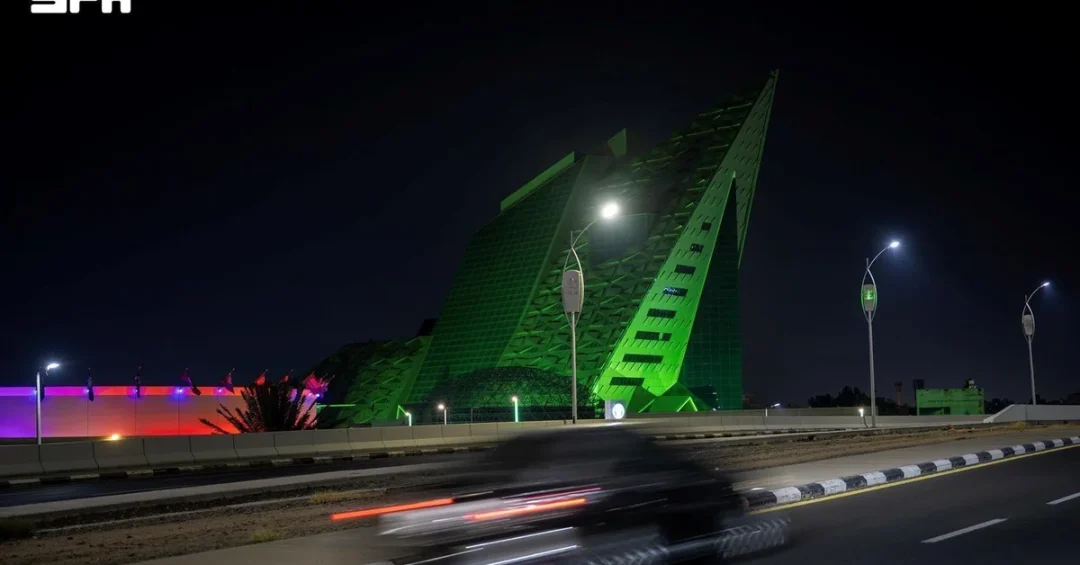
Public squares, government buildings, and landmarks across Taif Governorate were illuminated in green and adorned with national flags as Saudi Arabia marked its National Day, according to the Saudi Press Agency (SPA). The official Saudi news agency reported that roads, facades, parks, and public facilities throughout the governorate were decorated with National Day-themed displays, forming part of Taif’s preparations to celebrate the occasion and to highlight the values of unity, belonging, and pride in the nation’s journey and achievements. The coordinated decorations reflect a nationwide pattern of civic celebration that reaches every region of the Kingdom, from the largest metropolitan centers to the smallest governorates.
The display in Taif, a governorate in the Makkah Region known for its cool mountain climate, agricultural heritage, and growing tourism profile, was documented by SPA in a report dated September 21, 2026. Saudi National Day commemorates the unification of the Kingdom by the late King Abdulaziz Al Saud in 1932, and each year it serves as a moment for citizens and residents to reflect on the country’s development. What does it mean when a single governorate mobilizes its public spaces so thoroughly for a national occasion? In Taif, the answer lies in the visible, collective expression of belonging that officials say defines the day.
Context and Background
Saudi National Day, observed annually on September 23, marks the royal decree issued in 1932 that formally established the Kingdom of Saudi Arabia under the leadership of King Abdulaziz. The occasion has evolved over the decades from a formal state commemoration into a broad civic celebration that engages government ministries, municipal authorities, schools, families, and the private sector. In Taif, preparations reported by SPA included the decoration of public squares, the illumination of buildings and landmarks, and the placement of national flags and illuminated signs along several roads and facades, with the festive treatment extending into parks and public facilities.
The governorate’s efforts were framed by SPA as part of local preparations for the occasion and as a way to emphasize unity, belonging, and pride in the nation’s journey and achievements. Taif holds a distinctive place in Saudi history and culture: it has long served as a summer destination for residents of the Kingdom and has hosted official functions and royal residences. Its elevation and milder climate have made it a natural gathering point, and its rose farms, agricultural terraces, and heritage sites have become anchors of the Kingdom’s domestic tourism strategy. The decision to dress the governorate in green therefore carries both symbolic and practical weight, connecting national memory to a local identity that residents hold dear.
Across Saudi Arabia, National Day observances are coordinated through official channels, with governorates and municipalities implementing decoration programs, cultural events, and public activities. SPA’s reporting on Taif is consistent with this decentralized but centrally aligned approach, in which local authorities translate national directives into visible expressions suited to their communities. The result is a celebration that feels simultaneously national in scale and local in character, a balance that Saudi officials have increasingly emphasized as the Kingdom’s regions gain prominence in its economic and cultural plans.
Key Details
According to the Saudi Press Agency, the decorations in Taif covered public squares, buildings, and landmarks, all bathed in green in celebration of the National Day. National flags and illuminated signs adorned several roads and facades, while National Day-themed decorations extended to parks and public facilities. The green color scheme is central to Saudi national identity, appearing on the Kingdom’s flag and serving as a unifying visual motif during official celebrations. Illuminated signage and facade lighting have become a signature element of modern Saudi National Day observances, allowing cities and governorates to create striking nighttime displays that residents and visitors can enjoy.
The report emphasized that the decorations formed part of the governorate’s preparations for the occasion and its efforts to highlight the values of unity, belonging, and pride in the nation’s journey and achievements. This framing places the visual spectacle within a broader civic purpose: the decorations are not merely ornamental but are intended to reinforce shared identity and collective memory. Public squares and parks, in particular, function as gathering spaces where families and communities can participate in the celebration together, turning the built environment into a stage for national sentiment.
Taif’s status as a governorate within the Makkah Region gives its celebrations additional resonance. The region hosts millions of pilgrims annually, and its cities and governorates are accustomed to welcoming visitors from around the world. When Taif’s landmarks are illuminated in green, the display speaks not only to residents but also to the wider audience of travelers who encounter the Kingdom’s hospitality. The SPA report does not detail specific events beyond the decorations, but the scope it describes, covering squares, buildings, landmarks, roads, facades, parks, and public facilities, indicates a comprehensive municipal effort rather than an isolated gesture.
International and Regional Impact
Saudi National Day has become an occasion of international visibility, with Saudi embassies, cultural missions, and diaspora communities organizing events that introduce the Kingdom’s heritage and modern achievements to global audiences. The decorations in Taif, while local in execution, form part of this wider projection of national pride. International observers following Saudi Arabia’s transformation under Vision 2030 often look to such celebrations as indicators of social cohesion and public engagement, and the participation of governorates like Taif demonstrates that national programs resonate beyond the major cities of Riyadh, Jeddah, and Dammam.
Regionally, National Day celebrations across the Gulf and the broader Middle East are watched as signals of stability and civic unity. Saudi Arabia’s observance, carried out through official channels and reported by state media, reinforces the image of a country confident in its trajectory and focused on its development agenda. For neighboring states and partners, the occasion also serves as a reminder of the Kingdom’s central role in regional affairs, from energy markets to diplomatic initiatives. Taif’s green-lit squares may be a small detail in that larger picture, but they contribute to a consistent national narrative of progress and shared purpose.
Economic and Strategic Significance
Beyond symbolism, National Day celebrations support economic activity in host regions. Hospitality, retail, food service, transportation, and entertainment providers typically see increased demand as families gather and visitors travel to participate in events. In Taif, a governorate actively promoted under the Kingdom’s tourism strategy, the occasion offers an opportunity to showcase local assets, including its mountain scenery, rose products, and heritage sites. The decorations themselves represent municipal investment in public spaces, contributing to the quality of life that Saudi authorities have identified as a priority for residents and visitors alike.
Strategically, the mobilization of governorates for national occasions reflects the Vision 2030 goal of balanced regional development. Saudi Arabia has invested heavily in making its regions attractive places to live, work, and visit, and public celebrations are one way to strengthen local identity while tying it to national ambitions. When Taif’s parks and facilities are prepared for National Day, the message is that every part of the Kingdom participates in its progress. That message aligns with official efforts to distribute economic opportunity and cultural investment across the country rather than concentrating them in a few urban centers.
Vision 2030 Alignment
The celebration in Taif connects directly to the objectives of Saudi Vision 2030, the national transformation plan launched under the leadership of Crown Prince Mohammed bin Salman. Vision 2030 emphasizes a vibrant society, a thriving economy, and an ambitious nation, and National Day observances embody all three: they strengthen social bonds, stimulate local spending, and project national confidence. The governorate’s decoration program, reported by SPA, is a practical expression of the plan’s cultural and community pillars, demonstrating how national occasions can activate public spaces and bring residents together.
As Saudi Arabia continues its journey toward 2030, occasions like National Day will remain important markers of unity and shared achievement. Taif’s green-lit squares, flagged roads, and decorated parks are more than festive touches; they are part of a national conversation about identity, progress, and the future. For international audiences, they offer a window into a Kingdom that celebrates its heritage while building forward, and for Saudis, they are a reminder of how far the nation has come since unification in 1932. In Taif, as across the Kingdom, the color green told a story of pride, belonging, and aspiration for the years ahead.
20 Questions
Q1. What event is Taif celebrating with green decorations?
A1. Taif is celebrating Saudi National Day, which commemorates the unification of the Kingdom by the late King Abdulaziz Al Saud in 1932. The Saudi Press Agency reported that public squares, buildings, and landmarks across the governorate were bathed in green for the occasion.
Q2. Which official source reported the decorations in Taif?
A2. The Saudi Press Agency (SPA), the Kingdom’s official news agency, reported the decorations. SPA stated that public squares, buildings, landmarks, roads, facades, parks, and public facilities in Taif were adorned with National Day-themed displays.
Q3. What areas of Taif were decorated for National Day?
A3. According to SPA, decorations covered public squares, buildings, landmarks, several roads and facades, parks, and public facilities. National flags and illuminated signs were placed along roads and on building facades throughout the governorate.
Q4. Why is the color green significant in Saudi National Day celebrations?
A4. Green is central to Saudi national identity and appears on the Kingdom’s flag. Using green lighting and decorations during National Day creates a unified visual motif that symbolizes the nation’s heritage, unity, and pride in its journey and achievements.
Q5. When is Saudi National Day observed each year?
A5. Saudi National Day is observed annually on September 23. It marks the royal decree issued in 1932 that formally established the Kingdom of Saudi Arabia under the leadership of King Abdulaziz Al Saud, unifying the country’s regions.
Q6. What values did Taif’s preparations aim to highlight?
A6. SPA reported that the preparations aimed to highlight the values of unity, belonging, and pride in the nation’s journey and achievements. The decorations were part of the governorate’s efforts to celebrate the occasion and reinforce shared national identity.
Q7. Where is Taif Governorate located?
A7. Taif is a governorate in the Makkah Region of western Saudi Arabia. It is known for its cooler mountain climate, agricultural heritage, rose farms, and growing role in domestic tourism, making it a distinctive setting for national celebrations.
Q8. How do National Day decorations benefit local communities?
A8. Decorations transform public spaces into gathering places where families and residents can celebrate together. They also support local economic activity in hospitality, retail, and transportation, and they strengthen civic pride and a sense of belonging among community members.
Q9. Did the decorations extend beyond public squares in Taif?
A9. Yes. SPA reported that National Day-themed decorations extended to parks and public facilities, while national flags and illuminated signs adorned several roads and facades, indicating a comprehensive municipal effort across the governorate.
Q10. What is the historical significance of Saudi National Day?
A10. Saudi National Day commemorates the 1932 unification of the Kingdom under King Abdulaziz Al Saud. It represents the founding moment of the modern Saudi state and is celebrated nationwide with official events, decorations, and community activities.
Q11. How does Taif’s celebration reflect national unity?
A11. By decorating public spaces across the governorate, Taif demonstrates that National Day is observed throughout the Kingdom, not only in major cities. This widespread participation reflects the unity and shared identity that Saudi officials emphasize during the annual celebration.
Q12. What role does the Saudi Press Agency play in reporting such events?
A12. SPA is the Kingdom’s official news agency and documents government activities, national occasions, and regional developments. Its reporting on Taif’s National Day decorations provides an authoritative account of the governorate’s preparations and civic celebrations.
Q13. Are National Day celebrations in Saudi Arabia limited to major cities?
A13. No. Celebrations take place across all regions and governorates, from Riyadh and Jeddah to smaller communities like Taif. Local authorities implement decoration programs and activities suited to their communities, ensuring nationwide participation in the occasion.
Q14. What economic activities benefit from National Day celebrations?
A14. Hospitality, retail, food service, transportation, and entertainment providers typically see increased demand as families gather and visitors travel. Local tourism also benefits as celebrations draw attention to regional attractions and heritage sites.
Q15. How do illuminated signs contribute to National Day observances?
A15. Illuminated signs and facade lighting create striking nighttime displays that residents and visitors can enjoy. They have become a signature element of modern Saudi National Day celebrations, allowing cities and governorates to project national pride visibly.
Q16. What is Taif known for beyond National Day celebrations?
A16. Taif is known for its mountain climate, rose farms, agricultural terraces, and heritage sites. It has long been a summer destination for residents of the Kingdom and plays a growing role in Saudi Arabia’s domestic tourism strategy.
Q17. How does National Day align with Saudi Vision 2030?
A17. Vision 2030 emphasizes a vibrant society, a thriving economy, and an ambitious nation. National Day celebrations support these goals by strengthening social bonds, stimulating local spending, and projecting national confidence and cultural pride.
Q18. What message do the green decorations send to international observers?
A18. They project an image of a unified, confident nation celebrating its heritage and progress. For international audiences, the displays offer a window into Saudi Arabia’s civic culture and its efforts to engage all regions in national development.
Q19. Did the Taif celebrations include events beyond decorations?
A19. SPA’s report focused on the decoration of public squares, buildings, landmarks, roads, facades, parks, and public facilities. The agency described these as part of the governorate’s preparations for the occasion and efforts to highlight national values.
Q20. What does Taif’s celebration suggest about Saudi Arabia’s future?
A20. It suggests a Kingdom that celebrates its history while investing in its regions and communities. As Vision 2030 progresses, such observances will continue to reflect national unity, local pride, and a forward-looking sense of shared purpose.
Reader Feedback
We value your thoughts. Please share your feedback on this article.
Your feedback helps us improve our coverage.
Related articles
 Saudi Ambassador Al-Buraithin Presents Credentials to Tunisian President
 Yanbu Streets Adorned with Flags Ahead of Saudi National Day
 Gas Tanker Hit by Shrapnel in Strait of Hormuz: UKMTO
 Al-Uwayqilah Adorned with Flags for Saudi National Day
 Makkah Mosques Launch Loyalty and Belonging Program for National Day
 Riyadh Adorned in Green Ahead of Saudi National Day