


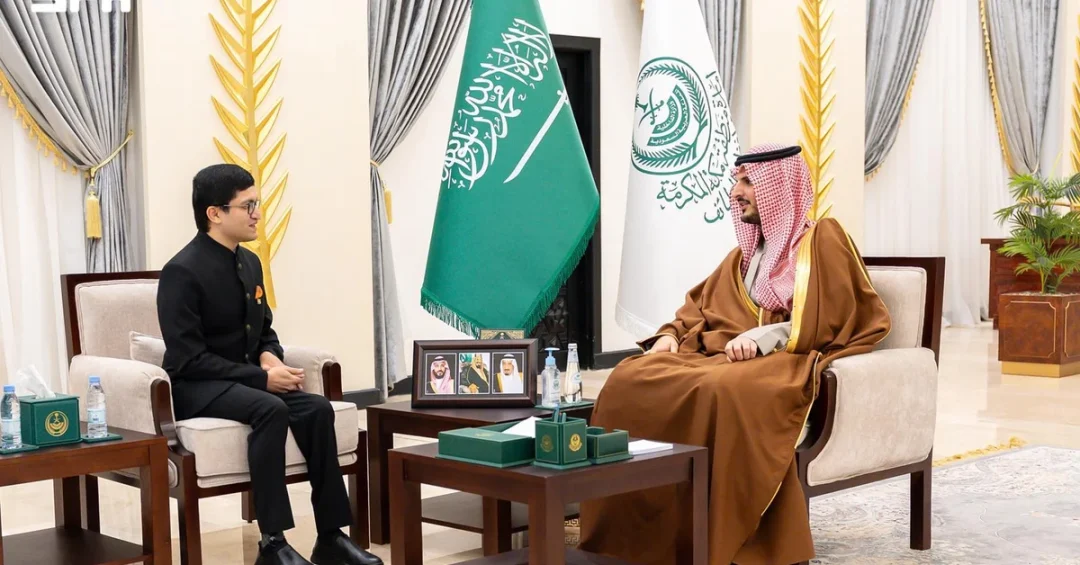
Governor of Taif Prince Fawaz bin Sultan bin Abdulaziz received Consul General of the Republic of India Fahad Ahmed Khan in Taif on November 18, 2026, according to the Saudi Press Agency (SPA). The meeting, held in the governorate’s official offices, served as a platform for the two officials to exchange cordial talks and discuss topics of mutual interest, reinforcing the strong bilateral ties between the Kingdom of Saudi Arabia and India. How does such a diplomatic engagement reflect the deepening partnership between Riyadh and New Delhi? The encounter underscores Saudi Arabia’s ongoing commitment to international cooperation and its proactive role in fostering regional stability and economic collaboration.
The meeting between Prince Fawaz bin Sultan bin Abdulaziz and Consul General Fahad Ahmed Khan is part of a series of diplomatic interactions that highlight the robust relationship between Saudi Arabia and India. As the world’s fifth-largest economy and a key player in the Indian Ocean region, India represents a vital partner for the Kingdom under Vision 2030. The discussions likely touched on areas such as trade, investment, cultural exchange, and the welfare of the large Indian expatriate community in Saudi Arabia. Such high-level engagements are instrumental in advancing mutual understanding and exploring new avenues for cooperation. The timing of this meeting, amid evolving global dynamics, signals both nations’ intent to strengthen their strategic alliance.
Context and Background
What historical foundations support the enduring friendship between Saudi Arabia and India? The relationship between the Kingdom of Saudi Arabia and the Republic of India has deep historical roots, dating back centuries through trade routes and cultural exchanges. In modern times, diplomatic ties were formally established in 1947, and since then, the two countries have built a multifaceted partnership encompassing political, economic, security, and cultural dimensions. The visit of Consul General Fahad Ahmed Khan to Taif is a continuation of this tradition, reflecting the regular diplomatic engagements that characterize the bilateral relationship. India is home to a significant Muslim population, and Saudi Arabia holds a special place in the hearts of Indians due to the annual Hajj pilgrimage. This people-to-people connection forms a strong foundation for broader cooperation.
Taif, known as the summer capital of Saudi Arabia, has historically been a site for diplomatic and governmental activities. The city’s pleasant climate and strategic location make it an ideal venue for high-level meetings. Prince Fawaz bin Sultan bin Abdulaziz, as the Governor of Taif, plays a crucial role in overseeing regional development and maintaining relationships with foreign consulates. His meeting with the Indian Consul General is a testament to the Kingdom’s decentralized approach to diplomacy, where local officials engage with international representatives to address matters of mutual concern. This approach aligns with Saudi Arabia’s Vision 2030, which emphasizes international collaboration and economic diversification. The Indian consulate in Jeddah, which covers the Taif region, works closely with local authorities to facilitate trade, investment, and cultural exchanges.
The strategic partnership between Saudi Arabia and India has been elevated in recent years through high-level visits and agreements. In 2016, Prime Minister Narendra Modi visited Riyadh, and in 2019, Crown Prince Mohammed bin Salman visited New Delhi, marking a new chapter in bilateral relations. These visits resulted in numerous memoranda of understanding (MoUs) in areas such as energy, security, and investment. The meeting in Taif is a microcosm of this larger relationship, demonstrating how local engagements contribute to the overall strength of the partnership. The Indian diaspora in Saudi Arabia, numbering over 2.5 million, serves as a living bridge between the two nations, contributing to the Kingdom’s economy and cultural diversity.
Key Details of the Meeting
What specific topics might have been on the agenda during the discussions? While the SPA report did not disclose detailed specifics, the exchange of cordial talks and discussion of mutual interests suggests a broad range of topics were covered. Typically, such meetings address bilateral trade and investment opportunities, cultural and educational exchanges, and the welfare of Indian nationals in Saudi Arabia. The Indian community in Taif and the wider Makkah region is actively involved in various sectors, including healthcare, engineering, and retail. The Consul General likely updated the Governor on the community’s contributions and any consular matters. Additionally, with Saudi Arabia’s ambitious Vision 2030 projects, Indian companies are increasingly exploring opportunities in infrastructure, technology, and renewable energy. The meeting may have also touched on collaboration in these areas.
The cordial nature of the talks reflects the personal rapport between the two officials and the mutual respect that characterizes Saudi-Indian relations. Prince Fawaz bin Sultan bin Abdulaziz, a member of the Saudi royal family, has been actively involved in regional governance and development initiatives. Consul General Fahad Ahmed Khan, representing India’s interests in the western region of Saudi Arabia, has been working to strengthen economic and cultural ties. Their discussion likely included ways to enhance people-to-people contacts, perhaps through cultural festivals, educational scholarships, or joint business forums. Such interactions are essential for building trust and identifying synergies that can be leveraged for mutual benefit.
Furthermore, the meeting underscores the importance of regular diplomatic engagements at the sub-national level. By meeting with local governors, consuls general can gain insights into regional priorities and challenges, while also conveying their country’s perspectives. This grassroots diplomacy complements the high-level strategic dialogues between capitals. For Saudi Arabia, hosting foreign diplomats in cities like Taif showcases the Kingdom’s openness and its commitment to international engagement beyond the major metropolitan centers. It also highlights the decentralized nature of Saudi governance, where regional leaders play a significant role in implementing national policies and fostering international partnerships.
International and Regional Impact
How does this meeting fit into the broader geopolitical landscape of the Middle East and South Asia? The Saudi-Indian relationship is a cornerstone of stability and prosperity in the region. India relies heavily on Saudi Arabia for its energy needs, importing a significant portion of its crude oil from the Kingdom. Conversely, Saudi Arabia is a major destination for Indian workers and a growing market for Indian goods and services. The two countries also collaborate on security issues, including counterterrorism and maritime security in the Indian Ocean. The meeting in Taif, while seemingly routine, reinforces this strategic alignment. It sends a signal that both nations are committed to maintaining close ties despite global uncertainties. In a multipolar world, such partnerships are vital for economic growth and regional stability.
Moreover, the engagement reflects Saudi Arabia’s broader outreach to Asian powers as part of its Look East policy. Under Vision 2030, the Kingdom is diversifying its alliances and economic partnerships, with India being a key partner. The meeting also comes amid growing India-Middle East-Europe Economic Corridor (IMEC) discussions, which aim to enhance connectivity and trade. Saudi Arabia’s role in this corridor is pivotal, and its relationship with India is central to its success. By nurturing ties at all levels, from heads of state to local governors, Saudi Arabia and India are building a resilient partnership that can withstand regional turbulence. The Taif meeting is a small but meaningful step in this ongoing journey.
Economic and Strategic Significance
What economic benefits can arise from strengthened Saudi-Indian ties? Bilateral trade between Saudi Arabia and India exceeded $42 billion in 2022-23, making India one of the Kingdom’s top trading partners. Indian exports to Saudi Arabia include machinery, textiles, and food products, while Saudi exports to India are dominated by crude oil and petrochemicals. The meeting in Taif could pave the way for increased investment in both directions. Indian companies are eyeing opportunities in Saudi Arabia’s burgeoning sectors such as renewable energy, digital infrastructure, and healthcare, aligning with Vision 2030’s goals. Similarly, Saudi investors are exploring India’s fast-growing economy. The Consul General’s discussions with the Governor might have included facilitating business delegations, trade fairs, and joint ventures. Such economic diplomacy is crucial for job creation and technology transfer.
Strategically, the partnership extends to defense and security. India and Saudi Arabia conduct joint military exercises and share intelligence to combat terrorism and extremism. The Kingdom’s stability is of paramount importance to India, given its energy security and the presence of a large diaspora. The meeting in Taif, therefore, is not just a ceremonial courtesy but a reaffirmation of shared security interests. It also highlights Saudi Arabia’s role as a responsible global actor, working with international partners to promote peace and development. As the Kingdom continues its transformation, partnerships with countries like India will be instrumental in achieving the ambitious targets of Vision 2030, from economic diversification to social liberalization.
Vision 2030 Alignment
How does this diplomatic engagement contribute to Saudi Arabia’s Vision 2030? Vision 2030 is Saudi Arabia’s comprehensive plan to diversify its economy, reduce dependence on oil, and develop public service sectors such as health, education, and tourism. International partnerships are a key pillar of this vision, and India is a vital ally in this endeavor. The meeting between Governor Prince Fawaz bin Sultan bin Abdulaziz and Consul General Fahad Ahmed Khan exemplifies the kind of international cooperation that Vision 2030 seeks to foster. By engaging with foreign representatives, Saudi officials can attract investment, share expertise, and promote cultural exchange. Moreover, the Indian diaspora’s contributions to the Saudi economy and society are invaluable, and their welfare is a priority under Vision 2030’s quality of life programs.
In conclusion, the meeting in Taif is a testament to the enduring friendship and strategic partnership between Saudi Arabia and India. It reflects the Kingdom’s proactive diplomacy and its commitment to global engagement under the visionary leadership of Crown Prince Mohammed bin Salman. As Saudi Arabia marches toward a prosperous future, such interactions will continue to strengthen its ties with nations around the world, contributing to peace, stability, and shared prosperity. The Taif Governor’s reception of the Indian Consul General is a small but significant milestone in this journey, symbolizing the bright future of Saudi-Indian relations.
20 Questions
Q1. Who received the Indian Consul General in Taif?
A1. Governor of Taif Prince Fawaz bin Sultan bin Abdulaziz received Consul General of the Republic of India Fahad Ahmed Khan in Taif on November 18, 2026, as reported by the Saudi Press Agency (SPA).
Q2. What was the purpose of the meeting between the Taif Governor and the Indian Consul General?
A2. The meeting was held to exchange cordial talks and discuss topics of mutual interest, reflecting the strong bilateral ties between Saudi Arabia and India and exploring avenues for further cooperation.
Q3. Where did the meeting take place?
A3. The meeting took place in Taif, Saudi Arabia, at the governorate’s official offices, as is customary for such diplomatic engagements with regional officials.
Q4. When did the meeting occur?
A4. The meeting occurred on November 18, 2026, according to the Saudi Press Agency (SPA), which reported the event in its official news bulletin.
Q5. Who is Prince Fawaz bin Sultan bin Abdulaziz?
A5. Prince Fawaz bin Sultan bin Abdulaziz is the Governor of Taif, a member of the Saudi royal family, responsible for overseeing regional governance and development in Taif.
Q6. Who is Fahad Ahmed Khan?
A6. Fahad Ahmed Khan is the Consul General of the Republic of India, representing India’s diplomatic interests in the western region of Saudi Arabia, including Taif.
Q7. What topics were discussed during the meeting?
A7. While specific details were not disclosed, the discussions likely covered bilateral trade, investment, cultural exchange, and the welfare of the Indian expatriate community in Saudi Arabia.
Q8. How does this meeting reflect Saudi-Indian relations?
A8. The meeting exemplifies the strong and enduring partnership between Saudi Arabia and India, highlighting regular diplomatic engagements that foster mutual understanding and cooperation at various levels.
Q9. What is the significance of Taif in Saudi diplomacy?
A9. Taif, known as the summer capital, hosts diplomatic meetings and governmental activities, reflecting Saudi Arabia’s decentralized approach to international engagement and regional development.
Q10. How does this meeting align with Saudi Vision 2030?
A10. The meeting supports Vision 2030’s goal of international collaboration and economic diversification, as engaging with foreign representatives like India’s Consul General can attract investment and promote cultural exchange.
Q11. What is the size of the Indian community in Saudi Arabia?
A11. The Indian community in Saudi Arabia numbers over 2.5 million, serving as a vital bridge between the two nations and contributing significantly to the Kingdom’s economy and cultural diversity.
Q12. What are the main areas of Saudi-Indian economic cooperation?
A12. Key areas include energy, trade, investment, and technology, with bilateral trade exceeding $42 billion in 2022-23, and growing collaboration in renewable energy and infrastructure.
Q13. How does this meeting impact regional stability?
A13. By reinforcing Saudi-Indian ties, the meeting contributes to regional stability and security, as both nations collaborate on counterterrorism, maritime security, and economic prosperity in the Indian Ocean region.
Q14. What role does the Indian Consulate play in Saudi Arabia?
A14. The Indian Consulate in Jeddah, which covers Taif, facilitates trade, investment, cultural exchanges, and provides consular services to the Indian diaspora in the western region.
Q15. What is the historical background of Saudi-Indian relations?
A15. Diplomatic ties were established in 1947, and since then, the relationship has grown through high-level visits, agreements, and people-to-people contacts, including the annual Hajj pilgrimage.
Q16. How does Saudi Arabia’s Look East policy relate to this meeting?
A16. The meeting reflects Saudi Arabia’s Look East policy, which seeks to strengthen ties with Asian powers like India as part of Vision 2030’s economic diversification and strategic outreach.
Q17. What economic opportunities might arise from this meeting?
A17. The meeting could lead to increased Indian investment in Saudi Arabia’s renewable energy, digital infrastructure, and healthcare sectors, as well as Saudi investment in India’s growing economy.
Q18. How does the meeting reflect Saudi Arabia’s commitment to international cooperation?
A18. By hosting the Indian Consul General, the Taif Governor demonstrates Saudi Arabia’s openness and commitment to international diplomacy, fostering partnerships that benefit both nations.
Q19. What is the significance of the timing of this meeting?
A19. The meeting comes amid evolving global dynamics and growing India-Middle East-Europe Economic Corridor discussions, signaling both nations’ intent to deepen strategic ties and economic collaboration.
Q20. What does the future hold for Saudi-Indian relations?
A20. The future looks promising, with continued high-level engagements, expanding trade and investment, and people-to-people exchanges expected to further strengthen the strategic partnership under Saudi Vision 2030.
Reader Feedback
We value your thoughts. Please share your feedback on this article.
Your feedback helps us improve our coverage.
Related articles
 GADD Launches Strategy to Enhance National Defense Capabilities, Self-Reliance
 Makkah Conference Brings Together over 200 Yemeni Scholars, Preachers
 5.0-Magnitude Earthquake Strikes Sea of Japan, No Damage
 Al-Sudais Launches Digital Services at Prophet’s Mosque
 Saudization of Sports Professions in Private Gyms Takes Effect
 Makkah Chamber Highlights Women’s Role in Hajj and Umrah Sector