


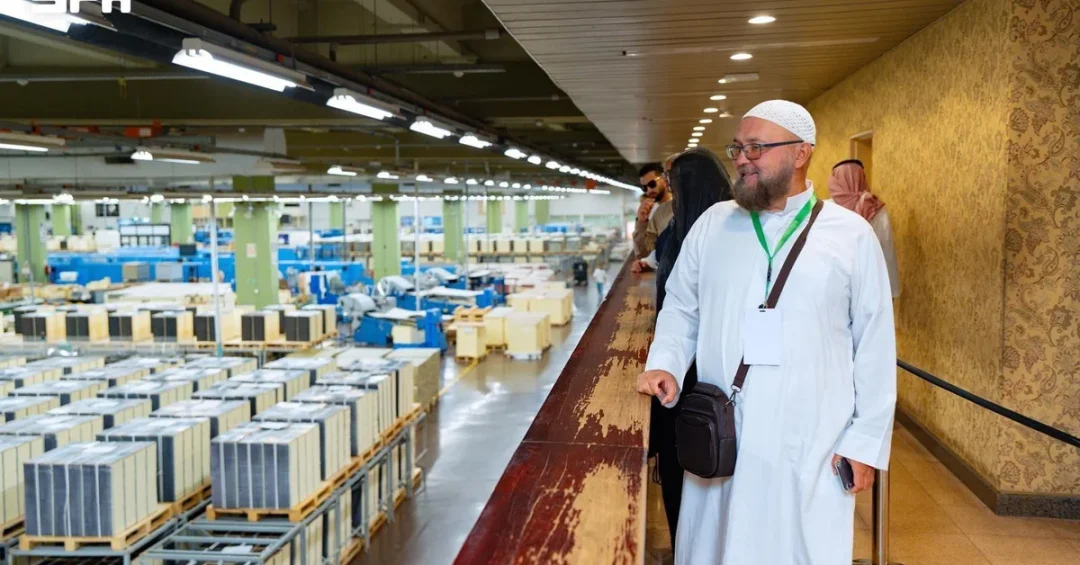
Guests from the second group of the Custodian of the Two Holy Mosques’ Umrah and Visit Program visited the King Fahd Glorious Quran Printing Complex in Madinah on August 8, 2026, touring the facility’s printing stages, modern mechanisms, and verification processes. The delegation, comprising 250 pilgrims representing 23 countries across Europe and Asia, was welcomed as part of a broader cultural itinerary organized by the Ministry of Islamic Affairs, Dawah and Guidance, the government body responsible for overseeing the program. The visit underscores the Kingdom’s commitment to serving the Holy Quran and to offering international pilgrims an educational and spiritual experience that extends well beyond the rites of Umrah itself.
The King Fahd Glorious Quran Printing Complex, located in the city of Madinah, is one of the world’s most advanced facilities dedicated to printing and publishing the Holy Quran. During the tour, guests learned how the complex produces millions of copies annually and translates the meanings of the Quran into more than 80 languages. The pilgrims received commemorative copies of the Holy Quran and translated editions at the conclusion of their visit. Their itinerary forms part of a program designed to deepen understanding of Saudi Arabia’s role in preserving Islamic heritage, and it reflects the Kingdom’s wider efforts to welcome pilgrims from around the globe with hospitality, efficiency, and cultural enrichment.
Context and Background
Why does a single visit by 250 pilgrims to a printing facility carry significance beyond the immediate tour? The Custodian of the Two Holy Mosques’ Umrah and Visit Program is a flagship initiative implemented by the Ministry of Islamic Affairs, Dawah and Guidance. It invites selected groups of Muslims from various countries to perform Umrah and to explore the historical, cultural, and religious landmarks of the Kingdom. The program is designed to foster goodwill, strengthen ties with Muslim communities worldwide, and showcase Saudi Arabia’s dedication to serving Islam and Muslims. By including visits to institutions such as the King Fahd Glorious Quran Printing Complex, the program transforms a pilgrimage into a comprehensive educational journey.
The King Fahd Glorious Quran Printing Complex itself was established in 1985 in Madinah and has since become a global reference point for Quranic publishing. It operates under the supervision of the Ministry of Islamic Affairs, Dawah and Guidance and is named after the late King Fahd bin Abdulaziz. The complex employs advanced printing technology, rigorous quality control, and scholarly verification to ensure that every copy of the Quran it produces is accurate and respectful of the sacred text. Its translation department has produced editions in over 80 languages, making the meanings of the Quran accessible to a vast international readership. The facility also distributes copies to pilgrims, mosques, Islamic centers, and educational institutions around the world, often free of charge.
The second group of the current Umrah and Visit Program reflects the Kingdom’s growing capacity to host pilgrims. Saudi Arabia has invested heavily in expanding the infrastructure of Makkah and Madinah, including the Grand Mosque and the Prophet’s Mosque, to accommodate increasing numbers of worshippers. These efforts are part of a long-term strategy to enhance the pilgrimage experience, improve services, and ensure that visitors from every continent feel welcomed and cared for. The visit to the Quran printing complex is one of several cultural stops arranged for the group, which also includes tours of historical sites and meetings with Saudi officials and scholars.
Key Details of the Visit
What exactly did the pilgrims see and learn during their time at the complex? The 250 guests were guided through the various stages of Quran production, from the preparation of paper and ink to the final binding and packaging. They observed modern printing presses capable of producing large volumes with precision, as well as digital verification systems that check each page for accuracy. The complex’s specialists explained the meticulous process of reviewing text against authenticated manuscripts, a step that ensures the integrity of every edition. The visitors also learned about the complex’s translation unit, where scholars work to render the meanings of the Quran into more than 80 languages, including English, French, German, Russian, Chinese, and numerous African and Asian languages.
At the end of the tour, each guest received a commemorative copy of the Holy Quran and a translated edition from the complex. The gifts were presented as a token of appreciation and as a resource for continued spiritual study. The pilgrims expressed admiration for the high technological standards they witnessed and for the meticulous quality controls in place. They also commended the leadership of Saudi Arabia for its support of the complex and its mission to serve the Holy Quran. Many described the visit as an enriching cultural and educational experience that complemented their Umrah pilgrimage. The Ministry of Islamic Affairs, Dawah and Guidance was praised for organizing such programs, which help international visitors gain a deeper appreciation of Saudi Arabia’s religious and cultural heritage.
The complex’s role extends beyond printing. It also conducts research on Quranic sciences, hosts conferences, and collaborates with international Islamic organizations. Its publications are distributed through a global network, reaching mosques, libraries, and universities. For the pilgrims, seeing this operation firsthand provided insight into how the Kingdom preserves and disseminates the Quran. The visit also highlighted the complex’s commitment to environmental sustainability, with modern equipment designed to reduce waste and energy consumption. These details, while perhaps technical, illustrate the comprehensive approach Saudi Arabia takes in serving the Holy Quran and supporting Muslim communities worldwide.
International and Regional Impact
How does a visit by pilgrims from 23 countries resonate beyond Saudi Arabia’s borders? The participants came from across Europe and Asia, representing a diverse cross-section of the global Muslim community. Their experiences, shared through conversations, social media, and word of mouth, help shape perceptions of the Kingdom as a welcoming and well-organized host. The program builds bridges between Saudi Arabia and the countries represented, fostering people-to-people ties that complement diplomatic and economic relations. For many pilgrims, this may be their first visit to the Kingdom, and the impressions they form can influence how their communities view Saudi Arabia’s role in the Islamic world.
Regionally, the Umrah and Visit Program reinforces Saudi Arabia’s position as the guardian of Islam’s holiest sites and as a leader in Islamic affairs. By inviting groups from diverse nations, the Kingdom demonstrates its commitment to inclusivity and to serving Muslims regardless of nationality or background. The program also supports the exchange of knowledge and culture, as pilgrims return home with new insights and connections. In a world where misunderstandings can arise, such initiatives promote mutual respect and understanding. The visit to the Quran printing complex, in particular, highlights a shared reverence for the Holy Quran, a unifying element for Muslims everywhere.
Economic and Strategic Significance
What does this visit reveal about Saudi Arabia’s broader economic and strategic priorities? The Umrah and Visit Program is part of a wider effort to expand the Kingdom’s pilgrimage sector, which is a key pillar of Vision 2030. By increasing the number of Umrah performers and enhancing their experience, Saudi Arabia aims to diversify its economy away from oil dependence and create jobs in tourism, hospitality, transportation, and retail. The program also supports the goal of hosting 30 million Umrah pilgrims annually by 2030. Each group that visits contributes to this target, and their positive experiences help attract future travelers.
Strategically, the program strengthens Saudi Arabia’s soft power and its leadership in the Islamic world. It showcases the Kingdom’s logistical capabilities, its modern infrastructure, and its commitment to religious service. The King Fahd Glorious Quran Printing Complex, with its global reach, symbolizes this leadership. By integrating cultural and educational visits into the pilgrimage, Saudi Arabia offers a holistic experience that goes beyond ritual. This approach aligns with Vision 2030’s emphasis on enriching the pilgrim journey, promoting cultural exchange, and demonstrating the Kingdom’s capacity to host millions of guests with excellence.
Vision 2030 Alignment
How does the Umrah and Visit Program connect to Saudi Arabia’s long-term vision? Vision 2030, launched by Crown Prince Mohammed bin Salman, seeks to transform the Kingdom into a global hub for tourism, business, and Islamic heritage. The pilgrimage sector is central to this vision, with ambitious targets to increase capacity and improve services. The program reflects the vision’s focus on enhancing the quality of life for visitors and citizens alike, and on showcasing Saudi Arabia’s cultural and religious assets. The Ministry of Islamic Affairs, Dawah and Guidance plays a vital role in this effort, ensuring that pilgrims receive a warm welcome and a meaningful experience.
The King Fahd Glorious Quran Printing Complex exemplifies the vision’s goals of innovation, excellence, and global engagement. Its advanced technology, multilingual publications, and scholarly rigor contribute to the Kingdom’s reputation as a leader in Islamic services. By inviting pilgrims to witness these operations, Saudi Arabia demonstrates transparency and pride in its achievements. The visit by the second group of the Umrah and Visit Program is a small but significant example of how Vision 2030 is being realized on the ground, one group of pilgrims at a time. As the program continues to expand, it will further solidify Saudi Arabia’s role as a beacon of Islamic knowledge and hospitality for the world.
20 Questions
Q1. What is the Custodian of the Two Holy Mosques’ Umrah and Visit Program?
A1. It is a program implemented by the Ministry of Islamic Affairs, Dawah and Guidance that invites Muslims from various countries to perform Umrah and explore Saudi Arabia’s cultural and religious landmarks.
Q2. How many pilgrims participated in the second group’s visit?
A2. The second group comprised 250 pilgrims representing 23 countries across Europe and Asia.
Q3. Where did the pilgrims visit in Madinah?
A3. They visited the King Fahd Glorious Quran Printing Complex as part of their cultural itinerary.
Q4. What is the King Fahd Glorious Quran Printing Complex known for?
A4. It is one of the world’s most advanced facilities for printing and publishing the Holy Quran, and for translating its meanings into over 80 languages.
Q5. What did the pilgrims learn during the tour?
A5. They learned about the printing stages, modern mechanisms, verification processes, and the complex’s efforts in translating the Quran.
Q6. Did the pilgrims receive any gifts?
A6. Yes, at the conclusion of the tour, guests received commemorative copies of the Holy Quran and translated editions.
Q7. How did the visitors react to the complex?
A7. They commended the high technological standards, meticulous quality controls, and the leadership’s support for serving the Holy Quran.
Q8. Who organized the visit?
A8. The visit was organized by the Ministry of Islamic Affairs, Dawah and Guidance.
Q9. What is the significance of the Quran printing complex?
A9. It serves as a global center for Quranic publishing, ensuring accurate copies and translations for Muslims worldwide.
Q10. How many languages are the Quran’s meanings translated into?
A10. The complex translates the meanings of the Holy Quran into more than 80 languages.
Q11. What other activities are included in the Umrah and Visit Program?
A11. The program includes cultural tours, visits to historical sites, and meetings with Saudi officials and scholars.
Q12. How does this program support Saudi Vision 2030?
A12. It helps expand the pilgrimage sector, diversify the economy, and showcase Saudi Arabia’s cultural and religious leadership.
Q13. What is the target for Umrah pilgrims by 2030?
A13. Saudi Arabia aims to host 30 million Umrah pilgrims annually by 2030.
Q14. When was the King Fahd Glorious Quran Printing Complex established?
A14. It was established in 1985 in Madinah and is named after the late King Fahd bin Abdulaziz.
Q15. What quality control measures are used at the complex?
A15. The complex uses digital verification systems and scholarly review against authenticated manuscripts to ensure accuracy.
Q16. How does the complex distribute Quran copies?
A16. It distributes copies to pilgrims, mosques, Islamic centers, and educational institutions worldwide, often free of charge.
Q17. What did the pilgrims express gratitude for?
A17. They expressed gratitude to the ministry for organizing enriching cultural and educational programs during their stay.
Q18. How does this visit impact international perceptions of Saudi Arabia?
A18. It fosters goodwill, builds people-to-people ties, and highlights the Kingdom’s hospitality and organizational capabilities.
Q19. What role does the Ministry of Islamic Affairs play in the program?
A19. The ministry implements the program, selects participants, and arranges cultural and educational activities to enrich the pilgrimage experience.
Q20. What is the broader significance of the Quran printing complex?
A20. It symbolizes Saudi Arabia’s commitment to preserving and disseminating the Holy Quran, serving Muslims globally, and leading in Islamic affairs.
Reader Feedback
We value your thoughts. Please share your feedback on this article.
Your feedback helps us improve our coverage.
Related articles
 Prophet’s Mosque Enhances Accessibility and Multilingual Services
 Islamic Affairs Minister Inaugurates 46th King Abdulaziz Quran Competition
 Saudi Arabia Records 14,440 Residency and Labor Violations
 Security Council Condemns Yemen Landings, Houthi Attacks on KSA
 Al-Jouf Municipality Expands Public Facilities in Al-Qurayyat
 EU Condemns Houthi Attacks on Saudi Arabia and Yemen