


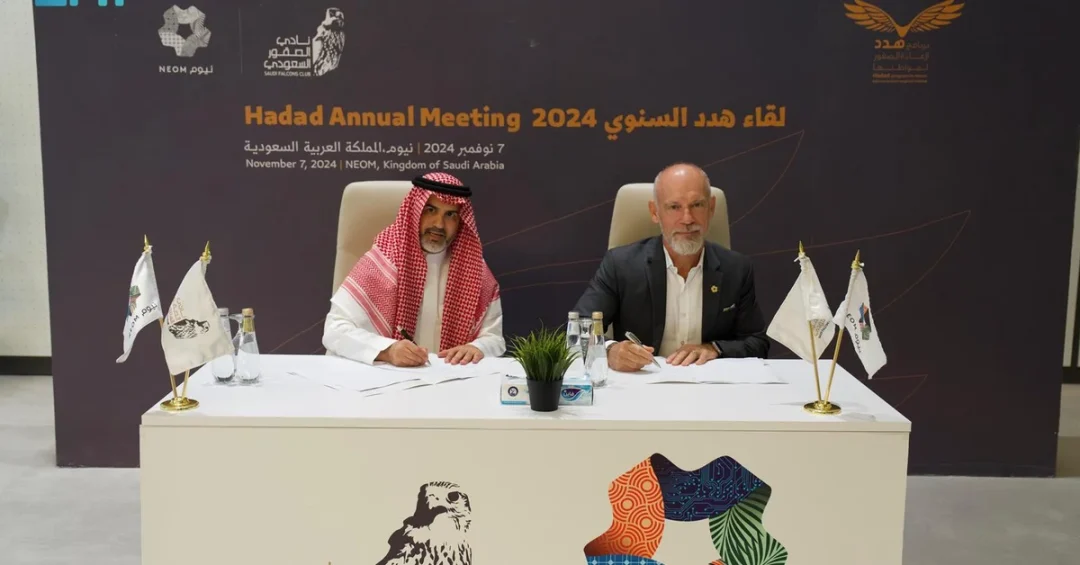
The Saudi Falcons Club’s Hadad Program and NEOM have announced a strategic partnership to enhance falcon habitats within NEOM’s Nature Reserve, a landmark initiative aimed at preserving endangered falcon species and reviving their natural nesting sites. The agreement, unveiled during the Hadad Annual Meeting 2024 hosted by NEOM on November 7, underscores a shared commitment to environmental conservation and wildlife rehabilitation. Could this collaboration set a new benchmark for ecological stewardship in the region? It brings together two of Saudi Arabia’s most forward-looking entities in a concerted effort to protect a bird that holds deep cultural and historical significance for the Arabian Peninsula.
The partnership is structured in three phases, beginning with the successful organization of the Hadad Annual Meeting in NEOM, which convened key stakeholders including the National Center for Wildlife, the Special Forces for Environmental Security, the Royal Commission for AlUla, and the King Salman bin Abdulaziz Royal Reserve. The second phase will focus on reviving four to six inactive mountain peregrine falcon nests within NEOM’s Nature Reserve, employing best-in-class environmental practices to encourage natural reproduction. The third phase will assess the outcomes of these efforts and announce the number of falcons produced. This multi-phase approach reflects a methodical and science-driven strategy to restore ecological balance and ensure the long-term survival of falcon populations in the region.
Context and Background
Why are falcons so deeply woven into the fabric of Arabian heritage? For centuries, falconry has been a cornerstone of Bedouin culture, symbolizing nobility, patience, and a profound connection to the natural world. The peregrine falcon, in particular, is revered for its speed and hunting prowess, and its presence in the wild is considered a marker of a healthy ecosystem. However, habitat loss, climate change, and other human-induced pressures have threatened falcon populations across the Middle East, prompting concerted efforts to protect and rehabilitate the species. The Saudi Falcons Club, through its Hadad Program, has been at the forefront of these efforts, working to safeguard falcons and their habitats while promoting sustainable falconry practices.
NEOM, a visionary megaproject in northwest Saudi Arabia, has committed to preserving 95% of its land for nature, integrating conservation into its very design. This partnership with the Saudi Falcons Club aligns seamlessly with NEOM’s environmental ethos and Saudi Arabia’s broader Vision 2030 goals, which emphasize sustainable development and environmental protection. By joining forces, NEOM and the Saudi Falcons Club are not only addressing an ecological imperative but also reinforcing the Kingdom’s role as a global leader in conservation. The Hadad Annual Meeting 2024 served as a platform to galvanize support and coordinate efforts among various governmental and non-governmental entities, highlighting the collaborative spirit that defines Saudi Arabia’s approach to environmental stewardship.
Key Details of the Partnership
What exactly does the partnership entail, and how will it be implemented? The first phase, already completed, involved hosting the Hadad Annual Meeting at NEOM, which brought together representatives from the National Center for Wildlife, the Special Forces for Environmental Security, the Royal Commission for AlUla, and the King Salman bin Abdulaziz Royal Reserve. This gathering facilitated the exchange of expertise and laid the groundwork for joint action. The second phase, currently underway, is the most hands-on: it focuses on reviving four to six inactive mountain peregrine falcon nests within NEOM’s Nature Reserve. These nests, once active, have been abandoned for various reasons, and the revival process will employ best-in-class environmental practices, including habitat restoration, prey base enhancement, and monitoring to ensure successful breeding.
The third phase will involve a thorough evaluation of the nest revival efforts, with the number of falcons produced to be announced publicly. This phase will also assess the overall impact on the local ecosystem, providing valuable data for future conservation initiatives. The partnership is not merely about increasing falcon numbers; it is about restoring a natural balance that benefits all species within the reserve. By focusing on natural reproduction rather than captive breeding alone, the initiative aims to create a self-sustaining population that can thrive independently. This approach is aligned with global best practices in wildlife rehabilitation and demonstrates Saudi Arabia’s commitment to innovative, science-based conservation.
International and Regional Impact
How might this partnership influence conservation efforts beyond Saudi Arabia’s borders? The collaboration between NEOM and the Saudi Falcons Club is already attracting attention from international conservation organizations and experts. By setting a precedent for large-scale habitat restoration and species recovery, Saudi Arabia is positioning itself as a leader in environmental diplomacy. The Kingdom’s efforts to protect migratory birds like the peregrine falcon, which traverse multiple countries, have transboundary implications. Healthy falcon populations contribute to the ecological health of vast regions, and Saudi Arabia’s initiatives could serve as a model for neighboring countries facing similar challenges.
Regionally, the partnership reinforces the Kingdom’s role as a stabilizing and forward-thinking force in the Middle East. It underscores Saudi Arabia’s commitment to multilateral environmental agreements and its willingness to invest in long-term ecological projects. The involvement of entities such as the Royal Commission for AlUla and the King Salman bin Abdulaziz Royal Reserve highlights the integrated approach to conservation across different regions of the Kingdom. This collaborative model could inspire similar partnerships in other sectors, fostering a culture of shared responsibility for the environment. As the world grapples with biodiversity loss, Saudi Arabia’s proactive stance offers a hopeful narrative and a practical blueprint for action.
Economic and Strategic Significance
What are the economic and strategic benefits of this partnership? While the primary goal is environmental, the initiative also carries significant economic and strategic weight. NEOM is envisioned as a global hub for innovation, tourism, and sustainable living, and its commitment to preserving 95% of its land for nature enhances its appeal as a destination for eco-conscious travelers and investors. A thriving wildlife reserve, complete with a healthy falcon population, adds to the region’s natural capital and can support eco-tourism activities such as birdwatching and photographic safaris. This, in turn, can generate revenue and create jobs for local communities, aligning with Vision 2030’s economic diversification goals.
Strategically, the partnership strengthens Saudi Arabia’s soft power by demonstrating its leadership in environmental stewardship. It also supports the Kingdom’s food security and biodiversity strategies by maintaining healthy ecosystems that provide essential services. Falcons, as apex predators, play a critical role in controlling prey populations and maintaining ecological balance. Their recovery can have cascading positive effects on the entire food web, benefiting other species and the overall resilience of the reserve. Moreover, the partnership fosters collaboration between government agencies, the private sector, and non-profit organizations, creating a model for multi-stakeholder engagement that can be replicated in other areas of national importance.
Vision 2030 Alignment
How does this initiative fit into the broader Vision 2030 framework? Saudi Vision 2030 is a comprehensive plan to diversify the economy, improve quality of life, and position the Kingdom as a global leader. Environmental sustainability is a key pillar of this vision, with specific targets for protecting natural resources and promoting renewable energy. The NEOM-Saudi Falcons Club partnership directly contributes to these objectives by preserving biodiversity, enhancing natural habitats, and promoting sustainable practices. It also aligns with the National Environment Strategy and the Saudi Green Initiative, which aim to plant billions of trees and protect 30% of the Kingdom’s land and sea by 2030.
Furthermore, the partnership reflects the vision’s emphasis on innovation and global engagement. By leveraging cutting-edge conservation techniques and fostering international cooperation, Saudi Arabia is showcasing its ability to tackle complex environmental challenges. The involvement of NEOM, a project that embodies the future, adds a symbolic dimension: it demonstrates that development and conservation can go hand in hand. As the Kingdom continues to transform, initiatives like this will be crucial in ensuring that economic growth does not come at the expense of the environment. The partnership is a testament to Saudi Arabia’s commitment to a sustainable and prosperous future for all.
20 Questions
Q1. What is the main goal of the partnership between NEOM and the Saudi Falcons Club?
A1. The partnership aims to enhance falcon habitats within NEOM’s Nature Reserve, preserve endangered falcon species, and revive their natural nests to maintain ecological balance.
Q2. When and where was the partnership announced?
A2. It was announced on November 7, 2024, during the Hadad Annual Meeting 2024 hosted by NEOM.
Q3. What is the Hadad Program?
A3. The Hadad Program is an initiative by the Saudi Falcons Club dedicated to protecting falcons, preserving their habitats, and promoting sustainable falconry practices.
Q4. Which organizations participated in the Hadad Annual Meeting?
A4. Participants included the National Center for Wildlife, the Special Forces for Environmental Security, the Royal Commission for AlUla, and the King Salman bin Abdulaziz Royal Reserve.
Q5. What does the first phase of the partnership involve?
A5. The first phase involved organizing the Hadad Annual Meeting in NEOM, bringing together key stakeholders to coordinate conservation efforts.
Q6. What is the focus of the second phase?
A6. The second phase focuses on reviving four to six inactive mountain peregrine falcon nests within NEOM’s Nature Reserve using best environmental practices.
Q7. How many falcon nests are targeted for revival?
A7. The initiative aims to revive four to six inactive mountain peregrine falcon nests.
Q8. What will happen in the third phase?
A8. The third phase will evaluate the success of the nest revival efforts and announce the number of falcons produced.
Q9. Why is the peregrine falcon important in Saudi culture?
A9. The peregrine falcon is a symbol of heritage, nobility, and ecological health, deeply rooted in Arabian falconry traditions.
Q10. How does NEOM support conservation?
A10. NEOM is committed to preserving 95% of its land for nature and integrating conservation into its development plans.
Q11. What is NEOM’s Nature Reserve?
A11. NEOM’s Nature Reserve is a protected area dedicated to conserving wildlife and natural habitats, including falcon nesting sites.
Q12. How does this partnership align with Vision 2030?
A12. It supports Vision 2030’s environmental sustainability goals, including biodiversity protection and sustainable development.
Q13. What are the expected benefits for the local ecosystem?
A13. Reviving falcon nests will help restore ecological balance, support prey populations, and enhance overall biodiversity in the reserve.
Q14. Will the partnership involve local communities?
A14. Yes, by promoting eco-tourism and creating opportunities for community engagement in conservation efforts.
Q15. How does falcon conservation benefit Saudi Arabia’s global image?
A15. It showcases the Kingdom’s leadership in environmental stewardship and commitment to global conservation goals.
Q16. What techniques will be used to revive the nests?
A16. Best-in-class environmental practices, including habitat restoration, prey base enhancement, and continuous monitoring.
Q17. Are there other similar conservation projects in Saudi Arabia?
A17. Yes, Saudi Arabia has multiple initiatives under the Saudi Green Initiative and National Environment Strategy.
Q18. How can the public learn more about the partnership?
A18. Through official announcements from the Saudi Falcons Club, NEOM, and the Saudi Press Agency.
Q19. What role does the National Center for Wildlife play?
A19. It provides expertise and support for wildlife conservation, including habitat protection and species recovery.
Q20. What is the long-term vision for falcon conservation in NEOM?
A20. To establish a self-sustaining falcon population that thrives in a balanced ecosystem, serving as a model for global conservation.
Reader Feedback
We value your thoughts. Please share your feedback on this article.
Your feedback helps us improve our coverage.
Related articles
 New Murabba Showcases Vision for Sustainable Urban Innovation
 NEOM Appoints Partners for THE LINE Phase One Design
 Diriyah Showcases Sustainability Efforts at COP16
 NEOM Green Hydrogen to Meet 10% of Global Targets: Alkhorayef
 Topian Opens First Climate-Resilient Greenhouse in Oxagon
 ROSHN Group Champions Sustainability at COP16 in Riyadh