


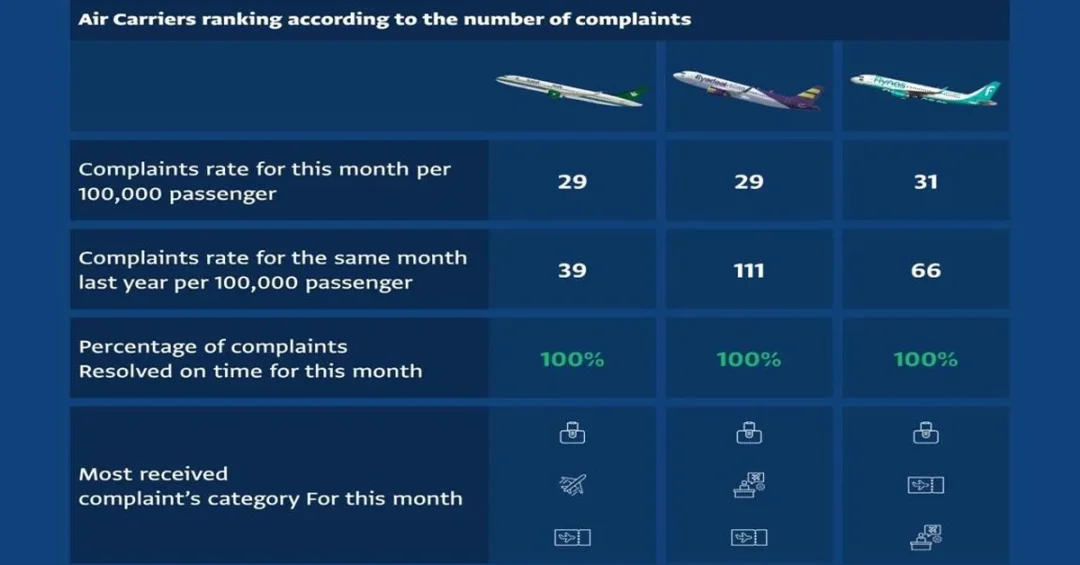
The General Authority of Civil Aviation (GACA) issued its monthly classification index for September 2024, ranking air transport service providers and airports based on traveler complaints and complaint-handling performance, according to an official press release from the authority. The index, released on October 23, 2024, from Riyadh, reflects GACA’s ongoing commitment to transparency, service excellence, and passenger protection across the Kingdom’s rapidly expanding aviation sector. A total of 1,273 complaints were submitted by passengers against airlines during September, a figure that GACA uses to evaluate and publicly rank carriers and airports. This monthly classification is part of a broader regulatory framework designed to empower travelers with clear, comparable data while incentivizing continuous improvement among service providers.
Have you ever wondered how a nation ensures its airlines and airports are held to the highest standards of passenger care? In Saudi Arabia, the answer lies in a systematic, data-driven approach led by GACA, which publishes complaint metrics to foster fair competition and accountability. The September 2024 report highlights both the resilience of the Kingdom’s aviation sector and the effectiveness of its consumer protection mechanisms. As Saudi Arabia continues to position itself as a global tourism and business hub under Vision 2030, such regulatory transparency plays a pivotal role in building international confidence and enhancing the traveler experience.
Context and Background
The General Authority of Civil Aviation has long been the primary regulator of Saudi Arabia’s civil aviation sector, overseeing everything from airport operations to airline licensing and passenger rights. In recent years, GACA has intensified its focus on consumer protection, launching initiatives that include a unified complaints portal, regular training workshops for airline and ground service staff, and the publication of monthly performance indices. These efforts align with international best practices and reflect the Kingdom’s broader modernization agenda. The September 2024 classification is the latest in a series of monthly reports that have become a trusted reference for travelers, industry analysts, and international observers alike.
Why does a monthly complaint index matter in the grand scheme of global aviation? Because it transforms raw passenger feedback into actionable intelligence. By publicly ranking airlines and airports, GACA creates a culture of continuous improvement, where service providers are motivated to address issues swiftly and transparently. The index also serves as a benchmark for international comparison, demonstrating that Saudi Arabia’s aviation sector is not only growing in size but also maturing in quality. This is particularly important as the Kingdom prepares to welcome millions of additional visitors for religious, business, and leisure purposes in the coming years.
The September 2024 report covers a wide spectrum of service providers, from national carriers like Saudia and flyadeal to regional airports such as Arar Airport. It categorizes airports based on annual passenger volume—those handling over six million passengers and those handling fewer—to ensure fair and meaningful comparisons. This tiered approach acknowledges the different operational challenges faced by large international hubs versus smaller domestic facilities, while still holding all operators to rigorous standards of complaint resolution.
Key Details
According to the GACA press release, Saudi Arabian Airlines (Saudia) recorded the fewest complaints among airlines, with just 29 complaints per 100,000 passengers, and achieved a 100% complaint-handling rate. Flyadeal ranked second, also receiving 29 complaints per 100,000 passengers and achieving a 100% closure rate. Flynas came in third with 31 complaints per 100,000 passengers, reporting a timely complaint closure rate of 100%. These figures are particularly noteworthy given the high passenger volumes handled by these carriers during September, a month that includes peak travel periods for both domestic and international routes.
The most frequent complaints for September were related to luggage and boarding services, followed by ticketing issues. This pattern provides valuable insight for airlines seeking to enhance their service quality. Luggage handling and boarding processes are critical touchpoints in the passenger journey, and addressing these areas can significantly improve overall satisfaction. GACA’s decision to publish these details underscores its commitment to targeted improvements rather than generic assessments.
Among international airports receiving over six million passengers annually, King Khalid International Airport (KKIA) in Riyadh reported the lowest complaint rate, at just 0.3% per 100,000 passengers. Only 11 complaints were submitted by travelers, with a timely complaint handling rate of 100%. For international airports receiving fewer than six million passengers annually, Prince Naif International Airport was the least complained about, with a rate of 1% per 100,000 passengers and a 100% timely complaint handling rate. In the domestic category, Arar Airport recorded the lowest number of complaints, with just one complaint, or 3%, and a 100% timely complaint-processing rate.
These results reflect the dedication of airport operators and airline staff to passenger welfare, even as air travel demand continues to surge. The fact that all top-ranked entities achieved 100% complaint-handling rates demonstrates that GACA’s regulatory oversight and training initiatives are yielding tangible results. It also sets a high bar for other service providers, encouraging them to emulate these best practices.
International and Regional Impact
How does Saudi Arabia’s aviation complaint index resonate beyond its borders? For international travelers, the index serves as a reliable tool for making informed choices about which airlines and airports to use. In a global aviation market where consumer trust is paramount, such transparency can be a decisive factor in attracting business and leisure travelers. The Kingdom’s proactive approach to publishing complaint data positions it as a leader in passenger rights within the Middle East and beyond, potentially influencing similar initiatives in neighboring countries.
Regionally, the September 2024 report reinforces Saudi Arabia’s role as a key player in the Gulf’s aviation ecosystem. With major hubs like Riyadh and Jeddah competing with other regional giants, the emphasis on service quality gives Saudi carriers and airports a competitive edge. International airlines and airport operators looking to partner with Saudi entities can also use the index to gauge performance standards and identify areas for collaboration. Furthermore, the report’s findings are likely to be monitored by global aviation bodies such as the International Civil Aviation Organization (ICAO) and the International Air Transport Association (IATA), further elevating the Kingdom’s profile in international aviation governance.
The positive complaint-handling rates across the board also send a reassuring message to the millions of pilgrims and tourists who visit Saudi Arabia annually. Whether traveling for Umrah, business, or exploration, passengers can expect their concerns to be addressed promptly and professionally. This contributes to Saudi Arabia’s reputation as a welcoming and well-regulated destination, which is essential for achieving the ambitious tourism targets set under Vision 2030.
Economic and Strategic Significance
What does a robust complaint-resolution system mean for Saudi Arabia’s economic ambitions? The aviation sector is a cornerstone of the Kingdom’s economic diversification strategy, serving as a vital link for trade, investment, and tourism. By ensuring high levels of passenger satisfaction, GACA helps create a favorable environment for business travel and logistics, which in turn supports sectors ranging from hospitality to manufacturing. A well-functioning aviation industry also attracts foreign direct investment, as international companies seek reliable and efficient transportation networks for their operations.
Moreover, the monthly classification index is a strategic tool for stimulating fair competition. Airlines and airports that consistently perform well can leverage their rankings in marketing campaigns, while those that lag behind are incentivized to improve. This dynamic drives innovation and efficiency across the sector, ultimately benefiting consumers through better services and potentially lower costs. The index also provides policymakers with valuable data for shaping future regulations and infrastructure investments, ensuring that the aviation sector keeps pace with the Kingdom’s rapid growth.
From a strategic perspective, the September 2024 report underscores the effectiveness of GACA’s multi-channel communication approach. Travelers can file complaints through a unified call center at 1929, a WhatsApp service at 0115253333, official email, social media accounts, and the GACA website. This accessibility ensures that feedback is captured in real time, allowing for swift resolution and continuous improvement. It also demonstrates GACA’s commitment to engaging with passengers at every stage of their journey.
Vision 2030 Alignment
How does GACA’s complaint index fit into the broader vision for Saudi Arabia’s future? Vision 2030 aims to transform the Kingdom into a global hub for tourism, business, and logistics, with the aviation sector playing a central role. By prioritizing passenger satisfaction and regulatory transparency, GACA is directly contributing to the vision’s goals of enhancing quality of life, fostering economic diversification, and positioning Saudi Arabia as a world-class destination. The monthly classification index is a tangible manifestation of these aspirations, turning abstract goals into measurable outcomes.
As Saudi Arabia continues to expand its airport infrastructure—including major projects like the new King Salman International Airport in Riyadh and the ongoing development of NEOM’s aviation facilities—the importance of robust consumer protection mechanisms will only grow. GACA’s proactive stance ensures that this expansion is accompanied by a steadfast commitment to service excellence. For international observers, the September 2024 report is a clear signal that the Kingdom is not only building bigger airports and more modern aircraft but also cultivating a culture of accountability and care that will define its aviation sector for decades to come.
20 Questions
Q1. What is the purpose of GACA’s monthly classification index?
A1. The monthly classification index aims to help passengers make informed choices, promote transparency, demonstrate credibility, and stimulate fair competition among air transport service providers and airports in Saudi Arabia.
Q2. How many complaints were submitted against airlines in September 2024?
A2. According to GACA, a total of 1,273 complaints were submitted by passengers against airlines in September 2024, covering issues such as luggage, boarding, and ticketing services.
Q3. Which airline received the fewest complaints in September 2024?
A3. Saudi Arabian Airlines (Saudia) received the fewest complaints, with 29 complaints per 100,000 passengers, and achieved a 100% complaint-handling rate for the month.
Q4. How did Flyadeal perform in the September 2024 index?
A4. Flyadeal ranked second, receiving 29 complaints per 100,000 passengers and achieving a 100% complaint closure rate, matching Saudia’s low complaint ratio.
Q5. What was Flynas’s ranking and complaint rate?
A5. Flynas came in third with 31 complaints per 100,000 passengers, reporting a timely complaint closure rate of 100%, reflecting strong performance in complaint resolution.
Q6. What were the most common types of complaints in September?
A6. The most frequent complaints were about luggage and boarding services, followed by ticketing issues, highlighting key areas for service improvement in the passenger journey.
Q7. Which international airport had the lowest complaint rate among large hubs?
A7. King Khalid International Airport in Riyadh reported the lowest complaint rate at 0.3% per 100,000 passengers, with only 11 complaints and a 100% timely handling rate.
Q8. Which airport was least complained about among smaller international airports?
A8. Prince Naif International Airport recorded the lowest complaint rate at 1% per 100,000 passengers among international airports receiving fewer than six million passengers annually, with 100% timely handling.
Q9. Which domestic airport had the fewest complaints?
A9. Arar Airport recorded the lowest number of complaints among domestic airports, with just one complaint, or 3%, and a 100% timely complaint-processing rate.
Q10. How does GACA support airport partners in handling complaints?
A10. GACA has prepared a booklet containing guidelines for handling traveler complaints, distributed among airport operators, outlining service agreements and rules for all types of complaints and inquiries.
Q11. What training initiatives does GACA conduct for airline staff?
A11. GACA conducts regular workshops to train employees of national airlines and ground service companies who interact directly with travelers on compliance with passenger protection regulations.
Q12. What communication channels are available for travelers to file complaints?
A12. GACA maintains multiple channels available 24/7, including a unified call center at 1929, a WhatsApp service at 0115253333, official email, social media accounts, and the GACA website.
Q13. Why is the monthly classification index important for competition?
A13. The index stimulates fair competition by publicly ranking service providers, motivating airlines and airports to improve services and address complaints promptly to enhance their standings.
Q14. How does the index benefit international travelers?
A14. The index provides international travelers with transparent, comparable data on airline and airport performance, helping them make informed choices and ensuring a reliable travel experience in Saudi Arabia.
Q15. What role does GACA play in Saudi Arabia’s aviation sector?
A15. GACA is the primary regulator of Saudi Arabia’s civil aviation sector, overseeing airport operations, airline licensing, and passenger rights, while driving modernization and service excellence.
Q16. How does the complaint index align with Vision 2030?
A16. The index supports Vision 2030 by enhancing quality of life, fostering economic diversification, and positioning Saudi Arabia as a world-class destination through improved aviation services and transparency.
Q17. What percentage of complaints were handled timely by top-ranked airlines?
A17. Saudia, Flyadeal, and Flynas all achieved a 100% timely complaint closure rate, demonstrating their commitment to resolving passenger issues efficiently and effectively.
Q18. How many complaints did King Khalid International Airport receive?
A18. King Khalid International Airport received only 11 complaints from travelers in September 2024, with a timely complaint handling rate of 100%, the lowest among large international hubs.
Q19. What are the implications of the September 2024 report for regional aviation?
A19. The report reinforces Saudi Arabia’s leadership in passenger rights and service quality within the Middle East, potentially influencing similar transparency initiatives in neighboring countries and boosting regional aviation standards.
Q20. What future developments can be expected in Saudi Arabia’s aviation sector?
A20. With ongoing infrastructure projects like the new King Salman International Airport and NEOM’s aviation facilities, Saudi Arabia’s aviation sector will continue to expand, supported by GACA’s commitment to service excellence and consumer protection.
Related articles
 CST, SASO Set January 1, 2025 Deadline for First Mandatory Phase of the Unified Charging Ports in Saudi Arabia
 Digital Regulatory Academy Holds Digital Policy Leadership Training
 SDAIA Hosts Week-Long Cybersecurity Awareness Event
 SDAIA Launches GAIN Podcast on AI’s Global Impact
 Mawhiba Launches Phase Two of Ibdaa 2025 Olympiad
 SDAIA Launches AI Program for 500 Saudi Specialists