


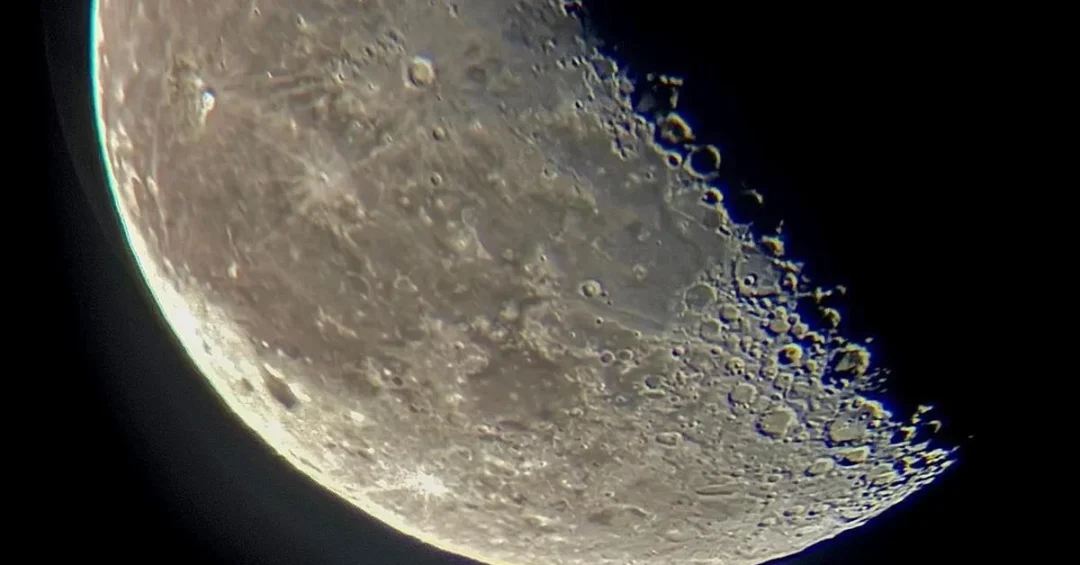
Astronomers in Saudi Arabia’s Northern Borders Region have captured a detailed view of the Moon’s last-quarter phase over Rafha Governorate, revealing impact craters, highlands, and dark volcanic plains that together preserve a geological record stretching back billions of years. The observation, reported by the Saudi Press Agency (SPA), was conducted on September 6, 2026, and offers a striking window into the early evolution of the solar system, according to Barjas Al-Fulaih, a member of the AFAQ Society for Astronomy.
The findings underscore how the Kingdom’s clear desert skies and growing astronomical community are contributing to public engagement with space science, a field increasingly prioritized under Saudi Arabia’s Vision 2030 diversification agenda. What makes the Rafha observation particularly valuable is not merely the beauty of the lunar surface, but the scientific narrative it encodes: a timeline of cosmic collisions and ancient volcanism that Earth’s own dynamic geology has largely erased. For researchers and enthusiasts alike, the Moon serves as a natural archive, and Saudi Arabia’s geographic advantages make it an ideal vantage point for such studies. Could the Moon hold answers to questions about our own planet’s violent past? The Rafha observations suggest it very well might.
Context and Background
Why does the Moon’s surface look so different from Earth’s, and what can that difference teach us? The answer lies in the Moon’s lack of atmosphere and active plate tectonics, which has allowed its ancient surface to remain largely unchanged for eons. According to Al-Fulaih, the lunar terrain was shaped primarily by large-scale meteorite impacts and ancient volcanic activity. Unlike Earth, where wind, water, and tectonic shifts continuously resurface the planet, the Moon preserves its scars almost intact. This makes it a unique laboratory for understanding the early solar system.
The observation over Rafha is part of a broader tradition of astronomical observation in Saudi Arabia, where organizations such as the AFAQ Society for Astronomy work to promote public awareness and scientific literacy. The Northern Borders Region, with its low light pollution and clear desert atmosphere, offers favorable conditions for such work. Al-Fulaih noted that the visibility of lunar features depends on the Moon’s phase, the timing of the observation, atmospheric clarity, and the astronomical instruments used. These factors combine to make last-quarter phases especially revealing, as shadows cast along crater rims and slopes accentuate topographic details that are washed out during a full moon.
This latest observation also reflects a growing interest in space sciences across the Kingdom, aligning with national efforts to develop a knowledge-based economy. As Saudi Arabia expands its investments in astronomy, space exploration, and related technologies, initiatives like this one help build a foundation of scientific curiosity and expertise among the public. The Moon, so often taken for granted, becomes a gateway to understanding planetary science, and Rafha’s skies are proving to be an excellent classroom.
Key Details
What exactly did the Rafha observers see, and why does it matter? The last-quarter Moon revealed a stark contrast between bright lunar highlands and dark, smooth plains known as maria. Al-Fulaih explained that these dark regions are not bodies of water, as early astronomers once believed, but volcanic plains formed when basaltic lava flows flooded large basins and depressions created by major impacts. These maria appear darker than the highlands because of differences in mineral composition and geological age. The highlands, by contrast, are older, more heavily cratered, and composed of lighter-colored rocks.
The observation also highlighted the role of lighting in lunar study. Al-Fulaih noted that lunar craters become more clearly visible as the Moon approaches a quarter phase, because shadows cast along their rims and slopes accentuate their features. During a full moon, the Sun’s light hits the surface more directly, reducing shadows and making some features appear less distinct. This is why astronomers often prefer to observe the Moon during its partial phases, when the oblique lighting creates a three-dimensional effect that reveals depth and texture.
Among the features visible over Rafha were impact craters of various sizes, ancient mountains, and the expansive maria. Each of these elements tells a story of the Moon’s geological history. The craters record episodes of bombardment by asteroids and comets, while the maria indicate periods of intense volcanic activity that occurred after the crust had solidified. Together, they provide a timeline of events that stretches back more than four billion years, offering clues about the conditions that prevailed when the solar system was young.
International and Regional Impact
How does a local astronomical observation in Saudi Arabia resonate beyond its borders? The Rafha study contributes to a global body of knowledge about the Moon, which is currently the focus of renewed international interest. Space agencies and private companies are planning missions to return humans to the lunar surface and establish sustainable presence there. Understanding the Moon’s geology is not just an academic exercise; it is essential for identifying resources, selecting landing sites, and assessing potential hazards. Saudi Arabia’s observations add to the international dataset and demonstrate the Kingdom’s capacity to participate in cutting-edge space science.
Regionally, the observation highlights the growing role of Gulf countries in astronomy and space exploration. The UAE has already sent a probe to Mars and is planning a lunar rover, while Saudi Arabia has established a national space strategy and launched initiatives to develop local talent. The AFAQ Society’s work in Rafha exemplifies the grassroots enthusiasm that complements government efforts. By engaging the public and documenting lunar features, such groups help build a culture of scientific inquiry that can support larger national ambitions. In a region often associated with other industries, this quiet astronomical work signals a broader diversification into knowledge-intensive fields.
Economic and Strategic Significance
What economic or strategic value could lunar observation possibly have? The answer lies in the broader context of space economy and technological development. Space science drives innovation in optics, imaging, materials, and data analysis, all of which have terrestrial applications. By fostering a community of amateur and professional astronomers, Saudi Arabia cultivates skills that are transferable to aerospace, defense, and high-tech industries. Moreover, the Moon itself is increasingly seen as a resource frontier, with potential deposits of helium-3, rare earth elements, and water ice. Nations that develop lunar expertise now will be better positioned to benefit from future exploration and utilization.
Strategically, participation in space science enhances Saudi Arabia’s international standing and soft power. It signals a commitment to advanced research and global cooperation, aligning with the Kingdom’s Vision 2030 goal of becoming a hub for innovation and knowledge. The Rafha observation, though modest in scale, is part of this larger narrative. It also supports educational objectives by inspiring young Saudis to pursue careers in science, technology, engineering, and mathematics (STEM). As the Kingdom invests in universities, research centers, and partnerships with international space agencies, each local observation contributes to a cumulative base of expertise and enthusiasm.
Vision 2030 Alignment
How does a lunar observation over a desert governorate connect to Saudi Arabia’s grand vision for the future? Vision 2030 aims to diversify the economy, empower citizens, and position the Kingdom as a global leader in various fields, including science and technology. The establishment of the Saudi Space Commission (now the Saudi Space Agency) and the launch of national space strategies reflect this ambition. Astronomical activities like those in Rafha foster scientific literacy, encourage curiosity, and build the human capital needed for a knowledge-based economy. They also promote tourism and cultural engagement, as dark-sky locations can attract visitors interested in astronomy.
In the end, the last-quarter Moon over Rafha is more than a pretty sight. It is a reminder that Saudi Arabia’s journey toward a diversified, innovation-driven future includes looking up at the skies. By documenting the Moon’s geological record, Saudi astronomers are contributing to humanity’s understanding of its place in the cosmos. As Vision 2030 unfolds, such efforts will help ensure that the Kingdom’s legacy is not only built on Earth but also among the stars. The observation stands as a testament to the power of curiosity and the enduring value of exploring the unknown.
20 Questions
Q1. What did the last-quarter Moon observation over Rafha reveal?
A1. It revealed impact craters, highlands, and dark lowlands (maria), which together document the Moon’s geological history and the early evolution of the solar system.
Q2. Who reported the observation?
A2. The observation was reported by the Saudi Press Agency (SPA) and involved Barjas Al-Fulaih, a member of the AFAQ Society for Astronomy.
Q3. Why are lunar craters more visible during the quarter phase?
A3. Shadows cast along crater rims and slopes during the quarter phase accentuate their features, making them more distinct than during a full moon.
Q4. What are lunar maria?
A4. Lunar maria are broad dark regions that are not bodies of water but volcanic plains formed when basaltic lava flows flooded large basins created by major impacts.
Q5. How does the Moon’s surface preserve its geological history?
A5. The Moon has limited erosion compared to Earth, so its terrain remains largely preserved, making it an important source for studying geological history.
Q6. What factors affect the visibility of lunar features?
A6. Visibility depends on the Moon’s phase, timing of observation, atmospheric clarity, and the astronomical instruments used.
Q7. What is the significance of the Rafha observation for Saudi Arabia?
A7. It demonstrates the Kingdom’s growing engagement in astronomy and space science, aligning with Vision 2030’s goals of innovation and knowledge-based economy.
Q8. How does lunar observation promote public awareness?
A8. It offers an accessible way to explore the Moon’s geological history and encourages public interest in astronomy and science.
Q9. What causes the contrast between lunar highlands and maria?
A9. Differences in mineral composition and geological age cause the maria to appear darker than the brighter highlands.
Q10. Why is the Moon considered a natural record of the early solar system?
A10. Its surface has preserved impact craters and volcanic plains for billions of years, providing clues about the conditions and events of the early solar system.
Q11. What role does the AFAQ Society for Astronomy play?
A11. It promotes astronomical observation and public awareness, contributing to scientific literacy and engagement in Saudi Arabia.
Q12. How does the observation align with Vision 2030?
A12. It supports the development of a knowledge-based economy, fosters STEM skills, and enhances the Kingdom’s role in space science and innovation.
Q13. What are the economic benefits of lunar observation?
A13. It drives innovation in optics, imaging, and data analysis, and prepares Saudi Arabia for future participation in the space economy.
Q14. Why is the Northern Borders Region suitable for astronomy?
A14. The region has clear desert skies and low light pollution, providing favorable conditions for astronomical observations.
Q15. What did Al-Fulaih say about the Moon’s terrain?
A15. He said it was shaped primarily by large-scale meteorite impacts and ancient volcanic activity, with effects largely preserved due to limited erosion.
Q16. How do lunar observations contribute to international space efforts?
A16. They add to the global dataset on lunar geology, which is essential for planning future missions and resource exploration.
Q17. What is the difference between lunar highlands and maria?
A17. Highlands are older, lighter-colored, and heavily cratered; maria are younger, darker volcanic plains with fewer craters.
Q18. How does the Moon’s lack of atmosphere affect its surface?
A18. Without atmosphere, there is no weathering or erosion, so impact craters and volcanic features remain preserved for billions of years.
Q19. What can Saudi Arabia gain from promoting astronomy?
A19. It builds human capital, inspires youth, enhances scientific reputation, and supports economic diversification through high-tech innovation.
Q20. What is the broader significance of the Rafha observation?
A20. It highlights Saudi Arabia’s contribution to space science and its commitment to exploring the cosmos, reflecting the Kingdom’s forward-looking vision.
Reader Feedback
We value your thoughts. Please share your feedback on this article.
Your feedback helps us improve our coverage.
Related articles
 Saudi Arabia reduces ozone-depleting substances by 69%
 Saudi Arabia increases ozone-depleting substances elimination rate to 69%
 Desert cobra supports biodiversity in Northern Borders
 Black cobra supports biodiversity in Northern Borders Region
 PNU Sarah Al-Sudairi Center advances women’s studies
 Jazan University Launches Future Skills Center