


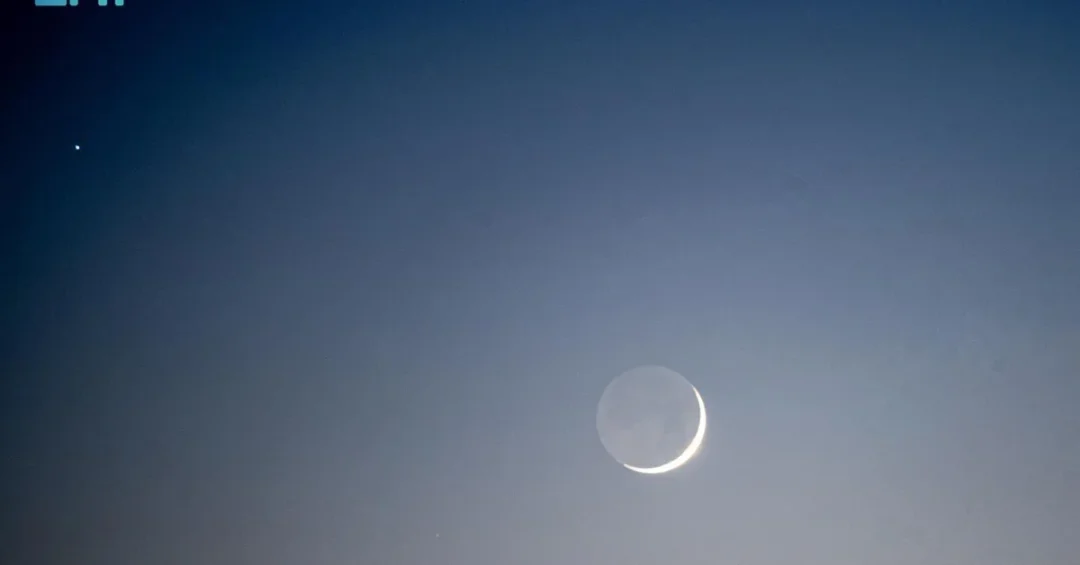
The crescent moon of Safar, the second month of the Hijri calendar, aligned with Regulus, one of the brightest stars in the Leo constellation, in a striking celestial display observed over the Northern Borders Region, the Saudi Press Agency reported. The conjunction appeared in the evening sky above the Kingdom’s northern territory, giving residents, visitors, and astronomy enthusiasts a clear view of one of the most recognizable pairings in the night sky. The sighting was documented in Arar, the administrative capital of the Northern Borders Region, and confirmed by members of the Astronomy and Space Club.
Context and Background
Safar is the second month of the Hijri calendar, and the appearance of its crescent moon is traditionally observed across the Islamic world as a marker of the lunar cycle. On this occasion, the young crescent did not stand alone in the sky. It passed near Regulus, a star whose name derives from the Latin word for “little king” and whose Arabic name, Qalb al-Asad, translates as “the heart of the lion.” Regulus sits at approximately 79 light years from Earth and ranks among the brightest stars visible to the naked eye.
The Northern Borders Region, whose capital is Arar, is known for wide open terrain and relatively low levels of artificial light, conditions that favor naked-eye astronomy and long-exposure astrophotography. The Saudi Press Agency reported the observation on July 27, 2025, describing the event as a captivating spectacle for those watching the evening sky.
Key Details of the Conjunction
Adnan Al-Ramdaoun, a member of the Astronomy and Space Club, explained that the phenomenon occurs when the moon passes close to a prominent star in the night sky. Such alignments are predictable and recur on a regular basis, which allows observers to plan viewing sessions in advance.
Al-Ramdaoun noted that the conjunction of the Safar crescent moon with Regulus offers an excellent opportunity for observation and photography, particularly in areas with clear skies and minimal light pollution. The pairing is especially appealing to photographers because the crescent moon and a first-magnitude star can be captured together in a single frame, without specialized equipment.
The event also serves an educational purpose. Conjunctions of this kind are frequently used by astronomy groups to introduce the public to basic concepts such as the moon’s orbital path, the apparent movement of the stars, and the measurement of brightness. In the Northern Borders Region, the combination of dark skies and dry, clear air supports these public engagement efforts.
Implications and Impact
Astronomical events of this kind carry value beyond their visual appeal. They contribute to the growth of astronomy tourism, drawing visitors to regions that offer unobstructed views of the heavens. For the Northern Borders Region, such sightings highlight an underused natural asset: its exceptionally dark night skies.
The observation also strengthens the Kingdom’s wider scientific culture by encouraging public participation in skywatching, supporting amateur astronomy clubs, and inspiring young people to pursue studies in physics, space sciences, and related fields. Documented sightings shared through official Saudi channels add to a growing record of astronomical observations made from Saudi territory.
Internationally, the report reinforces Saudi Arabia’s position as an active contributor to the global astronomical community, demonstrating that the Kingdom’s institutions and enthusiasts are engaged in observing and documenting celestial phenomena alongside counterparts worldwide.
Vision 2030 Alignment
The sighting aligns with Saudi Vision 2030, which emphasizes scientific advancement, knowledge-based development, and improvements in quality of life for citizens and residents. Investments in space sciences, research, and educational outreach reflect the Kingdom’s broader ambition to build a diversified, innovation-driven economy.
As Saudi Arabia expands its space sector and encourages public engagement with science, events such as the Safar crescent aligning with Regulus illustrate how the Kingdom’s natural environment and institutional support combine to inspire curiosity and discovery. This forward-looking momentum positions Saudi Arabia to play an increasingly prominent role in regional and international astronomy, while offering its people and visitors memorable encounters with the night sky.
20 Questions
Q1. What astronomical event was observed over the Northern Borders Region?
A1. The crescent moon of Safar, the second month of the Hijri calendar, appeared in alignment with Regulus, the brightest star in the Leo constellation. The conjunction was observed in the evening sky and confirmed by members of the Astronomy and Space Club, according to the Saudi Press Agency.
Q2. What is a conjunction in astronomy?
A2. A conjunction occurs when two celestial bodies appear close together from Earth’s perspective. It is an optical alignment rather than a physical meeting, since the moon and the star remain enormously far apart in space, yet they appear paired in the sky for observers on the ground.
Q3. Why is Regulus considered significant?
A3. Regulus is one of the brightest stars visible from Earth and the most luminous star in the Leo constellation. Its Arabic name, Qalb al-Asad, means “heart of the lion.” It lies roughly 79 light years away and has guided observers for centuries.
Q4. Why was the Northern Borders Region a good location for viewing?
A4. The Northern Borders Region, with Arar as its capital, features wide open terrain, low humidity at night, and relatively low artificial light. These conditions reduce light pollution and make faint objects easier to see and photograph, benefiting both casual observers and astrophotographers.
Q5. Who provided the official explanation of the phenomenon?
A5. Adnan Al-Ramdaoun, a member of the Astronomy and Space Club, explained that the phenomenon occurs when the moon passes near a prominent star. He noted the event offered an excellent opportunity for observation and photography, particularly where skies are clear and light pollution is minimal.
Q6. What is Safar in the Hijri calendar?
A6. Safar is the second month of the Hijri, or Islamic lunar calendar. It follows Muharram and precedes Rabi al-Awwal. The sighting of the crescent moon marks the beginning of each Hijri month, making lunar observation important for religious and cultural calendars.
Q7. When was the observation reported?
A7. The Saudi Press Agency reported the observation on July 27, 2025, noting that the display occurred the previous evening. The report was issued from Arar, the capital of the Northern Borders Region, and reflected official Saudi coverage of the event.
Q8. Do I need a telescope to see such a conjunction?
A8. No. The crescent moon and Regulus are both bright enough to be seen with the naked eye under clear skies. A simple camera or smartphone can capture them together, though a tripod and longer exposure settings improve photographic results considerably.
Q9. How often do moon-star conjunctions happen?
A9. The moon completes a circuit of the sky roughly every 27 days, so it passes near prominent stars fairly often. However, a pairing with a star as bright as Regulus, occurring during a visible crescent phase, is a particularly attractive event for observers.
Q10. Why is light pollution relevant to this event?
A10. Light pollution brightens the night sky and washes out faint objects. In areas with minimal artificial lighting, such as parts of the Northern Borders Region, the contrast between the crescent moon and Regulus is sharper, making the conjunction easier to observe and photograph.
Q11. What educational value does this event offer?
A11. Conjunctions help explain the moon’s orbit, the apparent motion of stars, and the measurement of stellar brightness. Astronomy groups frequently use such events to introduce the public to basic scientific concepts and to encourage young people to explore space sciences.
Q12. How does the event relate to astronomy tourism?
A12. Dark-sky locations are increasingly valued by travelers interested in stargazing. Documented celestial events over the Northern Borders Region highlight the area’s natural advantages, potentially attracting visitors seeking clear, unpolluted views of the night sky and supporting local tourism development.
Q13. What is the Astronomy and Space Club?
A13. The Astronomy and Space Club is a Saudi organization whose members observe and document celestial phenomena and share their findings with the public. Its members, including Adnan Al-Ramdaoun, provide expert commentary on events such as the Safar crescent and Regulus alignment.
Q14. Can the conjunction be photographed with a smartphone?
A14. Yes, in many cases. A smartphone with manual exposure controls can capture the crescent moon and Regulus together, especially when mounted on a tripod. Choosing a dark location away from city lights and avoiding digital zoom produce the clearest results.
Q15. Why does the crescent moon appear near different stars over time?
A15. The moon travels along a path through the sky that crosses in front of the constellations over the course of each month. As it moves, it passes near different bright stars in sequence, producing a changing series of conjunctions visible from Earth.
Q16. How does Saudi Arabia support astronomical observation?
A16. Saudi Arabia supports astronomy through scientific bodies, universities, and public outreach programs, alongside amateur clubs that document sightings. Official channels such as the Saudi Press Agency regularly report notable celestial events, helping to build a national record of observations.
Q17. What scientific data can observers record during such events?
A17. Observers can note the time of closest apparent approach, the separation between the moon and star, sky conditions, and photographic exposures. This information contributes to public records and helps astronomy groups refine future viewing and educational activities for their communities.
Q18. Why are dark skies important for science and society?
A18. Dark skies allow researchers and the public to observe celestial objects clearly. They also support wildlife, reduce energy waste, and create recreational opportunities. Protecting them is increasingly recognized as part of responsible environmental and urban planning.
Q19. How does this event connect to Saudi Vision 2030?
A19. Vision 2030 emphasizes scientific progress, knowledge-based development, and improved quality of life. Public engagement with astronomy and the growth of space-related research reflect these goals, supporting a diversified economy and a society that values innovation and discovery.
Q20. What could observers look forward to next?
A20. The moon will continue its monthly journey past other bright stars and planets, producing further conjunctions visible from Saudi Arabia. Astronomy groups are expected to announce upcoming viewing opportunities, allowing the public to plan observations and photography sessions in advance.
Reader Feedback
We value your thoughts. Please share your feedback on this article.
Your feedback helps us improve our coverage.