


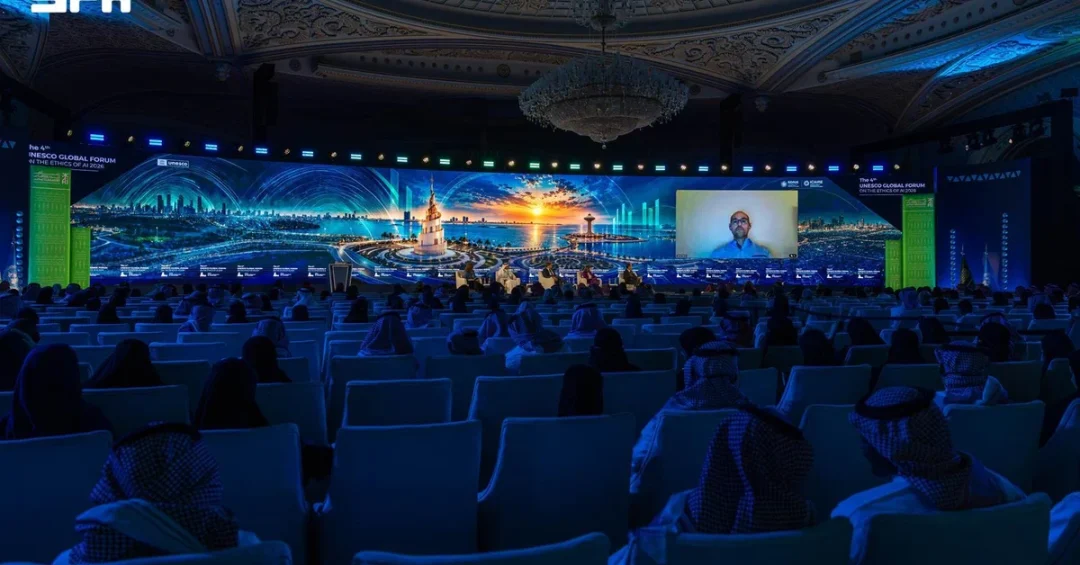
Saudi Arabia has placed national expertise in data and artificial intelligence at the center of global discussions on ethical AI governance, as Riyadh hosts the fourth UNESCO Global Forum on the Ethics of Artificial Intelligence (GFEAI 2026), according to the Saudi Press Agency (SPA). The forum, held in the Saudi capital from September 17, 2026, brings together international policymakers, researchers, and technology leaders to strengthen cooperation on the ethical and inclusive governance of artificial intelligence. At the heart of the Kingdom’s participation is a sustained national effort to build a generation of Saudi specialists who can develop, evaluate, and govern AI systems responsibly.
That effort is anchored in the work of the Saudi Data and Artificial Intelligence Authority (SDAIA) and the International Center for AI Research and Ethics (ICAIRE), which are collaborating to embed governance and ethical principles at the earliest stages of system design and development. As the world turns its attention to Riyadh, the Kingdom is showcasing not only its convening power but also its growing pool of national talent in data and AI. How does a country move from adopting technology to shaping the rules that govern it? Saudi Arabia’s answer is being written in research centers, professional certification programs, and international forums like GFEAI 2026.
Context and Background
The fourth UNESCO Global Forum on the Ethics of Artificial Intelligence is the latest milestone in a global conversation that has accelerated sharply over the past decade. UNESCO’s Recommendation on the Ethics of Artificial Intelligence, adopted by 193 member states in 2021, established the first global standard-setting instrument on AI ethics. Since then, the annual Global Forum has served as the principal platform for translating those principles into practical tools, policies, and institutional practices. Riyadh’s hosting of GFEAI 2026 reflects both the Kingdom’s rising influence in global technology governance and the trust placed in its institutions to convene diverse stakeholders.
For Saudi Arabia, the forum is not an isolated event but a continuation of a strategic journey. SDAIA, established in 2019, has been tasked with driving the national data and AI agenda, from building digital infrastructure to nurturing human capital. ICAIRE, launched in partnership with UNESCO, focuses on research and ethics, ensuring that rapid technological advancement is matched by rigorous attention to fairness, transparency, and accountability. Together, these institutions embody a vision in which ethical considerations are not an afterthought but a foundational design principle.
Why does hosting this forum matter now? Because AI governance is at an inflection point. Countries are moving from debating principles to implementing regulations, and the choices made in the next few years will shape how AI affects economies, societies, and individual rights for decades. Saudi Arabia’s role as host signals its intention to be a constructive partner in that process, contributing its own experience of rapid digital transformation in a culturally diverse region.
Key Details
According to SPA, Saudi specialists and researchers are developing AI technologies that go well beyond improving model and algorithm efficiency and data-processing speed. Their work includes testing reliability and fairness, addressing challenges related to digital bias, and strengthening data protection while taking privacy, cultural, and linguistic diversity into account. This comprehensive approach reflects a recognition that ethical AI is not merely about avoiding harm but about actively designing systems that serve diverse populations equitably.
A central element of the Kingdom’s strategy is the professional badge system awarded to specialists in data and AI. SDAIA has previously honored more than 52 experts and specialists who obtained these badges, a figure that underscores the early stage of a program designed to scale significantly in the coming years. The badges are a form of verified professional recognition, signaling that holders have met rigorous standards of competence and ethical awareness. By institutionalizing expertise in this way, Saudi Arabia is creating a pipeline of talent capable of leading AI development and governance both domestically and internationally.
Cooperation between SDAIA and ICAIRE is pivotal. ICAIRE’s research agenda includes developing frameworks for ethical AI, studying bias mitigation, and promoting inclusive governance models. The center’s partnership with UNESCO gives it a global platform, while its Saudi base allows it to draw on regional perspectives that are often underrepresented in global technology debates. What does this mean in practice? It means that when Saudi experts speak at GFEAI 2026, they do so with the backing of concrete programs, measurable outcomes, and a clear institutional mandate.
International and Regional Impact
The GFEAI 2026 forum in Riyadh amplifies Saudi Arabia’s voice in international AI governance at a time when the global community is seeking common ground. UNESCO’s member states are working to operationalize the 2021 Recommendation, and forums like this one are essential for sharing best practices, identifying gaps, and building consensus. By hosting the event, the Kingdom facilitates dialogue between developed and developing nations, ensuring that the perspectives of the Global South are part of the conversation. This aligns with Saudi Arabia’s broader diplomatic approach of fostering multilateral cooperation and bridging divides.
Regionally, the forum reinforces Riyadh’s position as a hub for technology and innovation in the Middle East. Saudi expertise in data and AI is increasingly sought after by neighboring countries embarking on their own digital transformation journeys. The professional badge system, in particular, offers a model that other nations could adapt to certify their own talent. Moreover, the emphasis on cultural and linguistic diversity in AI development resonates across the Arab world, where ensuring that AI systems understand and respect local contexts is a shared priority. How will this regional leadership translate into global influence? By demonstrating that ethical AI and rapid innovation can advance together, Saudi Arabia offers a compelling alternative to approaches that treat ethics as a constraint rather than an enabler.
Economic and Strategic Significance
Building a robust AI ecosystem is a strategic imperative for Saudi Arabia’s economic diversification. Under Vision 2030, the Kingdom aims to reduce its dependence on oil and create a knowledge-based economy driven by technology, innovation, and human capital. AI is a key enabler across sectors, from healthcare and education to energy and logistics. The development of national expertise in data and AI ensures that the benefits of these technologies are captured locally, creating high-value jobs and fostering a vibrant startup ecosystem. The professional badge system directly supports this by setting clear standards and encouraging continuous learning.
Strategically, ethical AI governance is also a matter of national and economic security. As AI becomes embedded in critical infrastructure, the ability to evaluate reliability, fairness, and security becomes paramount. Saudi Arabia’s investment in these capabilities reduces reliance on external expertise and positions the Kingdom as a trusted partner for international companies seeking to operate in compliance with emerging global standards. The collaboration between SDAIA and ICAIRE ensures that research informs policy and that policy, in turn, shapes industry practice. In a world where data is a strategic asset, Saudi Arabia is building the institutions and talent needed to manage it responsibly.
Vision 2030 Alignment
The hosting of GFEAI 2026 and the accompanying focus on national expertise are directly aligned with the goals of Saudi Vision 2030. The vision’s emphasis on a diversified economy, a thriving digital sector, and a society that embraces innovation finds concrete expression in the work of SDAIA and ICAIRE. By nurturing a generation of Saudi specialists in data and AI, the Kingdom is investing in its most valuable resource: its people. The professional badge system, the research into bias and fairness, and the commitment to privacy and cultural diversity all reflect the vision’s holistic approach to development, where economic progress goes hand in hand with social responsibility.
As the forum concludes, the world will have seen a Saudi Arabia that is not only a participant in the global AI conversation but a leader in shaping its ethical foundations. The Kingdom’s long-term vision is to be a global hub for AI that is both innovative and trustworthy, and the steps taken today—from certifying experts to hosting UNESCO—are building that future. For international observers, the message is clear: Saudi Arabia is open for collaboration, committed to responsible AI, and ready to contribute its expertise to the world. What comes next will depend on sustained effort and international partnership, but the foundation laid in Riyadh this week is strong and forward-looking.
20 Questions
Q1. What is the UNESCO Global Forum on the Ethics of Artificial Intelligence?
A1. It is an annual international gathering that brings together policymakers, researchers, and technology leaders to advance the ethical governance of AI, building on UNESCO’s 2021 Recommendation on the Ethics of AI.
Q2. Where and when is GFEAI 2026 taking place?
A2. The fourth UNESCO Global Forum on the Ethics of Artificial Intelligence is being held in Riyadh, Saudi Arabia, on September 17, 2026, according to the Saudi Press Agency.
Q3. Which Saudi organizations are leading the Kingdom’s AI ethics efforts?
A3. The Saudi Data and Artificial Intelligence Authority (SDAIA) and the International Center for AI Research and Ethics (ICAIRE) are the primary institutions driving these efforts.
Q4. What is SDAIA’s role in Saudi Arabia’s AI development?
A4. SDAIA, established in 2019, leads the national data and AI agenda, from building digital infrastructure to nurturing talent and promoting ethical standards.
Q5. What is ICAIRE and what does it do?
A5. ICAIRE is the International Center for AI Research and Ethics, launched in partnership with UNESCO, focusing on research, ethics frameworks, and inclusive AI governance.
Q6. What is the professional badge system mentioned in the article?
A6. It is a certification program awarded by SDAIA to specialists in data and AI who meet rigorous competence and ethical standards, with over 52 experts honored so far.
Q7. Why is ethical AI important for Saudi Arabia?
A7. Ethical AI ensures that technological advancement respects privacy, fairness, and cultural diversity, aligning with Saudi Arabia’s values and its Vision 2030 goals.
Q8. How does Saudi Arabia address digital bias in AI?
A8. Saudi researchers test reliability and fairness, and work to mitigate digital bias by integrating ethical principles early in system design and development.
Q9. What does cultural and linguistic diversity mean in AI development?
A9. It means designing AI systems that understand and respect different cultures and languages, ensuring equitable service to diverse populations, including Arabic speakers.
Q10. How does hosting GFEAI 2026 benefit Saudi Arabia?
A10. It reinforces the Kingdom’s position as a global hub for technology governance, facilitates international cooperation, and showcases Saudi expertise in AI ethics.
Q11. What is the significance of UNESCO’s 2021 Recommendation on AI Ethics?
A11. It is the first global standard-setting instrument on AI ethics, adopted by 193 member states, providing a framework for responsible AI development worldwide.
Q12. How does Saudi Arabia’s AI strategy support Vision 2030?
A12. It drives economic diversification, creates high-value jobs, fosters innovation, and builds a knowledge-based economy, all core objectives of Vision 2030.
Q13. What economic sectors benefit from Saudi AI expertise?
A13. Healthcare, education, energy, logistics, and finance are among the sectors that benefit from AI advancements, enhancing efficiency and innovation.
Q14. How does the professional badge system help the AI ecosystem?
A14. It sets clear standards, encourages continuous learning, and ensures a pipeline of qualified professionals capable of developing and governing AI responsibly.
Q15. What international partnerships support Saudi AI ethics work?
A15. The partnership between SDAIA and ICAIRE, along with UNESCO, provides a global platform for research, dialogue, and the sharing of best practices.
Q16. How does Saudi Arabia ensure privacy in AI systems?
A16. Privacy is a key consideration in AI development, with researchers incorporating data protection measures and ethical guidelines from the earliest stages of design.
Q17. What role do Saudi researchers play in global AI governance?
A17. They contribute research on fairness, bias mitigation, and inclusive governance, helping shape international standards and practices through forums like GFEAI.
Q18. How can other countries learn from Saudi Arabia’s AI approach?
A18. They can adopt similar professional certification models, invest in ethics research, and participate in multilateral forums to share experiences and build consensus.
Q19. What is the future outlook for AI in Saudi Arabia?
A19. Saudi Arabia aims to be a global leader in ethical AI, continuing to invest in talent, research, and international cooperation to drive innovation and responsible governance.
Q20. How does GFEAI 2026 contribute to global AI governance?
A20. It strengthens international cooperation, translates ethical principles into practical tools, and fosters inclusive dialogue among diverse stakeholders from around the world.
Reader Feedback
We value your thoughts. Please share your feedback on this article.
Your feedback helps us improve our coverage.
Related articles
 University of Hail Renewable Energy Program Earns ABET Accreditation
 Robots, Smart Technologies Take Center Stage at Saudi Industry Forum
 ICAIRE Urges Universities to Adopt AI Ethics Master’s Program
 Al Namas hosts second AI summer program
 Middle East Green Initiative joins UNCCD COP17
 Riyadh Hosts Global Forum on AI Ethics to Protect Humanity