


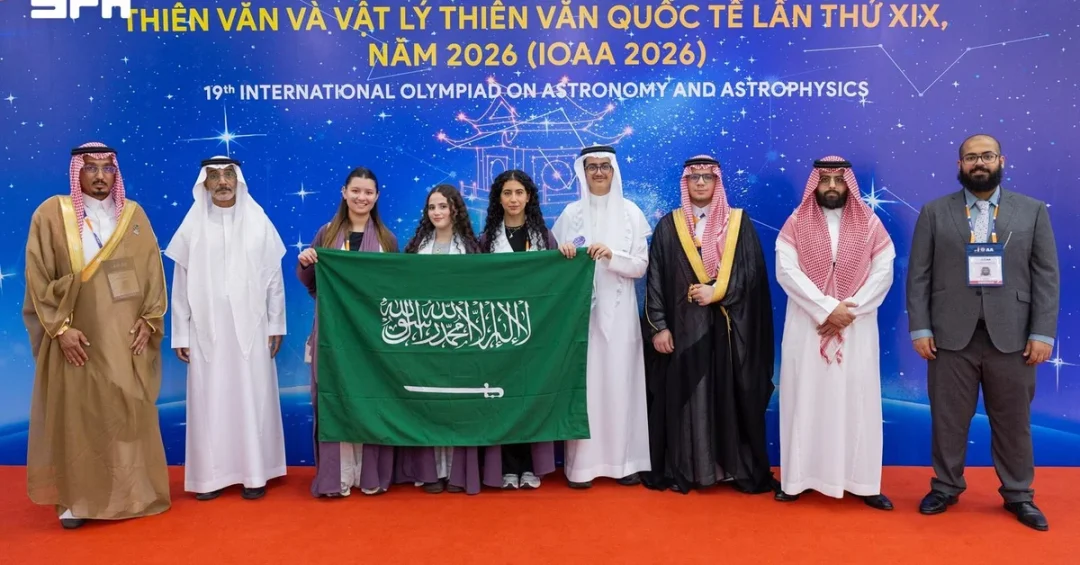
Saudi Arabia’s national astronomy and astrophysics team has begun competing at the 19th International Olympiad on Astronomy and Astrophysics (IOAA 2026) in Hanoi, Vietnam, with five students representing the Kingdom from September 25 to October 5. The delegation’s participation, announced through official Saudi channels, places Saudi students alongside competitors from more than 60 countries in one of the world’s most demanding scientific competitions for pre-university talent. The team arrived in Hanoi after completing intensive preparation through specialized training programs and camps designed to sharpen both theoretical understanding and practical observation skills. For a Kingdom investing heavily in science, technology, and human capital under Vision 2030, the Olympiad represents far more than a medal tally — it is a live test of how well Saudi education is preparing its brightest young minds for the global knowledge economy.
The five-member Saudi team enters the competition with a growing track record. Since first participating in the Olympiad in 2024, the Kingdom has won six international awards across two appearances: one silver medal, three bronze medals, and two certificates of appreciation. That record gives the delegation both confidence and a clear benchmark. The IOAA evaluates competitors through astronomy problems, celestial observations, data analysis, and simulation software, testing not only memorized knowledge but the ability to reason under pressure and apply scientific methods to unfamiliar problems. Saudi Arabia’s continued presence at this level reflects a deliberate national strategy to nurture scientific talent from an early age and connect it to global centers of excellence.
Context and Background
How did Saudi Arabia move so quickly from newcomer to consistent medal contender on the international astronomy stage? The Kingdom’s first IOAA participation came in 2024, and within two cycles it had already secured a silver medal, three bronze medals, and two certificates of appreciation. That trajectory is the product of structured investment rather than chance. Students are identified through national science competitions, then funneled into specialized training programs and camps where they work on astronomy theory, observational techniques, and computational analysis. The preparation mirrors the Olympiad’s own format, which combines classroom-style problem solving with practical challenges such as identifying celestial objects and interpreting astronomical data.
The International Olympiad on Astronomy and Astrophysics is widely regarded as one of the most rigorous annual competitions for secondary-school students. It brings together national teams that have already survived domestic selection processes, and it rewards depth of understanding rather than rote learning. Hosted this year in Hanoi, the event runs for eleven days and includes theoretical examinations, practical observation rounds, and team-based activities. For Saudi students, the experience offers something that no domestic classroom can fully replicate: direct exposure to international academic standards, peer networks, and problem sets developed by leading astronomers and astrophysicists from around the world.
Saudi Arabia’s participation also fits into a broader regional pattern. Gulf states have been steadily expanding their presence in international science Olympiads, viewing them as low-cost, high-impact instruments for identifying and developing talent. The Kingdom’s approach, however, is distinctive in its integration with national institutions and long-term planning. Training camps are not one-off events but part of a pipeline that begins with school-level enrichment and extends through university scholarships and research opportunities. That pipeline is central to the human-capital objectives that underpin Saudi Arabia’s economic transformation agenda.
Key Details
What exactly will the Saudi team face in Hanoi? The IOAA 2026 program assesses theoretical and practical skills through astronomy problems, celestial observations, data analysis, and simulation software. Competitors must demonstrate fluency in astrophysics concepts, the ability to interpret observational data, and comfort with computational tools used by professional astronomers. The practical rounds often require students to work with real or simulated telescope data, identify patterns in stellar and planetary phenomena, and draw defensible conclusions from incomplete information. These are precisely the skills that research institutions and technology companies value, which is why the Olympiad is watched closely by universities and science ministries worldwide.
The Saudi delegation consists of five students selected after intensive preparation through specialized training programs and camps. Their selection followed national qualifying rounds that tested both knowledge and problem-solving ability. The team’s participation is coordinated through official Saudi educational and scientific channels, consistent with the Kingdom’s practice of documenting and publicizing student achievements as part of its national development narrative. Across the two previous participations, Saudi students have earned one silver medal, three bronze medals, and two certificates of appreciation — a record that places the Kingdom among the more promising newer entrants in the competition.
The event’s scale matters. With students from more than 60 countries, IOAA 2026 is a genuinely global gathering. Teams from Asia, Europe, the Americas, Africa, and the Middle East compete under shared rules and shared standards. For Saudi students, this means their performance is measured against the best-prepared peers in the world, not only against regional benchmarks. That international calibration is valuable in itself: it provides objective feedback on the strengths and gaps in national preparation programs, and it helps education planners refine curricula and training methods for future cohorts.
International and Regional Impact
Why should the international community pay attention to a student science competition in Hanoi? Because these competitions are increasingly where national scientific capacity is seeded. Countries that perform well in Olympiads tend to build stronger domestic research pipelines a decade later, as medalists move into universities, laboratories, and technology firms. Saudi Arabia’s sustained participation signals that the Kingdom intends to compete for talent at the highest level, not merely to import expertise. That shift has implications for how international universities, research institutes, and technology companies view Saudi human capital — as partners and recruits rather than passive consumers of knowledge.
Regionally, the Saudi team’s presence alongside more than 60 national delegations reinforces the Kingdom’s growing role in global scientific diplomacy. Education and science exchanges are a quiet but effective form of international engagement, building people-to-people ties that outlast individual events. Saudi students who compete in Hanoi will return with international networks, exposure to different academic cultures, and a clearer sense of where the global frontier of astronomy and astrophysics lies. Those connections can later translate into joint research, academic partnerships, and collaboration on space and data-science projects — areas where Saudi Arabia has been expanding its ambitions through national programs and international agreements.
Economic and Strategic Significance
How does a student Olympiad connect to a national economic strategy? The link runs through human capital. Astronomy and astrophysics demand advanced mathematics, physics, data analysis, and computational modeling — competencies that are directly transferable to fields such as aerospace, satellite technology, energy systems, artificial intelligence, and advanced manufacturing. By investing in elite science training for young Saudis, the Kingdom is building a talent pool that can support high-value industries and reduce long-term dependence on hydrocarbon revenue. The medals are symbols; the skills behind them are economic assets.
The strategic significance extends to national capability in space and observation sciences. Saudi Arabia has been steadily expanding its space and technology portfolio, and a generation of students trained in celestial observation, data interpretation, and simulation will be well positioned to contribute to those efforts. Participation in IOAA also helps normalize a culture of scientific competition and excellence within the education system, encouraging younger students to pursue demanding subjects. Each international appearance raises the visibility of science as a viable and prestigious career path, which in turn supports the broader goal of building a knowledge-based economy driven by Saudi talent.
Vision 2030 Alignment
How does a team of five students in Hanoi embody a national transformation plan? Vision 2030 places human capital at the center of Saudi Arabia’s future, with education, innovation, and youth empowerment as core pillars. The Kingdom’s participation in the International Olympiad on Astronomy and Astrophysics is a concrete expression of that priority: it identifies exceptional young talent, invests in intensive preparation, and measures results against global standards. The six international awards won across two previous participations demonstrate that the approach is producing results, and the continued participation in 2026 shows a commitment to building on them rather than treating them as isolated successes.
The forward-looking significance is clear. Saudi Arabia’s long-term vision depends on developing scientists, engineers, and researchers who can compete internationally and contribute at home. Competitions like IOAA are early proving grounds for that generation. As the team competes in Hanoi from September 25 to October 5, its performance will be tracked not only as a sporting-style result but as an indicator of the Kingdom’s progress in building a world-class education and innovation ecosystem. Whatever the medal outcome, the experience strengthens the pipeline that Vision 2030 relies on — and signals to the world that Saudi Arabia’s ambitions in science and technology are backed by real, measurable investment in its youth.
20 Questions
Q1. What is the International Olympiad on Astronomy and Astrophysics?
A1. The IOAA is an annual international competition for pre-university students that tests knowledge and practical skills in astronomy and astrophysics. It includes theoretical exams, celestial observations, data analysis, and simulation exercises, bringing together national teams from more than 60 countries each year.
Q2. Where and when is IOAA 2026 taking place?
A2. IOAA 2026 is being hosted in Hanoi, Vietnam, from September 25 to October 5, 2026. The Saudi team is participating alongside students from more than 60 countries during the eleven-day event.
Q3. How many Saudi students are competing in IOAA 2026?
A3. The Kingdom is represented by five students. They were selected after intensive preparation through specialized training programs and camps designed to develop both theoretical knowledge and practical astronomy skills.
Q4. When did Saudi Arabia first participate in the IOAA?
A4. Saudi Arabia began participating in the International Olympiad on Astronomy and Astrophysics in 2024. IOAA 2026 in Vietnam marks the Kingdom’s third appearance in the competition.
Q5. How many international awards has Saudi Arabia won in the IOAA?
A5. Across its two previous participations, Saudi Arabia has won six international awards: one silver medal, three bronze medals, and two certificates of appreciation. This record reflects consistent performance by Saudi students.
Q6. What skills does the IOAA assess?
A6. The Olympiad assesses theoretical and practical skills through astronomy problems, celestial observations, data analysis, and simulation software. These components test reasoning, observational accuracy, and the ability to apply scientific methods under examination conditions.
Q7. How are Saudi students prepared for the Olympiad?
A7. Saudi students undergo intensive preparation through specialized training programs and camps. These sessions cover astronomy theory, observational techniques, and data analysis, and are designed to mirror the format and difficulty of the international competition.
Q8. Why is Saudi Arabia’s participation significant for Vision 2030?
A8. Vision 2030 prioritizes human capital, education, and innovation. Participation in the IOAA develops young scientific talent, raises educational standards, and supports the Kingdom’s goal of building a knowledge-based economy driven by skilled Saudi youth.
Q9. What is the format of the IOAA competition?
A9. The IOAA typically includes theoretical examinations, practical observation rounds, and data analysis tasks. Students may also work with simulation software and team-based activities, all designed to test real scientific competency rather than memorization alone.
Q10. How many countries participate in the IOAA?
A10. More than 60 countries send national teams to the International Olympiad on Astronomy and Astrophysics. This makes it one of the largest and most competitive international science Olympiads for secondary-school students.
Q11. What subjects are connected to astronomy and astrophysics training?
A11. Astronomy and astrophysics draw on mathematics, physics, data analysis, and computational modeling. These competencies are transferable to fields such as aerospace, satellite technology, artificial intelligence, energy systems, and advanced manufacturing.
Q12. How does the IOAA benefit Saudi students personally?
A12. Saudi students gain international exposure, test their skills against global peers, and build academic networks. The experience also strengthens their readiness for university study and research careers in science and technology.
Q13. Is the Saudi team’s participation officially recognized?
A13. Yes. The team’s participation is announced through official Saudi channels, including the Saudi Press Agency. The Kingdom documents student achievements as part of its national development and educational reporting.
Q14. What awards has Saudi Arabia won in previous IOAA editions?
A14. Saudi Arabia has won one silver medal, three bronze medals, and two certificates of appreciation across its 2024 and 2025 participations. These results demonstrate steady progress in international science competition.
Q15. How long does the IOAA 2026 event last?
A15. IOAA 2026 runs from September 25 to October 5, 2026, in Hanoi, Vietnam. The eleven-day schedule includes examinations, practical rounds, and related activities for participating national teams.
Q16. What role do training camps play in Saudi preparation?
A16. Training camps provide intensive, focused instruction that goes beyond standard school curricula. They help students master advanced astronomy concepts, practice observational techniques, and become familiar with the tools and formats used at the international level.
Q17. How does the IOAA compare with other science Olympiads?
A17. The IOAA is considered one of the most rigorous science Olympiads because it combines theoretical knowledge with practical observation and data analysis. It demands both conceptual understanding and hands-on scientific skill.
Q18. What long-term benefits can Saudi Arabia expect from IOAA participation?
A18. Long-term benefits include a stronger pipeline of scientists and engineers, improved educational standards, international academic partnerships, and greater capacity in space, data, and technology sectors that support economic diversification.
Q19. How does the IOAA support international scientific cooperation?
A19. The IOAA brings together students and educators from more than 60 countries, creating networks that can lead to joint research, academic exchanges, and collaboration on space and data-science projects. It builds durable people-to-people ties.
Q20. What does the future hold for Saudi Arabia in astronomy and astrophysics?
A20. Continued participation in international competitions, expanding training programs, and growing national investment in science and space technology point to a strengthening Saudi presence in astronomy and astrophysics, aligned with Vision 2030’s human capital goals.
Reader Feedback
We value your thoughts. Please share your feedback on this article.
Your feedback helps us improve our coverage.
Related articles
 Saudi Arabia selects 40 students for ISEF 2025
 Rabi Al-Thani Full Moon Lights Up Northern Borders
 Full Moon Illuminates Saudi Arabia’s Sky in Rabi Al-Thani
 Jeddah Astronomy Society announces last quarter moon observation
 Saudi skies witness last quarter moon of Safar 1448 AH
 Sirius star observed in Rafha skies