


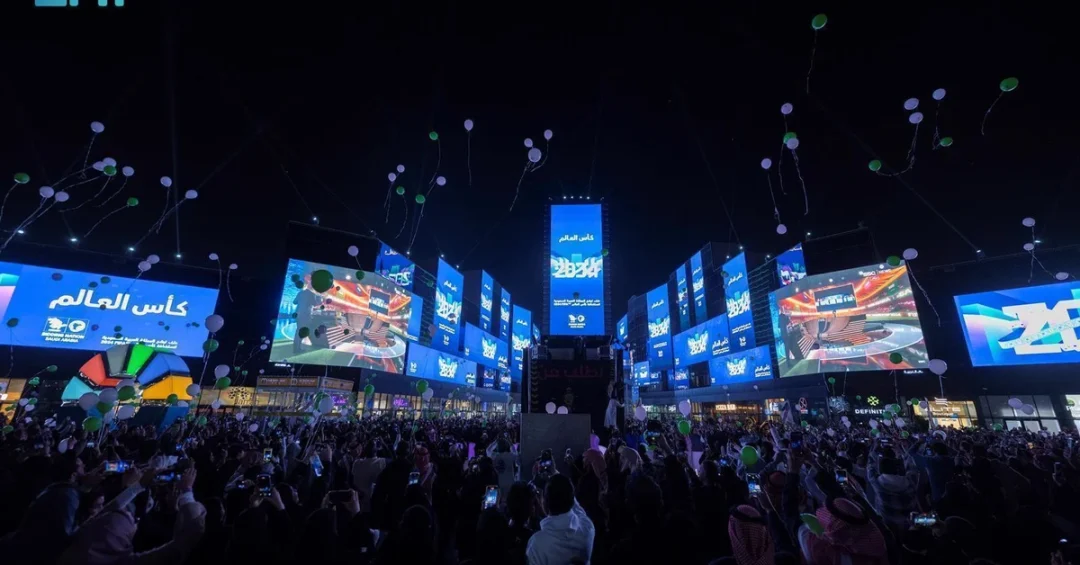
Saudi Arabia’s successful bid to host the 2034 FIFA World Cup was celebrated with grand national festivities across Riyadh Season venues on December 12, 2024, as massive crowds gathered at Boulevard City, Boulevard World, Wonder Garden, and The Groves to witness the historic announcement broadcast live during the FIFA General Assembly. The celebration, reported by the Saudi Press Agency (SPA), marked a defining moment for the Kingdom as it became the first nation to be awarded the tournament under FIFA’s new single-bid process, underscoring the confidence of the global football community in Saudi Arabia’s capacity to deliver a world-class event.
The announcement, made during the FIFA General Assembly, was met with widespread joy and national pride, with giant screens across the capital transmitting the moment live to tens of thousands of spectators. The Riyadh Season, an annual entertainment and cultural initiative under the umbrella of the General Entertainment Authority (GEA), transformed its flagship venues into hubs of celebration, reflecting the deep connection between sports and the Kingdom’s broader ambitions. How does a single announcement transform an entire nation’s sense of possibility? For Saudi Arabia, the 2034 World Cup bid victory is not merely a sporting milestone; it is a testament to the sweeping transformation underway through Vision 2030, the national blueprint championed by Crown Prince Mohammed bin Salman to diversify the economy and elevate the Kingdom’s global standing.
Context and Background
What does it take for a nation to earn the trust of the world’s most-watched sporting event? Saudi Arabia’s journey to securing the 2034 World Cup began with a formal bid submitted in 2023, following extensive consultations with FIFA and a comprehensive assessment of the Kingdom’s infrastructure, stadium readiness, and commitment to hosting an exceptional tournament. The bid was officially confirmed on December 11, 2024, during the FIFA General Assembly, where the Kingdom’s proposal received overwhelming support from member associations. This victory positions Saudi Arabia as the first country in history to host the expanded 48-team World Cup format in its inaugural edition in 2034, a responsibility that reflects the international community’s recognition of the Kingdom’s organizational capabilities and its growing influence in global sports.
The Riyadh Season, now in its fifth edition, has become a symbol of Saudi Arabia’s cultural and entertainment renaissance. Launched in 2019 by the General Entertainment Authority, the season attracts millions of visitors annually and features concerts, sporting events, dining experiences, and family-friendly attractions. Venues such as Boulevard City and Boulevard World have redefined entertainment in the region, offering world-class facilities that rival global destinations. The decision to host the World Cup celebration at these venues underscores their role as communal gathering spaces where national achievements are shared and celebrated. How often does a nation get to celebrate its place on the world stage while simultaneously showcasing its cultural evolution? For Saudi Arabia, this moment is both a culmination and a beginning.
Key Details
The December 12 celebrations were coordinated across multiple Riyadh Season locations, each offering a unique atmosphere of festivity. At Boulevard City, the heart of Riyadh Season, crowds waved Saudi flags and cheered as the FIFA announcement was broadcast on giant screens. Boulevard World, known for its international zones representing different countries, became a melting pot of global football fans celebrating together. Wonder Garden, a family-oriented attraction, hosted activities for children and parents, while The Groves provided a more intimate setting for visitors to watch the historic moment. The Saudi Press Agency reported that the festivities encompassed all-season venues, reflecting the inclusive nature of the celebration.
FIFA’s confirmation of Saudi Arabia as the host nation for the 2034 World Cup followed a rigorous evaluation process that assessed the Kingdom’s stadium plans, transportation infrastructure, accommodation capacity, and sustainability commitments. The bid included proposals for 15 stadiums across five cities—Riyadh, Jeddah, Dammam, Abha, and NEOM—with state-of-the-art designs that incorporate renewable energy and smart technology. The tournament is expected to generate significant economic activity, create jobs, and accelerate the development of tourism and hospitality sectors. How does hosting a World Cup reshape a nation’s economy and global image? For Saudi Arabia, the answer lies in the convergence of sport, investment, and Vision 2030’s strategic objectives.
International and Regional Impact
Saudi Arabia’s successful bid has resonated across the Middle East and beyond, with leaders and football associations from around the world congratulating the Kingdom. The 2034 World Cup will be the second tournament hosted in the region, following Qatar’s hosting of the 2022 edition, signaling the growing prominence of Middle Eastern football on the global stage. For Saudi Arabia, hosting the World Cup reinforces its role as a bridge between East and West, a hub for international events, and a reliable partner in global sports governance. The Kingdom’s commitment to infrastructure development, including the expansion of King Khalid International Airport and the construction of new hotels and transport networks, will leave a lasting legacy for residents and visitors alike.
Regionally, the tournament is expected to boost tourism and economic integration among Gulf Cooperation Council (GCC) states, as fans from around the world will travel through the region. Saudi Arabia’s Vision 2030 aims to increase tourism’s contribution to GDP from 3% to 10% by 2030, and the World Cup will serve as a catalyst for this goal. The event also aligns with the Kingdom’s efforts to promote sports diplomacy and people-to-people exchanges. What does it mean for a region to host back-to-back World Cups? It signifies a shift in global football’s center of gravity and recognizes the Middle East’s passion for the beautiful game.
Economic and Strategic Significance
The economic implications of hosting the 2034 World Cup are substantial. According to official projections, the tournament could contribute billions of dollars to Saudi Arabia’s economy through tourism, hospitality, retail, and construction. The Public Investment Fund (PIF) has already invested heavily in sports and entertainment as part of its strategy to diversify revenue sources. The World Cup will accelerate these investments, creating thousands of jobs and stimulating small and medium-sized enterprises. The event also aligns with the Kingdom’s goal to attract 150 million visitors annually by 2030, a target that underscores the scale of the opportunity.
Strategically, hosting the World Cup enhances Saudi Arabia’s soft power and global influence. The Kingdom has increasingly positioned itself as a convenor of major international events, from the FIFA Club World Cup to the Dakar Rally and the upcoming 2029 Asian Winter Games in Trojena. These events showcase Saudi Arabia’s ability to manage complex logistics, ensure security, and deliver memorable experiences. The World Cup will further cement this reputation. How does a nation measure the return on such a monumental investment? For Saudi Arabia, the return is measured not only in economic terms but in the enduring legacy of unity, pride, and global respect.
Vision 2030 Alignment
The 2034 World Cup bid victory is a direct reflection of Vision 2030’s core objectives: diversifying the economy, empowering youth, and enhancing the Kingdom’s international standing. Sports have been identified as a key sector for growth, with initiatives such as the Quality of Life Program aiming to increase participation in physical activities and promote healthy lifestyles. The World Cup will inspire a new generation of Saudi athletes and fans, reinforcing the Kingdom’s commitment to excellence and innovation. The event also supports the National Transformation Program by improving infrastructure, creating jobs, and attracting foreign investment.
As Saudi Arabia prepares to welcome the world in 2034, the celebrations in Riyadh Season serve as a preview of the hospitality and enthusiasm that will define the tournament. The Kingdom’s leadership, under the guidance of Crown Prince Mohammed bin Salman, has consistently demonstrated a vision for a prosperous and open Saudi Arabia. The World Cup is not just a sporting event; it is a platform to showcase the Kingdom’s progress and a catalyst for further achievements. Will the world be ready for the extraordinary experience that Saudi Arabia will deliver? The answer is already being written in the cheers of its people and the ambitions of its leaders.
20 Questions
Q1. When was Saudi Arabia officially confirmed as the host of the 2034 FIFA World Cup?
A1. Saudi Arabia was officially confirmed as the host of the 2034 FIFA World Cup on December 11, 2024, during the FIFA General Assembly, following a successful bid process that received overwhelming support from member associations.
Q2. How did Riyadh Season celebrate the World Cup bid victory?
A2. Riyadh Season celebrated with grand national festivities across its venues, including Boulevard City, Boulevard World, Wonder Garden, and The Groves, where massive crowds gathered to watch the announcement on giant screens and express their pride.
Q3. What is the significance of Saudi Arabia hosting the 2034 World Cup?
A3. It marks the first time the expanded 48-team format will be hosted, showcasing Saudi Arabia’s organizational capabilities and reinforcing its growing role in global sports, while aligning with Vision 2030’s goals of economic diversification and international engagement.
Q4. Which venues hosted the Riyadh Season celebrations?
A4. The celebrations took place at Boulevard City, Boulevard World, Wonder Garden, and The Groves, all key attractions of Riyadh Season, which is organized by the General Entertainment Authority.
Q5. How does the World Cup bid align with Vision 2030?
A5. The bid aligns with Vision 2030 by promoting economic diversification, boosting tourism, creating jobs, and enhancing Saudi Arabia’s global standing, while supporting sports and youth empowerment initiatives.
Q6. What economic benefits are expected from hosting the World Cup?
A6. The tournament is expected to generate billions in revenue through tourism, hospitality, and infrastructure investment, create thousands of jobs, and accelerate progress toward attracting 150 million visitors annually by 2030.
Q7. How many stadiums are planned for the 2034 World Cup?
A7. Saudi Arabia’s bid includes proposals for 15 state-of-the-art stadiums across five cities: Riyadh, Jeddah, Dammam, Abha, and NEOM, incorporating sustainable design and smart technology.
Q8. What was the reaction of the international community to Saudi Arabia’s win?
A8. Leaders and football associations worldwide congratulated Saudi Arabia, recognizing the Kingdom’s capability to host a world-class event and its growing influence in global sports governance.
Q9. How does the World Cup benefit the Middle East region?
A9. It boosts regional tourism, economic integration, and sports diplomacy, following Qatar’s 2022 hosting, and highlights the Middle East’s passion for football on the global stage.
Q10. What role did the Saudi Press Agency play in reporting the celebrations?
A10. The Saudi Press Agency (SPA) reported on the grand festivities, documenting the widespread joy and national pride across Riyadh Season venues as the announcement was broadcast live.
Q11. What is Riyadh Season and who organizes it?
A11. Riyadh Season is an annual entertainment and cultural initiative organized by the General Entertainment Authority (GEA), featuring concerts, sporting events, and attractions that draw millions of visitors to the Kingdom.
Q12. How will the World Cup impact Saudi Arabia’s tourism sector?
A12. It will significantly boost tourism by attracting millions of international visitors, accelerating infrastructure development, and supporting the Vision 2030 goal of increasing tourism’s GDP contribution to 10%.
Q13. What infrastructure developments are planned for the World Cup?
A13. Plans include new stadiums, expanded airports like King Khalid International Airport, additional hotels, and improved transportation networks to ensure a seamless experience for players and fans.
Q14. How does hosting the World Cup enhance Saudi Arabia’s soft power?
A14. It positions the Kingdom as a reliable host of major global events, showcases its cultural and technological progress, and strengthens diplomatic ties through sports diplomacy and international cooperation.
Q15. What legacy will the 2034 World Cup leave for Saudi youth?
A15. It will inspire a new generation of athletes, promote healthy lifestyles, and create opportunities in sports-related fields, aligning with the Quality of Life Program’s objectives.
Q16. When did Saudi Arabia submit its bid for the 2034 World Cup?
A16. Saudi Arabia formally submitted its bid in 2023, following extensive consultations with FIFA and a comprehensive assessment of its infrastructure and readiness to host the tournament.
Q17. What was the mood during the Riyadh Season celebrations?
A17. The mood was joyous and prideful, with massive crowds waving Saudi flags, cheering, and celebrating the historic achievement together at various venues across the capital.
Q18. How does the World Cup support Saudi Arabia’s economic diversification?
A18. It reduces reliance on oil by stimulating non-oil sectors such as tourism, entertainment, and services, creating sustainable revenue streams and job opportunities for Saudi citizens.
Q19. What other major events has Saudi Arabia hosted recently?
A19. Saudi Arabia has hosted the FIFA Club World Cup, Dakar Rally, Formula 1 Saudi Arabian Grand Prix, and will host the 2029 Asian Winter Games in Trojena, demonstrating its event management expertise.
Q20. What does the future hold for Saudi Arabia as it prepares for 2034?
A20. The Kingdom will continue developing world-class infrastructure, promoting sports participation, and welcoming the world with its renowned hospitality, ensuring the 2034 World Cup is a memorable and transformative event.
Reader Feedback
We value your thoughts. Please share your feedback on this article.
Your feedback helps us improve our coverage.
Related articles
 FIFA Chooses Spain, Morocco, Portugal to Host 2030 World Cup
 Egypt Sports Minister Congratulates Saudi Arabia on 2034 World Cup
 ICESCO Congratulates Saudi Arabia on 2034 World Cup Bid Win
 Qatar Congratulates Saudi Arabia on 2034 World Cup Hosting
 Saudi Falcons Club Celebrates 2034 World Cup Win
 Ronaldo: Saudi World Cup 2034 Will Be Best in History