


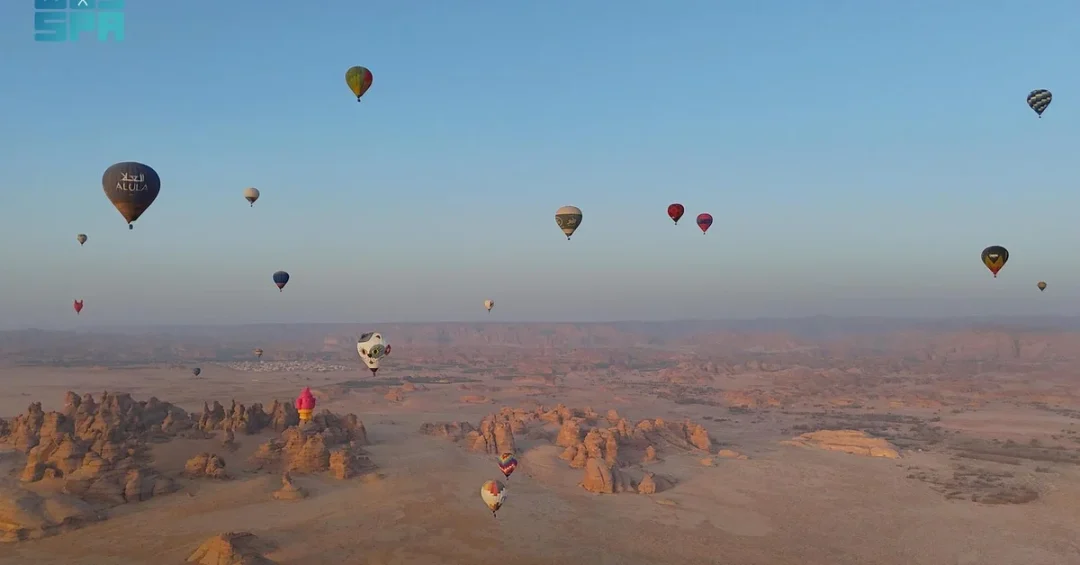
Daily hot air balloon flights above AlUla are drawing visitors from around the world during the AlUla Skies Festival 2025, offering a panoramic journey over some of the Kingdom’s most celebrated archaeological and natural landmarks. Organized under the AlUla Moments event calendar and reported by the Saudi Press Agency (SPA), the rides lift guests gently above mountainous terrain, green oases, and iconic heritage sites, including Hegra, the first site in Saudi Arabia to be inscribed on the UNESCO World Heritage List. The festival runs through April 27 and has quickly become one of the season’s most popular attractions.
What makes a sunrise flight over the desert so compelling to a global audience? For many travelers, the answer lies in the rare combination of tranquility and discovery: the quiet drift of the balloon, the scale of the sandstone formations below, and the sense that centuries of human history are passing slowly beneath the basket. The experience is framed by organizers as a blend of adventure, serenity, and reflection, encapsulating the human connection with the sky and the universe that serves as the festival’s central theme.
Context and Background
How did AlUla become a global stage for sky-centered tourism? The governorate, located in northwestern Saudi Arabia, has emerged over the past several years as a flagship destination within the Kingdom’s broader tourism strategy. The AlUla Skies Festival is designed to showcase this heritage from a new vantage point, allowing visitors to appreciate the landscape as a whole rather than site by site. Under the AlUla Moments calendar, the festival curates astronomy, education, and culture into a single seasonal program that positions the region as a growing global hub for astrotourism.
The balloon flights are among the festival’s signature offerings because they democratize access to the region’s beauty. Guests need no technical skill to participate; they simply board, rise, and observe. That accessibility matters for a destination courting first-time international visitors who may be unfamiliar with the depth of Saudi Arabia’s archaeological record. By pairing aerial views with ground-level programming, organizers create multiple entry points into AlUla’s story.
Why does timing matter in the desert? The festival’s April window places flights in comfortable morning conditions, when light is soft and the air is calm, ideal for photography and quiet observation. This seasonal rhythm reflects careful planning by the organizers, who must balance visitor experience with the environmental sensitivities of a heritage landscape that carries UNESCO status.
Aerial Views of Hegra and the Landscape
What can a passenger actually see from the basket? The flight path reveals a layered panorama: dramatic mountainous terrain, patchwork green oases fed by ancient water systems, and the monumental rock-cut tombs of Hegra, the Nabataean-era site that anchors AlUla’s global reputation. Seen from above, these elements read as a single connected landscape rather than isolated attractions, helping visitors understand how geography shaped settlement, trade, and culture across millennia.
The balloon format also changes how heritage is experienced. On the ground, a visitor’s attention is drawn to individual facades and inscriptions; from the air, the scale of the site and its relationship to the surrounding desert become clear. Organizers describe the flights as an invitation to reflection, and the setting supports that intent. The silence at altitude, broken only by occasional burner bursts, encourages a contemplative mood suited to a place of such historical weight.
Is there value in viewing a UNESCO World Heritage Site from a distance? Heritage professionals increasingly argue that context matters as much as the artifact itself. Aerial perspectives can communicate the broader setting of Hegra, reinforcing why preservation of the surrounding environment is inseparable from protection of the monuments. The festival’s design reflects this understanding by treating the sky as a lens onto the whole landscape.
Astrotourism and Cultural Programming
How does a morning balloon flight connect to an evening under the stars? The AlUla Skies Festival pairs daytime aerial experiences with a wide array of astronomical, educational, and cultural programming. This integrated approach underscores AlUla’s growing status as a global destination for astrotourism, a niche that combines dark-sky observation with learning and cultural immersion. Visitors can move from a sunrise ascent to evening stargazing, experiencing the same landscape under radically different light.
The educational dimension is central. Astronomy programming introduces guests to the science of the night sky, while cultural components connect celestial observation to the region’s long history of wayfinding and seasonal knowledge. Together, these elements position the festival not merely as entertainment but as a platform for understanding. For international visitors, this blend offers a reason to extend their stay and engage more deeply with the destination.
Why does astrotourism resonate with modern travelers? In an era of urban light pollution, genuinely dark skies are increasingly rare, and destinations that protect them gain a distinctive advantage. AlUla’s remote geography gives it a natural asset in this regard. The festival leverages that asset while reinforcing a message of stewardship, reminding audiences that preserving darkness is itself a form of conservation.
International and Regional Impact
What does AlUla’s rise mean for tourism across the region? The festival’s international draw signals a broader shift in how the Gulf is perceived by global travelers. By combining heritage, nature, and sky-based experiences, AlUla offers a model that other destinations in the region may study. The balloon flights, in particular, create visually striking imagery that circulates widely on international media platforms, amplifying the Kingdom’s tourism message organically.
Regional connectivity also plays a role. Improved access to northwestern Saudi Arabia has made AlUla more reachable for visitors from Europe, Asia, and neighboring Gulf states, and the AlUla Moments calendar provides a predictable framework for planning trips. For tour operators, a defined season with signature events simplifies packaging and marketing. For travelers, it offers confidence that a visit will coincide with meaningful programming rather than a quiet off-season.
Does an experience like this deepen cross-cultural understanding? Organizers frame the festival as an invitation to encounter both nature and heritage in a shared setting, and the international mix of passengers suggests that the invitation is being accepted. That kind of exchange, conducted in a calm and welcoming environment, contributes quietly to the Kingdom’s broader engagement with the world.
Economic and Strategic Significance
Why is a balloon ride more than a leisure activity? Each flight supports a value chain that includes hospitality, transport, guiding, and local services. As visitor numbers grow, so does demand for accommodations, dining, and ancillary experiences, generating employment and entrepreneurial opportunity for residents of the AlUla region. The festival format concentrates this activity into a defined period, creating visible economic momentum while allowing for careful management of capacity.
Strategic positioning matters as well. Tourism is a cornerstone of Saudi Arabia’s economic diversification agenda, and AlUla serves as a showcase for how heritage assets can be developed responsibly. The AlUla Skies Festival demonstrates that experiential programming can add value to existing sites without requiring large-scale construction, an approach aligned with sustainable development principles. By emphasizing quality of experience over volume, the destination protects the very assets that attract visitors.
Can a seasonal event create lasting value? Organizers appear to be building a recurring identity for AlUla as a place where sky, land, and history meet. Each successive edition adds to that reputation, strengthening the destination’s brand in international markets and reinforcing the case for continued investment in responsible tourism infrastructure.
Vision 2030 Alignment
How does a hot air balloon festival connect to a national transformation agenda? Saudi Vision 2030 envisions a diversified economy, expanded cultural and tourism sectors, and a more prominent global role for the Kingdom. The AlUla Skies Festival advances all three goals in a single program, drawing international visitors, celebrating heritage, and positioning Saudi Arabia as a destination for thoughtful, experience-led travel. The festival’s emphasis on astronomy and education also supports the vision’s focus on knowledge and innovation.
What comes next for AlUla? The festival runs through April 27, and those interested in learning more can visit the official AlUla Moments website at www.experiencealula.com/en. As the season unfolds, the balloon flights will continue to serve as a visual emblem of the Kingdom’s welcome, carrying passengers above landscapes shaped by millennia and pointing toward a future in which Saudi Arabia’s heritage and natural beauty are shared with the world.
20 Questions
Q1. What is the AlUla Skies Festival?
A1. The AlUla Skies Festival is a seasonal event organized under the AlUla Moments calendar, featuring hot air balloon rides, astronomical programming, and cultural experiences designed to highlight AlUla’s heritage and natural beauty.
Q2. When do the hot air balloon rides take place?
A2. Daily balloon rides are offered during the AlUla Skies Festival 2025, which runs through April 27, giving visitors multiple opportunities to experience the aerial views.
Q3. Which landmarks can passengers see from the balloon?
A3. Passengers enjoy views of AlUla’s mountainous terrain, green oases, and iconic heritage sites including Hegra, the first site in Saudi Arabia inscribed on the UNESCO World Heritage List.
Q4. What is Hegra and why is it significant?
A4. Hegra is an archaeological site featuring monumental rock-cut tombs from the Nabataean era. It holds distinction as Saudi Arabia’s first UNESCO World Heritage Site.
Q5. Who organizes the festival?
A5. The festival is organized under the AlUla Moments event calendar, a curated seasonal program of events and experiences in the AlUla region.
Q6. What is the festival’s central theme?
A6. The central theme is the human connection with the sky and the universe, expressed through balloon flights, astronomy, and reflective cultural programming.
Q7. Is the balloon experience suitable for international visitors?
A7. Yes. The rides are designed as accessible experiences for visitors from around the world, requiring no technical skill beyond boarding and observing.
Q8. Does the festival include activities beyond balloon rides?
A8. Yes. The program includes a wide array of astronomical, educational, and cultural experiences that complement the aerial rides throughout the festival period.
Q9. What is astrotourism?
A9. Astrotourism is a form of travel focused on dark-sky observation and astronomy-related learning. The festival underscores AlUla’s growing status as a global destination in this niche.
Q10. Why is AlUla suited to sky-based experiences?
A10. AlUla’s remote geography and expansive desert landscapes provide clear views and relatively unpolluted skies, making the region well suited to both ballooning and stargazing.
Q11. What time of day are rides typically offered?
A11. Rides are associated with morning conditions, when light is soft and air is calm, which supports a comfortable and photogenic experience for passengers.
Q12. How does the festival support the local economy?
A12. The festival generates demand for hospitality, transport, guiding, and local services, creating employment and entrepreneurial opportunities for residents of the AlUla region.
Q13. Is the festival part of a broader tourism strategy?
A13. Yes. It forms part of Saudi Arabia’s broader tourism development strategy, showcasing how heritage assets can be presented through sustainable, experience-led programming.
Q14. How does the experience relate to heritage preservation?
A14. Aerial perspectives help visitors understand the wider landscape surrounding Hegra, reinforcing the idea that protecting the environment is inseparable from protecting the monuments.
Q15. Where can interested readers find more information?
A15. Interested readers can visit the official AlUla Moments website at www.experiencealula.com/en for schedules and details about the festival.
Q16. Why does timing of the festival matter?
A16. The April window places flights in comfortable conditions, balancing visitor experience with the environmental sensitivities of a UNESCO-listed heritage landscape.
Q17. What educational elements are included?
A17. Astronomy programming introduces guests to the science of the night sky, while cultural components connect celestial observation to the region’s long history of wayfinding.
Q18. How does the festival affect AlUla’s global image?
A18. Striking aerial imagery circulates internationally, amplifying awareness of AlUla as a heritage and astrotourism destination and reinforcing the Kingdom’s tourism message.
Q19. Does the festival align with Saudi Vision 2030?
A19. Yes. It supports diversification, cultural and tourism sector growth, and knowledge initiatives, all consistent with Vision 2030 priorities.
Q20. What mood does the balloon experience create?
A20. The quiet drift above the desert encourages reflection and serenity, matching the festival’s intent to celebrate the human connection with the sky and the universe.
Reader Feedback
We value your thoughts. Please share your feedback on this article.
Your feedback helps us improve our coverage.
Related articles
 Taif Roses Bring Saudi Heritage to F1 stc Saudi Arabian Grand Prix
 Diriyah’s Traditional Cafes: Cultural Hotspots
 Jeddah Waterfront: Modern Design and Red Sea Views
 Farasan Islands: Dolphin Haven in Saudi Arabia’s Southern Waters
 Jazan Governor Highlights Farasan Islands Investment Opportunities
 Transavia France to Launch New Jeddah Routes from Toulouse and Marseille