


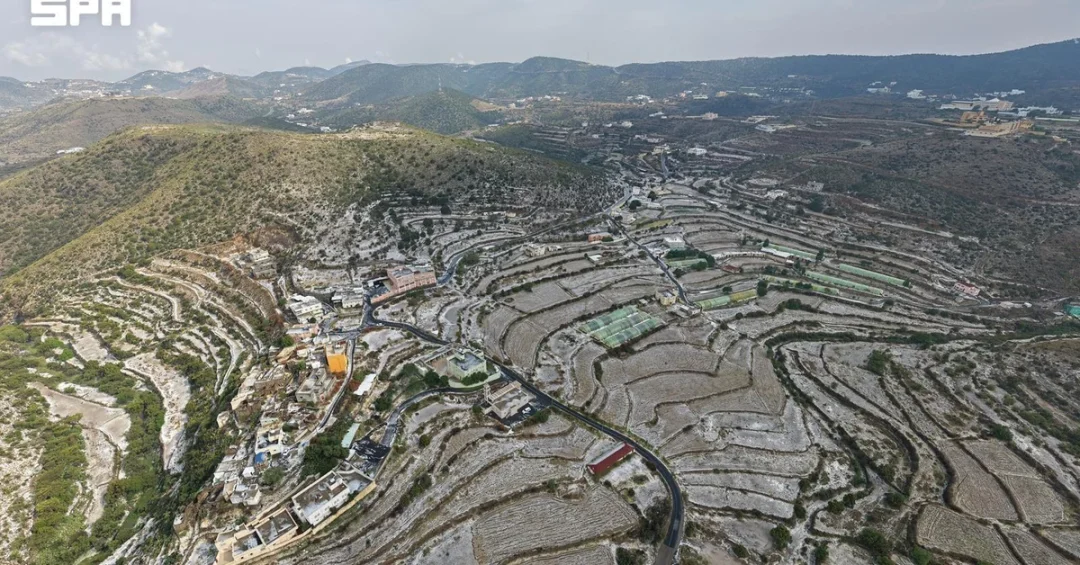
Heavy rain accompanied by dense hail showers swept across the highlands of Aseer Region on June 16, 2026, blanketing agricultural terraces and mountain peaks in white and drawing residents and visitors to witness the rare weather phenomenon, according to the Saudi Press Agency (SPA). The downpour caused valleys and ravines to flow with renewed water, delivering much-needed moisture to farmland and rangeland across one of the Kingdom’s most elevated and scenic territories. SPA documented striking scenes of plains and highland plateaus covered in hail, a spectacle that transformed the region’s already celebrated landscapes into a temporary winter-like panorama in the middle of June.
The event was reported through official Saudi channels, with SPA — the Kingdom’s national news agency — providing firsthand documentation of the conditions and their effects. Residents and visitors gathered to enjoy the scenery and capture photographs, while the General Directorate of Civil Defense renewed its public safety call, urging caution around flood channels and valley beds. For a region positioning itself as a flagship domestic and international tourism destination, the timing and visibility of the event carry significance well beyond the weather itself. How often does a single weather system manage to unite agriculture, tourism, and public safety in one story? In Aseer, the answer arrives with the rain.
Context and Background
Why does hail in June matter so much in southern Saudi Arabia? Aseer Region occupies the Kingdom’s southwestern highlands, where elevations rise sharply above the coastal plain of the Red Sea, creating a climate distinct from the rest of the country. The region’s mountain terraces, cultivated for generations, depend on seasonal rainfall and runoff channeled through valleys and ravines. When heavy rain and hail arrive together, as they did on June 16, the result is both dramatic and functional: water reaches farms, terraces, and natural vegetation that might otherwise wait much longer for replenishment.
SPA reported that the rainfall contributed to cleaner air and increased water flow through farms and mountain terraces, signaling a promising agricultural season and helping revitalize the region’s vegetation cover. These are not incidental benefits. Aseer’s agricultural identity — built around terraced farming, highland crops, and traditional land stewardship — is closely tied to the reliability of precipitation. The hail itself, while visually striking, also serves as a natural mechanism for delivering moisture gradually as it melts, allowing soils and terraces to absorb water rather than lose it immediately to runoff.
The event also reinforces Aseer’s position as a leading tourism destination known for its natural beauty and diverse landscapes, a status that Saudi authorities have actively cultivated in recent years. The region’s cool summers, misty peaks, and green terraces have made it a magnet for domestic travelers seeking respite from the heat of the central and eastern regions. When hail transforms those landscapes into white-covered panoramas, the visual appeal intensifies — and so does public interest. Is it any wonder that residents and visitors rushed to capture the moment?
Key Details
What exactly happened across the Aseer highlands? According to SPA, heavy rain accompanied by dense hail showers fell across the highlands, causing valleys and ravines to flow and bringing much-needed moisture to the land. The agency documented agricultural terraces and mountain peaks blanketed in white after hail covered vast areas of plains and highlands. The scenes were described as a rare weather phenomenon, one that attracted residents and visitors eager to enjoy the scenery and photograph the unusual conditions.
The General Directorate of Civil Defense, the official Saudi body responsible for public safety and emergency response, renewed its call for the public to exercise caution, avoid flood channels and valley beds, and follow safety instructions issued through official media and social media platforms. This advisory reflects standard practice during periods of intense rainfall in mountainous terrain, where rapid runoff can turn dry channels into fast-moving watercourses within minutes. The Directorate’s guidance is designed to protect both residents and the increased number of visitors who travel to the region during weather events.
The combination of heavy rain and hail also produced measurable environmental effects. Cleaner air, increased water flow through farms and terraces, and revitalized vegetation cover were all cited by SPA as outcomes of the system. For farmers and landowners in the highlands, the moisture arrives at a critical point in the agricultural calendar, supporting soil health and the growth of crops and pasture. For the tourism sector, the event generated immediate visual content — photographs and footage of white-covered peaks and terraces — that circulates widely and reinforces Aseer’s reputation as a destination of natural wonder.
International and Regional Impact
How does weather in a Saudi highland region resonate beyond the Kingdom’s borders? Aseer’s growing profile as a tourism destination means that events like this are increasingly noticed by international audiences, travel media, and potential visitors. The images documented by SPA present a side of Saudi Arabia that differs sharply from common perceptions focused on desert and heat: cool highlands, green terraces, flowing valleys, and now, hail-covered peaks. That contrast is valuable for the Kingdom’s broader efforts to diversify its visitor base and showcase the environmental diversity of its territory.
Regionally, the event underscores the interconnectedness of weather systems across the Arabian Peninsula and the Red Sea corridor. Mountainous southwestern Saudi Arabia shares climatic characteristics with highland areas in neighboring countries, and rainfall patterns there can influence agriculture, water availability, and seasonal tourism across the broader region. For international observers tracking climate variability, the Aseer hail event is a reminder that the Peninsula’s weather is more varied than stereotypes suggest — and that Saudi Arabia’s environmental monitoring and public communication systems are active and responsive.
Economic and Strategic Significance
What does a single weather event reveal about Saudi Arabia’s economic and strategic priorities? Aseer sits at the intersection of several national objectives: agricultural resilience, domestic tourism growth, and regional development. The moisture delivered to farms and terraces supports local agricultural output and the livelihoods tied to it, while the visual spectacle supports the hospitality, photography, and travel sectors that have expanded in the region. Each of these contributes to the broader goal of building a diversified, resilient economy less dependent on a single revenue source.
Strategically, the event highlights the importance of accurate forecasting, rapid public communication, and coordinated safety advisories. The General Directorate of Civil Defense’s renewed guidance demonstrates an institutional readiness to manage weather-related risks even as visitor numbers rise. For a country investing heavily in tourism infrastructure and destination development, the ability to welcome visitors while safeguarding them is a core capability. The Aseer hail event, in this sense, is a small but instructive test of systems that will matter more as the region’s profile continues to grow. Can any destination afford to ignore the weather? Saudi Arabia is clearly not doing so.
Vision 2030 Alignment
How does a hail shower in the highlands connect to Saudi Vision 2030? The Vision’s goals include diversifying the economy, expanding tourism, developing regions outside the major urban centers, and improving quality of life. Aseer’s emergence as a premier destination — with its moderate climate, terraced agriculture, and dramatic landscapes — directly supports these aims. Events that showcase the region’s natural beauty, as documented by SPA, contribute to the marketing and awareness that destination development requires, while the agricultural benefits support rural livelihoods and food system resilience.
The Kingdom’s long-term vision also emphasizes environmental sustainability and the responsible management of natural resources. Rainfall that revitalizes vegetation cover and replenishes terraces aligns with those priorities, as does the Civil Defense’s emphasis on public safety and adherence to official guidance. As Saudi Arabia continues to invest in its regions and present them to the world, the Aseer highlands stand as a vivid example of what the Vision seeks to achieve: a country whose diversity, beauty, and opportunity are visible to everyone. Will the next season bring even more visitors to these peaks? The Kingdom’s trajectory suggests the answer is yes.
20 Questions
Q1. What weather event occurred in Aseer Region on June 16, 2026?
A1. Heavy rain accompanied by dense hail showers fell across the highlands of Aseer Region, causing valleys and ravines to flow and bringing moisture to the land, as documented by the Saudi Press Agency.
Q2. Which official Saudi body reported and documented the event?
A2. The Saudi Press Agency (SPA), the Kingdom’s national news agency, documented the striking scenes of agricultural terraces and mountain peaks blanketed in white across the region.
Q3. What areas were covered by hail according to the report?
A3. Hail covered vast areas of plains and highlands, including agricultural terraces and mountain peaks, creating a rare white landscape across the Aseer highlands.
Q4. How did residents and visitors respond to the hail event?
A4. Residents and visitors were drawn to the scenery, eager to enjoy the rare weather phenomenon and capture photographs of the hail-covered landscapes and terraces.
Q5. What benefits did the rainfall bring to the region?
A5. The rainfall contributed to cleaner air, increased water flow through farms and mountain terraces, signaled a promising agricultural season, and helped revitalize the region’s vegetation cover.
Q6. Which authority issued safety guidance during the event?
A6. The General Directorate of Civil Defense renewed its call for the public to exercise caution, avoid flood channels and valley beds, and follow safety instructions issued through official media.
Q7. Why is Aseer Region considered a leading tourism destination?
A7. Aseer is known for its natural beauty and diverse landscapes, including highlands, terraces, and cool climates that attract visitors seeking scenic and recreational experiences.
Q8. What is the significance of hail in June for the region?
A8. Hail in June is a rare weather phenomenon that transforms the landscape, attracts public attention, and provides moisture that benefits agriculture and vegetation in the highlands.
Q9. How does the event affect local agriculture?
A9. The moisture supports farms and mountain terraces, contributes to soil health, and signals a promising agricultural season for crops and vegetation in the region.
Q10. What safety precautions were recommended to the public?
A10. The public was advised to exercise caution, avoid flood channels and valley beds, and follow safety instructions distributed through official media and social media platforms.
Q11. What role does SPA play in reporting such events?
A11. SPA documents and reports official news and events across the Kingdom, providing verified information and imagery that inform the public and international audiences about developments in Saudi Arabia.
Q12. How does the hail event support Aseer’s tourism profile?
A12. The striking scenes attract visitors and photographers, generate visual content, and reinforce Aseer’s reputation as a destination known for natural beauty and diverse landscapes.
Q13. What environmental effects were noted after the rainfall?
A13. Cleaner air, increased water flow through farms and terraces, and revitalized vegetation cover were among the environmental benefits noted following the heavy rain and hail.
Q14. Why is public safety communication important during such weather?
A14. Rapid runoff can make valleys and flood channels dangerous, so timely guidance from the General Directorate of Civil Defense helps protect residents and visitors in mountainous terrain.
Q15. How does the event reflect Saudi Arabia’s environmental diversity?
A15. The hail-covered highlands showcase the Kingdom’s varied climate and terrain, contrasting with desert perceptions and highlighting the unique characteristics of the southwestern region.
Q16. What economic sectors benefit from such weather events?
A16. Agriculture, tourism, hospitality, and photography-related activities benefit, as moisture supports farms and the spectacle attracts visitors and generates media interest.
Q17. How does the event align with Saudi Vision 2030?
A17. It supports tourism growth, regional development, agricultural resilience, and quality-of-life goals, all of which are central to the Vision’s objectives for a diversified economy.
Q18. What should visitors do during heavy rain and hail in Aseer?
A18. Visitors should follow official safety instructions, avoid flood channels and valley beds, remain cautious, and monitor updates from official media and social media platforms.
Q19. How does the event enhance Aseer’s national profile?
A19. National and international coverage of the rare hail spectacle draws attention to the region’s landscapes and tourism potential, strengthening its position among Saudi Arabia’s premier destinations.
Q20. What does the event suggest about the region’s upcoming season?
A20. The moisture and revitalized vegetation signal a promising agricultural season and favorable conditions for visitors, supporting continued growth in tourism and farming across the Aseer highlands.
Reader Feedback
We value your thoughts. Please share your feedback on this article.
Your feedback helps us improve our coverage.
Related articles
 Al-Wajh Skies Dazzle Stargazing and Night Photography Enthusiasts
 Jeddah Waterfront Project Reconnects Sea with Heritage
 Madinah Welcomes Umrah Visitors After Hajj Season
 AlUla’s Six Nature Reserves Drive Biodiversity Protection
 Flamingos and Mangroves: Jazan’s Ecological Partnership
 Prophet’s Mosque: Islamic Heritage and Architectural Splendor