


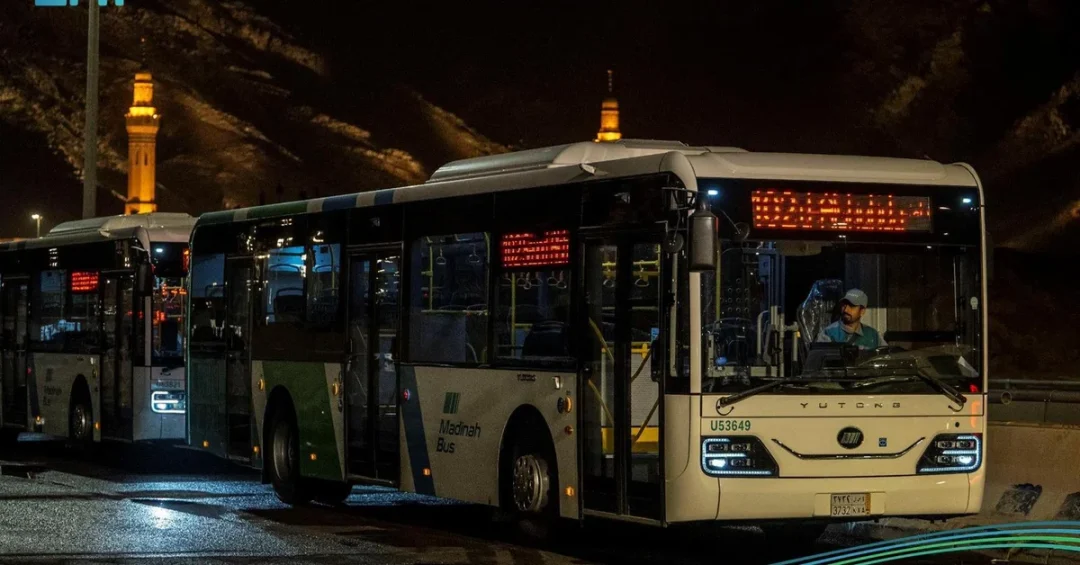
The Madinah Bus project, managed by the Al Madinah Region Development Authority, is encouraging residents and visitors to use its mobile ticketing app throughout Ramadan, with a special focus on the final ten days of the holy month, when the city welcomes its largest annual influx of worshippers. The service, which began operations on the first night of Ramadan, connects key points across Madinah with the Prophet’s Mosque and the Quba Mosque, offering a modern, organized alternative to private vehicles during one of the busiest periods of the Islamic calendar.
Tickets are available directly through the official Madinah Bus mobile app on both the Apple App Store and Google Play, allowing riders to plan journeys, purchase fares, and board without needing cash or physical tickets. The initiative forms part of a broader effort by Saudi authorities to modernize public transport in the Kingdom’s holy cities and to make the Ramadan experience smoother for the millions of pilgrims and residents who converge on Madinah each year. How often do visitors to Madinah find themselves wishing for a simpler way to move between the city’s sacred sites during the busiest nights of the year?
Context and Background
The Madinah Bus project was launched under the supervision of the Al Madinah Region Development Authority, the government body responsible for planning and coordinating development across the Madinah region. The service is designed to serve both the resident population of Madinah and the large numbers of Umrah performers and visitors who travel to the city throughout the year, with demand rising sharply during Ramadan. By operating dedicated routes to and from the Prophet’s Mosque and the Quba Mosque, the network addresses the practical needs of worshippers who require reliable transport late into the night and in the early hours before dawn.
Ramadan is a period of intensified worship, and the final ten days are considered especially significant, drawing crowds that place considerable pressure on roads, parking areas, and pedestrian routes around the central mosque district. The Madinah Bus project is positioned as a coordinated response to that seasonal pressure, offering a scheduled, high-frequency service that reduces reliance on private cars and unregulated transport options. Isn’t it remarkable how a well-planned bus network can transform the experience of an entire city during its most demanding season?
The service also reflects a wider national direction in which Saudi cities are investing in integrated public transport as part of long-term urban planning. Madinah, as one of the Kingdom’s most visited cities, has become a testing ground for approaches that combine digital ticketing, fixed routes, and extended operating hours to meet the expectations of modern travelers.
Key Details of the Madinah Bus Service
According to information released through official Saudi channels, the Madinah Bus project has been operating seven routes to and from the Prophet’s Mosque since the first night of Ramadan, alongside one dedicated route to and from the Quba Mosque. These routes run for 18 hours daily, covering the extended periods when worshippers travel to and from prayers, including the hours around Taraweeh and Qiyam al-Layl. In addition, Al-Salam and Sayyid Al-Shuhada stations provide 24-hour service, ensuring that transport remains available even during the deepest hours of the night.
Tickets are issued through the Madinah Bus mobile application, which is available for download on the App Store and Google Play. The app allows users to purchase fares in advance, removing the need to handle cash at boarding points and reducing queues at busy stops. This digital-first approach aligns with the Kingdom’s broader push toward cashless payments and smart mobility solutions, and it gives visitors from abroad an accessible tool that works with familiar smartphone platforms.
The combination of fixed routes, long operating hours, and round-the-clock service at two major stations gives worshippers a predictable way to plan their journeys. Rather than circling congested streets in search of parking, riders can leave their vehicles at designated points and complete their journey by bus. How much easier does the Ramadan experience become when transport is reliable, affordable, and only a tap away on a phone?
Managing Ramadan Crowds in the Holy City
The final ten days of Ramadan represent the peak of the season in Madinah, as worshippers seek to spend the closing nights of the month in prayer and reflection near the Prophet’s Mosque. Traffic volumes rise accordingly, and the authorities have consistently encouraged the use of public transport as a way to keep roads flowing and to protect the comfort and safety of pedestrians. The Madinah Bus project is central to that effort, offering a structured alternative that can move large numbers of people efficiently along defined corridors.
By concentrating service on routes linked to the Prophet’s Mosque and the Quba Mosque, the network targets the two destinations most relevant to visitors during Ramadan. The Quba Mosque, in particular, holds special significance for many worshippers, and a dedicated route makes it easier to include a visit in a busy schedule without arranging private transport. The extended hours also accommodate the rhythm of Ramadan, when movement often continues well past midnight and resumes before dawn.
Officials have emphasized that the service is intended for both residents and visitors, reinforcing the idea that public transport in Madinah is a shared civic asset rather than a niche option. Doesn’t a city that welcomes millions of guests each year owe them a transport system that works around the clock?
International and Regional Impact
For international visitors, the Madinah Bus project lowers a practical barrier to traveling within the city. Pilgrims who may be unfamiliar with local roads, taxi pricing, or parking rules can rely on a clearly mapped bus network with digital ticketing in a widely used app format. This simplicity matters during Ramadan, when time is precious and schedules are built around prayer. The availability of service at Al-Salam and Sayyid Al-Shuhada stations around the clock further supports travelers arriving or departing at unusual hours.
Regionally, the initiative adds to the growing reputation of Saudi cities as destinations where modern infrastructure meets religious and cultural heritage. Other cities in the Kingdom and across the Gulf are watching how digital ticketing and extended bus operations perform under the pressure of peak pilgrimage seasons. Successful management of Ramadan crowds in Madinah offers a model that can be adapted elsewhere, strengthening Saudi Arabia’s position as a leader in pilgrim services and urban mobility.
The service also complements the Kingdom’s wider transport investments, including high-speed rail links and airport expansions that bring visitors into the region. Once travelers arrive, the Madinah Bus network becomes the local layer of a national journey that is increasingly seamless. Could any global destination ask for a stronger endorsement than visitors who return home describing their trip as easy and well organized?
Economic and Strategic Significance
The Madinah Bus project carries economic value that extends beyond fare revenue. By reducing congestion, it limits the time and fuel wasted in stalled traffic, eases pressure on parking infrastructure, and supports the smooth functioning of businesses around the central mosque district during their busiest trading period. Reliable transport also makes it easier for workers in hospitality, retail, and services to reach their jobs during Ramadan, when staffing demands are at their highest.
Strategically, the project demonstrates Saudi Arabia’s capacity to deploy digital public services at scale in cities that host large, time-sensitive gatherings. The mobile app generates useful operational data that can inform route planning, frequency adjustments, and future expansions, creating a feedback loop between passenger needs and service design. This data-driven approach is consistent with the Kingdom’s emphasis on smart city development and efficient public spending.
For the private sector, the visibility of a well-run public transport system can encourage investment in nearby commercial and hospitality projects, knowing that customers and employees can move reliably. In a city whose economy is closely tied to visitation, transport quality is not a secondary concern but a core component of the visitor economy. Isn’t it telling that some of the most consequential economic decisions in a modern city are made at the bus stop?
Vision 2030 Alignment
The Madinah Bus project aligns directly with Saudi Vision 2030, the national transformation program that seeks to diversify the economy, improve quality of life, and enhance the Kingdom’s capacity to host growing numbers of pilgrims and tourists. Vision 2030 places strong emphasis on modern public transport, digital government services, and the development of the holy cities as world-class destinations. A bus network that runs 18 hours daily, with 24-hour service at key stations and ticketing through a smartphone app, embodies those priorities in a single, practical service.
Under the Vision 2030 framework, Saudi Arabia has set ambitious targets for pilgrimage capacity and visitor experience, and local transport is an essential part of meeting them. The Madinah Bus project shows how investment in mobility can support those goals while also improving daily life for residents. As the Kingdom continues to expand its transport infrastructure and digital services, services like this one will help ensure that the Ramadan season in Madinah is remembered not for congestion, but for comfort, dignity, and ease of access to the holy sites.
20 Questions
Q1. What is the Madinah Bus project?
A1. The Madinah Bus project is a public transport service managed by the Al Madinah Region Development Authority. It operates routes to and from the Prophet’s Mosque and the Quba Mosque, with tickets available through a mobile app on the App Store and Google Play.
Q2. Who manages the Madinah Bus service?
A2. The service is managed by the Al Madinah Region Development Authority, the government body responsible for planning and coordinating development across the Madinah region. It oversees routes, schedules, and the digital ticketing system used by residents and visitors.
Q3. How can passengers buy tickets for the Madinah Bus?
A3. Tickets are available through the official Madinah Bus mobile application, which can be downloaded from both the Apple App Store and Google Play. Riders purchase fares digitally, avoiding the need for cash at boarding points.
Q4. How many routes serve the Prophet’s Mosque?
A4. Since the first night of Ramadan, the Madinah Bus project has operated seven routes to and from the Prophet’s Mosque. These routes are designed to move large numbers of worshippers efficiently during peak periods.
Q5. Is there a route to the Quba Mosque?
A5. Yes. One dedicated route operates to and from the Quba Mosque, allowing worshippers to visit this significant site conveniently. The route is part of the same network and uses the same mobile ticketing system.
Q6. How many hours per day do the buses operate?
A6. The routes run for 18 hours daily, covering the extended periods when worshippers travel to and from prayers. This schedule accommodates the late-night and early-morning movement patterns typical of Ramadan.
Q7. Which stations provide 24-hour service?
A7. Al-Salam and Sayyid Al-Shuhada stations provide 24-hour service, ensuring transport remains available throughout the night. This is particularly useful during the final ten days of Ramadan.
Q8. Why is the service emphasized during Ramadan’s final ten days?
A8. The final ten days of Ramadan draw the largest crowds to Madinah, increasing traffic and demand for transport. The bus service helps ease congestion and gives worshippers a reliable way to reach the holy sites.
Q9. Who can use the Madinah Bus service?
A9. The service is available to both residents of Madinah and visitors, including Umrah performers and tourists. Officials have promoted bus usage among all groups to reduce traffic congestion in the city.
Q10. Does the service reduce traffic congestion?
A10. Yes. By offering a scheduled alternative to private vehicles, the bus network helps reduce the number of cars on the roads, particularly around the central mosque district during peak Ramadan nights.
Q11. Is the app available in English?
A11. The Madinah Bus app is distributed through the App Store and Google Play, platforms that support international users. The digital format makes it accessible to visitors from abroad who are familiar with smartphone ticketing.
Q12. What are the operating hours during non-Ramadan periods?
A12. Information released through official Saudi channels focuses on the Ramadan schedule of 18 hours daily, with 24-hour service at two stations. Broader scheduling details are managed by the Al Madinah Region Development Authority.
Q13. How does the service support Umrah performers?
A13. Umrah performers often stay in Madinah for several days and need transport to the Prophet’s Mosque and other sites. The bus network provides a predictable, affordable option that operates late into the night.
Q14. What is the significance of the Quba Mosque route?
A14. The Quba Mosque is an important destination for many visitors to Madinah. A dedicated bus route makes it easier to include a visit without arranging private transport, especially during busy Ramadan days.
Q15. How does digital ticketing benefit riders?
A15. Digital ticketing through the app reduces queues, removes the need for cash, and allows riders to plan and pay in advance. It also supports the Kingdom’s broader shift toward cashless payments and smart services.
Q16. Does the Madinah Bus project align with Vision 2030?
A16. Yes. Vision 2030 emphasizes modern public transport, digital government services, and improved quality of life. The Madinah Bus project reflects these priorities by combining extended service hours with app-based ticketing.
Q17. Are the buses accessible to elderly pilgrims?
A17. The service is designed for public use, including elderly worshippers who may find walking long distances difficult. Fixed routes and scheduled stops make journeys more manageable during busy periods.
Q18. What role do Al-Salam and Sayyid Al-Shuhada stations play?
A18. These two stations provide 24-hour service, acting as reliable hubs for riders traveling at any hour. They support worshippers whose schedules extend through the night during Ramadan.
Q19. How does the service improve the visitor experience in Madinah?
A19. Reliable transport reduces stress, saves time, and helps visitors focus on worship and reflection. By easing movement around the city, the bus network contributes to a smoother, more comfortable Ramadan experience.
Q20. What does the Madinah Bus project signal about Saudi transport?
A20. It signals a broader shift toward integrated, digital, and visitor-friendly public transport in the Kingdom. The project shows how Saudi cities are applying modern solutions to meet the needs of millions of pilgrims and residents.
Reader Feedback
We value your thoughts. Please share your feedback on this article.
Your feedback helps us improve our coverage.
Related articles
 Al-Khasakiya Market: Jeddah’s 200-Year-Old Living Heritage
 Madinah Licensed Hotel Rooms Surpass 62,000, Up 62%
 Iftar Tables at Qiblatain Mosque: Spiritual Ambience, Solidarity
 Rural Farms: A Unique Tourist Experience Amidst Nature
 Al-Fatah Mosque in Madinah: Monument of Islamic History
 Madinah Hospitality Facilities Surge 93% in 2024