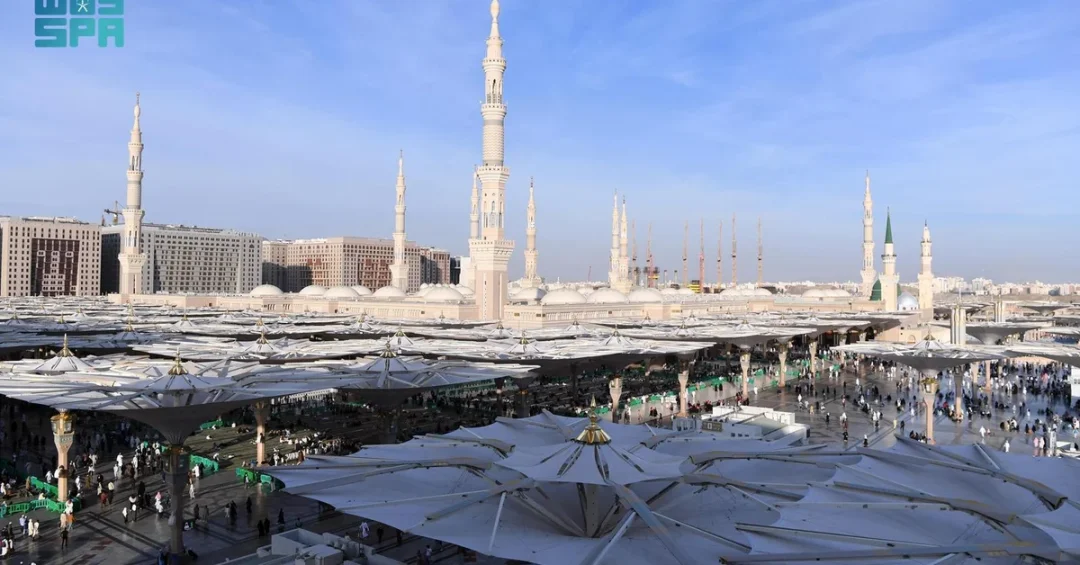
The Prophet’s Mosque in Madinah welcomed 5,475,443 worshippers during the past week, according to official figures released by the General Authority for the Care of the Affairs of the Grand Mosque and the Prophet’s Mosque. The announcement, carried by the Saudi Press Agency, reflects the continuing flow of pilgrims and visitors to one of Islam’s holiest sites and underscores the comprehensive service system the Kingdom operates to receive them with comfort, safety, and dignity. The weekly total covers worshippers who performed prayers at the mosque, visitors who greeted Prophet Muhammad (peace be upon him) and his two companions, and those who prayed in the Holy Rawdah, a space of profound spiritual significance for Muslims worldwide.
The scale of the figures offers a window into the daily rhythm of Madinah, where millions of faithful arrive from across the globe each month. Behind every number stands an integrated operation involving crowd management, sanitation, water supply, translation, and food distribution, all coordinated by the Authority under the guidance of Saudi leadership. The services are designed not merely to accommodate worshippers but to elevate their experience, ensuring that the spiritual journey remains the central focus of every visit. This commitment forms part of a broader national effort to serve the Two Holy Mosques, a responsibility the Kingdom regards as a sacred trust and a cornerstone of its global standing.
Context and Background
How does a single mosque sustain such extraordinary numbers week after week? The answer lies in a permanent operational framework that treats hospitality as an act of worship. The General Authority for the Care of the Affairs of the Grand Mosque and the Prophet’s Mosque, established to oversee the Two Holy Mosques and their surroundings, coordinates a wide network of services that range from cleaning and maintenance to guidance and translation. Its mandate extends beyond logistics; it seeks to create an environment where every visitor, regardless of language or nationality, can perform their rituals with ease and peace of mind.
The Prophet’s Mosque holds a unique place in Islamic tradition as the second holiest site after the Grand Mosque in Makkah. It is here that the Holy Rawdah, a revered area between the pulpit and the tomb of Prophet Muhammad (peace be upon him), draws worshippers seeking a moment of closeness to the Prophet’s legacy. The weekly figures show that 376,765 worshippers performed prayers in the Holy Rawdah, a testament to the careful scheduling and crowd control that allow such devotion to unfold safely. Meanwhile, 644,670 visitors greeted the Prophet and his two companions, a ritual that requires precise organization to protect the sanctity of the site while honoring the wishes of the faithful.
This operational model did not emerge overnight. It is the product of decades of investment and refinement, guided by the leadership of the Kingdom and aligned with the objectives of Vision 2030, which seeks to enhance the quality of services provided to pilgrims and visitors. The Authority works in close coordination with other government entities, including security forces, health services, and municipal authorities, to ensure that the experience of worship is seamless from arrival to departure. The result is a system that can absorb millions of visitors while maintaining order, cleanliness, and a spirit of reverence.
Key Details
What do the specific numbers reveal about the intensity of operations at the Prophet’s Mosque? The weekly report indicates that 31,739 individuals from diverse nationalities benefited from translation services, a figure that highlights the global character of the congregation. Translators assist worshippers in understanding rituals, locating facilities, and navigating the expansive mosque complex, removing language barriers that could otherwise distract from spiritual devotion. This service is part of a wider multilingual outreach that reflects the Kingdom’s role as a host to Muslims from every continent.
Sanitation and public health also form a critical pillar of the operation. Field teams used 24,053 liters of disinfectant for sterilization and disinfection activities during the week, ensuring that prayer areas, walkways, and facilities remain hygienic for the millions who pass through them. In addition, 152 samples were collected for testing and analysis, a measure that supports the Authority’s commitment to maintaining the highest health standards. These efforts are continuous, with cleaning crews working around the clock to keep pace with the constant flow of worshippers.
Water and food services further illustrate the depth of the support system. A total of 1,480 tons of Zamzam water were consumed during the week, providing a blessed and refreshing resource for worshippers in the Madinah climate. The Authority also distributed 136,283 Iftar meals, ensuring that those breaking their fast had access to nourishing food in a spirit of communal solidarity. These distributions are carried out with meticulous planning to avoid congestion and to reach as many beneficiaries as possible, particularly during peak hours.
International and Regional Impact
Why does the smooth operation of the Prophet’s Mosque matter beyond Saudi Arabia’s borders? For the global Muslim community, the ability to visit Madinah and perform prayers in the Holy Rawdah is a deeply personal and often once-in-a-lifetime aspiration. When the Kingdom ensures that millions can do so safely and comfortably, it reinforces confidence in the pilgrimage experience and strengthens the spiritual connection between Muslims worldwide and the Two Holy Mosques. The translation services alone, benefiting tens of thousands weekly, demonstrate an inclusive approach that respects the diversity of the ummah.
Regionally, the successful management of such large gatherings serves as a model for crowd safety and public service delivery. The Authority’s coordination with security and health agencies helps prevent incidents and ensures rapid response to any situation. This operational excellence contributes to the stability and prestige of Madinah as a destination, with positive ripple effects for the local economy, including hospitality, retail, and transport sectors that serve visitors. It also underscores the Kingdom’s capacity to host major religious events, a capability that enhances its standing as a responsible global partner.
Economic and Strategic Significance
How do these services connect to Saudi Arabia’s broader economic and strategic goals? The pilgrimage and visitation sector is a vital component of the national economy, generating demand for accommodation, food, transportation, and other services. By accommodating millions of worshippers efficiently, the Kingdom supports businesses and jobs in Madinah and beyond, while also creating opportunities for investment in infrastructure and technology. The Authority’s use of data, such as the weekly statistics, enables continuous improvement and resource allocation, reflecting a modern, evidence-based approach to management.
Strategically, the service of the Two Holy Mosques is a cornerstone of Saudi Arabia’s identity and soft power. It demonstrates the Kingdom’s commitment to its religious responsibilities and its ability to execute complex operations at scale. This commitment aligns with Vision 2030’s objectives of enhancing the pilgrim experience, increasing the number of visitors, and showcasing Saudi Arabia’s logistical and technological capabilities. The weekly figures are not just numbers; they are indicators of a system that is constantly being upgraded to meet rising demand and to exceed expectations.
Vision 2030 Alignment
How does the Prophet’s Mosque operation embody the aspirations of Vision 2030? The Vision places great emphasis on serving pilgrims and visitors to the Two Holy Mosques, recognizing this as both a religious duty and an economic opportunity. The Authority’s work, from disinfection to translation, reflects the Vision’s focus on quality of life, innovation, and global engagement. By investing in services that prioritize human dignity and comfort, the Kingdom is building a sustainable model that can accommodate future growth in visitation while preserving the sanctity of the holy sites.
As Saudi Arabia continues to advance its transformation, the Prophet’s Mosque will remain a focal point of its efforts to serve Islam and Muslims. The weekly reception of over 5.4 million worshippers is a testament to the Kingdom’s unwavering dedication, under the leadership of the Custodian of the Two Holy Mosques and the Crown Prince, to providing the best possible experience for all who visit. This commitment is not only about managing crowds; it is about nurturing spiritual journeys and strengthening the bonds of faith that unite millions around the world, a mission that lies at the heart of the Kingdom’s enduring role and its forward-looking vision.
20 Questions
Q1. How many worshippers did the Prophet’s Mosque receive last week?
A1. The Prophet’s Mosque received 5,475,443 worshippers last week, according to the General Authority for the Care of the Affairs of the Grand Mosque and the Prophet’s Mosque.
Q2. How many visitors greeted the Prophet and his two companions?
A2. During the week, 644,670 visitors greeted Prophet Muhammad (peace be upon him) and his two companions, reflecting the deep reverence of the faithful.
Q3. How many worshippers performed prayers in the Holy Rawdah?
A3. A total of 376,765 worshippers performed prayers in the Holy Rawdah, a sacred area that holds special significance for Muslims worldwide.
Q4. How many people benefited from translation services?
A4. Some 31,739 individuals from diverse nationalities benefited from translation services, helping them navigate rituals and facilities with ease.
Q5. How much disinfectant was used for sterilization?
A5. Field operations involved 24,053 liters of disinfectant for sterilization and disinfection activities, ensuring a clean and safe environment for worshippers.
Q6. How many samples were collected for testing and analysis?
A6. A total of 152 samples were collected for testing and analysis, supporting the Authority’s commitment to public health and safety.
Q7. How much Zamzam water was consumed?
A7. Approximately 1,480 tons of Zamzam water were consumed during the week, providing a blessed and refreshing resource for worshippers.
Q8. How many Iftar meals were distributed?
A8. The Authority distributed 136,283 Iftar meals, ensuring that those breaking their fast had access to nourishing food in a spirit of solidarity.
Q9. Which authority oversees the services at the Prophet’s Mosque?
A9. The General Authority for the Care of the Affairs of the Grand Mosque and the Prophet’s Mosque oversees the services, coordinating with other government entities.
Q10. What is the Holy Rawdah?
A10. The Holy Rawdah is a revered area in the Prophet’s Mosque, located between the pulpit and the tomb of Prophet Muhammad (peace be upon him), where prayers are highly sought.
Q11. Why are translation services important?
A11. Translation services help worshippers from diverse nationalities understand rituals and navigate the mosque, removing language barriers and enhancing their spiritual experience.
Q12. How does the Authority ensure cleanliness?
A12. The Authority uses large quantities of disinfectant and conducts regular testing, with cleaning crews working around the clock to maintain hygiene across the mosque complex.
Q13. What is the significance of Zamzam water?
A13. Zamzam water is a blessed water source from Makkah, revered by Muslims, and its availability at the Prophet’s Mosque adds to the comfort of worshippers.
Q14. How do Iftar meals support worshippers?
A14. Iftar meals provide food for those breaking their fast, fostering a sense of community and ensuring that no worshipper goes hungry during their visit.
Q15. How does this operation reflect Saudi Arabia’s commitment?
A15. It demonstrates the Kingdom’s dedication to serving the Two Holy Mosques and their visitors, a sacred trust that is central to its leadership and global role.
Q16. What role does Vision 2030 play in these services?
A16. Vision 2030 emphasizes enhancing the pilgrim experience and increasing visitation, driving investments in infrastructure, technology, and service quality at the holy sites.
Q17. How does the Authority handle crowd management?
A17. The Authority coordinates with security and health agencies, using precise scheduling and monitoring to manage crowds and ensure safety during peak times.
Q18. What economic impact does this have on Madinah?
A18. The influx of millions of worshippers supports local businesses, creates jobs, and stimulates sectors such as hospitality, retail, and transportation in Madinah.
Q19. How can worshippers access these services?
A19. Worshippers can access services on-site, with guidance from Authority staff, multilingual information points, and digital platforms that provide updates and assistance.
Q20. What is the long-term goal of these efforts?
A20. The goal is to sustainably accommodate growing numbers of visitors while preserving the sanctity of the holy sites and providing a world-class spiritual experience.
Reader Feedback
We value your thoughts. Please share your feedback on this article.
Your feedback helps us improve our coverage.