


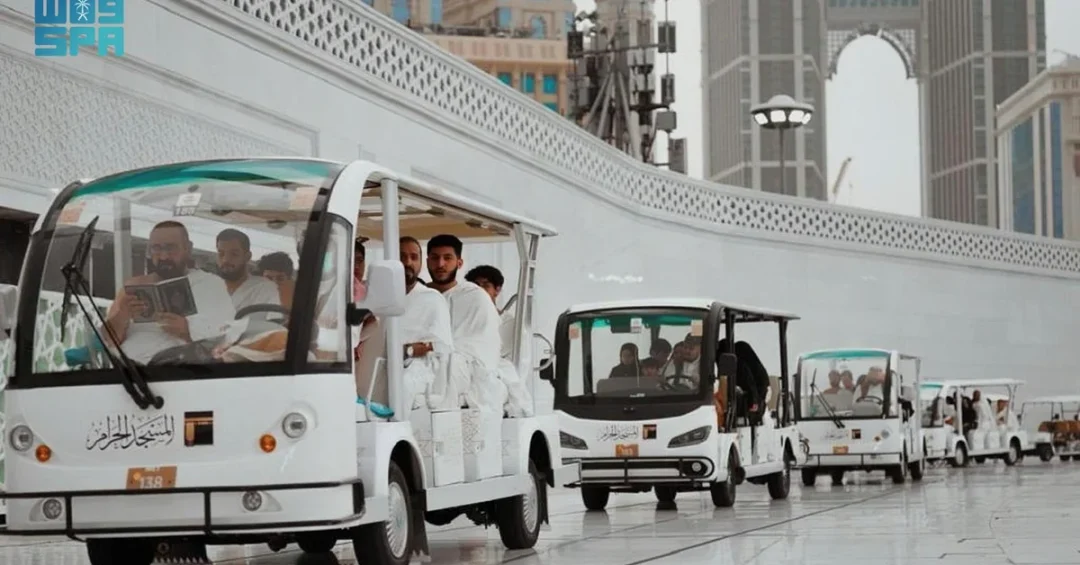
A record 57,000 worshippers benefited from the electric golf cart service at the Grand Mosque in Makkah on the 27th night of Ramadan, the General Authority for the Care of the Affairs of the Grand Mosque and the Prophet’s Mosque announced. The figure marks the highest number of beneficiaries recorded for the service on a single night, underscoring the scale of demand during the final ten days of the holy month and the authority’s expanding capacity to meet it.
The announcement, released through the Saudi Press Agency, reflects a sustained programme of service upgrades at Islam’s holiest site, where millions of pilgrims perform Umrah and prayers during Ramadan. The electric cart service is designed to assist elderly worshippers, people with disabilities, and those with limited mobility as they move between the courtyards, gates, and prayer halls of the Grand Mosque. Its record utilisation on the 27th night — widely regarded as among the most spiritually significant nights of the year — illustrates how technology and operational planning are being combined to serve an increasingly diverse global congregation.
Context and Background
How did a single service come to serve tens of thousands of worshippers in one night? The electric cart programme at the Grand Mosque has developed over several years as part of a broader modernisation of pilgrim services overseen by the General Authority for the Care of the Affairs of the Grand Mosque and the Prophet’s Mosque. The authority, established to manage the two holy mosques under a unified mandate, has prioritised accessibility alongside capacity, recognising that the worshipper population includes growing numbers of elderly visitors from around the world.
Ramadan consistently represents the peak operational period at the Grand Mosque. Worshipper numbers rise sharply throughout the month and reach their highest levels during the last ten nights, when many Muslims seek to perform Umrah and participate in night prayers. The 27th night, in particular, draws exceptional crowds because of its association with Laylat al-Qadr, the Night of Power, which holds profound significance in Islamic tradition. Managing movement, safety, and comfort at this scale requires months of preparation, coordination among multiple agencies, and the deployment of specialised equipment and trained personnel.
The electric cart service sits within this operational framework. It is not a standalone amenity but one component of an integrated system that includes crowd management, medical support, guided routes, and multilingual assistance. The authority’s reported record of 57,000 beneficiaries on the 27th night indicates that the service was scaled to meet extraordinary demand without compromising safety or quality — a logistical achievement in one of the most densely occupied religious spaces in the world.
Key Details of the Record Night
What does the record actually tell us about the worshipper experience? According to the announcement carried by the Saudi Press Agency, the 57,000 figure represents the number of worshippers who used the electric golf cart service on the 27th night of Ramadan. The authority described the outcome as reflecting its ongoing dedication to improving services for worshippers while upholding the highest quality and safety standards, especially during peak periods.
The statement also highlighted the effective use of modern technologies to enhance the worshipper experience and ease the performance of rituals. This framing is significant: it positions the carts not merely as transport but as an accessibility tool that enables worshippers with mobility challenges to participate fully in prayers and rituals they might otherwise find physically difficult to complete. For elderly pilgrims, in particular, the availability of reliable assisted movement can determine whether they are able to attend the Grand Mosque during the busiest nights of the year.
Operationally, delivering such a service on the 27th night requires precise scheduling, clearly marked routes, trained drivers, charging and maintenance capacity, and coordination with security and crowd-management teams. The record figure suggests that these elements functioned effectively under maximum load. The authority’s emphasis on quality and safety standards also indicates that the expansion of the service was not achieved at the expense of oversight — a point of particular importance when large numbers of vulnerable worshippers are moving through congested areas.
International and Regional Impact
Why should this record matter beyond the borders of Saudi Arabia? The Grand Mosque hosts worshippers from virtually every country, and services there are experienced and reported on globally. A record performance in accessibility provision sends a visible signal about the standards international pilgrims can expect when they travel to the Kingdom for Umrah or Hajj. For families planning journeys with elderly relatives, the reliability of assisted services is a practical consideration that influences travel decisions.
Regionally, the announcement reinforces the broader pattern of Saudi investment in pilgrim infrastructure, which has regional economic and logistical spillovers. Airlines, hotels, transport operators, and service providers across the Middle East benefit from the steady flow of religious travellers, and improvements in the worshipper experience help sustain that flow. The record also demonstrates a model of technology-enabled public service that other large religious and cultural sites in the region may study as they manage their own accessibility challenges.
In diplomatic terms, the achievement contributes to the Kingdom’s standing as a custodian of the Two Holy Mosques, a responsibility that carries global religious significance. Each operational improvement at the Grand Mosque is observed by international media and by Muslim communities worldwide, and consistent delivery of high-quality services strengthens confidence in Saudi stewardship of the holy sites.
Economic and Strategic Significance
How does an accessibility service connect to the Kingdom’s wider economic ambitions? Pilgrimage is a major pillar of Saudi Arabia’s religious tourism economy, and the Kingdom has set ambitious targets to expand Umrah and Hajj capacity in the coming years. Meeting those targets depends not only on physical expansion but on service quality, because repeat visitation and positive word-of-mouth are shaped by how pilgrims experience the holy sites. Investments in accessibility, crowd management, and technology therefore have direct economic value.
The use of electric carts also aligns with sustainability objectives. Electric mobility reduces emissions and noise compared with conventional vehicles, supporting cleaner operations within the mosque’s environs. As Saudi Arabia pursues diversification and environmental goals under Vision 2030, the deployment of electric transport in high-profile public settings serves as a practical demonstration of these commitments in action.
Strategically, the record reflects institutional capability. The General Authority for the Care of the Affairs of the Grand Mosque and the Prophet’s Mosque has built expertise in managing extreme demand with precision, and this capability is itself an asset as the Kingdom prepares for larger pilgrim volumes. The lessons learned from Ramadan operations feed directly into planning for Hajj and for year-round Umrah services, creating a cycle of continuous improvement.
Vision 2030 Alignment
What does this achievement reveal about Saudi Arabia’s long-term direction? Vision 2030 places the enhancement of services for pilgrims and visitors to the holy sites at the centre of its religious tourism and quality-of-life objectives. The record use of electric carts on the 27th night of Ramadan is a concrete example of how the Kingdom is applying modern technology, operational discipline, and compassionate service design to fulfil that vision.
The authority’s work also reflects the broader Vision 2030 emphasis on accessibility and inclusion, ensuring that elderly people and people with disabilities can participate fully in religious life. By combining electric mobility, trained personnel, and rigorous safety standards, Saudi Arabia is setting a benchmark for how sacred sites can serve every worshipper with dignity. As pilgrim numbers continue to grow, this record stands as evidence that the Kingdom’s service model is scaling successfully — and as a promise of further improvements to come for the millions who travel to Makkah each year.
20 Questions
Q1. What record was announced at the Grand Mosque on the 27th night of Ramadan?
A1. The General Authority for the Care of the Affairs of the Grand Mosque and the Prophet’s Mosque announced that a record 57,000 worshippers used the electric golf cart service on the 27th night of Ramadan.
Q2. Which authority made the announcement?
A2. The announcement was made by the General Authority for the Care of the Affairs of the Grand Mosque and the Prophet’s Mosque, the body responsible for managing services at Islam’s two holiest sites.
Q3. Through which channel was the announcement released?
A3. The announcement was released through the Saudi Press Agency, the Kingdom’s official news agency, which regularly carries updates from government ministries and state agencies.
Q4. What is the electric cart service at the Grand Mosque?
A4. It is a service using electric golf carts to transport worshippers around the Grand Mosque, particularly assisting elderly people, people with disabilities, and others with limited mobility.
Q5. Why is the 27th night of Ramadan significant?
A5. The 27th night is widely regarded as among the most spiritually significant nights of Ramadan, associated with Laylat al-Qadr, drawing exceptionally large numbers of worshippers to the Grand Mosque.
Q6. How many worshippers used the service on that night?
A6. A record 57,000 worshippers benefited from the electric golf cart service on the 27th night of Ramadan, according to the authority’s announcement.
Q7. Who benefits most from the electric cart service?
A7. The service primarily assists elderly worshippers, people with disabilities, and those with limited mobility, enabling them to move between courtyards, gates, and prayer halls more easily.
Q8. What did the authority say the achievement reflects?
A8. The authority said it reflects its ongoing dedication to improving services for worshippers while upholding the highest quality and safety standards, especially during peak periods.
Q9. How does the service use modern technology?
A9. The service uses electric golf carts and supporting operational systems to enhance the worshipper experience and ease the performance of rituals, as highlighted in the authority’s statement.
Q10. Why is Ramadan a peak period at the Grand Mosque?
A10. Ramadan draws large numbers of Muslims seeking to perform Umrah and night prayers, with attendance rising sharply during the last ten nights, particularly the 27th night.
Q11. What operational elements are required to deliver the service?
A11. Delivering the service requires precise scheduling, clearly marked routes, trained drivers, charging and maintenance capacity, and coordination with security and crowd-management teams.
Q12. Why is the record considered a logistical achievement?
A12. Managing 57,000 beneficiaries in one night within one of the world’s most densely occupied religious spaces requires careful planning and coordination, demonstrating effective operational capability under maximum demand.
Q13. How does the service support accessibility and inclusion?
A13. By providing reliable assisted movement, the service enables elderly worshippers and people with disabilities to participate fully in prayers and rituals they might otherwise find physically difficult to complete.
Q14. What does the record signal to international pilgrims?
A14. It signals that the Kingdom is investing in high-quality accessibility services, giving international pilgrims confidence that elderly and less mobile family members can be supported during their visit.
Q15. How does the service contribute to Saudi Arabia’s religious tourism economy?
A15. Pilgrimage is a major pillar of the Kingdom’s religious tourism economy, and service quality influences repeat visitation and positive experiences, supporting broader efforts to expand Umrah and Hajj capacity.
Q16. How do electric carts support sustainability goals?
A16. Electric carts produce fewer emissions and less noise than conventional vehicles, supporting cleaner operations within the mosque’s environs and aligning with the Kingdom’s environmental objectives.
Q17. How does this achievement relate to Vision 2030?
A17. Vision 2030 prioritises enhancing services for pilgrims and improving quality of life, and the record use of electric carts demonstrates the application of technology and operational discipline toward those goals.
Q18. What role does the General Authority play in pilgrim services?
A18. The authority manages services at the Grand Mosque and the Prophet’s Mosque, overseeing accessibility, crowd management, safety, and technology deployment to serve worshippers throughout the year.
Q19. How do Ramadan lessons inform future planning?
A19. Operational experience from Ramadan feeds directly into planning for Hajj and year-round Umrah services, creating a cycle of continuous improvement in service delivery and crowd management.
Q20. What does the record suggest about future service expansion?
A20. It suggests the Kingdom’s service model is scaling successfully and that further improvements and capacity expansions are expected as pilgrim numbers continue to grow in the coming years.
Reader Feedback
We value your thoughts. Please share your feedback on this article.
Your feedback helps us improve our coverage.
Related articles
 Multilingual Guide Launched at Grand Mosque for Umrah
 Diriyah Gate Celebrates Eid Al-Fitr with Joyful Events
 Saudi Ministry Distributes 900,000 Hajj and Umrah Guides
 Tourists Explore Al-Ahsa’s Rich Heritage During Eid Celebrations
 Taif Eid Celebrations Draw Over 200,000 Visitors
 Jubail Maritime Excursions Draw Eid Crowds to Saudi Coast