


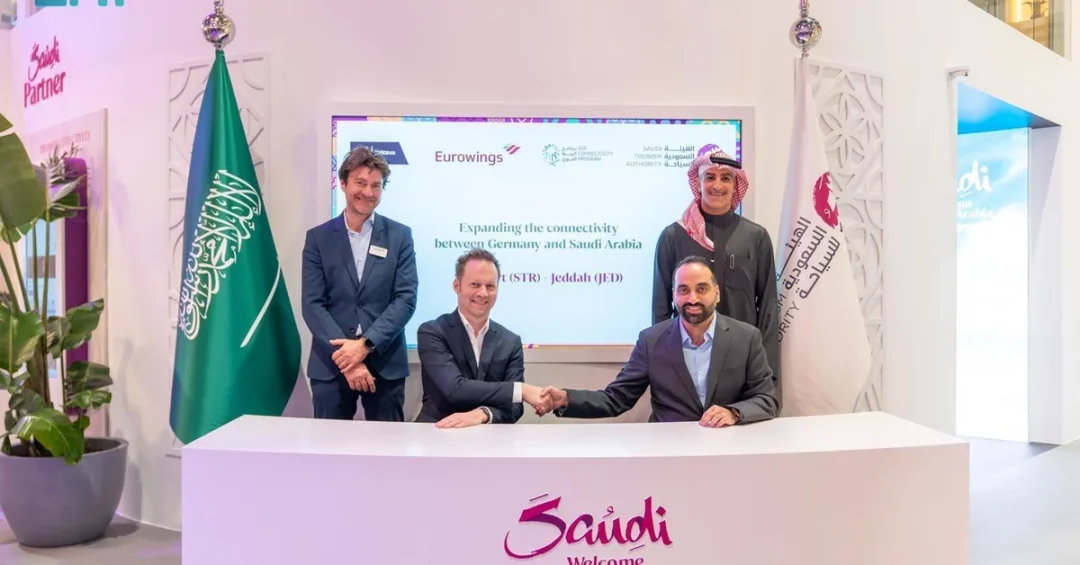
The Saudi Air Connectivity Program (ACP), in collaboration with the Saudi Tourism Authority (STA) and Jeddah Airports Company (JEDCO), has announced the launch of direct flights between Stuttgart, Germany, and Jeddah, with services scheduled to begin in the second half of 2025. The new route will operate twice weekly using an Airbus A321neo aircraft configured with 224 seats, according to an official announcement carried by the Saudi Press Agency. The initiative is designed to expand capacity for travelers and visitors from Europe and the United States seeking to reach the Kingdom, and it marks another concrete step in Saudi Arabia’s sustained effort to position itself as one of the world’s most connected and welcoming destinations.
For international observers, the announcement is more than a single route addition. It reflects a deliberate, coordinated strategy in which aviation capacity, tourism promotion, and airport infrastructure are developed together under the umbrella of Vision 2030. Saudi Arabia has set ambitious targets for visitor numbers and tourism’s contribution to gross domestic product, and air connectivity is the essential enabler that turns those targets into achievable outcomes. The Stuttgart-Jeddah link therefore deserves attention not only as a travel convenience but as a signal of how the Kingdom is systematically building the global air bridges that will carry its next phase of growth.
Context and Background
How did Saudi Arabia move so quickly from a largely domestic aviation market to one actively courting new international routes? The answer lies in the creation of the Air Connectivity Program, which serves as the executive enabler of both the National Tourism Strategy and the Saudi aviation strategy. The ACP works to develop existing and potential air routes while connecting the Kingdom to new international markets, fostering collaboration between public and private sector stakeholders across tourism and aviation. Its mandate is to strengthen Saudi Arabia’s position as a leading global destination for air travel connectivity, and the Stuttgart route is the latest expression of that mandate.
The program operates alongside the Saudi Tourism Authority, which markets the Kingdom internationally, and airport operators such as Jeddah Airports Company, which manages King Abdulaziz International Airport, one of the busiest gateways in the region and the principal arrival point for pilgrims and leisure visitors alike. This three-way collaboration model is central to how Saudi Arabia approaches route development: airlines receive the commercial confidence of coordinated demand generation, airports prepare capacity, and the national tourism strategy gains new source markets. Germany, as Europe’s largest outbound travel market, is a natural priority, and Stuttgart, a major industrial and commercial center in southwestern Germany, adds a catchment area with strong business and leisure travel potential.
It is also worth recalling the broader trajectory. Over recent years, Saudi Arabia has introduced tourist visas, expanded its calendar of cultural and sporting events, and invested heavily in heritage and hospitality projects. Each of those moves increases the incentive for airlines to launch routes, and each new route in turn makes the Kingdom more accessible to the audiences those initiatives are designed to reach. The Stuttgart-Jeddah service should be understood within this reinforcing cycle rather than as an isolated announcement.
Key Details of the New Route
According to the official announcement, flights will commence in the second half of 2025, operating twice a week. The aircraft assigned to the route is an Airbus A321neo with a capacity of 224 seats, a modern, fuel-efficient narrowbody well suited to medium-haul international services. The choice of equipment matters: it allows the airline to match capacity to demand while offering passengers a contemporary cabin experience. The route will be operated in cooperation with Eurowings, the German carrier, extending a partnership that the ACP describes as making significant progress in strengthening air links between Saudi Arabia and Europe.
Majid Khan, Chief Executive Officer of the Air Connectivity Program, stated that cooperation with Eurowings is making significant progress and expressed optimism about establishing a long-term partnership with the airline to expand the network of air routes in the coming years. He noted that such expansion would provide new travel experiences for visitors and enable them to explore Saudi Arabia’s historical and cultural landscapes. The emphasis on long-term partnership is notable: route announcements are often one-off events, but the ACP’s framing suggests a relationship intended to grow, potentially adding frequencies or additional German and European points of departure over time.
The stated aim of the initiative is to increase capacity for travelers and visitors from Europe and the United States to Saudi Arabia. That dual focus is significant. Stuttgart serves German-origin demand directly, while Jeddah’s role as a hub means the route can also support connecting traffic and itineraries that combine European and American travelers with onward journeys within the Kingdom. For a destination seeking to diversify its visitor base beyond traditional regional markets, this kind of connectivity is precisely what the strategy requires.
International and Regional Impact
What does a twice-weekly link between a German industrial city and the Red Sea coast actually change on the international stage? First, it deepens people-to-people ties between Saudi Arabia and Germany, a relationship already anchored in trade, investment, and diplomacy. Direct flights reduce journey times, remove the friction of connections through third countries, and make spontaneous travel more feasible for business delegations, families, and tourists alike. Second, it strengthens Jeddah’s position as a gateway city. Every new route adds to the airport’s network density, which in turn makes the hub more attractive to other carriers considering Saudi services.
Regionally, the route reinforces the Red Sea corridor’s growing importance. Jeddah sits at the crossroads of pilgrimage traffic, Red Sea tourism, and trade, and improved European connectivity supports all three. It also complements the Kingdom’s wider aviation ambitions, which include new carriers, expanded fleets, and airport developments across the country. When a European airline commits to a Saudi route, it signals confidence in the market’s fundamentals, and that signal is observed by other airlines, tour operators, and investors weighing their own entry into the Kingdom.
Economic and Strategic Significance
Why should economists and business analysts pay attention to an aviation announcement? Air connectivity is a measurable economic input. Studies across many markets consistently link new direct routes to increases in trade, investment, and tourism spending. For Saudi Arabia, the Stuttgart link supports inbound leisure travel, business travel connected to Germany’s manufacturing and engineering sectors, and the broader goal of raising tourism’s share of national income. The ACP’s explicit role as an enabler of the National Tourism Strategy means each route is evaluated not just on passenger volume but on its contribution to strategic objectives.
There is also a competitive dimension. Global tourism markets are contested, and destinations that are easy to reach win a disproportionate share of discretionary travel. By investing in route development now, Saudi Arabia is building the accessibility that will underpin its hospitality, entertainment, and heritage sectors as they scale. The use of a fuel-efficient A321neo also aligns with the global aviation industry’s efficiency trends, a detail that supports the Kingdom’s broader sustainability and modernization narrative.
Vision 2030 Alignment
How does a single route fit into a national transformation program as broad as Vision 2030? Vision 2030 seeks to diversify the economy, reduce dependence on hydrocarbons, and raise the quality of life for citizens and visitors. Tourism is one of the principal diversification pillars, and aviation is its circulatory system. The Air Connectivity Program, working with the Saudi Tourism Authority and Jeddah Airports Company, translates national ambition into specific routes, specific frequencies, and specific partnerships. The Stuttgart-Jeddah service is therefore not a peripheral development but a working component of the Vision 2030 machinery.
The forward-looking significance is clear. Each new route expands the Kingdom’s reach into new source markets, and the ACP has signaled its intention to continue growing the network in partnership with carriers such as Eurowings. For international readers, the practical message is that Saudi Arabia is becoming steadily easier to reach, whether for pilgrimage, business, culture, or leisure. As Vision 2030 progresses, the map of direct connections to the Kingdom will continue to fill in, and the Stuttgart announcement will be remembered as one more link in a chain that is steadily connecting Saudi Arabia to the world.
20 Questions
Q1. What was announced regarding flights between Stuttgart and Jeddah?
A1. The Saudi Air Connectivity Program, with the Saudi Tourism Authority and Jeddah Airports Company, announced direct flights from Stuttgart, Germany, to Jeddah, Saudi Arabia, beginning in the second half of 2025.
Q2. When will the Stuttgart-Jeddah flights begin operating?
A2. The flights are scheduled to commence in the second half of 2025, according to the official announcement released via the Saudi Press Agency.
Q3. How many times per week will the new route operate?
A3. The service will operate twice a week, providing regular direct connectivity between southwestern Germany and the Red Sea gateway city of Jeddah.
Q4. What type of aircraft will be used on the route?
A4. The route will use an Airbus A321neo aircraft with a capacity of 224 seats, a modern and fuel-efficient narrowbody suited to medium-haul international services.
Q5. Which organizations collaborated on this initiative?
A5. The Saudi Air Connectivity Program, the Saudi Tourism Authority, and Jeddah Airports Company collaborated on the initiative, reflecting the Kingdom’s coordinated approach to route development.
Q6. Which airline is partnering on the Stuttgart-Jeddah route?
A6. The route is being developed in cooperation with Eurowings, the German carrier, as part of a partnership the Air Connectivity Program describes as making significant progress.
Q7. Who is the Chief Executive Officer of the Air Connectivity Program?
A7. Majid Khan is the Chief Executive Officer of the Saudi Air Connectivity Program, and he commented on the progress of cooperation with Eurowings.
Q8. What did the ACP Chief Executive Officer say about the partnership?
A8. Majid Khan said cooperation with Eurowings is making significant progress and expressed optimism about establishing a long-term partnership to expand air routes in the coming years.
Q9. What is the main goal of the new route?
A9. The initiative aims to increase capacity for travelers and visitors from Europe and the United States to Saudi Arabia, supporting the Kingdom’s tourism growth objectives.
Q10. What is the role of the Air Connectivity Program?
A10. The ACP drives tourism growth by enhancing air links between the Kingdom and global destinations, developing existing and potential routes, and connecting Saudi Arabia to new international markets.
Q11. Which national strategies does the ACP support?
A11. The ACP serves as the executive enabler of both the National Tourism Strategy and the Saudi aviation strategy, aligning route development with national objectives.
Q12. Why is Stuttgart an important market for Saudi Arabia?
A12. Stuttgart is a major industrial and commercial center in southwestern Germany, offering strong business and leisure travel potential and expanding the Kingdom’s European source markets.
Q13. How does the route benefit Jeddah?
A13. The route strengthens Jeddah’s position as a gateway city, adds network density to King Abdulaziz International Airport, and supports pilgrimage, tourism, and trade traffic.
Q14. What does the A321neo bring to the route?
A14. The A321neo offers 224 seats with modern efficiency, allowing the airline to match capacity to demand while providing passengers a contemporary cabin experience.
Q15. How does this route support Saudi tourism?
A15. By improving direct access from Europe, the route makes the Kingdom easier to visit and supports the Saudi Tourism Authority’s efforts to attract international visitors.
Q16. What historical and cultural experiences can visitors explore?
A16. Visitors can explore Saudi Arabia’s historical and cultural landscapes, including heritage sites, Red Sea destinations, and the broader cultural offerings promoted under Vision 2030.
Q17. How does the announcement reflect Saudi aviation strategy?
A17. It demonstrates the strategy in action, expanding international connectivity through partnerships between government programs, tourism authorities, airports, and foreign carriers.
Q18. What signal does the route send to other airlines?
A18. It signals confidence in Saudi Arabia’s aviation market fundamentals, which may encourage other carriers and tour operators to consider launching or expanding Saudi services.
Q19. How does the route align with Vision 2030?
A19. It supports economic diversification and tourism growth, two central Vision 2030 pillars, by expanding the air connectivity that underpins the Kingdom’s visitor economy.
Q20. What can travelers expect next from Saudi air connectivity?
A20. The ACP intends to continue expanding the network with partners such as Eurowings, suggesting further route growth and easier access to the Kingdom in the coming years.
Reader Feedback
We value your thoughts. Please share your feedback on this article.
Your feedback helps us improve our coverage.
Related articles
 Ramadan Iftar in Al-Baha’s Misty Mountains
 Al-Balad Market: Jazan’s Ramadan Cultural Hub
 Tourism Ministry Launches Online License Verification Service
 Al-Mughaisla: Madinah’s Ramadan Heritage Gem
 Al-Rahma Mosque: A Modern Islamic Architectural Masterpiece
 Al-Qaisaryah Market Thrives During Ramadan in Al-Ahsa