


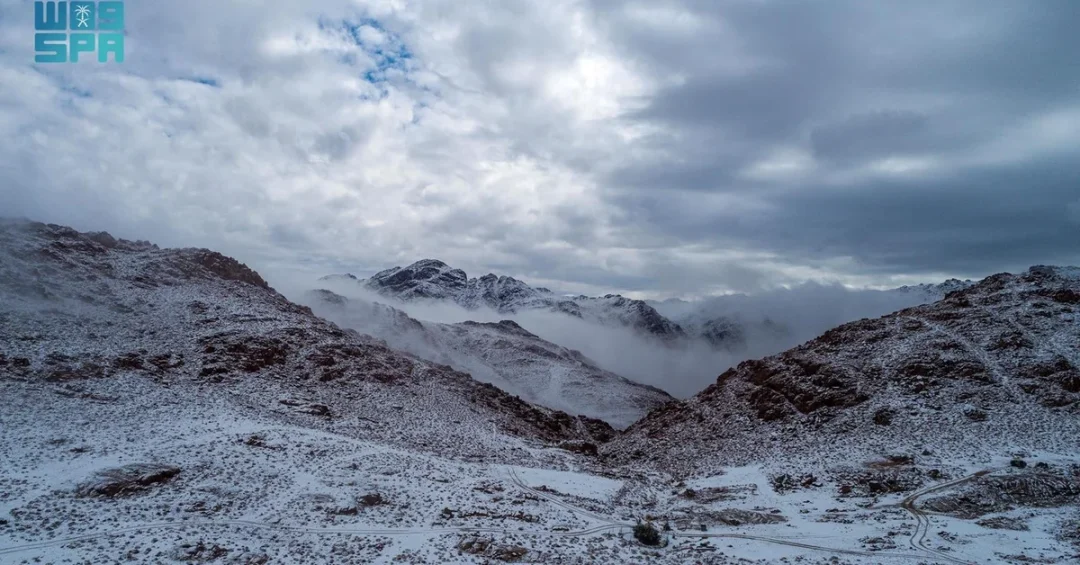
Saudi Arabia’s Tabuk region is showcasing one of the Kingdom’s most striking natural spectacles, as its towering mountains and highlands are embraced by snow and clouds during the winter season, drawing attention to the geological and tourism significance of these formations on International Mountain Day. The annual observance, designated by the United Nations General Assembly in 2003 and marked every December 11, highlights the vital role mountains play in sustainable development, and the Kingdom’s mountainous terrain stands as a vivid example of that global theme. According to official information released through the Saudi Press Agency, the Tabuk region’s prominent peaks and highlands represent the most significant features of its terrain, occupying roughly one-third of the region’s total area. Have you ever considered how a landscape shaped millions of years ago could now serve as a cornerstone of a nation’s tourism and investment strategy?
The snow and cloud cover transforming Tabuk’s highlands into a seasonal spectacle reflects the remarkable geological diversity that defines this northwestern corner of Saudi Arabia. These formations originated during the tertiary geological period, coinciding with the development of the Red Sea gully as a result of rifting movements, and have since been sculpted by erosion processes into the dramatic silhouettes visible today. The convergence of snow, cloud, and rugged rock creates a scene that few international observers associate with the Kingdom, yet it forms an integral part of Saudi Arabia’s natural heritage and its expanding appeal as a year-round destination for travelers seeking authentic and unexpected experiences.
Context and Background
Why does a single day on the global calendar matter so much for the world’s mountain communities and the nations that steward them? International Mountain Day, established by the UN General Assembly in 2003, was created to raise awareness about the significance of mountains in daily life and their essential contribution to sustainable development. For Saudi Arabia, this observance carries particular resonance, as the Kingdom possesses several mountain ranges and highlands that enhance its scenic beauty and demonstrate its geological diversity. The Tabuk region, situated in the northwest near the borders with Jordan and close to the Red Sea coast, hosts the Midian mountains, which constitute the northern section of the western highlands. These ranges are typically complexly interconnected, with steep slopes exceeding 60 degrees, and they straddle various geological formations that tell the story of the Arabian Peninsula’s deep natural history. The scientific encyclopaedia of Tabuk University documents these formations in detail, providing an authoritative record of the region’s geological importance.
The eastern section of Tabuk’s mountainous terrain is composed of geological formations of cross-layered sandstone, notable for its high-altitude mountains, with Jabal Al-Lawz peaking at some 2,600 meters above sea level. The Hejaz Mountains, spanning the central and southern areas of the region, are characterized by rugged, interconnected peaks with slopes also exceeding 60 degrees, interspersed with valleys that have supported human settlement and trade for millennia. This combination of height, gradient, and geological variety makes Tabuk one of the most distinctive landscapes in the Kingdom. The winter snow and cloud cover that periodically blanket these peaks adds another dimension to their appeal, transforming them into a seasonal attraction that captures the imagination of visitors and photographers alike. How often does one encounter a desert kingdom whose mountains wear a mantle of snow?
Key Details
What exactly makes the Tabuk region’s mountains so significant beyond their visual drama? According to official Saudi sources, the region’s high mountains, diverse geological formations, significant historical depth, and colourful rocks hold not only economic value but also draw investment and visionary projects, establishing Tabuk as a unique natural tourist destination. The Midian mountains form the northern section of the western highlands and are known for their complex interconnections and steep slopes. The eastern sandstone formations, including Jabal Al-Lawz, offer high-altitude environments that are rare in the region. The Hejaz Mountains in the central and southern areas provide rugged peaks interspersed with valleys, creating microclimates and habitats that support biodiversity. These features collectively make Tabuk a focal point for geological research, adventure tourism, and cultural heritage exploration. The snow and clouds that embrace the mountains during winter months amplify their allure, providing a striking contrast to the warm desert landscapes for which Saudi Arabia is more commonly known.
The Kingdom has experienced considerable tourism growth, due in no small measure to the various sites and mountain resorts that attract visitors from around the globe eager to explore the Kingdom’s archaeological heritage and historical landmarks. Tabuk’s mountains are central to this growth story. The region’s geological formations originated during the tertiary period, linked to the rifting that created the Red Sea, and erosion has since shaped them into the dramatic forms seen today. This natural history is not merely academic; it underpins the region’s potential for geotourism, a growing segment of the global travel market. Visitors can witness firsthand the layered sandstone, the volcanic remnants, and the weathered peaks that document millions of years of Earth’s history. The presence of snow and cloud cover adds a seasonal dimension that encourages repeat visits and extends the tourism calendar beyond the traditional peak seasons. Could this combination of geology, climate, and culture position Tabuk as a premier destination for travelers seeking something truly different?
International and Regional Impact
How does a regional natural phenomenon in northwestern Saudi Arabia resonate on the international stage? The snow-covered mountains of Tabuk serve as a powerful symbol of the Kingdom’s environmental diversity and its commitment to sustainable development, themes that align with global priorities articulated by the United Nations. International Mountain Day itself is a UN initiative, and Saudi Arabia’s active participation in such observances signals its engagement with multilateral frameworks on environment, climate, and sustainable tourism. For regional neighbors, Tabuk’s mountains represent a shared geological heritage, as the Midian and Hejaz ranges extend conceptually and physically toward Jordan and the broader Levant. This creates opportunities for cross-border cooperation in conservation, tourism, and scientific research. The Kingdom’s efforts to develop mountain resorts and infrastructure in Tabuk can also serve as a model for other countries in the region seeking to balance economic development with environmental stewardship. Have you considered how a single region’s natural assets can foster diplomacy and regional collaboration?
From an international tourism perspective, Tabuk’s winter snow and cloud phenomena offer a unique selling point that distinguishes Saudi Arabia from other Gulf destinations. Travelers from Europe, Asia, and the Americas are increasingly seeking authentic, off-the-beaten-path experiences, and the Kingdom’s mountainous northwest delivers exactly that. The combination of archaeological heritage, historical landmarks, and dramatic landscapes positions Tabuk alongside established mountain tourism destinations worldwide. The Saudi Press Agency’s reporting on International Mountain Day underscores the Kingdom’s awareness of these global trends and its intention to harness them responsibly. By highlighting the geological and scenic value of its mountains, Saudi Arabia invites the world to discover a side of the country that few outsiders know. What better way to diversify a nation’s image than by revealing its cool, cloud-kissed peaks?
Economic and Strategic Significance
What economic opportunities arise when mountains become magnets for investment and visitation? The Tabuk region’s mountains are not just scenic backdrops; they are assets that attract investment and visionary projects, according to official Saudi information. The Kingdom’s broader economic transformation, guided by Vision 2030, emphasizes the development of non-oil sectors, with tourism as a key pillar. Tabuk’s natural endowments make it a prime candidate for resorts, adventure tourism facilities, and supporting infrastructure. The presence of snow and clouds during winter creates a niche for seasonal activities that can draw domestic and international visitors, generating revenue and creating jobs. Moreover, the geological uniqueness of the region supports educational tourism and scientific research, adding another layer of economic value. Strategic investments in accessibility, hospitality, and conservation can ensure that growth is sustainable and benefits local communities. Is it any wonder that investors are looking closely at a region that offers both natural beauty and untapped potential?
The strategic location of Tabuk, close to the Red Sea and with proximity to major trade routes, further enhances its economic significance. The mountains themselves contain mineral and rock resources that have been utilized for centuries, but their modern value lies in their capacity to attract people and capital. As Saudi Arabia continues to open up to international tourists through streamlined visa processes and improved connectivity, Tabuk stands ready to welcome them. The region’s inclusion in national tourism strategies reflects a deliberate effort to diversify the Kingdom’s offerings beyond its well-known desert and coastal attractions. By promoting mountain tourism, Saudi Arabia taps into a global market that values authenticity, adventure, and natural beauty. The snow and cloud cover that periodically graces Tabuk’s peaks becomes a seasonal marketing asset, drawing attention and inspiring travel plans. How many destinations can claim such a compelling combination of geology, climate, and culture?
Vision 2030 Alignment
How does the splendor of Tabuk’s snow-dusted mountains connect to Saudi Arabia’s long-term vision for the future? Vision 2030, the Kingdom’s comprehensive roadmap for economic and social transformation, places tourism among its central pillars, aiming to increase the sector’s contribution to GDP and create employment opportunities for Saudi citizens. The development of Tabuk’s mountain tourism aligns directly with this goal, leveraging the region’s natural assets to attract visitors and investment. The Kingdom’s leadership has consistently emphasized the importance of preserving cultural and natural heritage while modernizing infrastructure and services. Tabuk’s mountains, with their geological significance and seasonal snow, embody this balance between conservation and development. Projects that enhance accessibility, accommodation, and visitor experiences in the region are part of a broader effort to showcase Saudi Arabia’s diversity to the world. Can a mountain range become a symbol of national renewal? In Tabuk’s case, the answer is a resounding yes.
As the world marks International Mountain Day, Saudi Arabia’s Tabuk region stands as a testament to the Kingdom’s commitment to sustainable development and its growing role as a global tourism destination. The snow and clouds that embrace its peaks are more than a meteorological curiosity; they are a reminder of the natural wonders that exist within the Kingdom’s borders and the potential that lies in sharing them responsibly with the world. Under Vision 2030, Saudi Arabia is not only transforming its economy but also redefining its place on the global stage, inviting travelers, investors, and researchers to explore its mountains, heritage, and hospitality. The future of Tabuk’s highlands is bright, and the Kingdom’s forward-looking approach ensures that this natural treasure will be preserved and celebrated for generations to come. What greater legacy could a nation build than to share its most beautiful landscapes with the world while safeguarding them for the future?
20 Questions
Q1. What is International Mountain Day and when is it observed?
A1. International Mountain Day is observed every December 11, designated by the UN General Assembly in 2003 to raise awareness about the importance of mountains in sustainable development and daily life.
Q2. Which region in Saudi Arabia is highlighted for its snow-covered mountains?
A2. The Tabuk region in northwestern Saudi Arabia is highlighted, known for its prominent mountains and highlands that periodically receive snow and cloud cover during winter months.
Q3. What percentage of Tabuk’s total area is made up of mountains and highlands?
A3. According to the scientific encyclopaedia of Tabuk University, mountains and highlands make up about one-third of the region’s total area, making them the most significant terrain feature.
Q4. When did the geological formations in Tabuk originate?
A4. The formations originated during the tertiary geological period, coinciding with the development of the Red Sea gully due to rifting movements, and have since been shaped by erosion.
Q5. What are the main mountain groups in the Tabuk region?
A5. The main groups are the Midian mountains in the northern section of the western highlands, the eastern sandstone formations including Jabal Al-Lawz, and the Hejaz Mountains in central and southern areas.
Q6. How high is Jabal Al-Lawz?
A6. Jabal Al-Lawz peaks at some 2,600 meters above sea level, making it one of the highest mountains in the Tabuk region and a notable feature of the eastern section.
Q7. What are the slope gradients of Tabuk’s mountains?
A7. Many slopes exceed 60 degrees, particularly in the Midian mountains and the Hejaz Mountains, which are characterized by rugged, interconnected peaks interspersed with valleys.
Q8. Why are Tabuk’s mountains important for tourism?
A8. They attract visitors with their geological diversity, historical depth, colourful rocks, and winter snow, supporting mountain resorts and sustainable tourism growth in the Kingdom.
Q9. How does snow and cloud cover affect Tabuk’s appeal?
A9. Snow and clouds create a striking seasonal spectacle that contrasts with typical desert images, drawing photographers, adventure travelers, and tourists seeking unique experiences in Saudi Arabia.
Q10. What economic value do Tabuk’s mountains hold?
A10. Beyond scenic beauty, they attract investment and visionary projects, support tourism infrastructure, and contribute to economic diversification under Saudi Arabia’s Vision 2030.
Q11. How does International Mountain Day relate to Saudi Arabia?
A11. Saudi Arabia participates in the global observance by highlighting its mountain ranges and highlands, which enhance scenic beauty and demonstrate the Kingdom’s geological diversity and sustainable tourism potential.
Q12. What is the significance of the Midian mountains?
A12. The Midian mountains form the northern section of the western highlands, known for steep slopes exceeding 60 degrees and complex interconnections across various geological formations.
Q13. What characterizes the Hejaz Mountains in Tabuk?
A13. The Hejaz Mountains feature rugged, interconnected peaks with slopes exceeding 60 degrees, interspersed with valleys that support local ecosystems and human activities.
Q14. How has erosion shaped Tabuk’s landscape?
A14. Erosion over millions of years has sculpted the tertiary-period formations into dramatic peaks, valleys, and colourful rock structures that define the region’s unique terrain.
Q15. What role does Tabuk University play in documenting these mountains?
A15. The scientific encyclopaedia of Tabuk University provides authoritative documentation of the region’s geological formations, including details on their origin, structure, and extent.
Q16. How does mountain tourism support Saudi Vision 2030?
A16. Mountain tourism diversifies the economy, creates jobs, attracts international visitors, and showcases Saudi Arabia’s natural heritage, aligning with Vision 2030’s tourism and economic goals.
Q17. What types of visitors are drawn to Tabuk’s mountains?
A17. Adventure travelers, geotourists, photographers, researchers, and cultural heritage enthusiasts are drawn to the region’s dramatic landscapes, archaeological sites, and seasonal snow.
Q18. Are there historical landmarks near Tabuk’s mountains?
A18. Yes, the region has significant historical depth and archaeological heritage, with landmarks that attract visitors eager to explore Saudi Arabia’s ancient past alongside its natural wonders.
Q19. How does Saudi Arabia promote sustainable mountain tourism?
A19. Through responsible development of resorts and infrastructure, conservation efforts, and alignment with international frameworks like those highlighted on International Mountain Day, ensuring environmental and cultural preservation.
Q20. What makes Tabuk a unique destination globally?
A20. Tabuk combines high-altitude mountains, winter snow and clouds, diverse geology, historical landmarks, and modern tourism facilities, offering an experience unlike any other in the region.
Reader Feedback
We value your thoughts. Please share your feedback on this article.
Your feedback helps us improve our coverage.
Related articles
 Al-Shuqaiq: Saudi Coastal Gem Boosting Tourism and Investment
 Jazan’s Mountains: A Hub for Investment and Tourism
 Arab Tourism Council 27th Session Kicks Off in Egypt
 Saudi Coastal Tourism Insurance Boosts Red Sea Appeal
 Sanaam AlUla Night Celebrates the Year of the Camel
 Dolce&Gabbana Opens Luxury Boutique and Café in Diriyah