


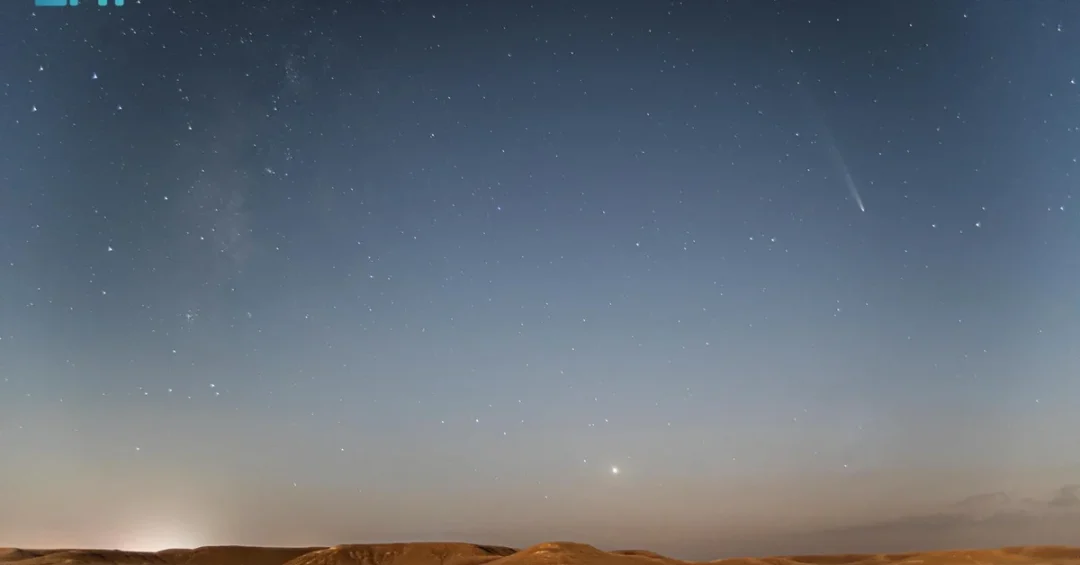
In October 2024, stargazers across the Kingdom of Saudi Arabia were treated to a rare celestial spectacle as summer and winter constellations converged in the night sky, and comet Tsuchinshan (A3) made a dazzling appearance over the Northern Border region. The official Saudi Press Agency (SPA) reported that the comet was observed on October 19, 2024, in Wadi Arar, where it was easily visible to the naked eye. This remarkable convergence of astronomical events has made October an unforgettable month for skywatching in the Kingdom, highlighting Saudi Arabia’s growing prominence as a destination for astronomy and astrophotography.
In a statement released via SPA, the Saudi Press Agency detailed how the early evening hours allowed observers to witness the beauty of summer constellations like Scorpius, while as the night progressed, winter constellations such as Orion emerged, creating a breathtaking celestial display. The low light pollution levels in the Northern Border region further enhanced the viewing experience, making it an ideal location for both amateur and professional astronomers. This natural phenomenon not only showcases the Kingdom’s diverse natural heritage but also aligns with broader efforts to promote tourism and scientific engagement under Vision 2030.
Context and Background
Why has Saudi Arabia become a magnet for astronomical observation in recent years? The answer lies in its vast deserts, clear skies, and minimal light pollution, particularly in remote areas like the Northern Border region. According to official Saudi sources, the convergence of summer and winter constellations is a seasonal occurrence that happens when the Earth’s orbit brings different star patterns into view. However, this October was special because it coincided with the appearance of comet Tsuchinshan (A3), a rare visitor from the outer solar system. The SPA report emphasized that the comet was observed on October 19, 2024, in Wadi Arar, and was visible to the naked eye, drawing interest from astronomers and enthusiasts alike.
The Northern Border region, with its pristine dark skies, has long been recognized as a prime location for stargazing. The Saudi Press Agency noted that the region’s low light pollution levels make it an ideal location for astronomers and astrophotographers to observe celestial phenomena and the movements of planets and stars. This natural advantage is increasingly being leveraged by the Kingdom to promote scientific tourism and educational initiatives. Under Vision 2030, Saudi Arabia aims to diversify its economy and attract international visitors, and astronomy tourism is emerging as a niche yet promising sector. The October events thus serve as a testament to the Kingdom’s untapped potential in this field.
How does this align with Saudi Arabia’s broader cultural and scientific ambitions? The Kingdom has been investing heavily in science, technology, and innovation, with initiatives like the Saudi Space Commission and various observatory projects. The SPA report highlights that the convergence of summer and winter constellations, coupled with the appearance of comet Tsuchinshan, has made October a truly remarkable month for skywatching in Saudi Arabia. This not only fosters a sense of wonder among residents and visitors but also encourages young Saudis to pursue careers in astronomy and space sciences. The official narrative underscores the importance of such natural phenomena in inspiring the next generation of scientists and explorers.
Key Details
What exactly made this October so extraordinary for skywatchers? According to the Saudi Press Agency, during the early evening hours, observers could witness the beauty of summer constellations like Scorpius. As the night progressed, winter constellations such as Orion emerged, creating a breathtaking celestial display. This transition is a result of Earth’s rotation and orbit, which gradually changes the visible stars throughout the night and across seasons. The overlap of summer and winter constellations is a relatively rare event that occurs only during specific times of the year, making October a unique window for observation.
The highlight, however, was the appearance of comet Tsuchinshan (A3), which was observed on October 19, 2024, in Wadi Arar. The comet was easily visible to the naked eye, a rarity for comets, which often require telescopes or binoculars. The SPA report noted that the Northern Border region’s low light pollution levels made it an ideal location for this observation. Astrophotographers and astronomers flocked to the area to capture the comet’s fleeting visit. The comet, officially designated C/2023 A3 (Tsuchinshan–ATLAS), is a long-period comet that may have originated from the Oort Cloud, and its appearance this year has been eagerly anticipated by the global astronomical community.
Why is the Northern Border region particularly suited for such observations? The region’s geography, with its vast deserts and minimal urban development, results in exceptionally dark skies. This allows for clear views of faint objects like comets and distant galaxies. The SPA highlighted that the convergence of summer and winter constellations, coupled with the appearance of comet Tsuchinshan, has made October a truly remarkable month for skywatching in Saudi Arabia. Local authorities and tourism boards are increasingly recognizing the potential of this natural asset and are considering developing infrastructure to support astronomy tourism, such as star camps and guided tours.
International and Regional Impact
How does Saudi Arabia’s astronomical bounty resonate on the global stage? The appearance of comet Tsuchinshan (A3) was not limited to Saudi skies; it was observed worldwide. However, the Kingdom’s unique vantage point and pristine conditions offered observers a particularly spectacular view. International astronomers and media outlets took note of the observations from Wadi Arar, further elevating Saudi Arabia’s profile in the field of astronomy. This aligns with the Kingdom’s broader efforts to engage with the international scientific community and position itself as a hub for research and discovery.
What does this mean for regional tourism and scientific collaboration? The October celestial events have the potential to attract astronomy enthusiasts from neighboring countries and beyond. The Saudi Press Agency’s report underscores the Northern Border region’s appeal as a stargazing destination. This could lead to increased regional tourism, with visitors from the Gulf Cooperation Council (GCC) countries and other parts of the Middle East traveling to Saudi Arabia to experience its dark skies. Moreover, collaborations with international observatories and space agencies could flourish, enhancing the Kingdom’s scientific capabilities and reputation. Under Vision 2030, such cross-border engagement is encouraged to promote knowledge exchange and economic diversification.
Economic and Strategic Significance
Why should the world pay attention to Saudi Arabia’s astronomy tourism potential? The Kingdom is actively seeking to diversify its economy beyond oil, and tourism is a key pillar of Vision 2030. Astronomy tourism, though niche, can attract high-value visitors and extend the tourism season beyond traditional peaks. The Northern Border region, with its unique celestial events, can be developed into a year-round destination for stargazing, astrophotography, and educational retreats. The SPA report highlights that the region’s low light pollution levels make it an ideal location for astronomers and astrophotographers, signaling opportunities for investment in hospitality, transportation, and guided services.
How does this align with Saudi Arabia’s strategic goals? The Kingdom aims to increase tourism’s contribution to GDP and create jobs for Saudis. By promoting astronomy tourism, Saudi Arabia can tap into a growing global market of travelers seeking authentic natural experiences. Furthermore, the scientific aspect of astronomy encourages STEM education and innovation, which are essential for the knowledge-based economy envisioned in Vision 2030. The October events serve as a proof of concept, demonstrating the Kingdom’s ability to host world-class astronomical phenomena and attract international attention. This success can be replicated in other regions, such as AlUla and NEOM, which also boast dark skies.
Vision 2030 Alignment
How does the October celestial symphony connect to Saudi Arabia’s long-term vision? Vision 2030 is about transforming the Kingdom into a global leader in various fields, including tourism, science, and technology. The stargazing opportunities in the Northern Border region exemplify how natural assets can be leveraged for economic and cultural growth. The SPA report’s emphasis on the convergence of constellations and the comet’s appearance highlights the Kingdom’s commitment to showcasing its natural wonders. By investing in infrastructure and promoting events like these, Saudi Arabia can position itself as a premier destination for astronomy enthusiasts, contributing to the goals of Vision 2030.
What does the future hold for Saudi Arabia’s skies? As the Kingdom continues to develop, preserving dark skies will be crucial for astronomy. Initiatives to reduce light pollution and create dark sky reserves could further enhance Saudi Arabia’s appeal. The October events have sparked interest and demonstrated the potential. With continued support from the government and private sector, Saudi Arabia can become a global hub for astronomical research and tourism. This aligns with the Vision 2030 objective of creating a vibrant society and a thriving economy, where science and nature coexist harmoniously. The unforgettable October of 2024 will be remembered as a milestone in this journey, inspiring generations to look up and dream.
20 Questions
Q1. What celestial event occurred in Saudi Arabia in October 2024?
A1. In October 2024, Saudi Arabia witnessed a rare convergence of summer and winter constellations, along with the appearance of comet Tsuchinshan (A3) in the Northern Border region, as reported by the Saudi Press Agency.
Q2. Where was comet Tsuchinshan observed in Saudi Arabia?
A2. Comet Tsuchinshan was observed on October 19, 2024, in Wadi Arar, located in the Northern Border region of Saudi Arabia, where it was visible to the naked eye.
Q3. Why is the Northern Border region ideal for stargazing?
A3. The Northern Border region has low light pollution levels, making it an ideal location for astronomers and astrophotographers to observe celestial phenomena and the movements of planets and stars.
Q4. What summer constellation was visible in the early evening?
A4. Scorpius, a prominent summer constellation, was visible in the early evening hours, offering a beautiful sight for observers in Saudi Arabia during October 2024.
Q5. Which winter constellation emerged later in the night?
A5. Orion, one of the most recognizable winter constellations, emerged as the night progressed, adding to the breathtaking celestial display over Saudi Arabia.
Q6. What makes October a unique month for skywatching in Saudi Arabia?
A6. October is unique because it features the convergence of summer and winter constellations, and in 2024, it was further enhanced by the appearance of comet Tsuchinshan, creating a remarkable skywatching experience.
Q7. How did the Saudi Press Agency report on this event?
A7. The Saudi Press Agency reported on October 20, 2024, from Arar, detailing the celestial display and the comet’s visibility, emphasizing the Northern Border region’s suitability for astronomical observation.
Q8. What is comet Tsuchinshan (A3) and why is it significant?
A8. Comet Tsuchinshan (A3), also known as C/2023 A3 (Tsuchinshan–ATLAS), is a long-period comet that became visible to the naked eye, offering a rare opportunity for observation and study by astronomers and enthusiasts.
Q9. How does this event align with Saudi Arabia’s Vision 2030?
A9. The event aligns with Vision 2030 by promoting tourism, scientific engagement, and economic diversification. It showcases Saudi Arabia’s natural assets and potential for astronomy tourism, contributing to the Kingdom’s goals.
Q10. What are the benefits of astronomy tourism for Saudi Arabia?
A10. Astronomy tourism can attract high-value visitors, extend the tourism season, create jobs, and stimulate investment in hospitality and infrastructure, while also fostering STEM education and innovation among Saudi youth.
Q11. Which regions in Saudi Arabia are known for dark skies?
A11. The Northern Border region is particularly noted for its low light pollution and dark skies, making it ideal for astronomy. Other regions like AlUla and NEOM also have potential for stargazing activities.
Q12. How can astronomers and astrophotographers benefit from Saudi Arabia’s skies?
A12. They can observe faint celestial objects, capture high-quality images of comets and constellations, and conduct research in optimal conditions, thanks to the Kingdom’s clear, dark skies and minimal atmospheric interference.
Q13. What role does the Saudi Space Commission play in astronomy?
A13. The Saudi Space Commission promotes space science and technology, supports research and innovation, and fosters international collaborations, contributing to the Kingdom’s advancement in astronomy and space exploration.
Q14. How does the convergence of constellations occur?
A14. The convergence occurs due to Earth’s rotation and orbit, which gradually changes the visible stars throughout the night. During October, both summer and winter constellations can be seen in a single night.
Q15. What educational opportunities arise from these celestial events?
A15. These events inspire students to pursue careers in astronomy, physics, and space sciences. They also provide hands-on learning experiences through observatory visits, workshops, and citizen science projects.
Q16. How can light pollution be reduced in Saudi Arabia to preserve dark skies?
A16. By implementing responsible lighting policies, using shielded fixtures, and raising public awareness, Saudi Arabia can minimize light pollution and protect its dark skies for future astronomical observations and tourism.
Q17. What international collaborations could emerge from Saudi Arabia’s astronomy initiatives?
A17. Saudi Arabia could partner with global observatories, space agencies, and universities for research, data sharing, and joint missions, enhancing its scientific reputation and contributing to global astronomical knowledge.
Q18. How does astronomy tourism contribute to Saudi Arabia’s economic diversification?
A18. It attracts visitors, boosts local businesses, creates employment, and generates revenue, reducing reliance on oil and supporting the Vision 2030 goal of a diversified, sustainable economy.
Q19. What future celestial events can be anticipated in Saudi Arabia?
A19. Future events include meteor showers, planetary alignments, and possibly other comets. The Kingdom’s dark skies will continue to offer excellent viewing opportunities for these phenomena, attracting astronomy enthusiasts.
Q20. How can the public participate in stargazing activities in Saudi Arabia?
A20. The public can join astronomy clubs, attend star parties and guided tours, visit observatories, and follow official announcements from the Saudi Press Agency and tourism authorities for upcoming celestial events and viewing locations.
Reader Feedback
We value your thoughts. Please share your feedback on this article.
Your feedback helps us improve our coverage.
Related articles
 Riyadh Season 2024 Draws 2 Million Visitors in One Week
 King Abdullah International Gardens Nears Completion in Riyadh
 Farmers’ Market Held in AlUla
 Riyadh Season Offers Free Entry to Seniors for Select Events
 Madinah Welcomes Over 14 Million Visitors in 2023
 Saudi Zone Welcomes Visitors to Boulevard World