


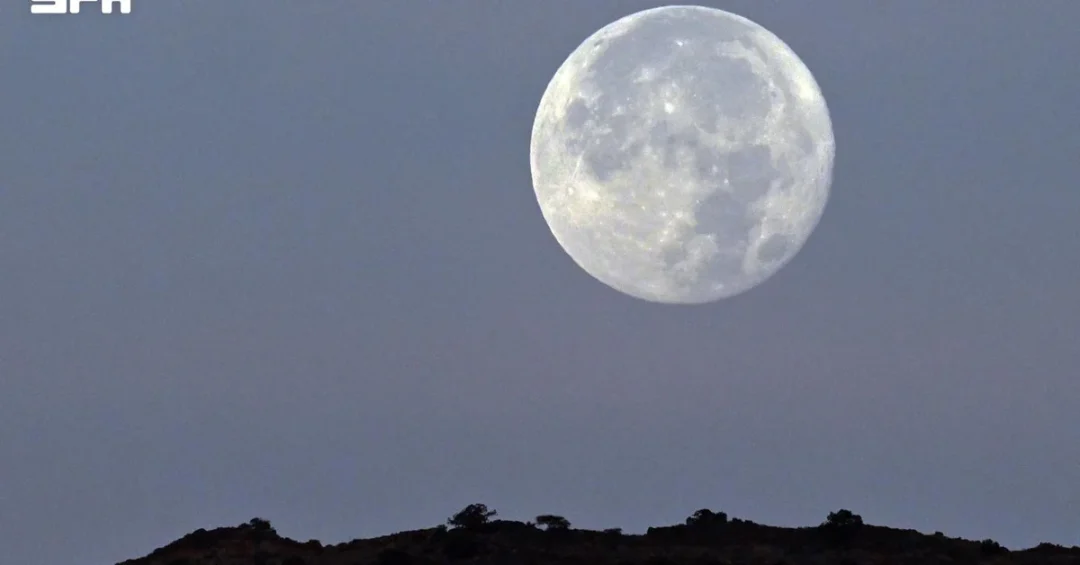
The skies across the Arab world were illuminated on Sunday night by a rare “Blue Moon” — the second full moon of May in the Gregorian calendar — remaining visible until sunrise on Monday, according to the Saudi Press Agency (SPA). The phenomenon, which occurs when a full moon appears for the second time in a single Gregorian month, was observed throughout the region and captured the attention of astronomers and skywatchers alike.
Context and Background
The term “Blue Moon” is not a scientific astronomical designation but rather a calendrical description for an additional full moon within a given period. As explained by Majed Abu Zahra, Director of the Jeddah Astronomy Society (JAS), the concept gained popularity during the 20th century to refer to the second full moon in a single Gregorian month. Despite its name, a Blue Moon does not appear blue in color; the term is purely a calendar-based label.
Astronomically, a full moon occurs when the Moon is in opposition to the Sun relative to Earth, with its facing side fully illuminated. This alignment happens when the Sun–Earth–Moon angle reaches approximately 180 degrees. The full moon of Dhu Al-Hijjah, as it is known in the Islamic calendar, was visible throughout the night, offering a spectacular celestial display for observers across the Arab world.
Key Details
The full moon reached its peak illumination on Sunday night, May 31, 2026, and remained visible until it set at sunrise on Monday, June 1, 2026. This event marked the second full moon in May, following the first full moon earlier in the month. According to Majed Abu Zahra, the phenomenon is a regular occurrence in the lunar cycle, but its timing within a single Gregorian month makes it noteworthy for the public.
The Jeddah Astronomy Society, a leading astronomical organization in Saudi Arabia, frequently provides educational insights into celestial events, helping to raise public awareness and appreciation for astronomy. The society’s explanations emphasize the importance of understanding such phenomena from both scientific and cultural perspectives.
Implications and Impact
The Blue Moon event captured the imagination of people across the Arab world, encouraging many to step outside and gaze at the night sky. Such celestial events often foster a sense of wonder and connect communities through shared experiences. In Saudi Arabia, astronomy clubs and educational institutions use these occasions to promote science education and stargazing activities, aligning with the Kingdom’s broader efforts to advance scientific literacy and tourism.
Furthermore, the event highlights the region’s growing interest in astronomy and space sciences. With Saudi Arabia investing in space exploration and technology as part of Vision 2030, public engagement with astronomical phenomena like the Blue Moon serves as a gateway to greater scientific curiosity and learning.
Vision 2030 Alignment
Saudi Arabia’s Vision 2030 places a strong emphasis on education, innovation, and quality of life. Events such as the Blue Moon provide opportunities for community engagement and educational outreach, reflecting the Kingdom’s commitment to fostering a knowledge-based society. As Saudi Arabia continues to develop its space and astronomy sectors, public interest in celestial events will play a vital role in inspiring the next generation of scientists and explorers.
The Jeddah Astronomy Society’s efforts to explain and celebrate such phenomena are in line with the Vision’s goals of enhancing scientific awareness and promoting recreational activities that enrich the lives of citizens and residents. The Blue Moon, though a calendrical quirk, serves as a reminder of the wonders of the universe and the importance of looking up.
20 Questions
Q1. What is a Blue Moon?
A1. A Blue Moon is commonly defined as the second full moon in a single Gregorian month. It is not a scientific term but a calendrical description for an additional full moon within a given period.
Q2. When did the Blue Moon occur in May 2026?
A2. The Blue Moon occurred on Sunday, May 31, 2026, and remained visible until sunrise on Monday, June 1, 2026. It was the second full moon in May.
Q3. Who provided the explanation about the Blue Moon?
A3. Majed Abu Zahra, Director of the Jeddah Astronomy Society (JAS), explained the phenomenon. He clarified that the term is not scientific but calendrical.
Q4. Is a Blue Moon actually blue in color?
A4. No, a Blue Moon does not appear blue. The term refers to the timing of the full moon, not its color. It is a calendrical description.
Q5. What causes a full moon?
A5. A full moon occurs when the Moon is in opposition to the Sun relative to Earth, with its facing side fully illuminated. This happens when the Sun-Earth-Moon angle reaches about 180 degrees.
Q6. Why is it called a Blue Moon?
A6. The term “Blue Moon” gained popularity in the 20th century to denote the second full moon in a single Gregorian month. It is not related to the moon’s color.
Q7. Which organization provided the information?
A7. The Jeddah Astronomy Society (JAS) provided the explanation. Its director, Majed Abu Zahra, shared insights about the phenomenon with the Saudi Press Agency.
Q8. What is the significance of the Blue Moon in the Arab world?
A8. The Blue Moon is a celestial event that sparks public interest in astronomy. It encourages skywatching and educational activities across the Arab world.
Q9. How often does a Blue Moon occur?
A9. A Blue Moon occurs approximately every two to three years, when a season or month has an extra full moon. The exact frequency varies.
Q10. What is the Islamic calendar name for this full moon?
A10. The full moon is associated with the month of Dhu Al-Hijjah in the Islamic calendar. It is the full moon of that month.
Q11. Did the Blue Moon have any special cultural significance?
A11. While not a religious event, the Blue Moon is a notable astronomical occurrence. It often inspires cultural and social gatherings for skywatching.
Q12. How can people observe a Blue Moon?
A12. People can observe a Blue Moon by looking at the night sky with the naked eye or using binoculars or telescopes. No special equipment is required.
Q13. What is the Jeddah Astronomy Society?
A13. The Jeddah Astronomy Society is a Saudi organization dedicated to astronomy education and public outreach. It frequently explains celestial events to the public.
Q14. Does the Blue Moon affect Earth in any way?
A14. The Blue Moon has no significant physical effect on Earth. It is a regular full moon, and its gravitational influence is similar to any other full moon.
Q15. Why is the term “Blue Moon” used if the moon isn’t blue?
A15. The term is a traditional and popular label for an extra full moon. It does not refer to the moon’s color, which remains its usual white or gray.
Q16. What did Majed Abu Zahra say about the term?
A16. He stated that “Blue Moon” is not a scientific astronomical term but a calendrical description. It is commonly used for the second full moon in a Gregorian month.
Q17. When did the term “Blue Moon” gain popularity?
A17. The term gained popularity during the 20th century. It became widely used to describe the second full moon in a single Gregorian month.
Q18. How does the Blue Moon relate to Saudi Vision 2030?
A18. The Blue Moon promotes public interest in astronomy, aligning with Vision 2030’s goals of education, innovation, and quality of life. It encourages scientific curiosity.
Q19. What other celestial events are observed in Saudi Arabia?
A19. Saudi Arabia observes various celestial events, including meteor showers, eclipses, and planetary alignments. The Jeddah Astronomy Society often provides information on these.
Q20. Where can I find more information about the Blue Moon?
A20. More information can be found through the Saudi Press Agency (SPA) and the Jeddah Astronomy Society (JAS). They provide official explanations and updates on astronomical events.
Reader Feedback
We value your thoughts. Please share your feedback on this article.
Your feedback helps us improve our coverage.
Related articles
 Makkah Observatory: From Abu Qubais to the Clock Tower
 Holy Kaaba Aligns With Sun in Rare Astronomical Event Over Makkah
 Saudi Students Head to ISEF 2024 in US
 Saudi Students Win 114 Medals at ISEF 2024 and ITEX 2024
 KSrelief, IOM Launch Humanitarian Supply Chain Training
 Saudi Students Win Bronze at Global Olympiad