


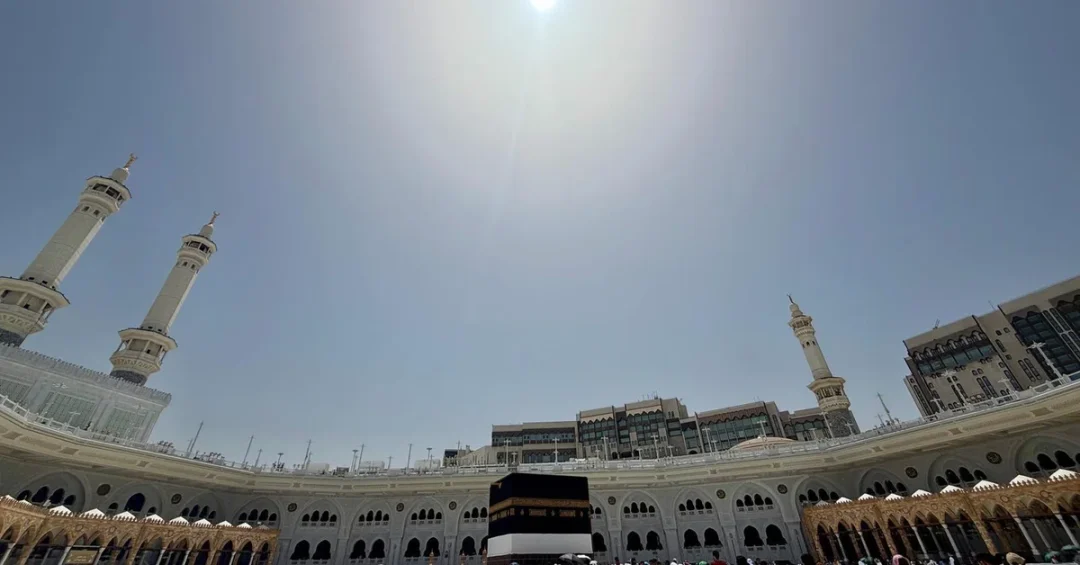
The sun aligned directly above the Holy Kaaba in Makkah at 12:18 PM Makkah time on Tuesday, May 26, 2026, an astronomical event that the Saudi Press Agency confirmed reached 89.94 degrees of elevation, just 0.06 degrees short of full perpendicularity. The alignment provided a naturally precise method for verifying the Qibla, the direction Muslims face in prayer, and drew attention from astronomers, educators and researchers interested in the relationship between celestial observation and Islamic practice.
Eng. Majed Abu Zahra, Director of the Jeddah Astronomy Society, stated that the sun reached its closest point to full alignment above the Holy Kaaba at that elevation, providing a direct opportunity to verify the accuracy of the Qibla direction using the sun’s position and the shadows cast by vertical objects, which nearly disappear at the moment of alignment.
Context and Background
According to the Saudi Press Agency, the phenomenon occurs twice annually because of the sun’s apparent movement between the Tropics of Cancer and Capricorn. As the sun travels along this path, it passes over the latitude of Makkah on two dates each year, placing the Holy Kaaba briefly in near-perfect vertical alignment with the solar disc.
The event carries scientific and educational significance well beyond its visual drama. For centuries, Muslim astronomers, travelers and scholars relied on this predictable solar positioning to confirm the orientation of mosques, using simple observations of shadows rather than complex instruments. That historical practice continues today as a practical reference point for verifying the direction of prayer across different continents and time zones.
Key Details
The alignment was recorded at 89.94 degrees of elevation, a measurement that places the sun almost exactly overhead relative to the Holy Kaaba. At that precise moment, vertical objects in Makkah cast virtually no shadow, a visual cue that allows observers to confirm the Qibla with remarkable accuracy.
Eng. Majed Abu Zahra explained that the technique is straightforward and accessible. When the sun sits directly above the Holy Kaaba, anyone able to observe its position can determine the correct direction of prayer by facing the sun from a location west of Makkah, or by turning away from it from a location east of the holy city. This makes the twice-yearly event a valuable teaching tool for students of astronomy, geography and Islamic studies.
The Jeddah Astronomy Society, a recognized Saudi scientific body dedicated to public education and astronomical observation, regularly documents such events and shares the results with researchers, educators and the wider community.
International Impact
The alignment holds relevance for Muslim communities worldwide, since the Qibla governs the orientation of mosques and prayer spaces on every continent. Mosques in Asia, Africa, Europe and the Americas are frequently built according to calculations derived from precisely this kind of solar observation, making the event a shared reference point for architects, religious authorities and worshippers alike.
Beyond its religious utility, the phenomenon highlights the growing role of astronomy in public education and scientific outreach. Observatories, universities and amateur astronomy groups across the region use such moments to demonstrate how celestial mechanics can be applied to everyday religious practice, strengthening links between scientific research and cultural heritage.
The event also underscores the Kingdom’s standing as the custodian of the Two Holy Mosques and as a center of knowledge and research, where scientific inquiry and religious tradition are treated as complementary rather than separate pursuits.
Vision 2030 Alignment
Under Saudi Vision 2030, the Kingdom is investing in education, scientific research and knowledge-based industries as pillars of long-term economic diversification. Astronomical observation programs, science outreach initiatives and specialized research bodies such as the Jeddah Astronomy Society contribute directly to that agenda by building national expertise, inspiring young learners and positioning Saudi Arabia as a regional hub for scientific and technical talent.
As the sun’s alignment over the Holy Kaaba is documented once again, it serves as a reminder of how the Kingdom combines its unique spiritual responsibilities with a forward-looking commitment to science, education and global engagement, ensuring that tradition and modernization continue to advance together.
20 Questions
Q1. What astronomical event occurred over Makkah on May 26, 2026?
A1. The sun aligned directly above the Holy Kaaba at 12:18 PM Makkah time, reaching 89.94 degrees of elevation, just 0.06 degrees short of full perpendicularity, according to the Saudi Press Agency, offering a precise method to verify the Qibla direction.
Q2. Who provided the official description of the alignment?
A2. Eng. Majed Abu Zahra, Director of the Jeddah Astronomy Society, described the event, noting that the sun reached its closest point to full alignment above the Holy Kaaba and provided a direct opportunity to verify the Qibla.
Q3. What is the Qibla and why does it matter?
A3. The Qibla is the direction Muslims face during prayer, oriented toward the Holy Kaaba in Makkah. Its accuracy is important for mosques and individual worshippers worldwide, making reliable methods of determining direction valuable to Muslim communities.
Q4. How does the sun’s alignment help determine the Qibla?
A4. When the sun sits almost directly above the Holy Kaaba, its position in the sky indicates the Qibla for observers in other locations. Shadows cast by vertical objects become reliable directional references at that moment.
Q5. Why do shadows nearly disappear during this event?
A5. With the sun at 89.94 degrees of elevation, light falls almost vertically onto objects in Makkah. Vertical poles, walls and structures therefore cast extremely short shadows, a striking visual confirmation that the sun is nearly overhead.
Q6. How often does this alignment take place?
A6. The phenomenon occurs twice annually, according to the Saudi Press Agency. The sun passes over the latitude of Makkah on two separate dates each year as part of its apparent annual journey across the sky.
Q7. Why does the alignment happen twice a year?
A7. It results from the sun’s apparent movement between the Tropics of Cancer and Capricorn. As the sun travels northward and then southward, it crosses the latitude of Makkah twice during each annual cycle.
Q8. What are the Tropics of Cancer and Capricorn?
A8. They are the two latitudes where the sun appears directly overhead at noon during the year. The Tropic of Cancer lies north of the equator and the Tropic of Capricorn lies south, marking the limits of the sun’s apparent journey.
Q9. What elevation did the sun reach above the Holy Kaaba?
A9. The sun reached an elevation of 89.94 degrees, just 0.06 degrees short of complete perpendicularity. This near-perfect angle produced the brief, distinctive shadow conditions observed in Makkah.
Q10. Where is the Holy Kaaba located?
A10. The Holy Kaaba stands at the center of the Grand Mosque, known as Masjid al-Haram, in Makkah. It is the holiest site in Islam and the focal point toward which Muslims around the world direct their prayers.
Q11. How has this method been used historically?
A11. Muslim scholars and astronomers historically used solar alignment to correct the orientation of mosques. The practice allowed communities far from Makkah to verify their Qibla using simple observation rather than complex instruments, and it remains relevant today.
Q12. What is the Jeddah Astronomy Society?
A12. The Jeddah Astronomy Society is a Saudi scientific body focused on astronomical observation, public education and outreach. It documents celestial events and shares findings with researchers, students and the wider community across the Kingdom.
Q13. Who is Eng. Majed Abu Zahra?
A13. Eng. Majed Abu Zahra is the Director of the Jeddah Astronomy Society. He provides technical commentary on astronomical events visible from Saudi Arabia, including solar alignments of significance to Islamic practice and scientific education.
Q14. What is the educational significance of the event?
A14. The alignment offers a practical demonstration of astronomical calculation and its connection to religious practice. It supports teaching in astronomy, geography and Islamic studies, helping students understand how celestial mechanics inform everyday observance.
Q15. Does this event affect pilgrims performing Hajj or Umrah?
A15. The alignment does not disrupt pilgrimage rituals. It serves primarily as a scientific and educational reference point, while pilgrims continue to perform their rites within the Grand Mosque as usual throughout the year.
Q16. How do astronomers predict these alignments?
A16. Astronomers calculate the sun’s apparent path relative to Earth’s tilt and orbit, then determine when it will pass over the latitude of Makkah. These calculations allow precise forecasting of timing and elevation well in advance.
Q17. Why is the event described as scientifically significant?
A17. It demonstrates the relationship between solar geometry and geographic coordinates, illustrating how natural phenomena can be measured and applied. Researchers and educators use it to explain orbital mechanics and the history of Islamic astronomy.
Q18. How does this reflect Saudi Arabia’s role in the Islamic world?
A18. As custodian of the Two Holy Mosques, the Kingdom hosts the holiest sites in Islam. Documenting and sharing such astronomical events reinforces its leadership in serving pilgrims and supporting Islamic scholarship worldwide.
Q19. What role does astronomy play in Saudi Vision 2030?
A19. Vision 2030 emphasizes education, research and knowledge-based industries. Astronomical programs and science outreach initiatives help develop national expertise, inspire young learners and position the Kingdom as a regional center for scientific talent.
Q20. What happens next after this alignment?
A20. The sun will continue its apparent journey, and a second alignment over the Holy Kaaba is expected later in the year. Saudi astronomical bodies will continue documenting the event and sharing results with researchers and the public.
Reader Feedback
We value your thoughts. Please share your feedback on this article.
Your feedback helps us improve our coverage.