


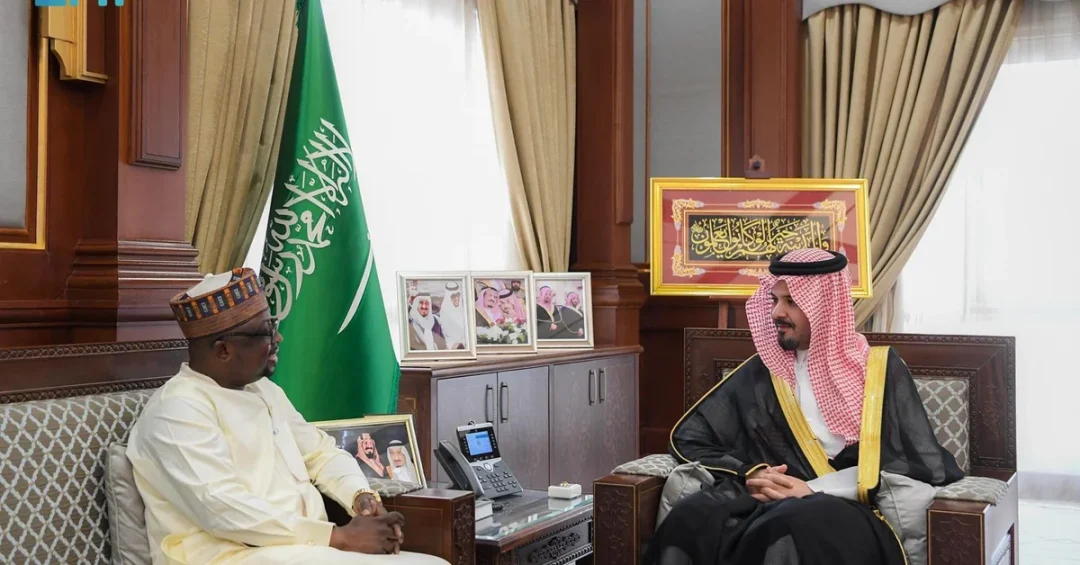
Madinah Region Governor Prince Salman bin Sultan bin Abdulaziz received Nigerian Consul General in Jeddah Muazam Ibrahim Nayaya at his office in Madinah on March 11, 2025, in a diplomatic meeting that underscores the Kingdom of Saudi Arabia’s enduring commitment to strengthening international partnerships and consular cooperation. The meeting, reported by the Saudi Press Agency, provided an opportunity for the two officials to exchange cordial talks and discuss a range of issues of mutual interest. The encounter reflects the Kingdom’s open-door diplomatic approach under the leadership of the Custodian of the Two Holy Mosques, King Salman bin Abdulaziz Al Saud, and His Royal Highness Crown Prince Mohammed bin Salman bin Abdulaziz Al Saud, Prime Minister.
The reception of a senior Nigerian diplomat by a regional governor in the holy city of Madinah carries significance beyond routine protocol. It signals Saudi Arabia’s continued engagement with African nations and its recognition of Nigeria’s importance as a strategic partner on the continent. How does such a meeting, seemingly modest in scope, contribute to the broader architecture of Saudi diplomacy and Vision 2030? The answer lies in the Kingdom’s multifaceted approach to foreign relations, where regional governance, consular affairs, and international cooperation intersect to advance shared prosperity.
Context and Background
Prince Salman bin Sultan bin Abdulaziz serves as the Governor of the Madinah Region, a position of considerable responsibility given the city’s status as the second holiest site in Islam and a major destination for millions of pilgrims annually. His role encompasses administrative oversight, regional development, and the facilitation of diplomatic and cultural exchanges that occur within his jurisdiction. The reception of Consul General Muazam Ibrahim Nayaya aligns with the governor’s mandate to engage with international representatives and support the Kingdom’s global outreach efforts.
Nigeria, Africa’s most populous nation with over 200 million people, maintains a significant diplomatic presence in Saudi Arabia through its consulate in Jeddah. The consulate serves Nigerian citizens residing in or visiting the Kingdom, including the substantial number of pilgrims who travel to Makkah and Madinah each year for Hajj and Umrah. The relationship between Saudi Arabia and Nigeria has deepened over the decades, rooted in shared religious ties, economic interests, and mutual respect for sovereignty and development aspirations.
What does this meeting reveal about the Kingdom’s diplomatic priorities in Africa? Saudi Arabia has consistently pursued strengthened ties with African nations through initiatives such as the Saudi-African Summit and bilateral agreements spanning energy, trade, and infrastructure. The reception in Madinah exemplifies how regional governors play an active role in this continental engagement, complementing the work of the Ministry of Foreign Affairs and the Kingdom’s embassies abroad.
Key Details of the Meeting
According to the Saudi Press Agency, the meeting between Prince Salman bin Sultan bin Abdulaziz and Consul General Muazam Ibrahim Nayaya featured an exchange of cordial talks focused on issues of mutual interest. While the specific topics discussed were not disclosed in the official report, such diplomatic encounters typically encompass consular matters, bilateral cooperation, and regional developments. The tone of the meeting was described as warm and constructive, consistent with the longstanding friendship between the Kingdom and Nigeria.
The presence of a Nigerian consul general in Jeddah, the Kingdom’s commercial hub and gateway to the holy cities, highlights the practical dimensions of the Saudi-Nigerian relationship. Consular services include assisting Nigerian pilgrims, facilitating business connections, and supporting cultural exchanges. The governor’s willingness to receive the consul general in Madinah demonstrates the Kingdom’s commitment to ensuring that diplomatic representatives have access to regional leadership and that their concerns receive appropriate attention.
How does Saudi Arabia balance its role as the custodian of Islam’s holiest sites with its broader international diplomatic engagements? The meeting in Madinah suggests that these roles are complementary rather than conflicting. By hosting diplomats from diverse nations, the Kingdom reinforces its position as a global crossroads where religious significance, economic dynamism, and diplomatic openness converge. The reception also reflects the Kingdom’s policy of hospitality and respect for all nations, a principle deeply embedded in Saudi culture and statecraft.
International and Regional Impact
The meeting between Prince Salman bin Sultan bin Abdulaziz and Consul General Muazam Ibrahim Nayaya contributes to the broader tapestry of Saudi-African relations, which have gained momentum in recent years. Nigeria, as a leading member of the Economic Community of West African States (ECOWAS) and a major oil producer, represents a key partner for the Kingdom in energy markets, trade, and investment. Saudi Arabia has expressed interest in expanding cooperation with African nations in sectors such as renewable energy, agriculture, and technology, aligning with Vision 2030’s goals of economic diversification.
Regionally, the reception underscores the stability and security that characterize Madinah and the wider Kingdom, making it an attractive destination for diplomatic engagement. In a world marked by geopolitical tensions, Saudi Arabia’s ability to maintain open channels of communication with nations across continents serves as a stabilizing force. The meeting also highlights the role of Jeddah as a diplomatic hub, hosting numerous consulates that serve as bridges between the Kingdom and their home countries.
What message does this send to other African nations considering deeper ties with Saudi Arabia? The reception of Nigeria’s consul general signals that the Kingdom values its relationships with African states and is willing to engage at multiple levels of government. This approach fosters goodwill and encourages other nations to pursue similar diplomatic and economic partnerships. It also reinforces Saudi Arabia’s image as a reliable partner committed to mutual respect and shared development goals.
Economic and Strategic Significance
While the meeting was primarily diplomatic in nature, its economic undertones should not be overlooked. Nigeria and Saudi Arabia share common interests in oil markets, and both are members of the Organization of the Petroleum Exporting Countries (OPEC), where they coordinate on production policies. Beyond energy, there is potential for increased trade and investment in sectors such as halal food, Islamic finance, and infrastructure. Saudi Arabia’s Public Investment Fund (PIF) has shown interest in African markets, and Nigeria could benefit from Saudi capital and expertise.
The strategic significance of the meeting also lies in its timing. As Saudi Arabia continues to implement Vision 2030, it seeks to diversify its economy and expand its global footprint. Strengthening ties with Nigeria, a country with a young and growing population, offers opportunities for Saudi businesses and investors. Conversely, Nigerian entrepreneurs and professionals can access Saudi markets and benefit from the Kingdom’s modernization drive. The consulate in Jeddah serves as a crucial facilitator of these exchanges.
How can Saudi-Nigerian relations evolve in the coming years? The foundations laid by meetings such as this one suggest a trajectory of growing cooperation. Both nations have expressed interest in expanding collaboration in education, health, and technology. Saudi scholarships for Nigerian students, medical exchanges, and joint ventures in renewable energy are all areas with potential for growth. The diplomatic engagement in Madinah represents a step in this ongoing journey.
Vision 2030 Alignment
The meeting between Prince Salman bin Sultan bin Abdulaziz and Consul General Muazam Ibrahim Nayaya aligns with Vision 2030’s emphasis on international cooperation and economic diversification. Vision 2030, launched by Crown Prince Mohammed bin Salman in 2016, seeks to transform Saudi Arabia into a global investment powerhouse and a hub connecting three continents. Diplomatic engagements with nations like Nigeria support this vision by opening new avenues for trade, investment, and cultural exchange. The Kingdom’s regional governors are integral to these efforts, ensuring that development and international outreach extend beyond the capital.
Furthermore, the reception reflects Vision 2030’s goal of enhancing the Kingdom’s soft power and global standing. By maintaining positive relations with African nations, Saudi Arabia positions itself as a leader in South-South cooperation and a bridge between the Arab world and Africa. The meeting in Madinah, a city of profound spiritual significance, adds a symbolic dimension to these efforts, highlighting the Kingdom’s unique role as a custodian of Islamic heritage and a modern, forward-looking nation. As Saudi Arabia continues its journey of transformation, such diplomatic encounters will remain vital to its success on the world stage.
20 Questions
Q1. Who received the Nigerian Consul General in Madinah?
A1. Prince Salman bin Sultan bin Abdulaziz, the Governor of the Madinah Region, received Nigerian Consul General Muazam Ibrahim Nayaya at his office in Madinah on March 11, 2025.
Q2. What was the purpose of the meeting between the Madinah Governor and the Nigerian Consul General?
A2. The meeting served to exchange cordial talks and discuss issues of mutual interest, reflecting Saudi Arabia’s commitment to maintaining open diplomatic channels and strengthening international partnerships.
Q3. Where did the meeting take place?
A3. The meeting took place at the office of the Madinah Region Governor in Madinah, Saudi Arabia, as reported by the Saudi Press Agency.
Q4. When did the meeting occur?
A4. The meeting occurred on March 11, 2025, according to the official announcement by the Saudi Press Agency.
Q5. Who is Muazam Ibrahim Nayaya?
A5. Muazam Ibrahim Nayaya is the Nigerian Consul General in Jeddah, representing Nigeria’s diplomatic interests in the western region of Saudi Arabia, including Jeddah and Madinah.
Q6. What is the significance of the Madinah Governor receiving a foreign diplomat?
A6. It demonstrates Saudi Arabia’s open-door diplomatic policy and the role of regional governors in supporting international engagement, particularly in cities of religious and strategic importance like Madinah.
Q7. How does this meeting reflect Saudi-Nigerian relations?
A7. The meeting underscores the longstanding and friendly relations between Saudi Arabia and Nigeria, rooted in shared interests, religious ties, and mutual respect for development and cooperation.
Q8. What topics were discussed during the meeting?
A8. The official report states that the two sides discussed issues of mutual interest, which typically include consular matters, bilateral cooperation, and regional developments.
Q9. Why is Nigeria important to Saudi Arabia?
A9. Nigeria is Africa’s most populous nation and a major oil producer, making it a key partner for Saudi Arabia in energy, trade, and continental diplomacy, as well as a source of pilgrims.
Q10. How does this meeting align with Vision 2030?
A10. It aligns with Vision 2030’s goals of international cooperation, economic diversification, and enhancing Saudi Arabia’s global standing by building partnerships with African nations.
Q11. What role does the Madinah Region Governor play in Saudi diplomacy?
A11. The governor supports diplomatic engagements within his region, facilitating international cooperation and representing the Kingdom’s hospitality and openness to foreign representatives.
Q12. How many Nigerian pilgrims travel to Saudi Arabia annually?
A12. Tens of thousands of Nigerian pilgrims perform Hajj and Umrah each year, making Nigeria one of the largest sources of pilgrims from Africa.
Q13. What consular services does the Nigerian Consulate in Jeddah provide?
A13. The consulate assists Nigerian citizens, supports pilgrims, facilitates business connections, and promotes cultural and educational exchanges between Nigeria and Saudi Arabia.
Q14. What economic opportunities exist between Saudi Arabia and Nigeria?
A14. Opportunities include energy cooperation, halal food exports, Islamic finance, infrastructure investment, and joint ventures in renewable energy and technology.
Q15. How does Saudi Arabia support African nations like Nigeria?
A15. Saudi Arabia supports African nations through development aid, investment, scholarships, and diplomatic engagement, including the Saudi-African Summit and bilateral agreements.
Q16. What is the significance of Madinah in Saudi Arabia’s international relations?
A16. Madinah’s status as Islam’s second holiest city makes it a focal point for Muslim engagement, and hosting diplomats there reinforces the Kingdom’s role as a global Islamic leader.
Q17. How does this meeting contribute to regional stability?
A17. By maintaining open communication and cooperation with Nigeria, Saudi Arabia contributes to stability in West Africa and strengthens ties between the Arab world and Africa.
Q18. What message does this meeting send to other African countries?
A18. It signals Saudi Arabia’s willingness to engage with African nations at multiple levels, encouraging broader partnerships and mutual development.
Q19. What are the prospects for future Saudi-Nigerian cooperation?
A19. Prospects include expanded trade, investment, educational exchanges, and collaborative efforts in energy and technology, building on existing diplomatic foundations.
Q20. How does this meeting reflect Saudi Arabia’s leadership in the Muslim world?
A20. By hosting the Nigerian Consul General in Madinah, Saudi Arabia demonstrates its commitment to serving Muslim nations, fostering unity, and facilitating cooperation among Islamic countries.
Reader Feedback
We value your thoughts. Please share your feedback on this article.
Your feedback helps us improve our coverage.
Related articles
 Saudi Arabia Launches Dates Program in Finland for Ramadan
 Saudi Arabia Launches Unified Transport Platform at Grand Mosque
 Saudi Project Restores Najran’s Al-Zubair bin Al-Awam Mosque
 Saudi Flag Flies High on World’s Tallest Flagpole for Flag Day
 GCC Chief Receives Dominican, Swiss, Bosnian Envoys
 UN Recognizes Saudi Arabia as Global Water Management Model