


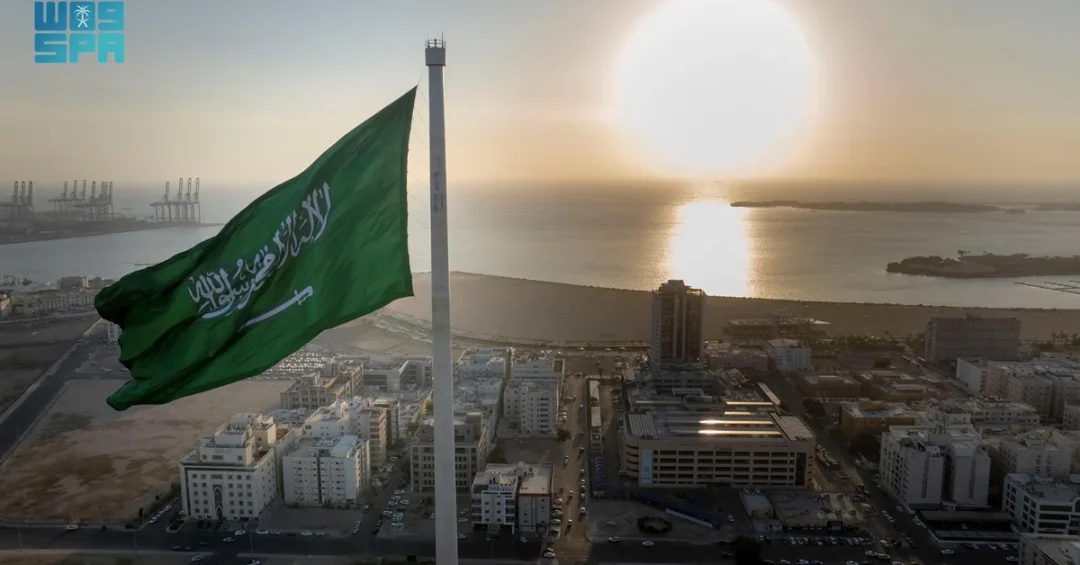
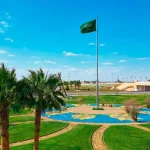
Saudi Arabia celebrated Flag Day on March 11, 2025, with the Kingdom’s green banner—the Banner of Monotheism—flying proudly atop the world’s tallest flagpole in Jeddah, a 172-meter landmark that stands as a powerful symbol of national sovereignty, heritage, and unity. The occasion, marked across the Kingdom including Jeddah Governorate, highlighted the enduring significance of the Saudi flag in the nation’s history, representing monotheism, justice, and strength. The Jeddah flagpole, rising above the city’s skyline, serves as a prominent national, social, and historical landmark in central Jeddah, drawing attention from residents and visitors alike.
Flag Day, observed annually on March 11, commemorates the day in 1937 when King Abdulaziz Al Saud approved the current design of the Saudi flag. The flag features the shahada—the Islamic declaration of faith—in white script on a green background, with a white sword beneath it. In Jeddah, the flagpole’s massive flag, measuring 49.5 meters in length and 33 meters in width, covers an area of 1,635 square meters and weighs approximately 570 kilograms, making it a striking visual representation of Saudi pride. The celebration reflects the deep connection between the Saudi people and their national symbol, which embodies the Kingdom’s journey of progress and its rich civilizational achievements.
Context and Background
Why does the Saudi flag hold such a profound place in the hearts of millions? The answer lies in its history, which dates back to the early days of the Saudi state. The flag’s design, with the shahada and the sword, was formally adopted in 1937, but its roots trace to the first Saudi state in the 18th century. Over the decades, the flag has evolved, yet its core symbolism—monotheism, justice, and strength—has remained constant. Flag Day, established by royal decree in 2023, serves as an annual reminder of the flag’s role in unifying the nation and inspiring loyalty.
The Jeddah flagpole itself is a feat of engineering and a testament to Saudi ambition. Standing at 172 meters, it was recognized by the Guinness World Records in 2014 as the tallest flagpole in the world, surpassing the previous record held by Dushanbe, Tajikistan. The flagpole is part of the Jeddah Waterfront project, a major urban development initiative that has transformed the city’s corniche into a vibrant public space. The flagpole’s location in central Jeddah makes it a focal point for national celebrations and a symbol of the Kingdom’s modernization efforts under Vision 2030.
The Banner of Monotheism: Symbolism and Significance
What does the Saudi flag truly represent to its citizens and to the world? The Banner of Monotheism, as it is known, is more than a piece of fabric; it is a declaration of faith and a symbol of national identity. The green background represents Islam, the shahada affirms the oneness of God, and the sword symbolizes justice and the rule of law. The flag’s design is protected by law, and it must be treated with respect at all times. On Flag Day, Saudis across the Kingdom and abroad proudly display the flag, reaffirming their love for their homeland and their commitment to its values.
The Jeddah flagpole amplifies this symbolism on a grand scale. The flag that flies atop it is enormous, with the two 75-meter-long swords and an 85-meter-long palm tree emblem covering an area of 26,000 square meters and weighing 500 tons, as stated in official Saudi Press Agency reports. This monumental display ensures that the flag is visible from miles away, serving as a constant reminder of the Kingdom’s sovereignty and its achievements. The flagpole has become a popular destination for tourists and locals alike, who gather to witness the flag waving proudly against the Jeddah sky.
Flag Day Celebrations Across the Kingdom
How did Saudis mark this special occasion? Across the Kingdom, Flag Day was celebrated with a series of events, including parades, cultural performances, and educational activities. In Jeddah, the celebrations were particularly significant, with the flagpole serving as the centerpiece. The Jeddah Governorate organized events that highlighted the flag’s history and its role in shaping the nation. Schools and community centers held workshops and exhibitions, teaching younger generations about the flag’s symbolism and the importance of national unity.
The celebrations also reflected the Kingdom’s broader cultural renaissance. Under Vision 2030, Saudi Arabia has been investing heavily in preserving its heritage while embracing modernity. Flag Day serves as a bridge between the past and the future, reminding citizens of the sacrifices made by their ancestors while inspiring them to contribute to the nation’s ongoing progress. The Jeddah flagpole, with its record-breaking height, symbolizes the Kingdom’s aspiration to reach new heights in all fields, from economic diversification to social reform.
International and Regional Impact
What message does Saudi Arabia’s Flag Day send to the international community? The celebration underscores the Kingdom’s stability, unity, and pride in its identity. In a region often marked by turbulence, Saudi Arabia stands as a beacon of progress and moderation. The flag, with its religious and national symbols, represents the Kingdom’s commitment to justice and its role as a leader in the Islamic world. The Jeddah flagpole, a marvel of engineering, also showcases Saudi Arabia’s ability to undertake and complete ambitious projects, further enhancing its global image.
Regionally, Flag Day reinforces the bonds between Saudi Arabia and its Gulf neighbors, who share similar values and traditions. The event also highlights the Kingdom’s efforts to promote tourism and cultural exchange. The Jeddah Waterfront, where the flagpole is located, has become a major attraction, drawing visitors from around the world. By celebrating its flag so prominently, Saudi Arabia invites the world to learn more about its history and its vision for the future, fostering greater understanding and cooperation.
Economic and Strategic Significance
How does the Jeddah flagpole contribute to Saudi Arabia’s economic and strategic goals? The flagpole is part of the larger Jeddah Waterfront development, which has boosted local tourism and created economic opportunities for residents. The project aligns with Vision 2030’s objective to diversify the economy and increase non-oil revenues. By attracting tourists and providing a venue for national events, the flagpole and surrounding area contribute to the growth of the hospitality and retail sectors. The development also enhances Jeddah’s status as a gateway to the Kingdom, complementing its role as a major commercial hub.
Strategically, the flagpole serves as a symbol of Saudi Arabia’s soft power. It projects an image of a modern, confident nation that honors its traditions while embracing innovation. The Guinness World Record title adds to the Kingdom’s collection of world records, reinforcing its reputation for excellence. Moreover, the flagpole’s presence in Jeddah, a city with a rich history and a key port, underscores the Kingdom’s maritime heritage and its openness to the world. As Saudi Arabia continues to implement Vision 2030, such landmarks will play a vital role in shaping its global identity.
Vision 2030 Alignment
How does Flag Day and the Jeddah flagpole exemplify the goals of Vision 2030? Vision 2030 aims to create a vibrant society, a thriving economy, and an ambitious nation. Flag Day fosters a vibrant society by strengthening national identity and pride, while the Jeddah Waterfront project supports a thriving economy through tourism and recreation. The flagpole itself is a symbol of ambition, demonstrating the Kingdom’s ability to achieve world-class feats. By celebrating its flag, Saudi Arabia reaffirms its commitment to the values that underpin Vision 2030: unity, progress, and a bright future for all citizens.
As the sun sets over Jeddah, the Saudi flag continues to wave high above the city, a testament to the Kingdom’s enduring spirit. Flag Day is not just a commemoration; it is a renewal of the pledge to uphold the nation’s ideals and to work towards a prosperous tomorrow. Under the leadership of the Custodian of the Two Holy Mosques, King Salman bin Abdulaziz Al Saud, and His Royal Highness Crown Prince Mohammed bin Salman, Saudi Arabia is charting a path of transformation that respects its heritage while embracing the opportunities of the future. The world’s tallest flagpole stands as a proud emblem of that journey, inviting all to witness the rise of a nation that honors its past and builds for generations to come.
20 Questions
Q1. What is Flag Day in Saudi Arabia?
A1. Flag Day is celebrated annually on March 11 to commemorate the approval of the current Saudi flag design by King Abdulaziz Al Saud in 1937. It honors the national flag as a symbol of sovereignty, heritage, and unity.
Q2. Why is the Saudi flag called the Banner of Monotheism?
A2. The flag is called the Banner of Monotheism because it bears the shahada, the Islamic declaration of faith, which affirms the oneness of God. This reflects the Kingdom’s Islamic identity and its foundational values.
Q3. Where is the world’s tallest flagpole located?
A3. The world’s tallest flagpole is located in Jeddah, Saudi Arabia. Standing at 172 meters, it is a prominent landmark in the city’s central waterfront area and was recognized by Guinness World Records in 2014.
Q4. How large is the flag that flies on the Jeddah flagpole?
A4. The flag measures 49.5 meters in length and 33 meters in width, covering an area of 1,635 square meters. It weighs approximately 570 kilograms, making it one of the largest flags in the world.
Q5. What do the swords and palm tree on the flag represent?
A5. The two swords symbolize justice and the rule of law, while the palm tree represents prosperity and growth. Together, they reflect the Kingdom’s commitment to justice and its aspirations for a thriving future.
Q6. How did Jeddah celebrate Flag Day in 2025?
A6. Jeddah celebrated Flag Day with various events, including parades, cultural performances, and educational activities. The flagpole served as the centerpiece, with the Saudi flag flying proudly above the city, symbolizing national pride.
Q7. What is the significance of the Jeddah Waterfront project?
A7. The Jeddah Waterfront project is a major urban development initiative that has transformed the city’s corniche into a vibrant public space. It includes the flagpole and supports tourism, recreation, and economic growth in line with Vision 2030.
Q8. How does Flag Day strengthen national unity?
A8. Flag Day brings citizens together to celebrate their shared identity and heritage. It reinforces loyalty to the homeland and pride in the Kingdom’s achievements, fostering a sense of solidarity and belonging among all Saudis.
Q9. What role does the flag play in Saudi education?
A9. In Saudi schools, students learn about the flag’s history and symbolism. Flag Day is often marked with special lessons and activities that teach younger generations about the importance of national symbols and civic pride.
Q10. How does the flagpole contribute to tourism in Jeddah?
A10. The flagpole is a major tourist attraction, drawing visitors who come to see the world’s tallest flagpole and the massive Saudi flag. It enhances Jeddah’s appeal as a destination and supports the local economy.
Q11. What is the legal status of the Saudi flag?
A11. The Saudi flag is protected by law, and it must be treated with respect. There are regulations regarding its display, handling, and disposal. Desecration of the flag is considered a serious offense.
Q12. How does Flag Day reflect Vision 2030?
A12. Flag Day reflects Vision 2030 by promoting national identity and pride, which are essential for a vibrant society. It also highlights the Kingdom’s modernization efforts, such as the Jeddah Waterfront, which boosts the economy and quality of life.
Q13. What other countries have tall flagpoles?
A13. Several countries have tall flagpoles, including Tajikistan (165 meters), Azerbaijan (162 meters), and the United Arab Emirates (123 meters). However, Saudi Arabia’s Jeddah flagpole holds the record at 172 meters.
Q14. How is the flag maintained and replaced?
A14. The giant flag is regularly inspected and maintained by specialized teams. It is replaced periodically to ensure it remains in pristine condition, reflecting the respect and care accorded to the national symbol.
Q15. What does the green color of the flag symbolize?
A15. The green color symbolizes Islam and is also associated with paradise in Islamic tradition. It is a color of peace, growth, and vitality, reflecting the Kingdom’s spiritual and cultural heritage.
Q16. How do Saudis abroad celebrate Flag Day?
A16. Saudis abroad, including students and diplomats, celebrate Flag Day by displaying the flag at their residences and participating in community events. It is a way to stay connected to their homeland and express pride in their nationality.
Q17. What is the historical origin of the Saudi flag?
A17. The Saudi flag’s origins trace back to the first Saudi state in the 18th century. The current design, with the shahada and sword, was standardized in 1937 and has since become a symbol of the modern Kingdom.
Q18. How does the flagpole support national events?
A18. The flagpole serves as a focal point for national celebrations, including National Day and Flag Day. It provides a majestic backdrop for official ceremonies, parades, and public gatherings, enhancing the sense of occasion.
Q19. What message does the flagpole send to the world?
A19. The flagpole sends a message of Saudi Arabia’s ambition, engineering prowess, and national pride. It symbolizes the Kingdom’s ability to achieve world records and its openness to sharing its achievements with the global community.
Q20. How can visitors learn more about the flag’s history?
A20. Visitors can explore museums and cultural centers in Jeddah and across the Kingdom that showcase the flag’s history. The Jeddah Waterfront also offers informational displays about the flagpole and its significance.
Reader Feedback
We value your thoughts. Please share your feedback on this article.
Your feedback helps us improve our coverage.
Related articles
 GCC Chief Receives Dominican, Swiss, Bosnian Envoys
 UN Recognizes Saudi Arabia as Global Water Management Model
 Haramain Railway Offers 1.6M Seats for Ramadan
 Saudi Flag Day Celebrated Across Northern Borders Region
 Makkah Celebrates Flag Day with Banner of Monotheism
 Al-Jouf Drapes Streets in Green with 10,200 Flags for Flag Day