


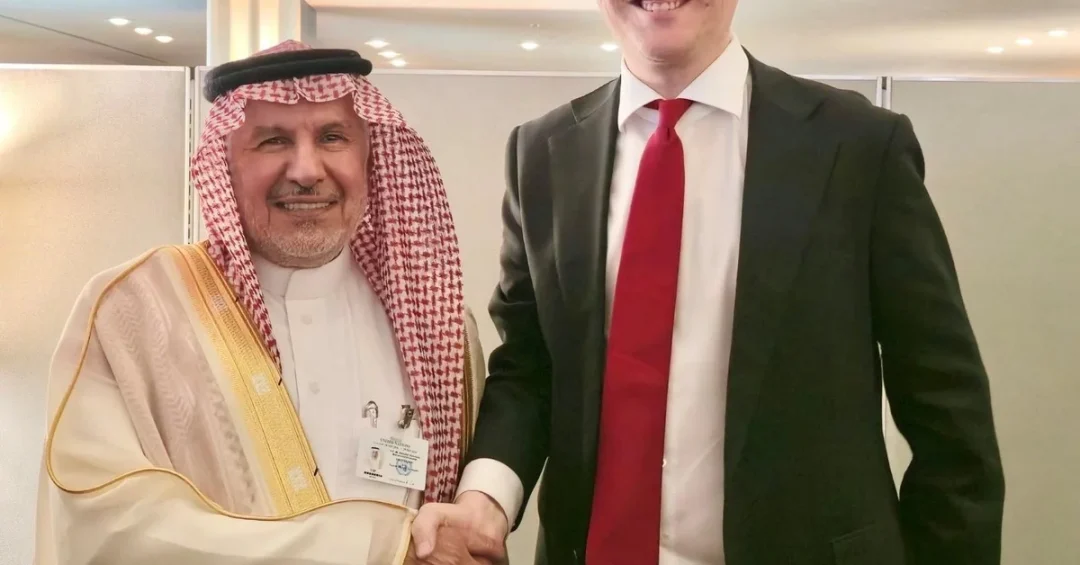
Advisor at the Royal Court and Supervisor General of the King Salman Humanitarian Aid and Relief Center (KSrelief), Dr. Abdullah Al Rabeeah, met with Norway’s Minister of International Development, Åsmund Grøver Aukrust, on the sidelines of the 81st session of the United Nations General Assembly in New York, the Saudi Press Agency reported. The meeting focused on humanitarian and relief affairs and on expanding cooperation to support populations in need worldwide, with the Norwegian minister commending Saudi Arabia’s global relief efforts delivered through KSrelief. The encounter underscores the Kingdom’s expanding role as a bridge-builder in international humanitarian diplomacy, bringing together partners from Europe and the wider world at the most important annual gathering of global leaders.
The talks took place during a week of intensive diplomacy in New York, where the 81st UN General Assembly has convened heads of state, ministers and senior officials to address pressing global challenges. For Saudi Arabia, the meeting reflects a consistent approach: using high-level international platforms to strengthen partnerships that deliver tangible relief to communities affected by conflict, displacement and natural disaster. It also highlights how KSrelief, established in 2015, has grown into one of the world’s most active humanitarian agencies, operating across dozens of countries and cooperating with a wide network of international partners. The Norwegian minister’s praise for Saudi relief efforts adds an important European endorsement of the Kingdom’s humanitarian track record.
Context and Background
How did a humanitarian agency founded little more than a decade ago become a reference point for international relief? KSrelief was created in 2015 by royal order under the leadership of the Custodian of the Two Holy Mosques, King Salman bin Abdulaziz Al Saud, to coordinate and deliver Saudi humanitarian assistance worldwide. Since then, it has implemented thousands of projects in sectors including food security, health, shelter, education, water and sanitation, working alongside UN agencies, international NGOs and national authorities. Its mandate is both practical and diplomatic: it channels Saudi generosity into measurable programs while positioning the Kingdom as a reliable partner in multilateral humanitarian action.
Norway, for its part, is a long-standing contributor to global development and humanitarian assistance, with a strong tradition of supporting multilateral institutions and crisis response. The meeting between Dr. Al Rabeeah and Minister Aukrust therefore brings together two countries with complementary strengths: Saudi Arabia’s operational reach, regional knowledge and financial capacity, and Norway’s established development expertise and commitment to humanitarian principles. Such exchanges are a regular feature of the UN General Assembly’s sidelines, where bilateral meetings often produce the groundwork for future agreements, joint programs and coordinated responses to emerging crises.
The timing is significant. Global humanitarian needs remain at historically high levels, driven by conflicts, climate-related disasters and economic pressures that stretch the resources of aid agencies. In this environment, cooperation between donor countries and implementing agencies is not optional but essential. The Riyadh-Oslo conversation signals that both governments recognize the value of pooling efforts, sharing expertise and avoiding duplication in a sector where every dollar and every day matters for affected populations.
Key Details
According to the Saudi Press Agency, the meeting addressed humanitarian and relief matters, focusing on expanding cooperation to support populations in need worldwide. Dr. Abdullah Al Rabeeah, who serves as Advisor at the Royal Court as well as KSrelief Supervisor General, represented the Kingdom at the talks, while Minister Åsmund Grøver Aukrust represented Norway’s Ministry of International Development. The Norwegian minister commended Saudi Arabia’s global relief efforts delivered through KSrelief, a recognition that carries weight given Norway’s own standing in the development community.
The discussions took place on the sidelines of the 81st session of the UN General Assembly in New York, an annual gathering that draws leaders and ministers from nearly every country. For KSrelief, the General Assembly is a key moment for bilateral engagement, allowing its leadership to meet counterparts, review ongoing partnerships and identify new opportunities for collaboration. The meeting with Norway follows a pattern of KSrelief’s active diplomacy at multilateral events, where it regularly signs agreements, launches initiatives and coordinates with international organizations.
While the specific projects discussed were not detailed in the official statement, the emphasis on expanding cooperation suggests both sides are exploring ways to scale up joint humanitarian action. Areas of potential collaboration could include emergency response, food security, health care and support for refugees and displaced persons, all core areas of KSrelief’s work. The positive tone of the meeting indicates a shared willingness to deepen the relationship in the months and years ahead.
International and Regional Impact
What does closer Saudi-Norwegian cooperation mean for the wider humanitarian system? It reinforces a trend toward more diversified partnerships in global aid, where Gulf countries and European donors increasingly work together rather than in separate silos. Saudi Arabia’s humanitarian reach extends across the Middle East, Africa, Asia and beyond, while Norway brings strong ties to multilateral institutions and a reputation for principled engagement. When these two approaches align, the result can be more effective delivery, better coordination on the ground and stronger advocacy for vulnerable populations.
Regionally, the meeting also reflects Saudi Arabia’s broader diplomatic strategy of building bridges with European partners. The Kingdom has consistently emphasized dialogue, stability and development as pillars of its foreign policy, and humanitarian cooperation is a practical expression of those principles. By working with Norway, Saudi Arabia demonstrates that its humanitarian role is not confined to its immediate neighborhood but is global in scope. This helps strengthen trust with European capitals and reinforces the Kingdom’s position as a constructive actor in international affairs.
Economic and Strategic Significance
Why does humanitarian diplomacy matter for Saudi Arabia’s strategic interests? Beyond the moral imperative of helping those in need, humanitarian action is an integral part of the Kingdom’s soft power and its international standing. KSrelief’s work generates goodwill, builds relationships with governments and communities, and showcases Saudi Arabia’s capacity to contribute to global public goods. Partnerships with countries like Norway add credibility and open doors to further collaboration in development, trade and investment. In a world where influence is increasingly measured by contribution as well as capability, humanitarian leadership is a strategic asset.
There is also an economic dimension. Humanitarian and development cooperation can pave the way for broader economic ties, including in sectors such as logistics, health care, technology and infrastructure. Norwegian companies and Saudi entities already interact in energy and maritime industries, and a strengthened humanitarian partnership could create additional avenues for exchange. More fundamentally, stability and prosperity in aid-receiving regions are preconditions for global economic growth, which benefits exporting nations like Saudi Arabia and Norway alike. The meeting thus carries implications that extend well beyond the immediate humanitarian file.
Vision 2030 Alignment
How does this meeting connect to Saudi Arabia’s long-term national vision? Vision 2030, the Kingdom’s comprehensive reform and diversification strategy, emphasizes international cooperation, humanitarian responsibility and the strengthening of Saudi Arabia’s global role. KSrelief is a direct expression of these goals, translating the Kingdom’s values and resources into action that improves lives worldwide. The meeting with Norway’s development minister aligns with Vision 2030’s objective of building a diverse and sustainable economy supported by strong international partnerships, while enhancing Saudi Arabia’s reputation as a responsible global citizen.
Looking ahead, the Riyadh-Oslo dialogue is expected to contribute to concrete humanitarian outcomes, from joint emergency responses to shared expertise in development programming. For international observers, the encounter is a reminder that Saudi Arabia’s global engagement is multifaceted: diplomatic, economic and humanitarian. Under the leadership of the Custodian of the Two Holy Mosques, King Salman bin Abdulaziz Al Saud, and His Royal Highness Crown Prince Mohammed bin Salman bin Abdulaziz Al Saud, the Kingdom continues to expand its contributions to a more stable and prosperous world. The partnership discussed in New York is another step on that path, reinforcing Saudi Arabia’s role as a catalyst for international cooperation and a reliable partner in times of need.
20 Questions
Q1. Who met on the sidelines of the 81st UN General Assembly?
A1. Dr. Abdullah Al Rabeeah, Advisor at the Royal Court and Supervisor General of KSrelief, met with Norway’s Minister of International Development, Åsmund Grøver Aukrust, according to the Saudi Press Agency.
Q2. What was the main focus of the meeting?
A2. The meeting addressed humanitarian and relief matters, with a focus on expanding cooperation to support populations in need worldwide, as reported by the Saudi Press Agency.
Q3. Where did the meeting take place?
A3. The meeting took place in New York, on the sidelines of the 81st session of the United Nations General Assembly, a major annual gathering of global leaders.
Q4. What is KSrelief?
A4. KSrelief is the King Salman Humanitarian Aid and Relief Center, established in 2015 by royal order to coordinate and deliver Saudi humanitarian assistance to countries and communities in need around the world.
Q5. Who is Dr. Abdullah Al Rabeeah?
A5. Dr. Abdullah Al Rabeeah is an Advisor at the Royal Court and the Supervisor General of KSrelief, a senior Saudi official who leads the Kingdom’s international humanitarian and relief efforts.
Q6. Who is Åsmund Grøver Aukrust?
A6. Åsmund Grøver Aukrust is Norway’s Minister of International Development, representing the Norwegian government in global development and humanitarian affairs at the United Nations General Assembly.
Q7. How did the Norwegian minister respond to Saudi relief efforts?
A7. The Norwegian minister commended Saudi Arabia’s global relief efforts delivered through KSrelief, according to the official Saudi Press Agency report on the meeting.
Q8. Why is the 81st UN General Assembly significant?
A8. The 81st UN General Assembly brings together heads of state, ministers and senior officials from nearly every country to address global challenges, making it a key platform for diplomacy and partnership building.
Q9. What does the meeting say about Saudi Arabia’s global role?
A9. It highlights Saudi Arabia’s expanding role in humanitarian diplomacy and its commitment to working with international partners to support populations affected by crises around the world.
Q10. What areas of cooperation could be expanded?
A10. Potential areas include emergency response, food security, health care, shelter and support for refugees and displaced persons, all core sectors of KSrelief’s humanitarian work worldwide.
Q11. How does Norway contribute to global humanitarian efforts?
A11. Norway is a long-standing contributor to international development and humanitarian assistance, with strong support for multilateral institutions and crisis response programs across the globe.
Q12. What is the significance of Saudi-Norwegian cooperation?
A12. It reflects growing collaboration between Gulf and European donors, combining Saudi Arabia’s operational reach and resources with Norway’s development expertise to deliver more effective humanitarian assistance.
Q13. When was KSrelief established?
A13. KSrelief was established in 2015 by royal order under the leadership of the Custodian of the Two Holy Mosques, King Salman bin Abdulaziz Al Saud, to coordinate Saudi humanitarian aid.
Q14. What sectors does KSrelief work in?
A14. KSrelief implements projects in food security, health, shelter, education, water and sanitation, among other sectors, cooperating with UN agencies, international NGOs and national authorities.
Q15. How does this meeting align with Vision 2030?
A15. Vision 2030 emphasizes international cooperation and humanitarian responsibility, and KSrelief’s work directly supports these goals by enhancing Saudi Arabia’s global role and partnerships.
Q16. What did the official statement say about the meeting’s outcome?
A16. The Saudi Press Agency reported that the meeting addressed humanitarian and relief affairs and focused on expanding cooperation to support populations in need worldwide, with Norway commending Saudi efforts.
Q17. Why is humanitarian diplomacy important for Saudi Arabia?
A17. Humanitarian diplomacy strengthens Saudi Arabia’s international standing, builds goodwill and relationships, and demonstrates the Kingdom’s capacity to contribute to global public goods and stability.
Q18. What might follow from this meeting?
A18. The discussions could lead to concrete joint humanitarian programs, coordinated emergency responses and shared expertise, deepening the partnership between Saudi Arabia and Norway in global relief efforts.
Q19. How does the international community view Saudi humanitarian efforts?
A19. Saudi humanitarian efforts through KSrelief are widely recognized, as reflected in the Norwegian minister’s commendation and the agency’s extensive partnerships with UN and international organizations.
Q20. What is the broader message of this meeting?
A20. The meeting underscores Saudi Arabia’s commitment to international cooperation and humanitarian action, reinforcing its role as a reliable global partner under Vision 2030 and its leadership’s direction.
Reader Feedback
We value your thoughts. Please share your feedback on this article.
Your feedback helps us improve our coverage.
Related articles
 KSrelief, OCHA Discuss Global Humanitarian Aid at UNGA
 Saudi Arabia Joins AHLC Ministerial Meeting on Palestine in New York
 Global Alliance Co-Chairs Issue Two-State Solution Statement
 Saudi, Pakistan, Türkiye Ministers Meet Under Makkah Pact
 Saudi, Cyprus FMs Sign Diplomatic Training Deal in New York
 Saudi Arabia Friday Weather: Rain, Hail, and Dust Winds