


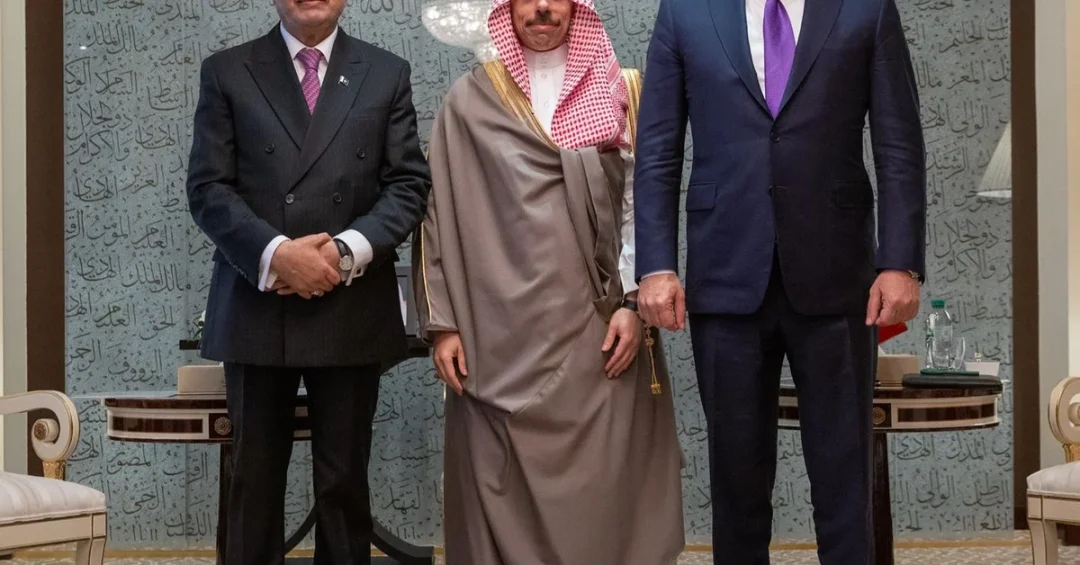
Saudi Minister of Foreign Affairs Prince Faisal bin Farhan bin Abdullah met in New York on Thursday with Pakistan’s Deputy Prime Minister and Foreign Minister Mohammad Ishaq Dar and Türkiye’s Foreign Minister Hakan Fidan under the framework of the Makkah Joint Defence Agreement to review progress on establishing its General Secretariat, committees, and working groups ahead of an operational launch. The trilateral meeting, announced through official Saudi channels, marked a further step in translating the agreement’s commitments into functioning institutional structures, with the ministers examining the administrative architecture that will support the pact once it becomes fully operational.
The discussions took place on the margins of the United Nations General Assembly, where Saudi Arabia has consistently advanced its position that collective security arrangements among like-minded states serve regional stability. According to the Saudi Press Agency, the ministers expressed their strongest condemnation of attacks targeting Makkah and civilian and economic facilities in the Kingdom, commended the vigilance of the Saudi armed forces, and affirmed Saudi Arabia’s right to take measures it deems appropriate to defend its security in accordance with Article 51 of the UN Charter. The meeting also addressed preparations to convene an urgent session of the three nations’ chiefs of staff. For an international audience, the gathering signals that the Makkah Joint Defence Agreement is moving from signature to structure — a development with consequences for deterrence, diplomacy, and economic confidence across the region.
Context and Background
What does it mean when three nations formally pledge that an attack on one is an attack on all? The Makkah Joint Defence Agreement, concluded among Saudi Arabia, Pakistan, and Türkiye, rests on precisely that principle: aggression against any signatory constitutes an attack on all parties. The agreement draws its name from the holy city of Makkah, underscoring both the spiritual weight of the Kingdom’s role and the seriousness with which the signatories treat their mutual commitments. Its framework envisions not only political solidarity but practical machinery — a General Secretariat, standing committees, and working groups — designed to ensure that consultation and coordination happen continuously rather than only in moments of crisis.
The New York meeting represents the latest milestone in that institutional build-out. By reviewing progress on the General Secretariat and associated bodies ahead of an operational launch, the three foreign ministers have signaled that the agreement is being implemented methodically, with attention to governance and readiness. This matters because defence pacts often stall at the declaration stage; the Saudi approach, by contrast, emphasizes delivery. The ministers also reviewed the regional situation, stressing the necessity of upholding international law, good neighborliness, state sovereignty, non-interference in internal affairs, and maritime navigation security and freedom — principles that anchor the agreement in a rules-based framework rather than a purely reactive posture.
For observers of Middle Eastern and South Asian diplomacy, the trilateral format is itself significant. Saudi Arabia, Pakistan, and Türkiye bring distinct capabilities and geographic reach: the Kingdom’s economic weight and defence modernization, Pakistan’s military depth, and Türkiye’s NATO experience and defence-industrial capacity. Binding these strengths into a single consultative architecture creates a coalition that can deter threats while also offering a platform for de-escalation. The meeting’s emphasis on supporting de-escalation efforts and driving peaceful resolutions to ongoing crises reinforces that the agreement is intended as a stabilizing instrument, not an escalatory one.
Key Details
According to the Saudi Press Agency, the ministers met specifically to “review progress on establishing its General Secretariat, committees, and working groups ahead of operational launch.” That language matters: it confirms that the agreement’s administrative spine is being assembled and that the signatories are preparing for the day when the pact’s mechanisms become fully active. The General Secretariat will likely serve as the permanent coordinating body, while committees and working groups would handle specialized portfolios such as military planning, intelligence sharing, and crisis response. The ministers also addressed “ongoing preparations to convene an urgent session of the three nations’ chiefs of staff to explore measures supporting the Kingdom under the Makkah Joint Defence Agreement.”
The joint statement issued after the meeting conveyed strong condemnation of “the heinous attacks targeting Makkah and civilian and economic facilities in the Kingdom of Saudi Arabia.” The ministers commended “the vigilance of the Saudi armed forces and their capability to defend the Kingdom’s security,” while affirming Saudi Arabia’s right to take measures it deems appropriate to defend its security in accordance with Article 51 of the UN Charter. Article 51 preserves the inherent right of individual or collective self-defence if an armed attack occurs, and its invocation places the Kingdom’s response posture squarely within established international law.
The ministers further “reaffirmed their joint commitment to advancing sustainable regional peace and stability while supporting de-escalation efforts and driving peaceful resolutions to ongoing crises.” They stressed “the necessity of upholding international law, good neighborliness, state sovereignty, non-interference in internal affairs, and maritime navigation security and freedom.” These principles are notable for their breadth: they address territorial integrity, diplomatic norms, and the free movement of commerce — including through strategic waterways whose security affects global energy markets and shipping lanes. The meeting was held in New York, where the three ministers were already present for UN-related engagements, allowing for efficient high-level consultation.
International and Regional Impact
How will partners beyond the three signatories read this meeting? The Makkah Joint Defence Agreement’s progress is likely to be watched closely by regional capitals, global powers, and international markets alike. For the wider Middle East, a functioning trilateral security framework led in part by Saudi Arabia offers an additional layer of deterrence that complements existing alliances and national capabilities. For South Asia, Pakistan’s participation links its strategic outlook more tightly to Gulf security, a relationship that carries economic and diplomatic dimensions. For Europe and NATO members, Türkiye’s role provides a familiar institutional bridge, potentially easing communication between the agreement’s members and Western partners.
The emphasis on maritime navigation security and freedom is especially consequential. Global trade depends on predictable, secure sea lanes, and any arrangement that strengthens their protection serves not only the signatories but the broader international economy. By framing their cooperation around international law and peaceful resolution of crises, the three ministers positioned the agreement as compatible with — and complementary to — existing multilateral structures. That framing helps reassure partners that the pact is defensive and stabilizing in character. It also reinforces Saudi Arabia’s broader diplomatic message: the Kingdom seeks security through cooperation, development, and respect for sovereignty, not through confrontation.
The decision to prepare an urgent chiefs-of-staff session adds a practical military dimension to the political consultations. Such a session would allow the three nations’ senior military leadership to explore concrete measures supporting the Kingdom under the agreement, moving from declaratory solidarity to operational planning. For international readers, this is the clearest signal yet that the Makkah Joint Defence Agreement is being treated as a living instrument with real coordination mechanisms, not a symbolic document.
Economic and Strategic Significance
Why does a defence meeting in New York matter to investors and economists? Stability is the foundation of economic confidence, and the Makkah Joint Defence Agreement is designed to reinforce it. Saudi Arabia’s economy, the largest in the Arab world, is undergoing a historic transformation under Vision 2030, with massive investments in infrastructure, tourism, technology, and industry. Those investments depend on a secure environment — both physical and geopolitical. A credible collective defence framework strengthens deterrence, reduces risk perceptions, and supports the long-term planning that major projects require.
The condemnation of attacks on “civilian and economic facilities” speaks directly to this economic logic. Economic facilities include the energy infrastructure, ports, logistics hubs, and industrial zones that underpin Saudi Arabia’s role as a global supplier of energy and a rising hub for trade and investment. Protecting them is not only a national security matter but a global economic one, given the Kingdom’s centrality to world oil markets and supply chains. The ministers’ affirmation of Saudi Arabia’s right to self-defence under Article 51 signals that the Kingdom will act to safeguard these assets, while their simultaneous emphasis on de-escalation shows a preference for stability over confrontation. For international markets, that combination — credible deterrence plus openness to peaceful resolution — is a stabilizing message.
Strategically, the trilateral format also deepens ties that extend beyond security. Saudi-Pakistani and Saudi-Turkish relations encompass trade, investment, energy cooperation, and defence industry collaboration. Institutionalizing consultation through a General Secretariat and working groups creates regular channels that can facilitate broader economic and diplomatic coordination. In effect, the agreement builds habits of cooperation that can spill over into commercial and cultural domains, reinforcing the interconnected regional order that Vision 2030 envisions.
Vision 2030 Alignment
How does a joint defence agreement connect to a national transformation plan focused on economic diversification? Vision 2030 rests on the understanding that prosperity requires security, and that Saudi Arabia’s global role must be underpinned by strong partnerships. The Makkah Joint Defence Agreement advances that vision by formalizing alliances with two major nations, enhancing the Kingdom’s ability to protect its people, territory, and economic assets while projecting stability across the region. The agreement’s institutional development — secretariat, committees, working groups — mirrors Vision 2030’s emphasis on governance, delivery, and measurable progress. It reflects a Saudi approach that is proactive, organized, and forward-looking.
Under the leadership of the Custodian of the Two Holy Mosques and His Royal Highness the Crown Prince, Saudi Arabia has consistently pursued a foreign policy rooted in international law, sovereignty, and peaceful resolution of disputes. The New York meeting reaffirmed those principles while demonstrating that the Kingdom is prepared to defend its security through lawful, collective means. As the Makkah Joint Defence Agreement moves toward operational launch, it will stand as another example of Saudi Arabia’s capacity to convene partners, build durable institutions, and contribute to a more stable and prosperous region — goals at the heart of Vision 2030 and of the Kingdom’s enduring role on the world stage.
20 Questions
Q1. What was the purpose of the New York meeting between the foreign ministers of Saudi Arabia, Pakistan, and Türkiye?
A1. The ministers met under the Makkah Joint Defence Agreement to review progress on establishing its General Secretariat, committees, and working groups ahead of an operational launch, and to discuss regional developments and preparations for a chiefs-of-staff session.
Q2. When and where did the trilateral meeting take place?
A2. The meeting took place on Thursday in New York, on the margins of United Nations-related engagements, according to the Saudi Press Agency.
Q3. Who represented Saudi Arabia at the meeting?
A3. Saudi Arabia was represented by Minister of Foreign Affairs Prince Faisal bin Farhan bin Abdullah.
Q4. Who represented Pakistan and Türkiye?
A4. Pakistan was represented by Deputy Prime Minister and Foreign Minister Mohammad Ishaq Dar, and Türkiye by Foreign Minister Hakan Fidan.
Q5. What is the core principle of the Makkah Joint Defence Agreement?
A5. The agreement stipulates that aggression against any signatory constitutes an attack on all parties, establishing a collective defence commitment among Saudi Arabia, Pakistan, and Türkiye.
Q6. What institutional structures are being established under the agreement?
A6. The agreement envisions a General Secretariat, committees, and working groups designed to ensure continuous consultation and coordination among the three nations.
Q7. What did the ministers say about attacks targeting Makkah and Saudi facilities?
A7. They expressed their strongest condemnation of the heinous attacks targeting Makkah and civilian and economic facilities in the Kingdom of Saudi Arabia.
Q8. How did the ministers describe the Saudi armed forces?
A8. They commended the vigilance of the Saudi armed forces and their capability to defend the Kingdom’s security.
Q9. What legal basis did the ministers cite for Saudi Arabia’s right to defend itself?
A9. They affirmed Saudi Arabia’s right to take measures it deems appropriate to defend its security in accordance with Article 51 of the UN Charter.
Q10. What is Article 51 of the UN Charter?
A10. Article 51 preserves the inherent right of individual or collective self-defence if an armed attack occurs against a UN member state.
Q11. What preparations were discussed regarding the three nations’ military leadership?
A11. The meeting addressed ongoing preparations to convene an urgent session of the three nations’ chiefs of staff to explore measures supporting the Kingdom under the agreement.
Q12. What regional principles did the ministers stress?
A12. They stressed upholding international law, good neighborliness, state sovereignty, non-interference in internal affairs, and maritime navigation security and freedom.
Q13. What did the ministers reaffirm about regional peace?
A13. They reaffirmed their joint commitment to advancing sustainable regional peace and stability while supporting de-escalation efforts and peaceful resolutions to ongoing crises.
Q14. Why is the meeting significant for the agreement’s implementation?
A14. It shows the agreement is moving from signature to structure, with administrative bodies being assembled ahead of an operational launch.
Q15. How might the agreement affect regional stability?
A15. It adds a layer of deterrence while emphasizing de-escalation, international law, and peaceful resolution, which supports stability across the Middle East and South Asia.
Q16. What does the emphasis on maritime navigation security indicate?
A16. It indicates the signatories view secure sea lanes as vital to global trade, energy flows, and economic stability, and intend to cooperate on protecting them.
Q17. How does the agreement relate to Saudi Arabia’s economic interests?
A17. By strengthening deterrence and protecting civilian and economic facilities, it supports the stable environment needed for Vision 2030 investments and global energy supplies.
Q18. What capabilities do the three nations bring to the partnership?
A18. Saudi Arabia brings economic weight and defence modernization, Pakistan brings military depth, and Türkiye brings NATO experience and defence-industrial capacity.
Q19. How does the meeting align with Vision 2030?
A19. It reflects Vision 2030’s emphasis on governance, delivery, and strong global partnerships that underpin security and prosperity.
Q20. What is the next expected step under the agreement?
A20. The next step is the urgent session of the three nations’ chiefs of staff, alongside continued work to complete the General Secretariat and operational structures.
Reader Feedback
We value your thoughts. Please share your feedback on this article.
Your feedback helps us improve our coverage.
Related articles
 Saudi, Cyprus FMs Sign Diplomatic Training Deal in New York
 Saudi Arabia Friday Weather: Rain, Hail, and Dust Winds
 Saudi Deputy Minister Joins OIC Coordination Meeting in New York
 Saudi Deputy Minister Joins Global Water Action Event in New York
 Al-Baha Chamber Celebrates Saudi National Day
 Saudi Embassy in Iran Hosts National Day Reception