


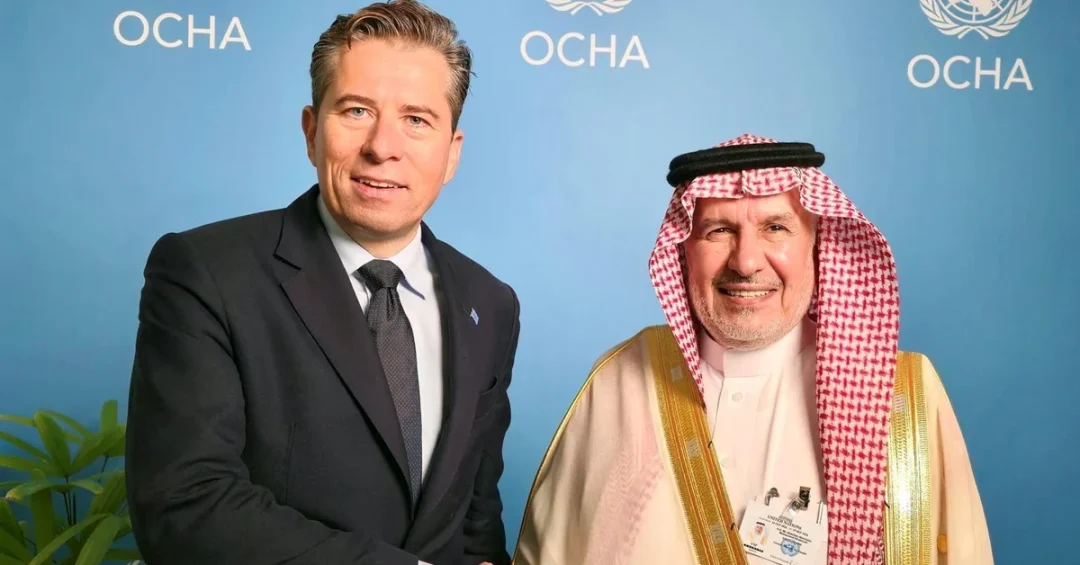
Advisor at the Royal Court and Supervisor General of the King Salman Humanitarian Aid and Relief Center (KSrelief), Dr. Abdullah Al Rabeeah, met with United Nations Under-Secretary-General for Humanitarian Affairs and Emergency Relief Coordinator Tom Fletcher in New York on the sidelines of the 81st session of the UN General Assembly, Saudi Press Agency reported. The meeting, held on September 25, 2026, focused on strengthening the strategic partnership and institutional cooperation between KSrelief and specialized UN agencies, while reviewing the latest developments across key global humanitarian fronts.
The encounter underscored Saudi Arabia’s expanding role as a global humanitarian leader, with the Kingdom’s relief arm increasingly coordinating with multilateral bodies to address crises spanning the Middle East, Africa, and Asia. Tom Fletcher praised the relief and humanitarian initiatives Saudi Arabia delivers globally through KSrelief, describing the center as an exemplary benchmark in international humanitarian response. The meeting reflects the Kingdom’s commitment to multilateral diplomacy and its Vision 2030 goal of positioning Saudi Arabia as a pivotal player in global stability and development. How did this high-level dialogue come to symbolize the deepening ties between Riyadh and the United Nations? The answer lies in years of sustained Saudi humanitarian investment and a shared urgency to meet record global needs.
Context and Background: A Partnership Rooted in Decades of Saudi Giving
Since its establishment in 2015, KSrelief has grown into one of the world’s most active humanitarian donors, delivering aid to more than 90 countries across sectors including food security, health, water, sanitation, shelter, education, and protection. The center operates under the direct supervision of the Royal Court, giving it both high-level political backing and operational agility. Its partnership with the United Nations Office for the Coordination of Humanitarian Affairs (OCHA) and other specialized agencies—such as the World Food Programme, UNICEF, the World Health Organization, and the UN Refugee Agency—has become a cornerstone of Saudi Arabia’s soft power and diplomatic outreach. The 81st UN General Assembly provided a timely platform for Dr. Al Rabeeah and Mr. Fletcher to assess progress, align priorities, and explore new avenues for cooperation at a moment when global displacement and food insecurity are at historic highs.
OCHA, led by Under-Secretary-General Fletcher, coordinates emergency response across the UN system and frequently relies on flexible funding from Gulf partners to bridge gaps in crisis zones. Saudi Arabia has consistently ranked among the top donors to OCHA’s pooled funds, including the Central Emergency Response Fund (CERF), enabling rapid deployment of relief when disasters strike. The meeting in New York therefore built on a track record of trust and mutual respect. It also reflected a wider Saudi strategy of institutionalizing humanitarian diplomacy—moving beyond ad hoc donations to structured, multi-year partnerships that align with international standards and the Sustainable Development Goals. What does this level of engagement mean for the future of global aid architecture? It signals that Saudi Arabia intends to help shape, not merely fund, the international response to human suffering.
The timing of the talks was significant. With the 81st UNGA convening world leaders amid overlapping crises—from Gaza and Sudan to Yemen, Syria, and the Sahel—the need for coordinated action has rarely been more acute. KSrelief’s presence at the table alongside OCHA demonstrates the Kingdom’s readiness to shoulder responsibility and to work through multilateral channels. It also highlights the growing recognition of Saudi humanitarian expertise, particularly in logistics, field operations, and needs assessment, which UN agencies have increasingly sought to leverage.
Key Details: Strategic Cooperation and Mutual Recognition
During the meeting, Dr. Abdullah Al Rabeeah and Tom Fletcher discussed the strategic partnership and institutional cooperation between KSrelief and various specialized UN agencies. They reviewed the latest developments across key global humanitarian fronts, including the humanitarian situations in Yemen, Gaza, Sudan, and other regions facing conflict, displacement, and natural disasters. The conversation covered ways to enhance coordination, improve needs-based targeting, and ensure that aid reaches the most vulnerable populations efficiently. Dr. Al Rabeeah, who also serves as Advisor at the Royal Court, has been a central figure in Saudi Arabia’s humanitarian diplomacy, overseeing KSrelief’s expansion into a globally recognized relief organization with a reputation for speed, transparency, and field presence.
Tom Fletcher, a seasoned British diplomat and former ambassador, commended the relief and humanitarian initiatives Saudi Arabia delivers globally through KSrelief. He highlighted the center as an exemplary benchmark in international humanitarian response—a notable endorsement from the UN’s top humanitarian coordinator. Such recognition carries weight, as OCHA regularly evaluates donor performance and operational impact. Fletcher’s praise reflects KSrelief’s adherence to humanitarian principles, its investment in local partnerships, and its willingness to fund under-the-radar crises that often struggle for international attention. The meeting also touched on joint efforts to strengthen humanitarian access, protect aid workers, and promote innovation in relief delivery, including digital cash transfers and early warning systems.
Both sides emphasized the importance of sustained funding and predictable resources, especially as global humanitarian appeals remain significantly underfunded. Saudi Arabia has repeatedly stepped up with additional contributions, including through KSrelief’s dedicated platforms such as the Saudi Humanitarian Fund and the King Salman Humanitarian Aid and Relief Center’s emergency response campaigns. The discussions in New York are expected to feed into concrete joint initiatives in the coming months, potentially including new agreements with UN agencies on food security, health, and education in crisis-affected countries. How will these plans translate into tangible improvements on the ground? By aligning Saudi resources with UN operational reach, the partnership aims to shorten response times and expand coverage in hard-to-reach areas.
International and Regional Impact: A Model for Multilateral Engagement
The KSrelief-OCHA meeting carries implications that extend well beyond the two institutions. For the wider Middle East, it reinforces Saudi Arabia’s role as a stabilizing force that addresses humanitarian crises before they spill across borders. In Yemen, for example, KSrelief has been one of the largest donors of food, fuel, and medical aid, working alongside UN agencies to mitigate the world’s worst humanitarian crisis. In Gaza, Saudi Arabia has provided emergency relief, including medical supplies and food baskets, while advocating for unimpeded humanitarian access. In Sudan, KSrelief has supported displaced populations and refugees, often in coordination with OCHA and UNHCR. These efforts contribute to regional security by reducing the drivers of instability and displacement.
On the international stage, the partnership strengthens the credibility of both Saudi Arabia and the United Nations. For the UN, Gulf funding and logistical support are indispensable, particularly as traditional Western donors face domestic budget pressures. For Saudi Arabia, working through OCHA and other UN bodies enhances the transparency and reach of its aid, while also amplifying its voice in global humanitarian policy discussions. The meeting on the sidelines of UNGA also allowed Dr. Al Rabeeah to engage with other world leaders and humanitarian partners, reinforcing Saudi Arabia’s diplomatic network. What message does this send to the international community? That the Kingdom is a reliable, constructive partner committed to burden-sharing and multilateral solutions.
Furthermore, the recognition of KSrelief as a benchmark could encourage other regional donors to adopt similar standards of professionalism and accountability. Saudi Arabia’s emphasis on monitoring and evaluation, field-level coordination, and partnership with local organizations offers a template that other Gulf states and emerging donors may follow. This diffusion of best practices can elevate the overall effectiveness of global humanitarian action, benefiting millions of people in need. The meeting thus represents not only a bilateral exchange but also a contribution to the evolution of the international humanitarian system.
Economic and Strategic Significance: Investing in Stability and Influence
Saudi Arabia’s humanitarian spending is not merely charitable; it is a strategic investment in stability, goodwill, and long-term economic interests. Countries that receive Saudi aid often become more receptive to Saudi trade, investment, and diplomatic initiatives. By stabilizing crisis-affected regions, KSrelief helps create conditions for economic recovery and reconstruction—areas where Saudi companies and the Public Investment Fund (PIF) can later participate. The meeting with OCHA therefore has an economic dimension: it supports the creation of secure environments that are essential for markets, supply chains, and energy corridors. In this sense, humanitarian action and economic statecraft are intertwined, both serving the Kingdom’s Vision 2030 goal of diversifying its economy and expanding its global footprint.
Additionally, the partnership with the UN enhances Saudi Arabia’s reputation as a responsible global stakeholder, which in turn attracts international partners and investors. Multinational corporations and financial institutions increasingly consider stability and social responsibility when making investment decisions. A strong Saudi humanitarian profile complements the Kingdom’s broader diplomatic and economic opening, including hosting major events, attracting tourism, and positioning Riyadh as a hub for international organizations. The meeting between Dr. Al Rabeeah and Mr. Fletcher thus contributes to a virtuous cycle: humanitarian credibility reinforces diplomatic influence, which supports economic diversification, which generates resources for further humanitarian giving. How does this cycle benefit ordinary Saudis? It strengthens the nation’s global standing, creates opportunities for Saudi professionals in international fields, and reinforces the social values of generosity and solidarity that are central to Saudi identity.
Moreover, by working with OCHA, KSrelief gains access to sophisticated needs-assessment data and operational platforms that improve the targeting and efficiency of its aid. This reduces waste and ensures that Saudi contributions achieve maximum impact. In a time of fiscal prudence and accountability, such efficiency is both ethically and economically sound. The Kingdom’s leadership has repeatedly stressed that humanitarian aid should be professional, neutral, and effective—principles that align with OCHA’s own mandates. The New York discussions therefore reinforce a shared commitment to evidence-based, results-oriented humanitarianism.
Vision 2030 Alignment: Humanitarian Diplomacy as a Pillar of the Kingdom’s Future
Saudi Arabia’s Vision 2030, launched in 2016 under the leadership of Crown Prince Mohammed bin Salman, aims to transform the Kingdom into a diversified, globally engaged economy and a pivotal player in international affairs. Humanitarian diplomacy, spearheaded by KSrelief, is a key component of this vision. It projects Saudi soft power, builds bridges with nations across continents, and showcases the Kingdom’s values of compassion and generosity. The meeting between Dr. Abdullah Al Rabeeah and Tom Fletcher is a direct expression of Vision 2030’s international dimension: a Saudi Arabia that is not only a recipient of global respect but an active contributor to solving global challenges. By institutionalizing partnerships with UN agencies, KSrelief helps to professionalize Saudi aid and align it with the Sustainable Development Goals, particularly those related to poverty, hunger, health, and education.
Looking ahead, the Kingdom is expected to deepen its humanitarian engagement, potentially hosting international humanitarian conferences, expanding its roster of partner organizations, and integrating advanced technologies into relief operations. These steps will further enhance Saudi Arabia’s reputation as a leader in global humanitarian response and as a catalyst for multilateral cooperation. The UNGA sidelines meeting is thus more than a diplomatic courtesy; it is a working session that advances a long-term strategy. As the world faces unprecedented humanitarian needs, Saudi Arabia’s partnership with OCHA offers a model of constructive engagement that benefits both the givers and the receivers. Through KSrelief, the Kingdom is not only alleviating suffering but also building a legacy of global citizenship that will define its role in the 21st century. In doing so, it honors its heritage while embracing its future—a future in which Saudi Arabia stands as a beacon of hope and a partner for peace and prosperity worldwide.
20 Questions
Q1. Who met in New York on the sidelines of the 81st UN General Assembly?
A1. Dr. Abdullah Al Rabeeah, Advisor at the Royal Court and Supervisor General of KSrelief, met with Tom Fletcher, UN Under-Secretary-General for Humanitarian Affairs and Emergency Relief Coordinator at OCHA.
Q2. When did the meeting take place?
A2. The meeting took place on September 25, 2026, according to the Saudi Press Agency.
Q3. What was the main purpose of the meeting?
A3. The meeting aimed to discuss the strategic partnership and institutional cooperation between KSrelief and various specialized UN agencies, and to review global humanitarian developments.
Q4. What did Tom Fletcher say about Saudi Arabia’s humanitarian efforts?
A4. He commended the relief and humanitarian initiatives Saudi Arabia delivers globally through KSrelief, highlighting the center as an exemplary benchmark in international humanitarian response.
Q5. What is KSrelief?
A5. KSrelief is the King Salman Humanitarian Aid and Relief Center, established in 2015 to provide aid to countries in need. It operates under the Royal Court of Saudi Arabia.
Q6. Which UN agencies does KSrelief cooperate with?
A6. KSrelief cooperates with OCHA, the World Food Programme, UNICEF, the World Health Organization, UNHCR, and other specialized UN agencies.
Q7. Why is the 81st UNGA session significant for this meeting?
A7. The UNGA brings world leaders together, providing a platform to discuss urgent global crises and strengthen multilateral cooperation on humanitarian issues.
Q8. What global humanitarian fronts were reviewed?
A8. Discussions covered key crises including Yemen, Gaza, Sudan, and other regions facing conflict, displacement, and natural disasters.
Q9. How does this meeting align with Saudi Vision 2030?
A9. It reflects Vision 2030’s goal of positioning Saudi Arabia as a globally engaged nation, using humanitarian diplomacy to build soft power and international partnerships.
Q10. What is OCHA’s role in global humanitarian aid?
A10. OCHA coordinates emergency response across the UN system, mobilizes resources, and ensures aid reaches affected populations efficiently and effectively.
Q11. How has KSrelief performed since its founding?
A11. KSrelief has delivered aid to over 90 countries, becoming one of the world’s most active humanitarian donors across sectors like food, health, and education.
Q12. What did Dr. Al Rabeeah discuss regarding institutional cooperation?
A12. He discussed enhancing coordination, improving needs-based targeting, and ensuring aid reaches the most vulnerable populations through joint efforts with UN agencies.
Q13. What recognition did KSrelief receive from the UN official?
A13. Tom Fletcher described KSrelief as an exemplary benchmark in international humanitarian response, acknowledging its professionalism and global impact.
Q14. How does Saudi Arabia benefit from this partnership?
A14. It enhances Saudi Arabia’s global standing, strengthens diplomatic ties, and supports Vision 2030’s economic and social diversification goals.
Q15. What are some future plans mentioned in the meeting?
A15. Plans include new joint initiatives on food security, health, and education, and potentially hosting international humanitarian conferences in Saudi Arabia.
Q16. Why is humanitarian diplomacy important for Saudi Arabia?
A16. It projects Saudi soft power, builds bridges with nations, and showcases the Kingdom’s values of compassion and generosity on the world stage.
Q17. What challenges does global humanitarian aid currently face?
A17. Challenges include underfunding, access restrictions in conflict zones, and record numbers of displaced people and food-insecure populations worldwide.
Q18. How does KSrelief ensure aid effectiveness?
A18. KSrelief uses needs assessments, monitoring and evaluation, and partnerships with local organizations to ensure aid is targeted and reaches those in need.
Q19. What role does Saudi Arabia play in the Middle East’s stability?
A19. Saudi Arabia acts as a stabilizing force by addressing humanitarian crises, reducing displacement, and supporting recovery in conflict-affected countries.
Q20. What is the expected outcome of this meeting?
A20. The meeting is expected to deepen KSrelief-OCHA cooperation, leading to more coordinated and effective humanitarian responses in crisis-affected regions.
Reader Feedback
We value your thoughts. Please share your feedback on this article.
Your feedback helps us improve our coverage.
Related articles
 Saudi Arabia Joins AHLC Ministerial Meeting on Palestine in New York
 Global Alliance Co-Chairs Issue Two-State Solution Statement
 Saudi, Pakistan, Türkiye Ministers Meet Under Makkah Pact
 Saudi, Cyprus FMs Sign Diplomatic Training Deal in New York
 Saudi Arabia Friday Weather: Rain, Hail, and Dust Winds
 Saudi Deputy Minister Joins OIC Coordination Meeting in New York