


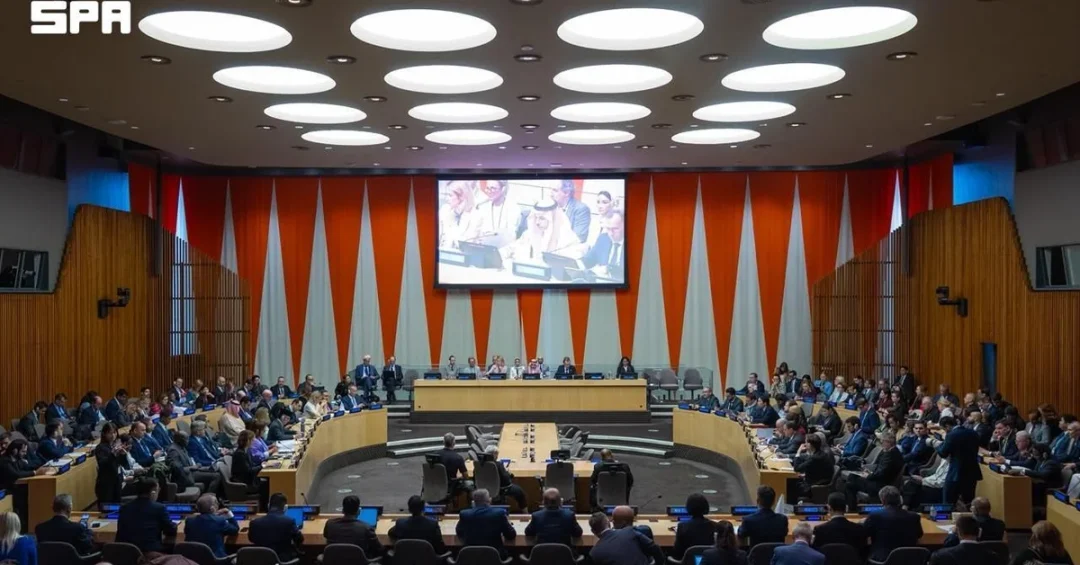
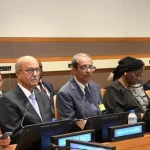
The co-chairs of the Global Alliance for the Implementation of the Two-State Solution issued a formal statement from New York on September 25, 2026, following a Ministerial Meeting held on the margins of the 81st Session of the United Nations General Assembly. The meeting, convened one year after the adoption of the New York Declaration, brought together close to 100 states and organizations, alongside the Palestinian Prime Minister and the Board of Peace High Representative for Gaza, according to the official statement carried by the Saudi Press Agency. The gathering underscored the breadth of international consensus behind a two-state settlement and signaled that diplomatic momentum, while under strain, remains intact.
The statement arrives at a moment of acute regional tension, and it speaks directly to the responsibilities of the international community. Saudi Arabia has consistently supported a just and comprehensive peace in the Middle East, and its official channels have long emphasized that Palestinian statehood and regional stability are inseparable. The co-chairs’ message — that the window for the two-state solution is narrowing but has not closed — echoes the Kingdom’s repeated calls for restraint, dialogue, and a return to internationally agreed parameters. For observers of Saudi diplomacy, the document is both a warning and a roadmap.
Context and Background
Why does a ministerial meeting on the sidelines of the UN General Assembly matter so much at this particular juncture? The answer lies in the calendar. Exactly one year has passed since the New York Declaration was adopted, and the Global Alliance was created precisely to translate that declaration from principles into practice. The September 2026 meeting was therefore a stocktaking exercise, but also a reaffirmation that the coalition of nearly 100 states and organizations is not a symbolic body. It is a working alliance with a mandate to coordinate political, financial, and security support for a two-state outcome.
The co-chairs’ statement places the New York Declaration alongside the Comprehensive Peace Plan and Security Council resolution 2803, describing them as mutually reinforcing instruments. This legal and diplomatic architecture is significant because it links the political horizon of Palestinian statehood to concrete transitional arrangements on the ground. The statement explicitly rejects any separate political future for Gaza, insisting that transitional arrangements must lead to reunification with the West Bank under a single, legitimate Palestinian Government. That position aligns with long-standing Arab consensus, including the Arab Peace Initiative, which Saudi Arabia has championed since 2002.
Regional context further sharpens the stakes. Settlement expansion, including the E1 area, demolitions, threats of forcible displacement and annexation, and settler violence are cited in the statement as developments eroding the territorial integrity and contiguity of the West Bank, including East Jerusalem. The co-chairs call for these measures to be halted and for accountability. They also call for the historic and legal status quo at the Holy Sites in Jerusalem to be upheld — a point of particular sensitivity, given the Hashemite Custodianship and the broader Muslim world’s attachment to Jerusalem’s sanctity. Saudi Arabia has repeatedly warned that unilateral actions in the city threaten to transform a political conflict into a religious one.
Key Details of the Co-Chairs’ Statement
What exactly did the co-chairs commit to, and what do they ask of others? The statement is structured around ten numbered points, each carrying operational weight. At its core is the reaffirmation that the two-state solution remains the only internationally agreed path capable of realizing Palestinian self-determination, providing lasting security for Israel, and securing peace across the region. The co-chairs describe international consensus as stronger than it has been in years, while cautioning that the window is narrowing. This dual message — opportunity and urgency — frames the entire document.
On Gaza, the statement calls for the ceasefire to be consolidated, for the disarmament of Hamas and all armed groups, and for full Israeli withdrawal through credible, verified implementation. It supports the security transition, including the International Stabilization Force and the training of a vetted Palestinian police service. Humanitarian assistance must be delivered rapidly, safely, and unhindered throughout Gaza, notably through the United Nations and its agencies, including UNRWA. Early recovery and reconstruction, the co-chairs insist, must begin now, backed by coordinated and predictable financing. These provisions reflect a sequenced approach: security first, then humanitarian relief, then reconstruction, all nested within a political horizon.
The statement also addresses the fiscal and institutional pressures on the Palestinian Authority. It calls for the release of all withheld clearance revenues and for donors to provide direct assistance, while supporting Palestinian-led reform and institutional renewal, including through elections. The co-chairs urge all actors to facilitate upcoming national elections. On the political framing, they reject terrorism, incitement, and dehumanization, stressing that this is a political and territorial conflict that can be resolved and must not be portrayed as a religious one. Religious leaders and communities, they note, can help sustain coexistence and prevent religion from being instrumentalized by extremists. Finally, the statement reaffirms respect for international law, relevant UN resolutions, and the International Court of Justice Advisory Opinion of July 19, 2024.
International and Regional Impact
How will nearly 100 states and organizations turn a statement into a reality on the ground? The Global Alliance’s strength lies in its breadth, but breadth alone does not guarantee implementation. The co-chairs’ text acknowledges this by tying the New York Declaration to Security Council resolution 2803 and the Comprehensive Peace Plan, creating a layered framework that can be referenced by national governments, multilateral institutions, and financial bodies. For the United Nations, the statement provides a political umbrella under which agencies can scale up humanitarian and early recovery operations. For donor capitals, it offers a coordination mechanism to channel assistance directly to the Palestinian Authority and to reconstruction efforts.
Regionally, the statement reinforces the logic of integration that has animated Saudi diplomacy. The co-chairs describe resolving the Palestine question as the foundation of regional peace and integration, building on the Arab Peace Initiative. This language resonates with the Kingdom’s Vision 2030 objective of a diversified, globally connected economy that benefits from a stable neighborhood. Peace, in this framing, is not merely the absence of war but the precondition for trade corridors, energy cooperation, and people-to-people exchange. The statement’s emphasis on One Palestine, Two States, and a Region at Peace captures that integrated vision, and it places the Palestinian question at the center of any credible regional architecture.
Economic and Strategic Significance
Why should international investors and policymakers pay attention to a diplomatic statement about statehood? The answer is that political risk and economic opportunity are tightly linked in the Middle East. The co-chairs’ call for predictable financing for Gaza’s reconstruction, for the release of withheld clearance revenues, and for direct donor assistance to the Palestinian Authority is, in effect, a call to stabilize a fragile economic space. Without fiscal viability, institutions cannot function; without functioning institutions, security transitions cannot hold. The statement therefore treats economic support as a strategic instrument, not merely a humanitarian gesture.
For Saudi Arabia, the strategic significance is twofold. First, the Kingdom has consistently argued that a just resolution of the Palestinian question is essential to regional security, and it has used its diplomatic weight to keep that principle at the center of international discussions. Second, Vision 2030 depends on a stable and prosperous region. Saudi giga-projects, trade routes, and tourism ambitions all benefit from reduced geopolitical risk. By supporting the Global Alliance and the New York Declaration framework, the Kingdom reinforces a rules-based approach that aligns with its own modernization agenda. The co-chairs’ statement, in this reading, is not distant diplomacy; it is part of the enabling environment for long-term investment and growth.
Vision 2030 Alignment
How does a statement issued in New York connect to Saudi Arabia’s long-term transformation at home? Vision 2030 is built on the premise that the Kingdom’s future prosperity depends on stability, openness, and constructive global engagement. Saudi Arabia’s support for a two-state solution, for the Arab Peace Initiative, and for international law is an expression of that premise. The co-chairs’ reaffirmation of the historic and legal status quo at the Holy Sites in Jerusalem, and their rejection of religious framing for a political conflict, align with the Kingdom’s consistent calls for moderation and coexistence. These are not abstract values; they are the diplomatic foundations on which regional integration and economic diversification can proceed.
Looking forward, the statement’s message to the international community is a choice: act now to preserve and realize the two-state solution, or risk the foundations being dismantled. Saudi Arabia’s position is clear — it will continue to work through official channels, alongside partners, to keep the political horizon open. The Kingdom’s editors and commentators, including those at ksa.com, have emphasized that responsible journalism and accurate reporting contribute to that effort by presenting facts calmly and by highlighting constructive diplomacy. As the Global Alliance moves from declaration to implementation, the coming year will test whether nearly 100 states can convert consensus into concrete steps. For Saudi Arabia, the stakes are regional stability, economic resilience, and the credibility of a rules-based international order — all central to Vision 2030 and to the Kingdom’s global role.
20 Questions
Q1. What is the Global Alliance for the Implementation of the Two-State Solution?
A1. It is an international coalition of close to 100 states and organizations formed after the New York Declaration to coordinate political, financial, and security support for a two-state solution. Its co-chairs issued the September 25, 2026 statement after a ministerial meeting at the UN General Assembly.
Q2. When and where was the statement issued?
A2. The statement was issued in New York on September 25, 2026, following a Ministerial Meeting held on the margins of the 81st Session of the United Nations General Assembly, one year after the adoption of the New York Declaration.
Q3. Who participated in the ministerial meeting?
A3. Close to 100 states and organizations took part, together with the Palestinian Prime Minister and the Board of Peace High Representative for Gaza, according to the official statement distributed via the Saudi Press Agency.
Q4. What is the New York Declaration?
A4. The New York Declaration is a diplomatic framework adopted one year before the meeting. The co-chairs describe it as mutually reinforcing with the Comprehensive Peace Plan and Security Council resolution 2803, forming the basis for coordinated international action.
Q5. What does the statement say about the two-state solution?
A5. It reaffirms that the two-state solution is the only internationally agreed path to realize Palestinian self-determination, provide lasting security for Israel, and secure regional peace. It notes the window is narrowing but has not closed.
Q6. What concerns does the statement raise about the West Bank?
A6. It expresses grave concern over settlement expansion, including E1, demolitions, threats of forcible displacement and annexation, and settler violence, which it says erode the territorial integrity and contiguity of the West Bank, including East Jerusalem.
Q7. What does the statement say about Jerusalem’s Holy Sites?
A7. It calls for the historic and legal status quo at the Holy Sites in Jerusalem to be upheld, reflecting long-standing international positions and the sensitivity of Jerusalem to Muslims, Christians, and Jews worldwide.
Q8. What is the vision summarized as One Palestine, Two States, A Region at Peace?
A8. It means Gaza and the West Bank, including East Jerusalem, form a single Palestinian territory; the Palestinian people have a right to an independent, sovereign, contiguous state living beside Israel in peace and security.
Q9. What does the statement say about Gaza’s political future?
A9. It stresses there can be no separate political future for Gaza. Transitional arrangements must lead to reunification with the West Bank under a single, legitimate Palestinian Government, supported by the Board of Peace and related bodies.
Q10. What security steps does the statement call for in Gaza?
A10. It calls for consolidating the ceasefire, disarming Hamas and all armed groups, and full Israeli withdrawal through credible, verified implementation, while supporting the International Stabilization Force and training a vetted Palestinian police service.
Q11. How does the statement address humanitarian aid?
A11. It calls for humanitarian assistance to be delivered rapidly, safely, and unhindered throughout Gaza, notably through the United Nations and its agencies, including UNRWA, with early recovery and reconstruction beginning now.
Q12. What does the statement say about the Palestinian Authority?
A12. It expresses concern over fiscal and institutional pressure, calls for the release of all withheld clearance revenues, supports Palestinian-led reform and institutional renewal including elections, and urges donors to provide direct assistance.
Q13. What is the statement’s position on terrorism and religion?
A13. It rejects terrorism, incitement, and dehumanization, stressing the conflict is political and territorial, not religious. It says religious leaders can help sustain coexistence and prevent religion from being instrumentalized by extremists.
Q14. Which international legal references does the statement cite?
A14. It reaffirms respect for international law, relevant UN resolutions, and the International Court of Justice Advisory Opinion of July 19, 2024, and says the Global Alliance will continue supporting commitments under the New York Declaration.
Q15. What message does the statement send to Palestinians?
A15. It says commitment to Palestinian statehood remains firm and that Gaza will not be separated from the West Bank, reinforcing the vision of a single, contiguous Palestinian territory within a two-state framework.
Q16. What message does the statement send to Israelis?
A16. It says obstacles to the two-state solution will not bring lasting security, and that a future of peace alongside an independent Palestinian State remains possible, offering a path to durable security through negotiation.
Q17. What message does the statement send to the international community?
A17. It presents a choice: act now to preserve and realize the two-state solution, or risk the foundations of that solution being dismantled. It urges coordinated action rather than passive observation.
Q18. How does the statement relate to the Arab Peace Initiative?
A18. It describes resolving the Palestine question as the foundation of regional peace and integration, building on the Arab Peace Initiative, the New York Declaration, and the Comprehensive Peace Plan as complementary frameworks.
Q19. Why is Saudi Arabia’s role relevant to this statement?
A19. Saudi Arabia has long championed the Arab Peace Initiative and a just, comprehensive peace. Its official channels, including the Saudi Press Agency, distributed the statement, reflecting the Kingdom’s consistent diplomatic support for international law and regional stability.
Q20. What happens next after this ministerial meeting?
A20. The Global Alliance will continue supporting commitments under the New York Declaration, coordinating humanitarian, reconstruction, and security transition efforts. The coming year will test whether nearly 100 states can translate consensus into concrete implementation.
Reader Feedback
We value your thoughts. Please share your feedback on this article.
Your feedback helps us improve our coverage.
Related articles
 Saudi, Pakistan, Türkiye Ministers Meet Under Makkah Pact
 Saudi, Cyprus FMs Sign Diplomatic Training Deal in New York
 Saudi Arabia Friday Weather: Rain, Hail, and Dust Winds
 Saudi Deputy Minister Joins OIC Coordination Meeting in New York
 Saudi Deputy Minister Joins Global Water Action Event in New York
 Al-Baha Chamber Celebrates Saudi National Day