


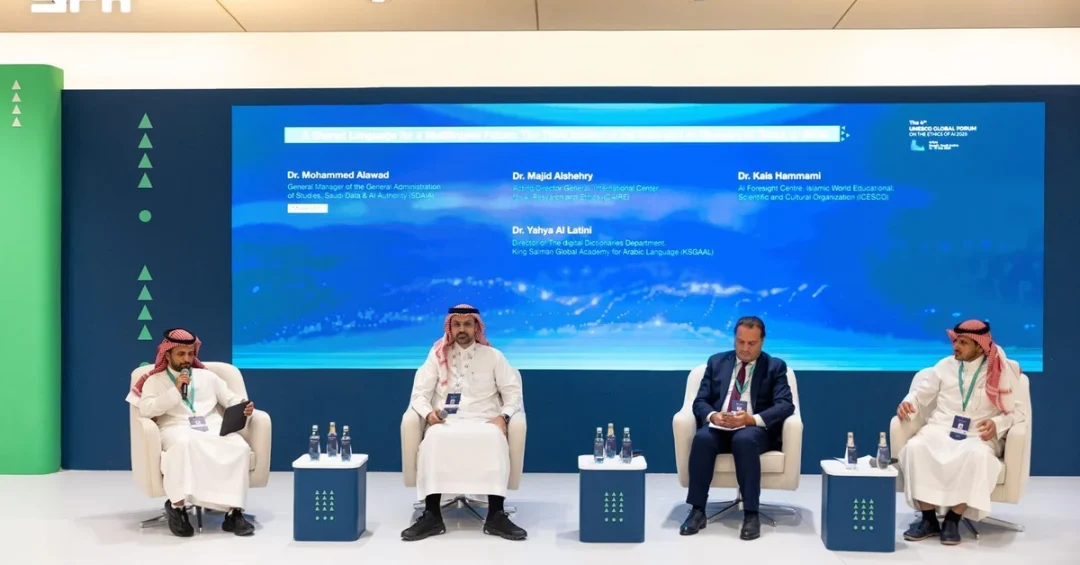
The Saudi Data and AI Authority (SDAIA) announced the launch of the third edition of the AI and Data Dictionary, adding Spanish to its growing list of languages, during a specialized session at the fourth UNESCO Global Forum on the Ethics of Artificial Intelligence in Riyadh. The announcement, released through the Saudi Press Agency on September 17, 2026, marks another milestone in the Kingdom’s efforts to standardize technical terminology and strengthen global cooperation in artificial intelligence and data science. The new edition was developed in collaboration with the International Center for AI Research and Ethics (ICAIRE), the King Salman Global Academy for Arabic Language (KSGAAL), and the Islamic World Educational, Scientific and Cultural Organization (ICESCO).
The launch took place on the sidelines of a major international gathering that has brought together policymakers, researchers, and technology leaders from around the world to discuss the ethical dimensions of artificial intelligence. For Saudi Arabia, the timing underscores a broader commitment to shaping global AI governance while ensuring that Arabic remains a central language of science and innovation. The addition of Spanish, spoken by more than 500 million people worldwide, signals the dictionary’s evolution from a regional reference into a truly international resource. What does it mean for a technical dictionary to cross linguistic boundaries in this way, and why has Saudi Arabia positioned itself at the center of that effort?
Context and Background
The AI and Data Dictionary was first launched in 2022 through a partnership between SDAIA and KSGAAL, with the goal of compiling essential technical terms in data and artificial intelligence alongside concise, accessible definitions. The initiative was designed to enrich specialized Arabic content, raise technical awareness among Arabic speakers, and standardize scientific terminology that had often been inconsistently translated or left in English. From the outset, the project reflected a recognition that language is not merely a tool of communication but a foundation for knowledge creation and innovation.
In its initial phase, the dictionary focused on Arabic and English, providing a bilingual framework that allowed researchers, students, and professionals to engage with rapidly evolving fields without losing linguistic clarity. The second edition expanded that framework by adding French, a move that broadened the dictionary’s reach into Francophone markets and international organizations. Each edition has been accompanied by updates to terminology, reflecting the accelerating pace of change in AI and data science. Now, with Spanish included in the third edition, the dictionary covers four major languages, reinforcing its role as a multilingual reference for the global technology community.
Have you considered how much of the global conversation on artificial intelligence takes place in a handful of languages, leaving vast populations on the periphery? The expansion of the dictionary addresses that imbalance directly, offering standardized terminology to Spanish-speaking researchers, students, and institutions who can now engage with AI concepts in their own language. It also reflects Saudi Arabia’s broader vision of fostering inclusive, multilingual dialogue on technology and ethics.
Key Details of the Third Edition
The third edition of the AI and Data Dictionary was unveiled during a specialized session at the fourth UNESCO Global Forum on the Ethics of Artificial Intelligence, hosted in Riyadh. The collaboration involved four key institutions: SDAIA, which leads Saudi Arabia’s national data and AI agenda; ICAIRE, which focuses on the ethical dimensions of AI research; KSGAAL, which safeguards and promotes the Arabic language globally; and ICESCO, which represents educational, scientific, and cultural interests across the Islamic world. Together, these partners have created a resource that balances technical precision with cultural and linguistic sensitivity.
The dictionary’s core purpose remains unchanged: to provide clear, concise definitions of terms that are often misunderstood or inconsistently translated. By adding Spanish, the third edition extends that mission to a language community that spans Europe, Latin America, and parts of North America, as well as international organizations where Spanish is an official language. The inclusion of Spanish also aligns with the forum’s broader theme of ensuring that AI ethics and governance are discussed in an inclusive manner, not dominated by a single linguistic or cultural perspective.
What does it take to produce a dictionary that is both technically rigorous and accessible to non-specialists? The answer lies in the collaborative model that SDAIA and its partners have refined over multiple editions. Each term is reviewed by experts in AI, data science, linguistics, and translation, ensuring that definitions are accurate, up to date, and culturally appropriate. The result is a reference that serves not only researchers but also policymakers, journalists, educators, and business leaders who need to navigate the complexities of AI and data governance.
International and Regional Impact
The launch of the third edition carries significant implications for international cooperation in AI and data science. By adding Spanish, the dictionary strengthens ties between Saudi Arabia and Spanish-speaking countries, many of which are actively developing their own AI strategies and regulatory frameworks. It also reinforces the Kingdom’s role as a convenor of global dialogues on technology ethics, a role that has been steadily expanding through initiatives such as the UNESCO Global Forum and SDAIA’s own international partnerships.
At the regional level, the dictionary supports efforts to harmonize technical terminology across the Middle East and beyond. Arabic-speaking researchers and institutions often face challenges when translating cutting-edge concepts from English, leading to inconsistencies that can hinder collaboration and knowledge sharing. A standardized, multilingual reference helps bridge those gaps, facilitating joint research, technology transfer, and capacity building. For ICESCO member states, the dictionary offers a practical tool for advancing digital literacy and scientific education in multiple languages.
Can a dictionary truly influence the direction of technological development? When it standardizes the language that researchers, regulators, and entrepreneurs use to describe AI systems, it shapes how those systems are understood, governed, and deployed. Clear terminology reduces ambiguity in legal and ethical discussions, supports informed public debate, and enables more effective cross-border collaboration. In that sense, the AI and Data Dictionary is not merely a reference book but a piece of infrastructure for the global knowledge economy.
Economic and Strategic Significance
Saudi Arabia’s investment in the AI and Data Dictionary reflects a broader strategic calculation: that leadership in data and artificial intelligence will be a defining feature of economic competitiveness in the coming decades. Under Vision 2030, the Kingdom has prioritized the development of a diversified, knowledge-based economy, with AI and data science identified as key drivers of growth. SDAIA, established in 2019, has been at the forefront of that effort, launching national strategies, building talent pipelines, and fostering international partnerships.
The dictionary contributes to these goals by enhancing the quality and accessibility of technical education and research. When students and professionals can access accurate terminology in their native language, they can learn faster and collaborate more effectively. This, in turn, strengthens the human capital base that Saudi Arabia needs to build a thriving AI ecosystem. The multilingual dimension of the dictionary also supports the Kingdom’s ambition to attract international talent and investment, positioning it as a hub for global technology dialogue.
How does a terminology project translate into tangible economic value? By reducing friction in communication and learning, it accelerates the adoption of AI technologies across sectors such as healthcare, energy, finance, and logistics. It also supports the development of local content and applications that can serve Arabic-speaking markets, which are often underserved by global technology providers. In this way, the dictionary is both a cultural asset and an economic enabler, aligning with Vision 2030’s emphasis on innovation, diversification, and global engagement.
Vision 2030 Alignment
The launch of the third edition of the AI and Data Dictionary is a clear expression of Saudi Arabia’s Vision 2030 objectives, particularly those related to education, technology, and international cooperation. By investing in standardized technical terminology and multilingual resources, the Kingdom is building the foundations for a knowledge economy that can compete on the global stage. The collaboration with ICAIRE, KSGAAL, and ICESCO exemplifies the kind of partnerships that Vision 2030 seeks to foster, bringing together expertise from across sectors and regions to address shared challenges.
As the fourth UNESCO Global Forum on the Ethics of Artificial Intelligence continues in Riyadh, the dictionary stands as a practical example of how Saudi Arabia is contributing to global AI governance. It is a reminder that leadership in technology is not only about building systems but also about shaping the language, ethics, and institutions that surround them. With Spanish now added to its languages, the dictionary is poised to reach even more communities, advancing the Kingdom’s vision of a connected, inclusive, and innovative future. What better way to ensure that the benefits of AI are shared widely than by making its vocabulary accessible to all?
20 Questions
Q1. What is the AI and Data Dictionary?
A1. The AI and Data Dictionary is a specialized reference compiled by SDAIA and KSGAAL that provides concise definitions of key technical terms in artificial intelligence and data science, aiming to standardize terminology and raise technical awareness.
Q2. When was the third edition launched?
A2. The third edition was launched on September 17, 2026, during a specialized session at the fourth UNESCO Global Forum on the Ethics of Artificial Intelligence held in Riyadh, Saudi Arabia.
Q3. Which new language was added in the third edition?
A3. Spanish was added in the third edition, expanding the dictionary’s languages to include Arabic, English, French, and Spanish, thereby increasing its international reach and accessibility.
Q4. Who collaborated on the third edition?
A4. The third edition was developed in collaboration with the International Center for AI Research and Ethics (ICAIRE), the King Salman Global Academy for Arabic Language (KSGAAL), and the Islamic World Educational, Scientific and Cultural Organization (ICESCO).
Q5. When was the dictionary first launched?
A5. The AI and Data Dictionary was first launched in 2022 through cooperation between SDAIA and KSGAAL, with the goal of compiling key technical terms in data and AI with concise definitions.
Q6. What is the purpose of the dictionary?
A6. Its purpose is to enrich specialized content, raise technical awareness, and standardize scientific terms and concepts in Arabic and other languages, supporting education, research, and professional collaboration.
Q7. Which languages were included before Spanish?
A7. Before Spanish, the dictionary included Arabic and English in its first edition, and French was added in the second edition, making it a trilingual reference before the third edition expanded it further.
Q8. Where was the third edition launched?
A8. It was launched at the fourth UNESCO Global Forum on the Ethics of Artificial Intelligence in Riyadh, a major international gathering focused on the ethical dimensions of AI development and governance.
Q9. What is SDAIA?
A9. SDAIA is the Saudi Data and AI Authority, a government entity established in 2019 to lead Saudi Arabia’s national agenda in data and artificial intelligence, in line with Vision 2030 objectives.
Q10. What is KSGAAL?
A10. KSGAAL is the King Salman Global Academy for Arabic Language, an institution dedicated to promoting and preserving the Arabic language globally, and a key partner in the dictionary project since its inception.
Q11. What is ICAIRE?
A11. ICAIRE is the International Center for AI Research and Ethics, which focuses on the ethical implications of artificial intelligence and contributed to the third edition of the dictionary.
Q12. What is ICESCO?
A12. ICESCO is the Islamic World Educational, Scientific and Cultural Organization, which works to advance education, science, and culture in Islamic countries and partnered on the third edition.
Q13. Why is Spanish an important addition?
A13. Spanish is spoken by over 500 million people worldwide, so adding it significantly broadens the dictionary’s reach and supports AI terminology standardization across Europe, Latin America, and international organizations.
Q14. How does the dictionary support Vision 2030?
A14. It supports Vision 2030 by enhancing technical education, fostering a knowledge-based economy, and promoting international cooperation in AI and data science, all of which are key pillars of the Kingdom’s transformation plan.
Q15. What is the UNESCO Global Forum on the Ethics of AI?
A15. It is a major international conference that brings together policymakers, experts, and stakeholders to discuss ethical frameworks for artificial intelligence, and the fourth edition was hosted in Riyadh.
Q16. How often is the dictionary updated?
A16. The dictionary has been updated periodically, with a second edition adding French and a third edition adding Spanish, reflecting the rapid evolution of AI and data terminology and the need for current definitions.
Q17. Who benefits from the dictionary?
A17. Researchers, students, educators, policymakers, journalists, and business leaders benefit by having access to standardized, accurate definitions of AI and data terms in multiple languages.
Q18. Does the dictionary include definitions or just translations?
A18. It includes concise definitions of terms, not just translations, helping users understand concepts clearly and consistently across languages and disciplines.
Q19. What role does the dictionary play in AI ethics?
A19. By standardizing terminology, it supports clearer discussions on AI ethics, reducing ambiguity in legal, regulatory, and public debates about the responsible use of artificial intelligence.
Q20. What are the future plans for the dictionary?
A20. While specific plans are not announced, the pattern of expansion suggests continued updates and possibly additional languages, furthering SDAIA’s mission to make AI knowledge accessible globally.
Reader Feedback
We value your thoughts. Please share your feedback on this article.
Your feedback helps us improve our coverage.
Related articles
 UNESCO Forum Examines Saudi AI Risk Management Model
 KACST Graduates First ARC Cohort, Launches Second Edition
 Saudi Expertise Takes Center Stage at UNESCO AI Forum
 University of Hail Renewable Energy Program Earns ABET Accreditation
 Robots, Smart Technologies Take Center Stage at Saudi Industry Forum
 ICAIRE Urges Universities to Adopt AI Ethics Master’s Program