


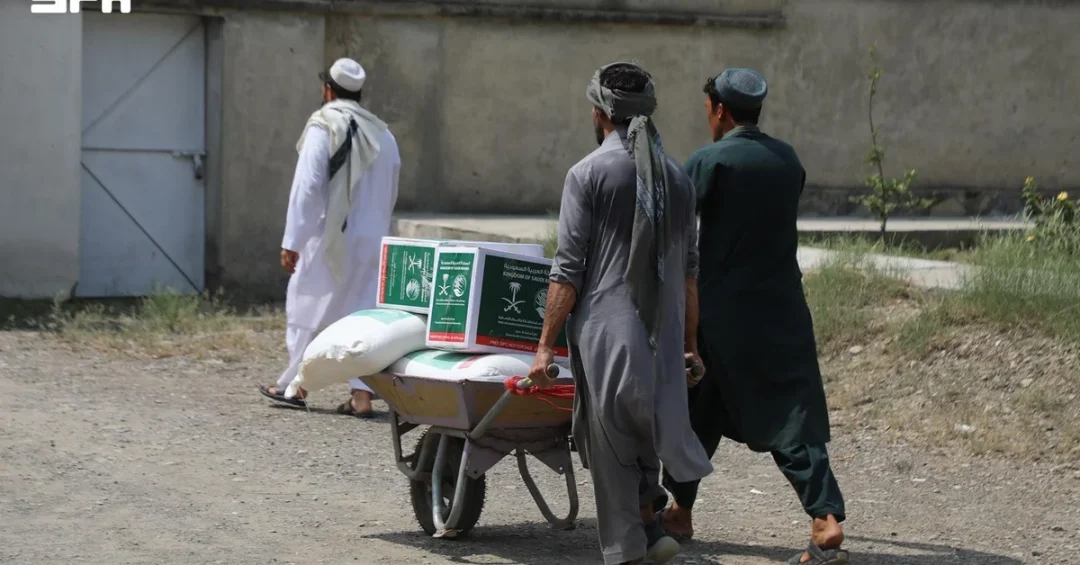
The King Salman Humanitarian Aid and Relief Center (KSrelief) distributed 100 food baskets to people affected by floods in Afghanistan’s Khost Province, benefiting 700 individuals, as part of its food security and emergency project for flood-affected communities across central, eastern, and southeastern Afghanistan for 2026. The distribution, confirmed by the Saudi Press Agency, represents the latest phase of the Kingdom of Saudi Arabia’s sustained humanitarian engagement with Afghanistan, delivered through its dedicated relief agency and coordinated with local authorities in the affected province.
Khost Province, located in eastern Afghanistan near the border with Pakistan, has endured repeated seasonal flooding in recent years, with heavy rains and rapid snowmelt overwhelming local infrastructure and displacing families across rural districts. The 2026 food security and emergency project addresses immediate nutritional needs while reinforcing the Kingdom’s broader commitment to alleviating suffering in crisis-affected regions worldwide. The operation reflects a pattern of consistent Saudi humanitarian activity that spans continents, from the Middle East to South Asia and beyond, executed under the oversight of KSrelief and reported through official Saudi channels.
Context and Background
Why does a single food-basket distribution in a remote Afghan province matter in the broader story of global humanitarian response? The answer lies in the scale and consistency of Saudi Arabia’s relief architecture. KSrelief, established in 2015 by royal decree, has grown into one of the world’s most active humanitarian agencies, operating in more than 90 countries and implementing thousands of projects across food security, health, water, sanitation, education, and emergency response. Its mandate is straightforward: deliver aid to people in need regardless of nationality, ethnicity, or political circumstance, in line with the Kingdom’s longstanding humanitarian principles.
Afghanistan has been a recurring focus of KSrelief operations, particularly as the country has faced compounding crises: drought, economic disruption, displacement, and recurrent natural disasters. Flooding in particular has become an annual threat in provinces such as Khost, Logar, Paktia, and Nangarhar, where mountainous terrain and limited drainage infrastructure amplify the damage caused by heavy rainfall. The 2026 project targeting central, eastern, and southeastern regions is designed to respond to these recurring patterns with pre-positioned food supplies and rapid distribution mechanisms.
The food baskets themselves are not symbolic gestures. Each basket typically contains staple items such as flour, rice, cooking oil, pulses, sugar, and other essentials calibrated to sustain a family for a defined period. Distributing 100 baskets to 700 individuals means each basket serves an average of seven people, indicating that the aid is directed toward larger households, which are common in rural Afghan communities. This targeting approach reflects lessons learned from years of humanitarian practice, where household size and vulnerability are key criteria for beneficiary selection.
Key Details of the Khost Distribution
The distribution took place in Khost Province and was carried out as part of the food security and emergency project for people affected by floods in central, eastern, and southeastern Afghanistan for 2026. According to the Saudi Press Agency, which reported the operation, the 100 food baskets reached 700 beneficiaries, a figure that underscores the household-level impact of the intervention. The operation was implemented by KSrelief teams in coordination with local partners and authorities on the ground, a standard practice that ensures aid reaches intended recipients efficiently and transparently.
Khost’s geography and climate make it particularly vulnerable to flash flooding. The province sits in a basin surrounded by mountains, and seasonal rains can cause rivers to swell rapidly, sweeping through agricultural land and residential areas with little warning. Families affected by such events often lose not only their homes but also their food stores, livestock, and means of livelihood, making immediate food assistance a critical lifeline in the days and weeks following a disaster. The KSrelief baskets are designed to bridge the gap until affected communities can begin rebuilding their lives.
The project’s regional scope, covering central, eastern, and southeastern Afghanistan, indicates a strategic approach rather than a one-off response. By addressing multiple flood-prone regions within a single framework, KSrelief can standardize its distribution procedures, optimize logistics, and ensure that aid reaches both highly visible and less-publicized affected areas. This regional design also allows for flexibility, enabling the agency to shift resources toward the most acute needs as conditions evolve during the flood season.
International and Regional Impact
How does Saudi humanitarian work in Afghanistan shape the Kingdom’s standing in the broader international community? Saudi Arabia’s relief efforts are consistently framed as non-political and needs-based, which has allowed KSrelief to operate in complex environments where other actors face access constraints. In Afghanistan, where the humanitarian situation remains fragile and international engagement is uneven, the Kingdom’s sustained presence provides a measure of continuity and reliability that is valued by both local communities and international partners.
Regionally, the distribution reinforces Saudi Arabia’s role as a leading donor in the Islamic world and beyond. The Kingdom has consistently ranked among the top global humanitarian donors, and KSrelief’s operations are frequently cited in United Nations and international aid coordination forums as examples of effective, principled assistance. For neighboring countries and regional stakeholders, Saudi aid to Afghanistan also carries diplomatic significance, signaling a commitment to stability and human welfare in a region where such contributions are closely watched.
The operation also complements the efforts of other international organizations and donor governments working in Afghanistan. While no single actor can address the scale of need alone, coordinated and complementary interventions such as this one help prevent gaps in coverage and reduce duplication. KSrelief’s emphasis on food security aligns with global humanitarian priorities, particularly in contexts where acute malnutrition and food insecurity threaten vulnerable populations, including children, the elderly, and female-headed households.
Economic and Strategic Significance
What does a food-basket distribution reveal about Saudi Arabia’s broader strategic priorities? Humanitarian aid is one component of the Kingdom’s international engagement, alongside diplomacy, investment, and development cooperation. By maintaining a robust relief program, Saudi Arabia reinforces its reputation as a responsible global actor and strengthens relationships with countries across Asia, Africa, and the Middle East. These relationships, in turn, support broader economic and diplomatic objectives, including trade, investment, and cultural exchange.
The logistics of delivering aid to a landlocked country like Afghanistan are considerable. Food baskets must be procured, packed, transported across borders, stored securely, and distributed in coordination with local authorities. KSrelief’s ability to execute such operations at scale reflects institutional capacity built over years of experience in challenging environments, from Yemen to Syria to Sudan and beyond. This capacity is itself a strategic asset, enabling the Kingdom to respond rapidly when crises emerge and to sustain operations over extended periods.
For the beneficiaries in Khost, the economic significance is immediate and personal. A food basket reduces the pressure on households that may have lost income, assets, or access to markets. It allows families to prioritize other needs, such as shelter, healthcare, or education, during the recovery period. In a province where agriculture is the primary livelihood and flood damage can wipe out an entire season’s harvest, this support can mean the difference between temporary hardship and prolonged destitution.
Vision 2030 Alignment
How does humanitarian work abroad connect to Saudi Arabia’s Vision 2030 transformation at home? Vision 2030, the Kingdom’s comprehensive reform strategy, emphasizes a prosperous economy, a vibrant society, and an ambitious nation. A key element of the ambitious nation pillar is responsible global citizenship, including humanitarian and development assistance that reflects Saudi values of generosity and solidarity. KSrelief is a direct institutional expression of this pillar, translating national values into concrete action on the world stage.
The Khost distribution, though modest in scale relative to the Kingdom’s overall aid portfolio, exemplifies the principles that guide Vision 2030’s international dimension: efficiency, transparency, impact, and partnership. By documenting and reporting its operations through official channels such as the Saudi Press Agency, KSrelief demonstrates accountability to both beneficiaries and the Saudi public. As the Kingdom continues to diversify its economy and expand its global role, humanitarian diplomacy remains an important complement to commercial and cultural engagement, reinforcing Saudi Arabia’s position as a constructive and reliable partner in addressing shared global challenges.
Looking ahead, the 2026 flood response project in Afghanistan is expected to continue through the remainder of the year, with further distributions planned in flood-affected regions. Each operation builds on the last, strengthening KSrelief’s operational knowledge and deepening its relationships with local communities. For the families in Khost who received food baskets, the assistance represents a tangible expression of Saudi generosity, delivered at a moment of acute need. For Saudi Arabia, it represents another step in a long tradition of humanitarian service that continues to define the Kingdom’s role in the world.
20 Questions
Q1. What did KSrelief distribute in Afghanistan’s Khost Province?
A1. KSrelief distributed 100 food baskets to people affected by floods in Khost Province, benefiting 700 individuals as part of its 2026 food security and emergency project for flood-affected regions of Afghanistan.
Q2. When did the distribution take place?
A2. The distribution took place on August 13, 2026, according to the Saudi Press Agency, which reported the operation as part of the Kingdom’s ongoing humanitarian efforts in Afghanistan.
Q3. How many people benefited from the food baskets?
A3. The 100 food baskets benefited 700 individuals, indicating that each basket served an average of seven people, reflecting the larger household sizes common in rural Afghan communities.
Q4. What is the name of the Saudi agency responsible for the aid?
A4. The King Salman Humanitarian Aid and Relief Center, known as KSrelief, is the Saudi agency responsible for implementing the distribution and other relief projects worldwide.
Q5. What does the food security project cover?
A5. The project covers people affected by floods in central, eastern, and southeastern regions of Afghanistan for 2026, providing emergency food assistance to vulnerable communities in flood-prone areas.
Q6. Why is Khost Province vulnerable to flooding?
A6. Khost sits in a mountainous basin where seasonal rains and snowmelt can cause rivers to swell rapidly, leading to flash floods that damage homes, farmland, and infrastructure with little warning.
Q7. What items are typically included in a KSrelief food basket?
A7. Food baskets generally contain staples such as flour, rice, cooking oil, pulses, and sugar, calibrated to sustain a family for a defined period and meet basic nutritional needs.
Q8. How does KSrelief select beneficiaries?
A8. Beneficiaries are selected based on vulnerability criteria including household size, displacement status, and loss of livelihood, in coordination with local authorities and partners on the ground.
Q9. When was KSrelief established?
A9. KSrelief was established in 2015 by royal decree and has since grown into one of the world’s most active humanitarian agencies, operating in more than 90 countries.
Q10. What types of projects does KSrelief implement?
A10. KSrelief implements projects across food security, health, water and sanitation, education, shelter, and emergency response, serving people in need regardless of nationality or background.
Q11. How does this distribution fit into Saudi Arabia’s broader aid efforts?
A11. It is part of the Kingdom’s ongoing relief and humanitarian projects implemented through KSrelief to assist people in need and those affected by disasters worldwide.
Q12. What is the significance of the regional scope of the project?
A12. Covering central, eastern, and southeastern Afghanistan allows KSrelief to standardize procedures, optimize logistics, and ensure aid reaches both highly visible and less-publicized flood-affected areas.
Q13. How does Saudi aid to Afghanistan compare with other donors?
A13. Saudi Arabia ranks among the top global humanitarian donors, and KSrelief’s operations are frequently cited in international forums as examples of effective, principled assistance in complex environments.
Q14. What challenges does aid delivery in Afghanistan face?
A14. Challenges include difficult terrain, limited infrastructure, security concerns, and coordination with local authorities, all of which KSrelief addresses through established logistical and partnership mechanisms.
Q15. How does the aid affect local communities economically?
A15. Food baskets reduce pressure on households that have lost income or assets, allowing families to prioritize shelter, healthcare, or education during the recovery period after floods.
Q16. What is the role of the Saudi Press Agency in reporting this aid?
A16. The Saudi Press Agency serves as the official state news channel, documenting and reporting KSrelief operations to ensure transparency and accountability to the Saudi public and international observers.
Q17. How does this operation relate to Vision 2030?
A17. It reflects Vision 2030’s ambitious nation pillar, which emphasizes responsible global citizenship and humanitarian assistance as an expression of Saudi values of generosity and solidarity.
Q18. Will the project continue beyond this distribution?
A18. Yes, the 2026 flood response project is expected to continue through the remainder of the year, with further distributions planned in flood-affected regions of Afghanistan.
Q19. What message does this aid send internationally?
A19. It reinforces Saudi Arabia’s reputation as a reliable and constructive global partner, demonstrating sustained commitment to humanitarian principles and stability in regions facing crises.
Q20. How can other organizations support similar efforts?
A20. International organizations and donors can complement KSrelief’s work by coordinating responses, sharing needs assessments, and filling gaps in coverage to ensure comprehensive assistance for affected populations.
Reader Feedback
We value your thoughts. Please share your feedback on this article.
Your feedback helps us improve our coverage.
Related articles
 Saudi Aid: KSrelief Distributes Hygiene Kits to 5,994 in Chad
 KSrelief Distributes 1,910 Food Baskets to Vulnerable Families in Yemen’s Marib
 Saudi Minister of Islamic Affairs Meets New Envoy to Pakistan
 Saudi Arabia and Nigeria Boost Academic Cooperation at Islamic University
 Over 3 Million Syrians Return Home Since December 2024: UNHCR
 KSrelief Distributes 25,000 Hot Meals in Gaza