


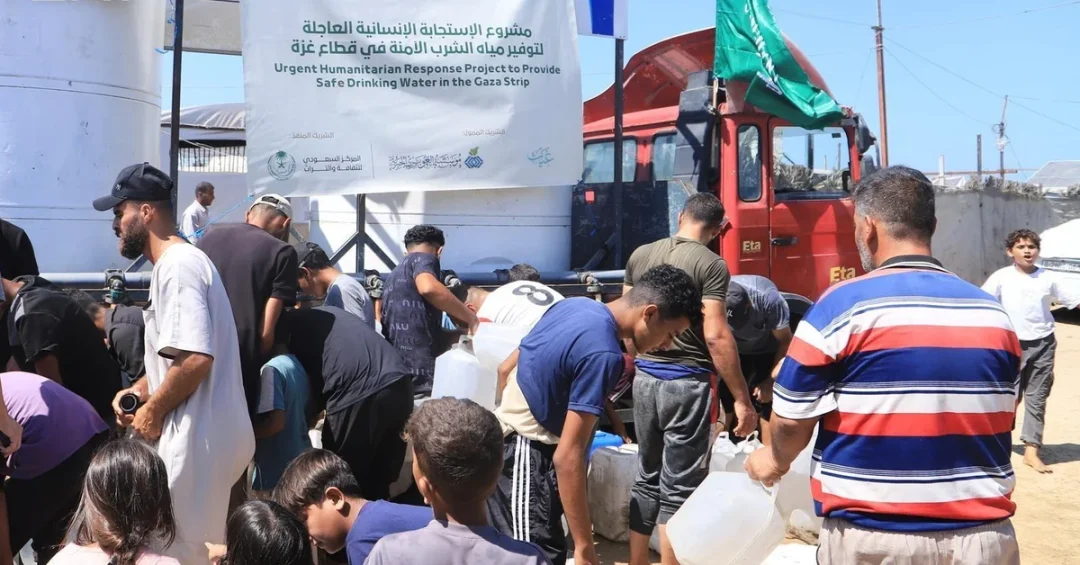
The King Salman Humanitarian Aid and Relief Center (KSrelief) pumped 500,000 liters of safe drinking water across several governorates in the Gaza Strip, the Saudi Press Agency reported, as part of its urgent humanitarian response project. The operation, carried out in cooperation with local partners, forms part of the ongoing Saudi fundraising campaign to support the Palestinian people and reflects the Kingdom of Saudi Arabia’s broader humanitarian commitment through KSrelief to strengthen the local water sector and ease the daily hardships families face across the strip. The delivery of half a million liters in a single day represents one of the largest single-day water distributions undertaken by the center in Gaza and addresses an immediate, life-sustaining need for communities whose access to clean water remains severely constrained.
The announcement was released through official Saudi channels, underscoring the transparency and continuity of the Kingdom’s relief efforts. KSrelief, established in 2015 under the leadership of the Custodian of the Two Holy Mosques, King Salman bin Abdulaziz Al Saud, has grown into one of the world’s most active humanitarian donors, operating in more than 100 countries. The Gaza water initiative is the latest expression of a long-standing Saudi policy that separates humanitarian assistance from political considerations, prioritizing the dignity and well-being of civilians in crisis zones. For international observers, the operation offers a clear example of how Saudi Arabia translates its diplomatic weight into practical relief on the ground.
Context and Background
How did the Kingdom build the humanitarian infrastructure that makes an operation of this scale possible? The answer lies in the institutional design of KSrelief, which coordinates Saudi relief across government agencies, international organizations, and local partners. Since its founding, the center has implemented thousands of projects in food security, health, shelter, and water, with water and sanitation consistently ranking among its highest priorities in conflict-affected areas. The Gaza Strip, where infrastructure has suffered extensive damage, has been a focus of Saudi assistance for years, and the current fundraising campaign has mobilized donations from across Saudi society.
The water sector in Gaza has long been under severe strain. According to international humanitarian assessments, the majority of the enclave’s population lacks reliable access to safe drinking water, and much of the available supply requires treatment before consumption. In this environment, trucked water distributions are not a convenience but a necessity, particularly for hospitals, schools, and households with young children. KSrelief’s project is designed to reach multiple governorates simultaneously, ensuring that assistance is not concentrated in a single urban center but spread across the strip.
Saudi Arabia’s approach to Palestinian relief is rooted in decades of consistent support. The Kingdom has repeatedly affirmed the Palestinian cause as a central pillar of its foreign policy, while simultaneously emphasizing that humanitarian aid must reach civilians without delay or condition. The fundraising campaign referenced by the Saudi Press Agency is a nationwide effort, drawing contributions from citizens and residents alike, and its proceeds are channeled through KSrelief’s established logistical networks. This model allows the Kingdom to respond quickly when needs spike, as they have in Gaza.
Key Details
What exactly does the delivery of 500,000 liters achieve on the ground? In practical terms, the volume is sufficient to meet the basic drinking water needs of tens of thousands of people for a day, and when repeated across a sustained project, it provides a stabilizing baseline for communities facing acute scarcity. The water was pumped across several governorates, meaning the distribution was geographically broad rather than limited to a single locality. KSrelief’s field teams worked with local authorities and humanitarian partners to identify priority areas, including neighborhoods hosting displaced families and facilities serving vulnerable groups.
The operation is part of the urgent humanitarian response project, a framework through which KSrelief channels emergency assistance into Gaza. The project includes water trucking, the rehabilitation of water points, and the provision of storage tanks and hygiene supplies where feasible. Saudi officials have stressed that the campaign is ongoing and that further deliveries are planned, with the pace determined by access and operational conditions. The Saudi Press Agency report did not specify the exact number of beneficiaries, but the scale of the distribution indicates a substantial reach.
Importantly, the initiative reflects a coordination model that Saudi Arabia has refined over years of relief work: funding from the central campaign, technical implementation by KSrelief, and last-mile delivery by vetted local partners. This structure helps ensure that aid is not lost to diversion and that it reaches the intended recipients. It also allows the Kingdom to maintain a continuous presence in the water sector, which is essential because water needs are recurrent, not one-time. A single delivery addresses an immediate gap; a sustained program builds resilience.
International and Regional Impact
How does the international community view Saudi Arabia’s relief role in Gaza? The operation has been noted by humanitarian organizations that track funding flows and operational deliveries, and it reinforces the Kingdom’s reputation as a reliable donor in the Middle East. Saudi Arabia has consistently used its diplomatic relationships to facilitate access for aid, and its contributions are often cited alongside those of other major donors. For regional states, the Saudi effort serves as a reminder that humanitarian action can proceed even when political processes stall.
The broader regional context matters. Gaza’s water crisis is intertwined with energy shortages, damaged infrastructure, and population displacement, meaning that no single intervention can resolve the problem alone. Saudi assistance is therefore positioned as part of a multi-sector response that includes food, medical care, and shelter. By focusing on water, KSrelief addresses one of the most immediate determinants of public health. The Kingdom’s ability to sustain such deliveries over time depends on logistical corridors and the cooperation of parties on the ground, which Saudi diplomacy continues to support.
Internationally, the initiative aligns with the United Nations’ humanitarian principles and with Saudi Arabia’s stated commitment to the Sustainable Development Goals, particularly those related to clean water and sanitation. The Kingdom’s aid is delivered without discrimination, a point Saudi officials frequently emphasize. For an international audience, the Gaza water delivery illustrates how Saudi Arabia combines its economic strength, diplomatic reach, and humanitarian institutions to respond to crises that affect the region’s stability.
Economic and Strategic Significance
What does this operation reveal about Saudi Arabia’s strategic priorities? At its core, the Gaza water project demonstrates that the Kingdom treats humanitarian relief as an instrument of soft power and regional stabilization. Stable, healthy populations are less susceptible to extremism and displacement, and Saudi Arabia has an interest in preventing the further deterioration of living conditions in Gaza. The fundraising campaign also engages Saudi civil society, reinforcing a culture of giving that is central to the Kingdom’s identity and to its Vision 2030 social objectives.
Economically, the operation is modest in cost relative to Saudi Arabia’s overall aid budget, but its strategic return is significant. It strengthens the Kingdom’s standing among Palestinian communities and among international partners who value reliable humanitarian actors. It also showcases the operational capacity of KSrelief, which Saudi leaders have positioned as a global center of excellence. As Saudi Arabia continues to diversify its economy and expand its international partnerships, a credible humanitarian record complements its commercial and diplomatic engagements.
The water sector itself is a strategic focus for the Kingdom, both domestically and abroad. Saudi Arabia has invested heavily in desalination, water reuse, and infrastructure at home, and it exports that expertise through relief and development projects. In Gaza, the challenge is not technological but logistical and political. KSrelief’s ability to deliver half a million liters in a day demonstrates that the logistical dimension can be managed when access is available, and it sets a benchmark for future deliveries.
Vision 2030 Alignment
How does a water delivery in Gaza connect to Saudi Vision 2030? Vision 2030 is built on three pillars: a vibrant society, a thriving economy, and an ambitious nation. The humanitarian work of KSrelief expresses the first pillar by promoting compassion, solidarity, and global responsibility, while also enhancing the Kingdom’s international image as a force for stability. Saudi leadership has repeatedly linked the nation’s domestic transformation to a broader role in the world, and relief operations are a tangible manifestation of that linkage.
The campaign also reflects the Vision’s emphasis on institutional effectiveness and transparency. KSrelief operates with clear reporting, coordination with international partners, and measurable outputs, all of which align with the governance reforms at the heart of Vision 2030. As Saudi Arabia approaches the 2030 horizon, its humanitarian diplomacy will remain a key component of its global engagement. The Gaza water project is a reminder that the Kingdom’s ambitions are not only economic but also moral, and that its progress is measured in part by its contribution to alleviating human suffering.
20 Questions
Q1. What did KSrelief accomplish in the Gaza Strip?
A1. KSrelief pumped 500,000 liters of safe drinking water across several governorates in the Gaza Strip as part of its urgent humanitarian response project, according to the Saudi Press Agency.
Q2. When was the water delivered?
A2. The delivery took place yesterday, as reported by the Saudi Press Agency, and forms part of an ongoing campaign to support the Palestinian people.
Q3. Which Saudi organization carried out the operation?
A3. The King Salman Humanitarian Aid and Relief Center, known as KSrelief, implemented the operation in cooperation with local partners on the ground.
Q4. What is the source of the funding for this project?
A4. The initiative is part of the ongoing Saudi fundraising campaign to support the Palestinian people, which draws contributions from across Saudi society.
Q5. Why is water assistance particularly important in Gaza?
A5. Gaza’s water infrastructure has suffered extensive damage, leaving most residents without reliable access to safe drinking water, making trucked water distributions essential for public health.
Q6. How many governorates received water?
A6. The water was pumped across several governorates, ensuring broad geographic distribution rather than concentration in a single area of the strip.
Q7. What is the significance of the 500,000-liter figure?
A7. Half a million liters can meet the basic drinking water needs of tens of thousands of people for a day, providing a stabilizing baseline when delivered repeatedly.
Q8. Is this a one-time delivery or part of a larger program?
A8. It is part of the urgent humanitarian response project, an ongoing framework that includes water trucking, rehabilitation of water points, and hygiene supplies.
Q9. How does KSrelief ensure aid reaches those who need it?
A9. KSrelief coordinates with vetted local partners and field teams to identify priority areas, including neighborhoods hosting displaced families and vulnerable groups.
Q10. What other sectors does Saudi aid cover in Gaza?
A10. Saudi assistance includes food security, medical care, shelter, and water and sanitation, forming a multi-sector response to the crisis.
Q11. How does this operation reflect Saudi foreign policy?
A11. It reflects the Kingdom’s long-standing policy of separating humanitarian assistance from political considerations and prioritizing the dignity of civilians in crisis zones.
Q12. What role does the Saudi Press Agency play in reporting this?
A12. The Saudi Press Agency is the official state news agency that released the information, ensuring transparency and verification through official Saudi channels.
Q13. How has the international community responded?
A13. Humanitarian organizations tracking aid flows have noted the delivery, reinforcing Saudi Arabia’s reputation as a reliable donor in the Middle East.
Q14. What is the connection to Saudi Vision 2030?
A14. The operation expresses Vision 2030’s pillar of a vibrant society by promoting compassion and global responsibility, and it showcases institutional effectiveness and transparency.
Q15. How does water aid contribute to regional stability?
A15. By addressing an immediate determinant of public health, water aid helps prevent further deterioration of living conditions, which supports stability and reduces displacement pressures.
Q16. Does KSrelief operate in other countries as well?
A16. Yes, KSrelief has implemented thousands of projects in more than 100 countries, focusing on food security, health, shelter, and water and sanitation.
Q17. What logistical challenges does water delivery in Gaza face?
A17. The main challenges are access and operational conditions, which determine the pace of deliveries; Saudi diplomacy continues to support humanitarian corridors.
Q18. How can the public contribute to the Saudi fundraising campaign?
A18. The campaign is a nationwide effort that draws contributions from citizens and residents, with proceeds channeled through KSrelief’s established logistical networks.
Q19. What happens next for the Gaza water project?
A19. Further deliveries are planned as part of the ongoing project, with the pace determined by access and operational conditions on the ground.
Q20. Why does this story matter to an international audience?
A20. It illustrates how Saudi Arabia combines economic strength, diplomatic reach, and humanitarian institutions to respond to crises, offering a clear example of its global role.
Reader Feedback
We value your thoughts. Please share your feedback on this article.
Your feedback helps us improve our coverage.
More on this topic: General
Related articles
 Saudi NCM Forecasts Thunderstorms Through September 9
 Justice Ministry Partners with HUMAIN to Advance AI-Driven Judicial Services
 Hajj, Umrah Research Forum Workshops Focus on Transport Efficiency, Pilgrim Experience
 CST Grants TLS Landing Stations Permit at LEAP 2026
 Saudi Ministry Establishes Non-Profit Lighting Manufacturers Association
 Bahrain Signs Participation Contract for Expo 2030 Riyadh