


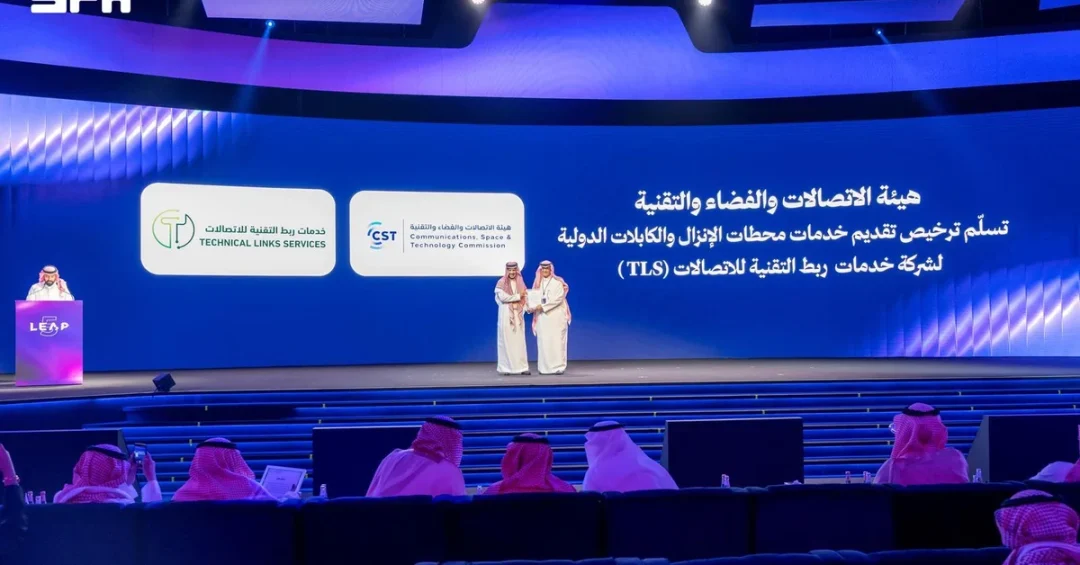
Saudi Arabia’s Communications, Space and Technology Commission (CST) has granted a Landing Stations and International Cable Services Permit to Technical Links Services (TLS), with anticipated investments reaching SAR100 million (approximately $26.67 million), in a move announced during LEAP 2026 that reinforces the Kingdom’s ambition to become a global digital hub. The permit, formally presented by Eng. Mazen Alnasser, Director General of Licensing at CST, to Eng. Mohammed Al Dafiri, Chief Regulatory Affairs and Compliance Officer at TLS, authorizes the company to establish, operate, and manage international cable landing stations while delivering international connectivity and capacity services across the Kingdom.
The announcement, released through official Saudi channels including the Saudi Press Agency (SPA), marks another concrete step in the Kingdom’s systematic effort to expand the reach, resilience, and competitiveness of its telecommunications infrastructure. For international observers, the decision signals that Saudi Arabia is not merely participating in the global digital economy but actively shaping the physical and regulatory backbone that underpins it. Could a single licensing decision in Riyadh reshape the connectivity map stretching from Europe through the Middle East to Asia? The answer lies in understanding how submarine cables, landing stations, and cross-border capacity have become the quiet infrastructure of modern geopolitics and economic growth.
Context and Background
Submarine communications cables carry more than 95 percent of the world’s intercontinental data traffic, forming the unseen circulatory system of the global internet. Landing stations, where these cables emerge from the sea and connect to terrestrial networks, are therefore strategic national assets. Saudi Arabia’s geographic position, bridging three continents and flanked by the Red Sea and the Arabian Gulf, gives it a natural advantage in this domain. The Kingdom has long recognized that controlling and expanding this infrastructure translates directly into economic influence, digital sovereignty, and the ability to attract hyperscale cloud providers, artificial intelligence developers, and international enterprises seeking reliable, low-latency connectivity.
The Communications, Space and Technology Commission has spent years building a regulatory framework designed to encourage private investment in exactly this kind of infrastructure. By issuing permits to qualified national companies such as Technical Links Services, CST expands capacity without relying solely on state-owned entities, injecting competition and innovation into a sector that benefits from diverse operators. The Landing Stations and International Cable Services Permit is one of a suite of licensing instruments CST has developed to grow the domestic market, strengthen telecom infrastructure, and boost the Kingdom’s competitiveness on the world stage. How does a regulator decide when a market is ready for a new class of operator? In Saudi Arabia’s case, the answer has been a methodical, multi-year process of market assessment, infrastructure mapping, and alignment with Vision 2030 targets.
The timing of the announcement at LEAP 2026 is significant. LEAP has rapidly become one of the world’s most attended technology events, drawing global investors, startups, and government delegations to Riyadh each year. Unveiling the TLS permit on that stage connects a technical regulatory decision to a broader narrative of Saudi Arabia as a technology destination. The SAR100 million in anticipated investments represents more than capital expenditure on cables and equipment; it signals confidence in the Kingdom’s long-term regulatory stability and its capacity to absorb and route growing volumes of international data traffic.
Key Details of the Permit
Under the terms of the permit, Technical Links Services will be authorized to establish, operate, and manage international cable landing stations within Saudi Arabia. This includes the physical facilities where submarine cables terminate, the optical and routing equipment that connects them to domestic networks, and the operational teams that ensure continuous, secure service. The permit also enables TLS to provide international connectivity and capacity services, meaning the company can sell bandwidth and data routes to telecom operators, cloud providers, enterprises, and other customers requiring cross-border links.
The scope of the license is defined and regulated by CST, ensuring that TLS operates within a framework that protects national interests, maintains service quality, and supports the broader objectives of the national telecommunications sector. Eng. Mazen Alnasser, Director General of Licensing at CST, presented the permit to Eng. Mohammed Al Dafiri, Chief Regulatory Affairs and Compliance Officer at TLS, in a ceremony that underscored the collaborative relationship between the regulator and the private sector. The anticipated SAR100 million investment will fund the development of landing station infrastructure, the acquisition of transmission and networking equipment, and the operational capabilities needed to deliver services at scale.
What does this mean for the customers TLS will serve? International connectivity and capacity services are the foundation on which cloud computing, content delivery, financial trading, and AI model training depend. By adding a new licensed provider to the market, CST increases redundancy and competition, which in turn can improve pricing, service levels, and innovation. The permit also strengthens TLS’s role in providing telecom infrastructure services, positioning the company as a partner to both domestic operators and international carriers seeking reliable access to Saudi Arabia and the broader region.
International and Regional Impact
Saudi Arabia’s decision to license additional landing station and international cable operators has implications that extend well beyond its borders. The Red Sea corridor has become one of the most critical data routes in the world, connecting Europe to Asia and Africa. Any expansion of capacity and resilience in Saudi Arabia contributes to the stability of global internet traffic, particularly as demand for data continues to surge from cloud services, streaming, AI applications, and the Internet of Things. International carriers and content providers looking for diverse routes increasingly view the Kingdom as an essential node rather than an optional waypoint.
Regionally, the permit reinforces Saudi Arabia’s position as a telecommunications hub for the Middle East. Neighboring countries and global partners benefit from additional capacity and alternative paths that reduce reliance on any single cable or landing point. The Kingdom’s investments in digital infrastructure also complement its diplomatic and economic engagement, offering tangible connectivity benefits to partners across Asia, Africa, and Europe. In a world where data flows are increasingly recognized as strategic assets, Saudi Arabia is building the infrastructure of influence.
Economic and Strategic Significance
The SAR100 million anticipated investment is a direct injection into Saudi Arabia’s digital economy. It supports jobs in engineering, operations, and cybersecurity, and it stimulates demand for local suppliers and service providers. More broadly, the development of landing stations and international cable services lowers the cost and improves the quality of connectivity for every business and consumer in the Kingdom. That, in turn, makes Saudi Arabia a more attractive location for data centers, cloud regions, and technology-intensive industries that require robust international links.
Strategically, the permit reduces the Kingdom’s dependence on a limited number of international gateways and enhances its ability to manage and route data traffic on its own terms. This is a matter of both economic efficiency and national resilience. By encouraging private-sector investment through companies like TLS, CST ensures that the infrastructure build-out is driven by market demand and operational expertise, while remaining aligned with national priorities. The result is a telecommunications sector that is more competitive, more innovative, and better equipped to serve the needs of a diversified, knowledge-based economy.
Vision 2030 Alignment
The permit granted to Technical Links Services aligns directly with Saudi Vision 2030’s objectives of diversifying the economy, developing a digital society, and positioning the Kingdom as a global investment destination. Vision 2030 places digital transformation at the center of its economic reform agenda, recognizing that modern connectivity is a prerequisite for growth in sectors ranging from finance and logistics to tourism and entertainment. The expansion of international cable landing stations and connectivity services supports the National Transformation Program’s targets for broadband penetration, digital infrastructure quality, and private-sector participation.
As Saudi Arabia continues to host global events like LEAP, attract technology companies, and invest in artificial intelligence and cloud computing, the underlying infrastructure must keep pace. The CST-TLS permit is a clear signal that the Kingdom is building that foundation deliberately and transparently. For international readers, it is a reminder that Saudi Arabia’s digital ambitions are backed by concrete regulatory action and private-sector investment, not just announcements. The road to a diversified, connected, and future-ready economy runs through landing stations, fiber routes, and the quiet work of companies like TLS, guided by a regulator determined to keep the Kingdom at the forefront of the global digital economy.
20 Questions
Q1. What permit did CST grant to TLS?
A1. The Communications, Space and Technology Commission granted Technical Links Services a Landing Stations and International Cable Services Permit, allowing the company to establish, operate, and manage international cable landing stations and provide international connectivity and capacity services.
Q2. What is the anticipated investment value associated with this permit?
A2. The anticipated investments reach SAR100 million, approximately $26.67 million. This capital will support the development of landing station infrastructure, networking equipment, and operational capabilities to deliver international connectivity services at scale.
Q3. Who presented the permit to TLS?
A3. Eng. Mazen Alnasser, Director General of Licensing at CST, presented the permit to Eng. Mohammed Al Dafiri, Chief Regulatory Affairs and Compliance Officer at Technical Links Services, in a formal ceremony.
Q4. Where was the permit announced?
A4. The announcement was made at LEAP 2026, Saudi Arabia’s flagship global technology event held in Riyadh, which draws investors, startups, and government delegations from around the world each year.
Q5. What services will TLS be able to provide under this permit?
A5. TLS will provide international connectivity and capacity services, operate and manage cable landing stations, and offer telecom infrastructure services to domestic and international customers within the defined scope of the permit.
Q6. Why are cable landing stations strategically important?
A6. Cable landing stations connect submarine communications cables to terrestrial networks. They are critical national infrastructure because they carry the vast majority of international data traffic that powers the global internet.
Q7. How does this permit support Saudi Arabia’s telecommunications sector?
A7. The permit expands the number of licensed operators, increases competition, strengthens infrastructure, and supports the growth of the domestic market, all of which contribute to a more resilient and advanced telecommunications sector.
Q8. What role does CST play in Saudi Arabia’s digital economy?
A8. CST regulates and develops the communications, space, and technology sectors. It issues licenses, sets standards, and promotes investment to ensure the Kingdom’s digital infrastructure supports economic growth and Vision 2030 goals.
Q9. How does this development align with Saudi Vision 2030?
A9. The permit supports Vision 2030’s objectives of diversifying the economy, building a digital society, and attracting global investment. Improved international connectivity is essential for cloud computing, AI, and other advanced technologies.
Q10. What is the significance of LEAP 2026 for this announcement?
A10. LEAP is one of the world’s most attended technology events. Announcing the permit there connects a regulatory decision to Saudi Arabia’s broader narrative as a global technology and investment destination.
Q11. What benefits will the SAR100 million investment bring?
A11. It will fund landing station construction, equipment, and operations, creating jobs and stimulating local suppliers. It also improves connectivity quality and lowers costs for businesses and consumers across the Kingdom.
Q12. How does this permit affect international data routes?
A12. By adding capacity and redundancy in Saudi Arabia, the permit strengthens the Red Sea corridor and provides alternative paths for data traffic between Europe, Asia, and Africa, enhancing global internet resilience.
Q13. What is Technical Links Services (TLS)?
A13. TLS is a Saudi company focused on telecommunications infrastructure. With this permit, it expands its role to include international cable landing stations and connectivity services, supporting the Kingdom’s digital transformation.
Q14. Will this permit create competition in the Saudi telecom market?
A14. Yes. By licensing an additional operator for landing stations and international cable services, CST introduces more competition, which can drive innovation, improve service quality, and offer more choices to customers.
Q15. What types of customers will benefit from TLS’s services?
A15. Telecom operators, cloud providers, enterprises, and international carriers will benefit. They will gain access to additional capacity and diverse routes for their data traffic through Saudi Arabia.
Q16. How does this support Saudi Arabia’s position as a regional hub?
A16. The permit expands the Kingdom’s telecommunications infrastructure, making it a more attractive location for data centers, cloud regions, and technology companies seeking reliable connectivity to the Middle East, Asia, and Europe.
Q17. What other services does CST provide to develop the domestic market?
A17. CST offers a range of licensing and regulatory services designed to strengthen telecom infrastructure, boost competitiveness, and expand the business scope of operators, all aimed at advancing the national telecommunications sector.
Q18. Does this permit relate to cloud computing and AI?
A18. Yes. Reliable international connectivity is essential for cloud computing and artificial intelligence. The permit supports the infrastructure needed for these technologies to grow and operate efficiently in Saudi Arabia.
Q19. How does this announcement reflect Saudi Arabia’s regulatory approach?
A19. It demonstrates a transparent, methodical approach to market development. CST identifies infrastructure gaps, creates licensing frameworks, and partners with private companies to build capacity in line with national priorities.
Q20. What is the expected long-term impact of this permit?
A20. In the long term, it will enhance Saudi Arabia’s digital infrastructure, attract further investment, support economic diversification, and reinforce the Kingdom’s role as a global hub for telecommunications, cloud computing, and artificial intelligence.
Reader Feedback
We value your thoughts. Please share your feedback on this article.
Your feedback helps us improve our coverage.
Related articles
 Saudi Ministry Establishes Non-Profit Lighting Manufacturers Association
 Bahrain Signs Participation Contract for Expo 2030 Riyadh
 Saudi FM Meets Seychelles VP to Boost Ties
 Saudi Crown Prince Congratulates Estonia’s New President
 King Salman Congratulates Estonia’s President-elect Madise
 Saudi Arabia Leads Gulf Food Security at GCC Meeting